Music Streaming App Development
Music Streaming App Development: A Complete Business & Tech Guide
January 16, 2026
January 16, 2026
Key Takeaways
The music streaming industry continues to grow rapidly, driven by on-demand listening, personalized recommendations, and access across devices.
There are multiple types of music streaming apps, including radio-style apps, podcast streaming apps, and niche music communities.
Core features like playlists, search filters, user profiles, offline listening, AI recommendations, social sharing, and secure streaming are essential for delivering a smooth, modern user experience.
The step-by-step development process covers planning, UI/UX design, backend development, licensing, testing, deployment, and post-launch improvements. Following these steps ensures a scalable and reliable music app.
Monetization models such as subscriptions, ads, premium upgrades, partnerships, and in-app purchases help you generate consistent revenue and grow sustainably.
Building a music streaming app requires strong technology, including a robust backend, secure APIs, cloud storage, and audio streaming protocols that ensure high-speed, high-quality playback.
Choosing the right development partner is crucial. A skilled tech team or agency helps with licensing, architecture, feature planning, and long-term maintenance, ensuring your app performs well and stands out in the market.
From ancient times until today, music is said to be the best therapy, as it brings comfort and peace immediately. It relieves you from the daily stress of your life and relaxes your brain.
The ways through which people accessed content evolved with technology. Music streaming apps have made music accessible to the whole world.
Music lovers can just download the app to listen to their favourite tracks. With the rise of music app development, businesses can now develop a music streaming app that brings millions of songs to users with just a tap.
If you want to create a music streaming app that stands out, you need a clear strategy and strong understanding of the process. That’s why we prepared this music streaming app development guide, a complete resource to help you understand the basics, features, and technologies involved in building a successful platform.
As you plan to develop a music streaming app, understanding the booming market helps you see where the opportunity lies.
Here are some key stats shaping the industry:
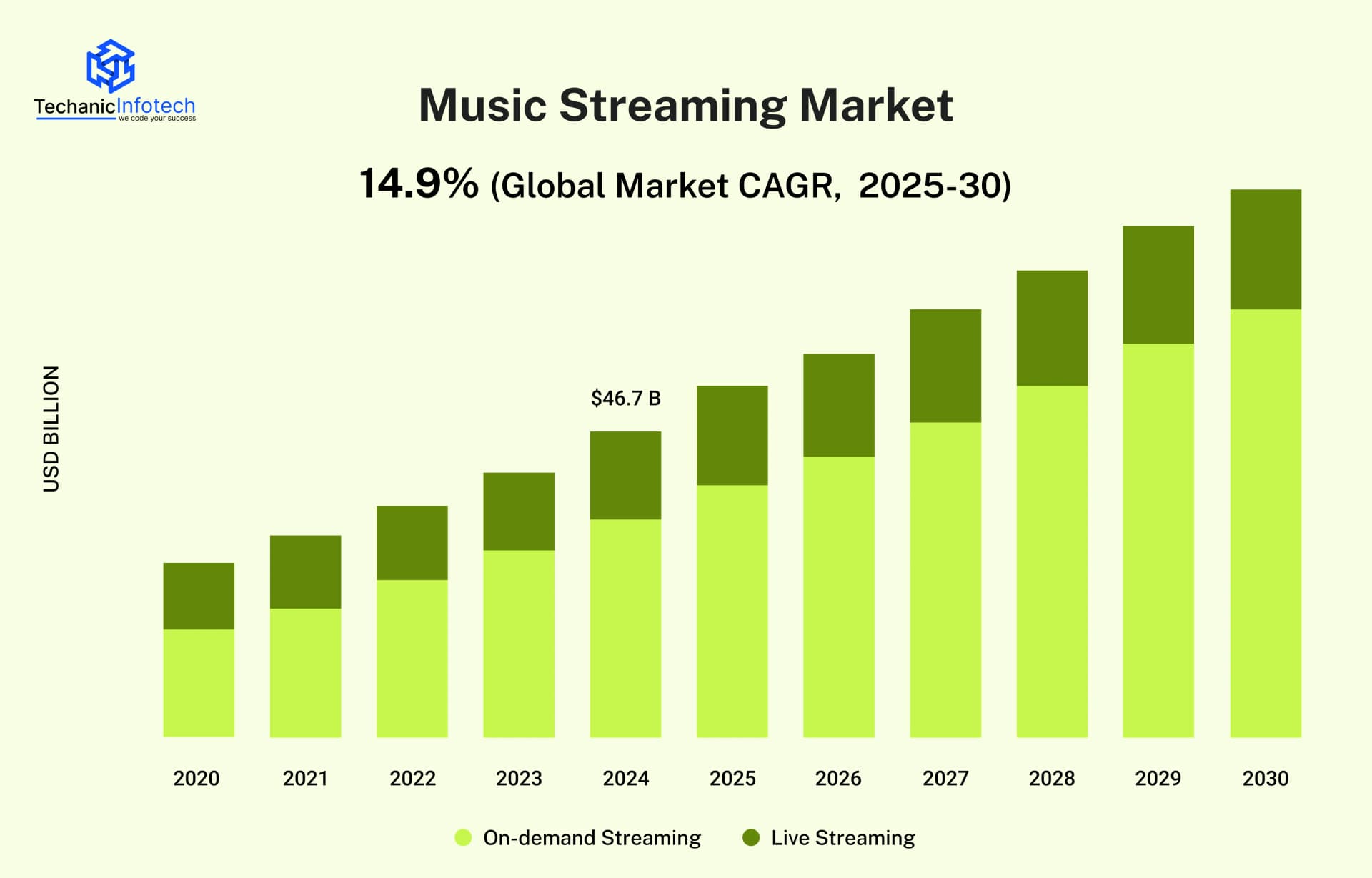
In 2024, music streaming apps generated an estimated $53.7 billion in global revenue, marking strong year-over-year growth as listeners shift to digital platforms.
Since 2015, the number of music streaming subscribers has skyrocketed from about 68 million to over 616 million, showing massive adoption worldwide.
The global market, valued at around $46.66 billion in 2024, is projected to exceed $108 billion by 2030, with a strong annual growth rate.
Spotify leads the market with approximately 31.7% of global streaming subscribers, followed by major players like Apple Music, Amazon Music, and YouTube Music.
Streaming accounts for a large share of overall music industry revenue, showing that on-demand access has overtaken downloads and physical formats in global recorded music revenues.
Understanding the market potential sets the foundation; now let’s explore the benefits of creating a music streaming app and why businesses are investing heavily in digital audio platforms.
Investing in mobile app development offers strong advantages for both businesses and users. A well-built music streaming app provides global reach, recurring revenue, and a personalized listening experience. Here are the key benefits explained clearly
Popular music streaming apps attract both free and premium listeners. As premium subscriptions grow, businesses earn more through subscription fees, ads, partnerships, and data-driven strategies. This ensures steady revenue and long-term business stability.
A custom music streaming app can easily scale to support millions of users without major infrastructure upgrades. Since streaming has no regional limitations, businesses can expand globally and reach diverse audiences.
Music streaming apps collect valuable user data that helps businesses understand listener behavior, preferences, and trends. These insights improve recommendations, content curation, and overall user satisfaction.
Successful platforms can collaborate with artists, labels, and brands to offer exclusive releases, curated playlists, and promotional campaigns. These partnerships strengthen brand presence and create unique user experiences.
Delivering a seamless, enjoyable music experience builds strong brand loyalty. High-quality UI, smooth streaming, and personalized content help the app stand out, attract referrals, and grow sustainably in a competitive market.
Once you know the advantages, the next step is choosing the right model. Let’s look at the different types of music streaming apps you can build based on your business goals.
Many mobile music streaming applications are available, each catering to the unique demands and tastes of users. Here are some common types of popular music streaming apps:
On-demand streaming apps provide access to huge song libraries, allowing users to look for their favorite tracks, albums, or playlists. These apps track your interests and offer music recommendations as per your listening history.
Radio-style streaming apps offer curated playlists or radio stations based on genres, moods, or artists. You have limited control over song selection, like a conventional radio system, but you have the option to like/dislike or skip features to customize your listening experience.
These platforms allow users to upload, share, and find user-generated content such as original music, remixes, covers, and podcasts. These apps also provide opportunities for beginners to follow and interact with other artists. You can upload and share your original music, covers, podcasts, and remixes.
Live music streaming apps provide live or recorded streams of concerts, music festivals, and other live events. Users are instantly notified about the live events. If they fail to attend, then they can get the recorded version of the live stream. It utilizes virtual reality for an immersive concert experience.
Social music apps integrate social networking features with music streaming, using which users can share and discover music with friends and followers. You can follow your friends and other artists to see their activities. Share your playlist of favourite songs with your friends, and enjoy listening.
After selecting the app type, it’s time to understand the core features that make a platform successful. Here are the key features of music streaming mobile apps you should include.
A successful music streaming app requires a perfect balance of user-friendly tools, powerful backend controls, and advanced features that enhance the listening experience.
Here’s a quick breakdown of the essential music streaming app features included in the Admin Panel, User Panel, and Advanced Features:
|
Admin Panel |
User Panel |
Advanced Features |
|
Music Uploading |
Profile Creation |
Multilingual Support |
|
User & Content Management |
Customised Playlists |
Music Categorisation |
|
Subscription Management |
Online Music Streaming |
Rating & Reviews |
|
Dashboard |
Payment Gateway |
Live Streaming |
|
Advertisement & Promotions |
Recommendations |
Voice Command |
|
Push Notifications |
Subscription Plan |
Social Sharing |
|
Revenue Management |
Radio |
Search Functionality |
|
Help Centre |
Offline Experience |
Attentive UI |
|
App Performance Monitoring |
Notifications |
Song Lyrics |
Now that you know what to include, let’s dive into the ultimate music streaming app development guide to help you structure your product the right way.
Developing a music streaming app is not a simple task. It involves multiple steps that should be carefully followed. We have described the main stages in this step-by-step guide to music streaming app development to ease your work.
Before starting the process to make a music app, it is very necessary to do detailed market research. Through research, you can learn about recent mobile app trends and also about your competitors.
Study the strategies used by your competitors and the mistakes they have made in their journey. All the valuable insights from your research can help you make an informed decision and decide on your business strategy for a custom music streaming app.
Users determine the success of any app. So, it is vital to understand your target audience and offer services that can cater to their preferences. Conduct surveys and collect data about their age, location, music taste, and other relevant information.
Decide on the features and pricing plans of your music streaming mobile app according to the survey data. From your app design to your revenue expectations, everything should be determined while keeping the target persona in mind.
It is very crucial to decide on a plan of action for good results. Your action plan should cover all the essential points that are considered for building an app like Spotify. Firstly, describe the purpose of your music streaming app and what mobile app features you are planning to add.
After that, determine the unique selling points and key performance indicators of your music app. From your budget to expected returns, creating an outline is essential for a business investing in music app development.
The appearance of your music streaming app will be the first thing that stands out to users. The layout, design, font, etc., are the major factors that determine the first impression.
The focus should be on creating an intuitive and user-friendly interface that facilitates seamless navigation. Ask designers to create a mockup that showcases the full layout of your custom music streaming app.
This ensures your mobile app UI/UX design aligns with Google Play Store or Apple App Store guidelines and helps identify shortcomings early.
Now, it is time to start the actual work with the right mobile app tech stack and pick a team of skilled music streaming app developers.
App development generally consists of two main stages: frontend and backend.
Frontend developers handle the client side, media players, playlists, and search options, using the best frameworks.
Backend developers set up infrastructure, integrate core admin features, create the database, and implement strong security for user privacy.
You can also hire music app developers from an established mobile app development company. From development to deployment, the company manages the entire cycle and provides expert-level guidance and resources.
To create a music application, you need proper licenses to stream legal audio content. Obtain permissions from record companies, publishers, and artists. This step is crucial to avoid copyright infringement issues and maintain the authenticity of your platform.
Once the prototype of your music streaming app is ready, it's time for testing.
QA testers should examine usability, functionality, localization, performance, speed, security, and more to ensure the app meets industry standards. Testing with real users helps gather essential feedback. Any flaws detected need to be fixed to stabilize the final app before launch.
Finally, submit your music streaming app for approval by uploading an app on the App Store and Play Store. Building a cross-platform app increases reach and visibility across both platforms.
When you upload an app on the Play Store or App Store, it goes through a detailed review process where safety, functionality, design quality, and compliance standards are evaluated. Depending on the complexity of your music streaming app, the approval process may take a few days or even several weeks.
With the full music streaming app development guide in place, the next important step is understanding the budget. So how much does it actually cost to create a music app?
The cost to create a music streaming app depends on multiple factors, including features, UI/UX complexity, tech stack, developer experience, and the platforms you choose (Android, iOS, or both). On average, the development cost ranges from $15,000 to $90,000, depending on how advanced and feature-rich the app needs to be.
Simple music apps with basic streaming, playlists, search, and user profiles fall on the lower end of the range. These apps typically include essential features that allow users to play songs, create playlists, and browse music categories without complex backend requirements.
Mid-level music streaming app development costs increase as you add features like offline downloads, curated recommendations, payment gateways, subscription plans, social sharing, multilingual support, and admin dashboards.
These apps require more robust architecture, higher security, and better personalization algorithms.
If you want a fully advanced, Spotify-like or Apple Music–style custom music streaming app, the cost moves toward the higher end. These platforms require AI-driven recommendations, adaptive streaming quality, large-scale storage, license management, real-time analytics, and high-performance backend systems capable of handling millions of users.
Beyond development, businesses must also consider additional costs such as UI/UX design, backend architecture, streaming servers, ongoing maintenance, updates, and marketing.
In short, the cost to build a mobile app varies widely, but with the right strategy and development partner, you can create a scalable, profitable platform that delivers a seamless listening experience.
|
Cost-Affecting Factor |
Description |
Average Cost |
|
Features & Functionality |
Basic to advanced features like streaming, playlists, downloads, AI, subscriptions, etc. |
$3,000 – $30,000 |
|
UI/UX Design |
Designing intuitive, responsive, user-friendly layouts for smooth navigation. |
$2,000 – $12,000 |
|
Platform Choice (Android/iOS/Both) |
Building for one platform costs less; dual-platform increases time & development cost. |
$5,000 – $25,000 |
|
Tech Stack & Architecture |
Cost varies based on backend complexity, cloud setup, streaming servers, and databases. |
$2,000 – $15,000 |
|
Developer Expertise |
Senior, experienced, or region-based developers influence total cost. |
$3,000 – $20,000 |
|
Backend Development |
Building APIs, user accounts, analytics, licensing systems, and scalable infrastructure. |
$5,000 – $30,000 |
|
Advanced Features |
AI recommendations, adaptive streaming, multilingual support, offline mode, etc. |
$5,000 – $40,000 |
|
Third-Party Integrations |
Payment gateways, CDN, cloud streaming, licensing APIs, and analytics tools. |
$1,000 – $8,000 |
|
Testing & QA |
Ensuring functionality, security, speed, and stability across all devices. |
$2,000 – $10,000 |
|
Maintenance & Updates |
Post-launch fixes, server monitoring, improvements, and feature upgrades. |
$1,000 – $5,000 / month |
After estimating the budget, it helps to study market leaders. Here are some of the popular music streaming apps shaping the global audio industry.
Before building your own platform, it’s important to understand how top music streaming apps dominate the industry with innovative features and smooth user experiences.
Spotify is a pioneer in the music streaming industry, with 165 million unique premium members worldwide. Spotify is, without a doubt, one of the biggest names in the music streaming business.
The platform offers a diverse range of music genres, podcasts, and original video content. From old pop songs to original movie soundtracks, Spotify's music library contains millions of songs.
Without a doubt, YouTube is the largest platform for streaming video content. The sole purpose of the desktop and mobile app, YouTube Music, is music streaming.
This platform has made an effort to maintain its dominance in the music streaming market via YouTube Music.
With its huge music catalog, Deezer is one of the greatest music streaming apps that is conquering the globe.
More than 73 million audio tracks from all around the world are included in its music library. It also produces audio, video, and music podcasts that are original to the platform.
This site additionally offers track films, short movies, artist interviews, behind-the-scenes content, and even live recordings in both audio and video codecs.
Furthermore, the Apple Music Classical app, which features the most effective classical songs, is available to top-rated users of Apple Music's plans.
Amazon Music began as a digital store selling real music albums on CDs and vinyl.
As their user base has grown and demanded constant access to free music online, they have expanded their services throughout time. This is exactly what Amazon Music is.
Knowing what top apps do well can inspire your strategy. Now let’s explore how to create a music streaming app that stands out and drives consistent revenue.
Even if your music app is available for free, you still have a lot of monetization opportunities to generate revenue.
Here are some of the commonly used revenue models:
Music streaming app development generates revenue by providing space for advertisements for other businesses.
These targeted ads can be in audio or video format. Ads will promote third-party products and increase their reach while users enjoy free music.
To leverage premium features such as ad-free listening, high-quality music, rewards, and additional content.
Users can subscribe to the premium plans and pay regularly over time. This strategy gives paying users a better experience while giving music streaming applications a steady source of income.
Apart from subscriptions, music streaming apps also offer extra benefits like in-app purchases including concert tickets, merchandise, and exclusive content.
It boosts the revenue of the app and deepens the connection between users and artists
Music streaming apps can partner with record labels, artists, and other brands to promote exclusive playlists and featured content.
By providing sponsored content on the platforms, the music apps can earn good revenue through sponsorship deals while adding value to the user experience.
At Techanic Infotech, we combine strong technical expertise with creative thinking to build music streaming apps that are fast, scalable, and enjoyable for users.
Our music streaming app development company understands how modern listeners behave, what features improve retention, and what it takes to create a platform that stands out in a highly competitive market.
We design and develop custom music streaming apps with smooth navigation, high-quality audio streaming, secure licensing workflows, and intelligent recommendations powered by smart algorithms.
Whether you’re launching a niche music platform or aiming to build a full-scale
Spotify-like product, we structure everything for long-term performance and growth.
Our developers follow a clear, transparent process, from planning and UI/UX to backend development, testing, and deployment.
Every component is optimized for speed, security, and seamless usage across all devices.
Building a music streaming app opens the door to a fast-growing digital entertainment market. With the right blend of technology, features, and user experience, your platform can attract a global audience and generate long-term revenue.
From planning and UI/UX design to backend development, licensing, and deployment, every step plays a key role in shaping a successful app. At Techanic Infotech, we help you turn your idea into a powerful, scalable, and intuitive music streaming platform built for real-world performance.
With expert developers, modern tools, and a user-first mindset, we ensure your app delivers seamless streaming, smart recommendations, and engaging features that keep listeners coming back. Ready to launch your streaming app?
The cost to build a music streaming app ranges from $15,000 to $90,000, depending on features, complexity, design quality, and the platforms you choose to develop for.
On average, development can take 3 to 8 months. Basic apps require less time, while apps with advanced features like AI recommendations or offline streaming take longer.
On average, development can take 3 to 8 months. Basic apps require less time, while apps with advanced features like AI recommendations or offline streaming take longer.
Essential features include playlists, search, online streaming, recommendations, offline downloads, subscription plans, radio, social sharing, and a secure payment gateway.
Essential features include playlists, search, online streaming, recommendations, offline downloads, subscription plans, radio, social sharing, and a secure payment gateway.
Yes. We offer ongoing updates, bug fixes, performance improvements, and feature enhancements to keep your music streaming app running smoothly.
Yes. We offer ongoing updates, bug fixes, performance improvements, and feature enhancements to keep your music streaming app running smoothly.
Absolutely. With the right tech stack and architecture, we can build a custom music streaming app that offers similar features, such as personalized recommendations, high-quality audio, and offline playback.
Absolutely. With the right tech stack and architecture, we can build a custom music streaming app that offers similar features, such as personalized recommendations, high-quality audio, and offline playback.


Abhishek Jangid is the CEO of Techanic Infotech, with extensive experience in mobile app and web development. He specializes in helping businesses turn innovative ideas into scalable digital solutions through strategic planning and modern technology.