Key Takeaways:
The astrology market is booming, driven by rising demand for personalized guidance. Everything from zodiac-based insights to horoscope app development shows strong user engagement and long-term growth potential.
Astrology apps come in many formats, including daily horoscope apps, birth-chart apps, matchmaking platforms, numerology tools, and live astrologer consultation apps, giving brands multiple pathways to stand out.
Features and UX matter the most, with in-app chat, AI-based predictions, secure payments, personalized dashboards, and real-time notifications becoming essential for user retention and credibility.
Development cost varies widely, typically ranging from $10,000 to $90,000, depending on complexity, platforms, features, backend systems, and design depth. Clear planning helps avoid unexpected expenses.
Techanic Infotech is a strong partner for businesses seeking to develop innovative astrology apps, offering expertise, scalability, and comprehensive support from ideation to deployment and growth.
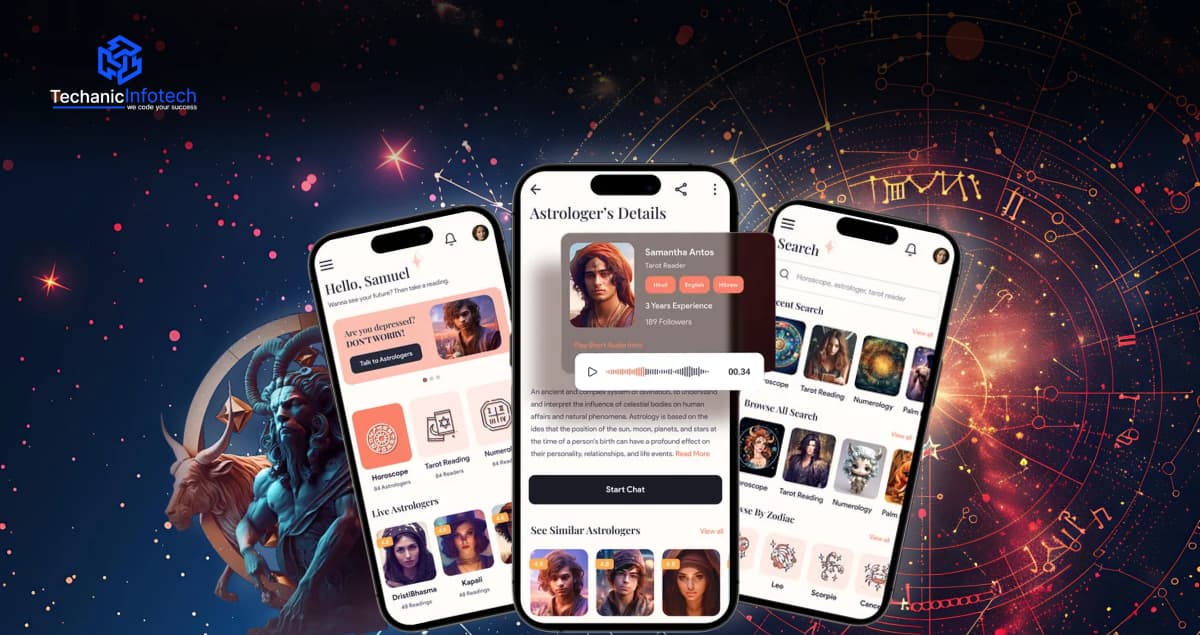
Astrology apps are booming as more people look for quick, personalized cosmic insights right on their phones.
If you’re planning to develop an astrology app, now is the perfect time to step into the market where users spend hours checking daily horoscopes, compatibility reports, and birth-chart readings.
Modern astrology platforms are no longer just about star signs; they mix data, AI, and interactive features to deliver a deeper, more intuitive experience.
Businesses are tapping into this demand by building apps that feel personal, accurate, and easy to navigate.
From feature choices to cost planning and development workflow, understanding what makes an astrology app successful can help you create something users genuinely trust and return to every day.
Astrology is thriving. What once lived in handwritten charts and quiet readings has evolved into a fast-growing digital industry.
Millions rely on mobile platforms for daily horoscopes, personality insights, and cosmic guidance, making it the perfect time for brands looking to create an astrology app.
With personalization, convenience, and spiritual curiosity driving user behavior, astrology apps are becoming a mainstream part of wellness and self-discovery.
Key Market Stats
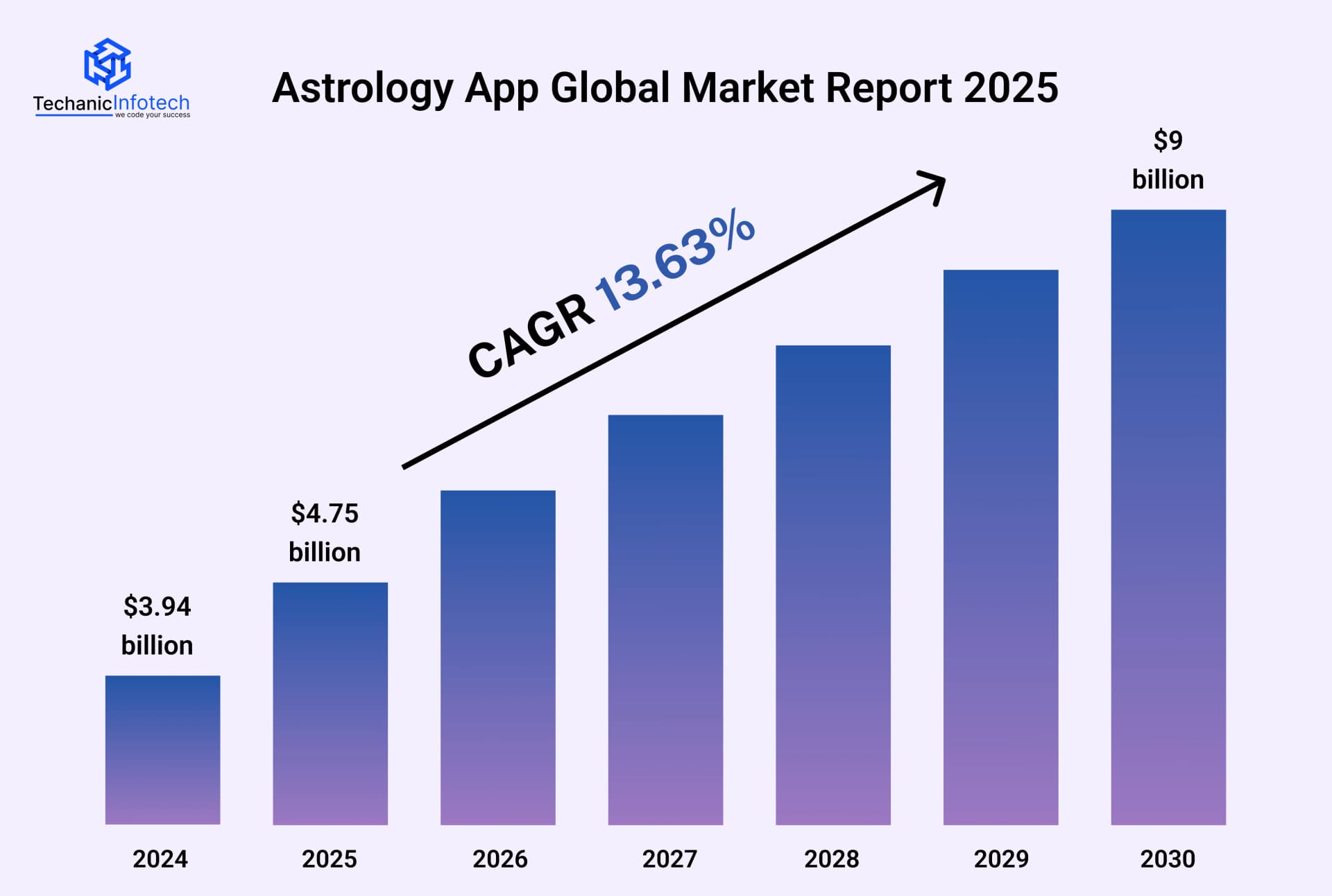
The global astrology app market size is projected to reach about USD 4.75 billion in 2025.
It’s projected to grow to USD 9 billion by 2030, nearly tripling in size.
The global market has seen rapid growth: from USD 3.94 billion in 2024 to the projected USD 4.75 billion in 2025, reflecting a strong compound annual growth rate.
User demand is rising due to interest in personalized guidance and wellness-focused lifestyle tools.
Increasing smartphone penetration is accelerating global adoption of astrology apps.
When you explore the different types of astrology apps, you’ll notice that each one serves a unique purpose, attracts a specific audience, and delivers a different experience.
From simple horoscope tools to full-fledged predictive platforms, every category offers its own value.
Understanding these types is essential if you plan to build something users love, keep them engaged, and stand out in a crowded digital space.
These apps focus on deep, personalized astrology based on a user’s birth details. They generate natal charts, planetary placements, zodiac interpretations, and life insights.
If you're exploring birth chart app development, the goal is to deliver accurate calculations, modern UI, and smooth onboarding.
Users expect advanced features like real-time transits, compatibility reports, and tailored predictions.
These apps are ideal for people who want a more profound understanding of personality traits, life patterns, and spiritual growth.
These are the most widely used astrology apps because they’re simple, fast, and habit-forming, making them a common starting point in horoscope app development.
They deliver daily, weekly, and monthly horoscope updates based on zodiac signs.
Push notifications play a huge role here, as they bring users back every day. These apps usually include mood meters, lucky numbers, affirmations, and micro-predictions.
Their appeal lies in consistent updates and clean snackable content.
These apps extend beyond astrology and blend different mystic tools like tarot cards, numerology, angel cards, and oracle readings.
If you're looking to make an astrology app with a unique appeal, this category gives you creative freedom. Users love the interactive nature: card shuffles, visual decks, guided readings, and intuitive layouts.
These apps usually attract younger users and those exploring multiple spiritual tools together.
These apps analyze compatibility between partners using zodiac signs, moon signs, birth charts, and synastry readings.
They’re especially popular among Gen-Z and millennials who want insights about dating, long-term relationships, and marriage.
Features often include love probability scores, emotional match indicators, and partner-behavior insights. These apps tend to gain viral traction on social media due to their shareable results.
These apps provide long-term predictions for career, finance, health, education, and lifestyle forecasts.
They often use complex Vedic or Western astrology systems to generate personalized predictions. Users who prefer detailed insights over quick entertainment usually gravitate toward these platforms.
Adding yearly forecasts, transit updates, and planetary movement analysis greatly improves retention in this category.
These offer real-time astrologer consultations through chat, audio, or video.
Think of them as the “Uber for astrology.” Users pay per minute or session while astrologers offer readings, remedies, or spiritual guidance.
This category requires strong backend architecture, secure payments, and reliable streaming. Live consultation apps generate high revenue because users pay for personalized attention.
These apps combine astrology with mindfulness practices. They usually include meditation guides, sound healing, manifestation routines, moon-cycle rituals, chakra balancing sessions, and sleep tracks.
If your goal is to create a mobile app with a softer, wellness-focused vibe, this category is perfect.
Users look for relaxation, emotional clarity, and ways to align their energy with planetary cycles. The wellness market is massive, and astrology-infused mindfulness apps fit beautifully into this trend.
Educational astrology apps serve users who want to study astrology from scratch. They provide structured lessons, video tutorials, quizzes, and certification programs.
People use them to learn reading charts, interpreting planets, analyzing nakshatras, or understanding Western vs. Vedic systems.
These apps work best with clear modules, gamification, and community features like discussion forums.
A successful astrology platform blends convenience, accuracy, and smooth usability, and that starts with choosing the right features of the astrology app.
Below are the top 10 must-have features, divided into astrologer-side and admin-side capabilities, designed to elevate user engagement and support real business growth.
Digital Kundli & Birth Chart Interpretation Tools
Astrologers must have access to automated chart-generation tools that support accurate readings.
This is essential for Birth Chart app development, helping experts deliver instant insights, generate detailed reports, and personalize predictions without delays.
Real-Time Consultation Dashboard
A streamlined dashboard helps astrologers manage calls, chats, or video sessions in real time.
It should be easy to track schedules, respond instantly, and maintain user history, a crucial part of modern astrology app development.
Customizable Predictions & Templates
Astrologers benefit from ready-to-use templates for love compatibility, career guidance, or yearly forecasts.
These templates simplify their workflow and help you make an astrology app that’s scalable and efficient for busy professionals.
Earnings, Wallet & Payout Management
Experts should be able to track consultation charges, revenue splits, withdrawals, and upcoming payouts.
A smooth financial workflow increases their trust and encourages long-term retention on your platform.
Review, Rating & Feedback System
Astrologers need visibility into their performance.
User ratings and feedback help them refine their offerings and help you build an astrology app that promotes credibility, transparency, and trust.
User Management & Access Control
Admins must quickly verify profiles, handle user queries, and resolve issues.
Smart controls help maintain safety and trust, something every brand needs when they create an on-demand astrology app.
App Content & Horoscope Management System
Admins should be able to add or edit daily horoscopes, blog posts, zodiac information, and notifications.
With this flexibility, you can manage content efficiently without increasing the overall cost to develop a mobile app.
This feature also makes it simple to create a mobile app with dynamic, fresh content that keeps users returning daily.
Astrologer Verification & Performance Monitoring
Verify astrologers through ID checks, experience proof, skill tests, or sample readings.
The admin should also track ratings, active hours, and completed sessions to maintain high quality.
Analytics & Insights Dashboard
Admins must see trends like user activity, session duration, top astrologers, conversion rates, and app revenue.
This enables data-driven decisions and stronger marketing strategies.
Promotion, Offers & Subscription Management
Admins should easily create discount coupons, manage premium plans, push notifications, and seasonal offers.
This feature also helps structure premium upgrades, especially when building a growth-oriented zodiac app development guide strategy.
Building a powerful astrology platform takes clear planning, smart execution, and the right tech choices, and this complete guide to astrology app development walks you through every stage with ease.
Start by identifying exactly what your astrology app will offer. Will it focus on horoscopes, compatibility, tarot readings, Vedic astrology, or personalized birth charts?
Clarifying your audience, beginners, spiritual seekers, or professional astrology enthusiasts, helps shape your feature list, design, and overall positioning.
To begin the mobile app development process, analyze what top-performing platforms are already doing right. Study their features, pricing, UI design, reviews, and gaps users frequently complain about.
This helps you refine your unique selling points and avoid repeating common mistakes.
List every essential feature based on your app concept. Include core tools like daily horoscopes, zodiac compatibility, birth chart calculators, and AI-powered predictions.
Decide on a reliable tech stack that ensures smooth performance on both Android and iOS.
User personas help you understand how different types of users will navigate the app.
Map out the entire journey, onboarding, profile setup, horoscope access, connecting with astrologers, and exploring premium features. This ensures a smooth, intuitive experience.
At this stage, outline your revenue approach by evaluating different monetisation models such as subscriptions, live session charges, per-minute consultations, ads, and digital product sales.
This keeps your financial planning aligned with real market demand.
A clean, modern layout is essential for astrology apps because users expect clarity and comfort.
Use soothing colors, simple icons, and interactive layouts that make the experience feel personal and engaging.
Your development team now builds front-end and back-end modules, integrates astrology APIs, and connects database systems.
Add features like birth-chart generation, matchmaking algorithms, and AI-driven insights to improve accuracy and engagement.
Multiple testing rounds are needed before you launch the app on the Play Store or the App Store.
Check for bugs, slow screens, incorrect predictions, and design inconsistencies. Test users' flow thoroughly to guarantee a polished experience.
Astrology apps often handle sensitive user data. Include secure payment systems, encrypted storage, and transparent privacy controls.
Smooth transaction flows help increase user trust and boost conversions.
Make necessary improvements before full release.
Focus on ASO, social media content, creator partnerships, and astrology-based promotions. Strong pre-launch branding helps build hype and attract early adopters.
Understanding the cost to develop an astrology app is essential for planning your budget wisely.
Most astrology apps today range from $10,000 to $90,000 or more, depending on features, platform choices, and overall complexity.
Below is a clear, structured breakdown to help you estimate your budget.
A typical astrology app can cost anywhere from $20,000 to $120,000+, depending on complexity.
Basic apps with simple horoscope features fall at the lower end, while advanced apps with AI, real-time consultations, and personalized chart analysis require more investment.
Your chosen platform plays a major role in the final pricing.
Building for Android or iOS individually lowers the initial expense, but dual-platform development increases the cost to develop a mobile app.
Cross-platform frameworks like Flutter or React Native can help reduce cost without compromising quality.
The heart of your budget lies in the features.
Birth charts, kundli generation, compatibility analysis, live chat with astrologers, video calls, AI-driven predictions, and multi-language support all impact overall investment.
More features require additional backend architecture, APIs, and stronger security.
A polished interface can significantly boost engagement. Investing in a clean layout, smooth navigation, and attractive visuals is essential.
Following a strong design guide for a mobile app ensures your app feels modern, intuitive, and visually aligned with user expectations, especially for a spiritual or wellness-focused audience.
Your budget will also include integrations like payment gateways, analytics tools, and secure user authentication.
Testing across multiple devices ensures stability, while planning your monetisation model, subscriptions, consultations, or premium features keeps the app profitable long-term.
Finally, you’ll set aside funds to launch the app on the App Store and Play Store, including developer accounts and deployment tasks.
After launch, you’ll need ongoing maintenance, updates, analytics optimization, bug fixes, and feature improvements, usually costing 15–25% of your initial build annually.
Techanic Infotech stands out as a trusted astrology app development company for brands that want speed, quality, and real results.
Their team blends deep technical expertise with a strong understanding of modern user behavior, helping you shape an app that feels smooth, accurate, and genuinely useful.
From UI/UX to real-time chat, dashboard setup, and performance optimization, they handle everything with a clear, strategic approach.
If you're figuring out how to develop an astrology app, Techanic gives you the support, planning, and guidance you need to avoid costly mistakes.
With transparent communication and proven experience, they turn complex ideas into reliable, scalable astrology apps ready for growth.
Building an astrology app is no longer just a trend; it’s a strong digital opportunity backed by real demand, growing user trust, and a rapidly expanding global market.
With the right strategy, features, and development approach, you can create an app that feels personal, intuitive, and genuinely valuable to users.
This astrology app development guide has already walked you through the essentials: app types, must-have features, development steps, and cost breakdowns.
Now, the next move is simply choosing the right tech partner who can turn your vision into a polished, high-performing product.
If you focus on user experience, scalability, and long-term growth, your astrology app can easily stand out in this competitive market and become a trusted platform for millions seeking guidance and clarity.
The cost to develop an astrology app typically ranges from $25,000 to $120,000, depending on features, tech stack, design quality, and whether you add live consultations or AI-based predictions.
Most astrology apps take 3–6 months to complete. Complex apps with real-time chat, detailed birth chart calculations, or subscription systems may take longer.
Popular features include personalized horoscopes, birth chart analysis, matchmaking, real-time chat with astrologers, AI insights, push notifications, and secure payments.
Yes. Astrology apps commonly earn revenue through subscriptions, pay-per-session astrologer consultations, in-app purchases, ads, and premium content upgrades.
A niche-focused team understands astrology algorithms, charting systems, user flows, and accurate data handling. This ensures a reliable, user-friendly product and faster delivery, especially helpful when you’re learning how to develop an astrology app.


Neha Sharma is a tech expert at heart who loves exploring new technologies and turning complex ideas into easy-to-understand content. With a passion for learning and writing, she enjoys sharing insights on emerging tech, digital products, and innovation that help businesses stay ahead.