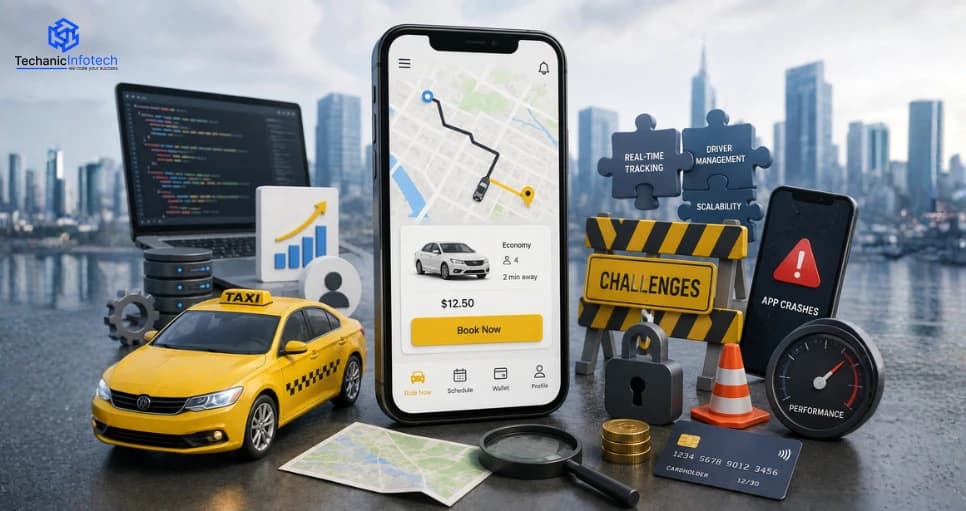
Building a taxi booking app may seem simple, but the real effort happens behind the scenes.
Every business entering this industry faces technical, operational, and user-related issues that require the right planning and execution.
This is why understanding taxi booking app development challenges becomes extremely important before launching a ride-hailing platform.
A successful taxi app needs:
Accurate real-time tracking
Fast response systems
Secure payment processing
Smooth rider-driver communication
Stable backend infrastructure
If any of these systems fail, users can quickly lose trust in the platform.
With increasing competition in the transportation industry, businesses must offer better features, reliable performance, and smooth user experiences to stand out in the market.
Many startups want to build platforms similar to Uber or Ola, but even strong ideas can fail if core development problems are not addressed early.
Businesses planning scalable transportation solutions often work with an experienced taxi app development company to build stable and future-ready ride-booking platforms.
The ride-hailing industry is growing rapidly, and these statistics highlight why businesses must focus on scalability, performance, and user experience.
According to market reports, the global ride-hailing market is expected to reach USD 145.8 billion by 2025, showing increasing demand for app-based transportation services.
By 2035, the market is projected to grow to nearly USD 798.8 billion, making scalability and performance optimization essential for new businesses entering the industry.
From 2024 to 2030, ride-sharing services are expected to grow at an impressive CAGR of around 13.7%, increasing the need for continuous feature upgrades and infrastructure improvements.
The market is also projected to rise from USD 91.6 billion in 2023 to USD 418.5 billion by 2033, creating significant opportunities for startups and transportation businesses.
India’s ride-hailing industry is expected to reach approximately US$8.28 billion by 2025, increasing the demand for high-performance and scalable taxi booking applications.
By 2030, India is projected to have more than 400 million ride-hailing users, making secure payments, real-time tracking, and smooth app performance more important than ever.
Rapid market growth also means stronger competition.
Businesses must focus on:
Stable backend systems
Accurate GPS tracking
Fast booking systems
Reliable server performance
Better customer experience
Understanding these statistics helps companies better plan long-term scalability, feature improvements, and operational growth.
Businesses researching modern transportation platforms also analyze top taxi booking app trends before planning future-ready ride-hailing solutions.
Building a taxi booking app offers huge business opportunities, but it also comes with multiple technical and operational challenges.
Understanding the major development problems helps businesses reduce risks and create reliable applications that users trust.
One of the biggest challenges in taxi app development is ensuring accurate real-time location tracking.
Riders expect live updates from the moment the driver accepts the ride until they reach the destination.
Challenges:
GPS inaccuracies in crowded areas
Slow map loading
Delayed driver location updates
High battery consumption
Solutions:
Use reliable APIs like Google Maps or Mapbox
Optimize background tracking systems
Add route recalculation functionality
Use lightweight coding practices
These improvements help riders and drivers experience smoother navigation and better ride tracking performance.
Businesses planning modern transportation platforms often integrate scalable taxi booking app features to improve navigation accuracy and customer satisfaction.
Payment integration is another critical part of taxi app development.
Users expect payment systems to be fast, secure, and compatible with multiple payment methods.
Challenges:
Online transaction security risks
Payment gateway integration issues
Managing refunds and cancellations
Wallet synchronization problems
Solutions:
Use PCI-DSS-compliant payment gateways
Support UPI, wallets, and cards
Enable automated invoicing systems
Encrypt sensitive financial data
A secure and smooth payment experience improves customer trust and reduces payment-related complaints.
A taxi booking platform must connect riders and drivers instantly and accurately.
Poor driver matching systems can negatively affect user experience and ride completion rates.
Challenges:
Delays during peak traffic hours
Assigning drivers located far away
Supply-demand imbalance
Solutions:
Use AI-powered matching algorithms
Prioritize nearby drivers
Implement surge pricing systems
Offer driver incentives during peak hours
Modern businesses increasingly invest in AI in taxi app development to improve ride allocation accuracy and operational efficiency.
As a taxi app grows, it must handle thousands of ride requests simultaneously without crashing.
Poor scalability can lead to slow performance, app downtime, and frustrated users.
Challenges:
Server overload during peak traffic
Poor database optimization
Slow ride history loading
Solutions:
Use scalable cloud platforms like AWS or Google Cloud
Optimize backend databases
Implement microservice architecture
Monitor server performance continuously
Scalable infrastructure improves long-term stability and business growth opportunities.
Safety is one of the most important aspects of every ride-hailing platform.
Without proper security systems, users may lose confidence in the app.
Challenges:
Fake driver profiles
Security concerns during late-night rides
Lack of emergency systems
Solutions:
Perform driver background verification
Add SOS emergency buttons
Enable live ride tracking
Allow users to share trip details
Strong security systems improve platform trust and long-term user retention.
Taxi booking apps must remain simple and easy to use for both drivers and riders.
A confusing interface can reduce engagement and negatively affect app usage.
Challenges:
Overcrowded screens
Complicated navigation
Poor onboarding experiences
Solutions:
Use clean UI layouts
Add step-by-step onboarding
Use simple text and icons
Test the design with real users
Businesses often study how to create an app like Uber to improve ride-booking experiences and simplify customer journeys.
Taxi booking platforms usually include:
Rider application
Driver application
Admin dashboard
Managing all systems efficiently across multiple devices and operating systems can be challenging.
Challenges:
Device compatibility issues
Bugs across app versions
Continuous maintenance requirements
Solutions:
Perform regular updates
Conduct detailed QA testing
Use cross-platform frameworks
Monitor app performance continuously
Proper maintenance ensures smooth functionality and long-term platform stability.
Taxi apps must comply with local transportation regulations and privacy laws.
Failure to follow compliance standards can create legal and operational risks.
Challenges:
Transport regulation compliance
Managing driver documentation
User data privacy concerns
Solutions:
Work with legal consultants
Add document verification systems
Follow data protection standards
Maintain secure record systems
Compliance-focused development improves platform credibility and reduces business risks.
Modern ride-hailing applications require advanced functionalities that should work smoothly without affecting performance.
Challenges:
Slower app speed after adding features
Complex backend integrations
Frequent feature update management
Solutions:
Use modular architecture
Optimize backend APIs
Test features before deployment
Implement performance monitoring systems
Businesses comparing scalability often evaluate overall taxi app development cost before integrating advanced ride-booking functionalities.
Strong customer support systems are essential for resolving ride issues, payment concerns, and safety complaints quickly.
Challenges:
High support request volumes
Slow customer response times
Poor issue tracking systems
Solutions:
Add 24/7 chat support
Use AI-powered chatbots
Implement ticketing systems
Train support teams properly
Fast and responsive customer support improves customer satisfaction and platform reliability.
Developing a taxi booking application offers several business advantages that improve operational efficiency and customer experience.
Taxi apps allow businesses to serve users across multiple cities and operate 24/7.
This helps companies expand their customer base and improve brand visibility in competitive markets.
Automated ride-booking systems help businesses manage drivers, bookings, schedules, and routes more efficiently.
This reduces manual workload while improving operational accuracy.
Users benefit from:
Easy ride booking
Real-time ride tracking
Secure payments
Fast transportation services
Smooth user experiences significantly improve customer retention.
Drivers receive optimized navigation support, instant ride requests, and earnings insights that help reduce idle time and increase ride completion rates.
Analytics systems help businesses improve services, understand customer behavior, and explore innovative transportation solutions.
Businesses planning scalable transportation startups also analyze why taxi booking apps fail before optimizing long-term platform strategies.
As the ride-sharing industry evolves rapidly, businesses must follow modern technologies and user expectations to remain competitive.
EV ride options help businesses support eco-friendly transportation while reducing fuel costs and environmental impact.
These services also improve modern brand positioning and sustainability efforts.
AI-powered route optimization analyzes traffic conditions, trip history, and road congestion to suggest the fastest travel routes.
This improves ride efficiency, fuel optimization, and customer satisfaction.
Voice-enabled booking systems allow users to request rides using voice commands.
This improves convenience, accessibility, and hands-free interaction experiences.
Digital wallet integration enables fast and secure cashless transactions through:
UPI
Cards
Wallet balances
Online banking
These systems improve payment convenience and transaction transparency.
Loyalty programs encourage users to book rides regularly through discounts, reward points, and exclusive offers.
These programs improve user retention and customer engagement.
Selecting the right development partner is extremely important for building a stable and scalable ride-booking platform.
A reliable company understands user expectations, technical requirements, and operational challenges effectively.
Choose a company with proven experience in building transportation and ride-booking platforms.
Their previous work helps evaluate their understanding of real-world taxi app operations.
The company should have expertise in:
GPS systems
Payment integration
Real-time tracking
Backend scalability
Cloud infrastructure
Strong technical skills help businesses solve major development challenges efficiently.
Analyze previous projects and client reviews to understand the company’s quality standards and project management approach.
Simple navigation, fast booking flows, and clean interfaces significantly improve customer engagement and usability.
Businesses should request clear pricing structures and development plans before starting the project.
Transparent cost estimation reduces future financial confusion.
Regular communication and post-launch support are important for long-term app maintenance and improvements.
Many startups partner with professional teams offering scalable ride-booking solutions and long-term support services.
Building a successful taxi booking app requires much more than just developing a mobile application. Businesses must focus on scalability, real-time tracking, security, smooth payment systems, user-friendly design, and reliable backend infrastructure.
Understanding major Taxi Booking App Development Challenges early helps businesses reduce risks, improve performance, and create better user experiences.
With the right development strategy, advanced technologies, and experienced team support, businesses can successfully build scalable ride-hailing platforms that remain competitive and deliver long-term value to users and transportation businesses alike.
Major challenges include real-time GPS tracking, secure payment integration, backend scalability, driver-rider matching, user safety, and maintaining smooth app performance during high traffic.
The cost to develop a taxi booking app generally ranges between $10,000 and $120,000+ depending on app complexity, features, integrations, and scalability requirements.
Important features include ride booking, GPS tracking, payment integration, push notifications, driver management, ratings & reviews, ride history, and emergency support systems.
Scalable infrastructure helps taxi booking apps handle thousands of ride requests simultaneously without affecting app speed, performance, or customer experience.
AI improves ride allocation, route optimization, traffic prediction, customer support automation, and personalized ride experiences for users and drivers.
An experienced taxi app development company helps businesses build secure, scalable, and feature-rich ride-booking platforms while reducing technical risks and development challenges.


Abhishek Jangid is the CEO of Techanic Infotech, with extensive experience in mobile app and web development. He specializes in helping businesses turn innovative ideas into scalable digital solutions through strategic planning and modern technology.