AI Development
Agentic AI vs Generative AI: Differences, Benefits, Use Cases & More (2026)
May 12, 2026
May 12, 2026
AI is evolving fast, and two terms that are gaining attention are agentic AI vs generative AI. While both are powerful, they serve different purposes and are used in different ways.
Understanding the difference between agentic AI and generative AI is important for businesses looking to adopt the right solution.
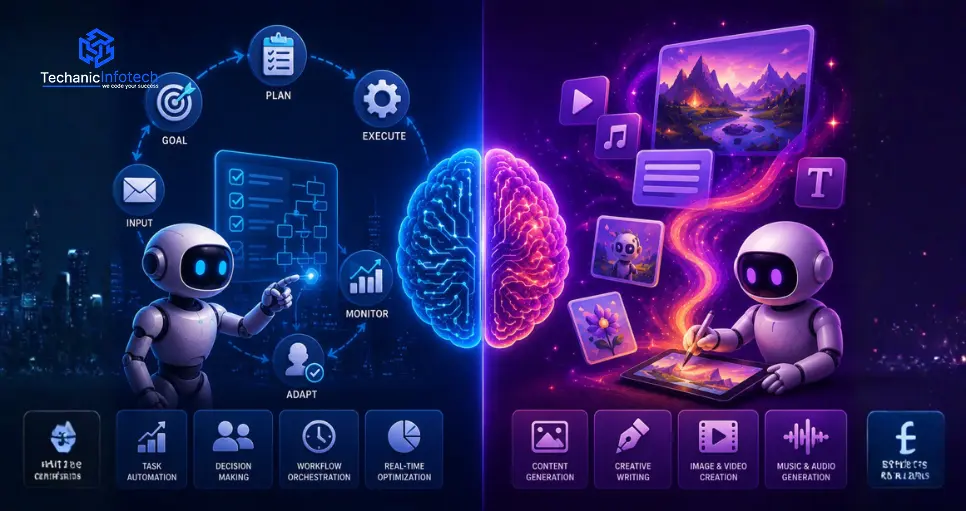
In simple terms, generative AI focuses on creating content, while agentic AI focuses on taking actions and making decisions. But the real comparison goes deeper.
In this guide, we’ll break down the agentic AI vs generative AI comparison, explore real examples, and help you understand when to use agentic AI vs generative AI based on your needs.
Generative AI is a type of artificial intelligence that focuses on creating content such as text, images, videos, or code.
It works by learning patterns from large datasets and then generating new outputs based on that knowledge. In the context of agentic AI vs generative AI, generative AI is mainly used for tasks like content writing, chatbots, design generation, and automation of creative work.
For example, tools like AI writing assistants or image generators are powered by generative AI. When understanding the difference between agentic AI and generative AI, generative AI is more about producing results rather than taking actions or making decisions independently.
Agentic AI refers to AI systems that can make decisions, take actions, and complete tasks with minimal human intervention.
Unlike generative AI, which focuses on content creation, agentic AI is designed to act autonomously based on goals and instructions. In the agentic AI vs generative AI comparison, agentic AI is more action-oriented and goal-driven.
For example, an AI agent that manages workflows, automates business processes, or handles customer interactions without constant input is considered agentic AI.
When exploring what is the difference between agentic AI and generative AI, agentic AI stands out for its ability to think, plan, and execute tasks independently.
Generative AI works by learning patterns from large amounts of data and then using that knowledge to create new content. In the context of agentic AI vs generative AI, generative AI focuses on producing outputs like text, images, or code rather than taking independent actions.
Here’s how it works step by step:
Generative AI models are trained on massive datasets that include text, images, or other types of content. The model learns patterns, language structure, and relationships within the data. This training phase is the foundation of how generative AI understands and creates content.
Once trained, the model identifies patterns in the data. For example, it understands how sentences are formed, how images are structured, or how code is written. This ability to recognize patterns is what allows generative AI to generate realistic outputs.
Generative AI works based on user input, also known as a prompt. When you give a command or question, the model analyzes it and understands what kind of output is needed. In the agentic AI vs generative AI comparison, this shows that generative AI depends on user input to function.
After understanding the prompt, the model generates a response based on the patterns it has learned. It predicts the most suitable output step by step. For example, in text generation, it predicts the next word based on context.
Generative AI models improve over time with more data and feedback. Developers update models to make them more accurate, relevant, and useful. This helps enhance performance and output quality.
Finally, the generated content is delivered to the user. This could be a written response, an image, a video, or even code. The goal is to provide useful and relevant output based on the input.
Agentic AI works by acting like an intelligent system that can make decisions, plan tasks, and execute actions with minimal human input.
In the context of agentic AI vs generative AI, agentic AI is more action-driven, meaning it doesn’t just generate content, it actually completes tasks.
Here’s how it works step by step:
Agentic AI starts with a goal or objective given by the user. Instead of just responding to a prompt, it understands what needs to be achieved.
For example, the goal could be “automate customer support” or “manage a workflow.” This is a key part of the difference between agentic AI and generative AI.
Once the goal is clear, the AI breaks it down into smaller tasks. It creates a step-by-step plan to achieve the objective. This planning ability makes agentic AI more advanced in the agentic AI vs generative AI comparison.
Agentic AI evaluates different options and decides the best way to move forward. It uses data, rules, and logic to make decisions. Unlike generative AI, which waits for input, agentic AI can decide actions on its own.
After planning and decision-making, the AI performs actions. This could include sending messages, updating systems, triggering workflows, or interacting with other tools. This is where agentic AI stands out in agentic AI vs generative AI examples.
Agentic AI continuously monitors results and learns from feedback. If something doesn’t work, it adjusts its approach. This helps improve performance over time and makes it more efficient.
Once set up, agentic AI can run processes continuously without constant human involvement. It manages tasks, optimizes workflows, and ensures goals are achieved efficiently.
|
Aspect |
Generative AI |
Agentic AI |
|
Definition |
AI that creates content like text, images, code, or videos |
AI that can make decisions and perform tasks autonomously |
|
Primary Purpose |
Content generation and creative output |
Task execution, automation, and decision-making |
|
Core Function |
Predicts and generates output based on input (prompt-based) |
Plans, decides, and acts based on goals |
|
Dependency on Input |
Highly dependent on user prompts |
Can operate with minimal human input once goals are defined |
|
Action Capability |
Does not take real-world actions |
Can perform actions like sending emails, updating systems, or managing workflows |
|
Decision-Making Ability |
Limited (follows patterns, no real decisions) |
Strong (analyzes data and makes decisions) |
|
Autonomy Level |
Low (needs continuous input) |
High (can work independently) |
|
Use Cases |
Content writing, design, chatbots, code generation |
Workflow automation, customer support, operations management |
|
Examples |
AI writing tools, image generators, code assistants |
AI agents, automation systems, smart assistants |
|
Learning Approach |
Learns patterns from large datasets |
Learns from feedback, actions, and outcomes |
|
Real-Time Adaptation |
Limited adaptation |
Adapts in real-time based on situations |
|
Complexity Level |
Moderate |
High |
|
Business Impact |
Improves productivity in creative tasks |
Improves efficiency in operations and processes |
|
Integration Scope |
Usually standalone or integrated into tools |
Integrates across multiple systems and workflows |
|
When to Use |
When you need content or creative outputs |
When you need automation and decision-based execution |
Generative AI is transforming how businesses create content and automate creative tasks.
It helps save time, improve efficiency, and scale content production easily. In the agentic AI vs generative AI comparison, it stands out for its ability to generate high-quality outputs quickly.
Faster Content Creation: Generative AI can create text, images, videos, and code in seconds. This helps businesses save time on tasks like writing blogs, designing creatives, or generating reports. In the agentic AI vs generative AI comparison, generative AI is ideal for speeding up creative work.
Cost Efficiency: It reduces the need for large content teams by automating repetitive creative tasks. Businesses can produce more output with fewer resources, making it a cost-effective solution.
Scalability: Generative AI allows businesses to create large volumes of content quickly. Whether it’s marketing campaigns, product descriptions, or emails, it can scale content production easily.
Personalization: It helps deliver personalized content based on user preferences and behavior. For example, AI can generate customized emails or recommendations, improving user engagement.
Improved Creativity: Generative AI can suggest new ideas, designs, and approaches that humans may not think of. It acts as a creative assistant, helping teams innovate faster.
Easy Integration: Generative AI tools can be integrated into existing systems like websites, apps, and CRM platforms, making it easier to automate workflows.
Agentic AI is changing how businesses manage operations by enabling systems to act and make decisions independently.
It focuses on automation, efficiency, and real-time execution. In the agentic AI vs generative AI comparison, agentic AI is more powerful for handling complex workflows and tasks.
End-to-End Task Automation: Agentic AI can handle complete workflows from start to finish without constant human input. This makes it powerful in the agentic AI vs generative AI comparison for automation-heavy use cases.
Smart Decision-Making: It can analyze data, evaluate options, and make decisions based on goals. This helps businesses automate complex processes like operations, customer service, and workflow management.
Increased Efficiency: Agentic AI reduces manual work by managing tasks independently. This improves productivity and allows teams to focus on strategic activities.
Real-Time Problem Solving: It can monitor situations and respond instantly to changes. For example, it can adjust workflows or handle customer queries without delay.
Continuous Learning: Agentic AI improves over time by learning from feedback and outcomes. This makes it more effective and accurate with continued use.
Better Workflow Management: It connects multiple systems and tools to streamline operations. From managing tasks to optimizing processes, agentic AI helps businesses run more efficiently.
Generative AI is widely used across industries for creating content, improving productivity, and enhancing user experience.
In the agentic AI vs generative AI comparison, generative AI is mainly focused on producing outputs rather than executing tasks. Here are some key use cases:
Generative AI is heavily used for creating blogs, social media posts, emails, and ad copy. Businesses use it to generate large volumes of content quickly and consistently. It helps marketing teams save time while maintaining quality and engagement.
AI tools can create images, graphics, logos, and UI designs based on simple prompts. Designers use generative AI to speed up the creative process and explore new ideas. This is especially useful for branding and digital marketing.
Generative AI powers chatbots that can respond to customer queries in a human-like way. These chatbots improve customer support by providing quick and accurate responses, enhancing user experience.
Developers use generative AI to write code, debug issues, and automate repetitive tasks. It helps speed up the development process and reduces manual effort, making it easier to build applications.
Generative AI can create personalized content based on user behavior. For example, it can generate product suggestions, emails, or offers tailored to individual users, improving engagement and conversion rates.
AI can generate videos, voiceovers, and audio content. Businesses use this for marketing videos, tutorials, and presentations. It reduces the need for manual production and speeds up content creation.
Generative AI can create reports, contracts, summaries, and business documents automatically. This is useful for industries like finance, legal, and healthcare, where documentation is important.
Agentic AI is designed to take actions, make decisions, and manage workflows independently.
In the agentic AI vs generative AI comparison, agentic AI stands out for handling real-world tasks instead of just generating content. Here are some key use cases:
Agentic AI can manage complete customer support processes. It can receive queries, analyze them, provide solutions, and even escalate issues when needed. Unlike basic chatbots, it can take actions like updating tickets or processing requests, improving response time and customer experience.
Businesses use agentic AI to automate workflows across departments. It can assign tasks, track progress, and complete processes without manual intervention. For example, it can manage onboarding, approvals, or internal operations efficiently.
Agentic AI can handle lead generation, qualification, and follow-ups automatically. It can interact with potential customers, analyze their behavior, and guide them through the sales funnel. This helps businesses improve conversions and reduce manual effort.
In fintech, agentic AI can automate loan approvals, risk analysis, and payment processing. It can evaluate user data, make decisions, and execute actions. This makes it highly useful in scenarios where decision-making is critical.
Agentic AI can monitor supply chains, manage inventory, and optimize logistics. It can detect issues, adjust processes, and ensure smooth operations. This helps businesses reduce delays and improve efficiency.
Agentic AI can monitor systems, detect issues, and fix them automatically. It can manage servers, handle alerts, and ensure system stability without constant human supervision.
Advanced AI assistants powered by agentic AI can manage schedules, send reminders, book appointments, and complete tasks independently. This improves productivity for individuals and teams.
When comparing agentic AI vs generative AI, the cost varies based on complexity and use case.
Generative AI is generally more affordable, with costs starting from $10,000 to $50,000+, as it mainly focuses on content generation and simpler integrations.
On the other hand, agentic AI development costs typically range from $10,000 to $80,000+, because it involves workflow automation, decision-making systems, and multiple integrations.
In the agentic AI vs. generative AI comparison, generative AI is suitable for budget-friendly, content-focused needs, while agentic AI requires higher investment but delivers more value through automation and operational efficiency.
Choosing between agentic AI vs generative AI depends on your business goals, use case, and level of automation needed. Here’s how to decide:
If your main goal is content creation, like blogs, marketing copy, designs, or code, generative AI is the right choice. It helps you scale creative output quickly and cost-effectively.
If you want to automate workflows, manage tasks, or build systems that can act independently, agentic AI is a better option. It’s ideal for operations, customer support, and process automation.
Generative AI is more budget-friendly and easier to implement. Agentic AI requires higher investment but delivers deeper automation and long-term efficiency.
If your solution needs to connect multiple systems and perform actions across platforms, agentic AI is more suitable. Generative AI works well as a standalone or supportive tool.
In many cases, the best solution is using both together, generative AI for creating content and agentic AI for executing tasks.
While both technologies are powerful, understanding their limitations is important before choosing between agentic AI vs generative AI. Each comes with its own challenges that can impact performance, AI development cost, and implementation.
Both generative and agentic AI rely heavily on data. If the data is incomplete, biased, or outdated, the results can be inaccurate. In the agentic AI vs generative AI comparison, poor data can lead to irrelevant content in generative AI and wrong decisions in agentic AI systems.
Building an AI app requires investment in infrastructure, tools, and expertise. While generative AI is relatively more affordable, agentic AI can be expensive due to its complexity, integrations, and automation capabilities.
Generative AI can sometimes produce incorrect or misleading outputs, especially when dealing with complex topics. Agentic AI, on the other hand, may make incorrect decisions if not properly trained or monitored. This raises concerns about reliability in critical applications.
Handling sensitive data is a major challenge. Without proper safeguards, both technologies can expose user data to risks. Businesses must follow strict security practices to prevent breaches and ensure compliance.
Even though AI is advanced, it lacks true human understanding and judgment. Generative AI may not fully understand context, while agentic AI may not always make the best decision in complex scenarios. This highlights the difference between agentic AI and generative AI in terms of limitations.
Integrating AI into existing systems can be complex. Agentic AI, in particular, requires connections across multiple tools and platforms, which can increase development time and effort.
AI systems require continuous monitoring, app maintenance, and improvements. Without proper maintenance, performance can decline over time. This adds to long-term costs and effort.
Understanding agentic AI vs generative AI is important for choosing the right solution for your business. While generative AI focuses on creating content and improving creativity, agentic AI is designed to take actions, automate workflows, and make decisions.
The difference between agentic AI and generative AI comes down to purpose, one creates, the other executes. From our experience, businesses get the best results when they choose based on their specific needs or even combine both technologies.
As AI continues to evolve, knowing when to use agentic AI vs generative AI will help you build smarter, more efficient, and future-ready solutions.
The main difference between agentic AI and generative AI is that generative AI creates content, while agentic AI takes actions and completes tasks independently.
Generative AI is a type of AI that creates content like text, images, videos, or code based on input and learned patterns.
Agentic AI refers to AI systems that can make decisions, plan tasks, and execute actions with minimal human input.
It depends on your needs. In the agentic AI vs generative AI comparison, generative AI is better for content creation, while agentic AI is better for automation and execution.
You should use generative AI when you need content generation, such as writing, designing, or coding.
Use agentic AI when you need automation, workflow management, or systems that can make decisions and act independently.
Yes, many systems combine both. Generative AI creates content, while agentic AI uses it to perform tasks and automate processes.
Examples include AI writing tools, image generators, chatbots, and code generation tools.
Examples include AI agents for workflow automation, customer support systems, and intelligent assistants that perform tasks.
Agentic AI is considered more advanced in terms of automation and decision-making, but both serve different purposes.


Bharat Sharma is the CTO of Techanic Infotech, bringing deep technical expertise in software architecture, mobile app development, and scalable system design. He leads the engineering team with a strong focus on innovation, performance, and security.