Key Takeaways
Bike rental app development is rapidly growing due to rising demand for affordable, app-based urban mobility solutions worldwide.
GPS tracking, QR unlocking, smart payments, and IoT integration are core features for modern bike rental platforms in 2026.
The Bike Rental App Development Cost usually ranges between $10,000 and $80,000+ based on app complexity and scalability.
Aggregator, dedicated fleet, and hybrid models are the most profitable business structures for bike rental app businesses.
AI, ML, Data Analytics, AR, and IoT technologies improve fleet management, pricing automation, and customer experience significantly.
Strong UI/UX, secure payment systems, and scalable backend architecture are essential for long-term growth and operational stability.
Bike rental app development is becoming one of the fastest-growing business opportunities in the mobility industry. From daily commuters to tourists, people now prefer app-based bike rentals because they are affordable, quick, and convenient. And honestly, if you look around any major city today, bike rental services are almost everywhere.
The market is growing much faster than most businesses expect. According to fortune business insights, the global bike and scooter rental market was valued between USD 7.82 billion and USD 9.04 billion in 2025 and is expected to reach nearly USD 39.37 billion by 2034. market data forecast also predicts the industry will grow at a CAGR of around 15% to 19% over the next decade.
At the same time, the e-bike rental market is expected to hit USD 10.97 billion in 2026, according to OpenPR, while GreenMoov reports that the smart bike-sharing market could grow from USD 1.93 billion in 2025 to USD 5.3 billion by 2033.
The bike rental businesses are not limited to the US or UK but are widespread across the world. With time, more individuals are showing interest in building their own bike rental apps.
In this guide, we will introduce you to different aspects of how to develop a bike rental app.
A bike rental app is an on-demand mobile platform that allows users to rent two-wheelers for short or long commutes. Operating similarly to cab-booking apps, it simplifies urban transportation through a few quick steps:
Easy Onboarding: Users download the app and create a secure profile with basic verification.
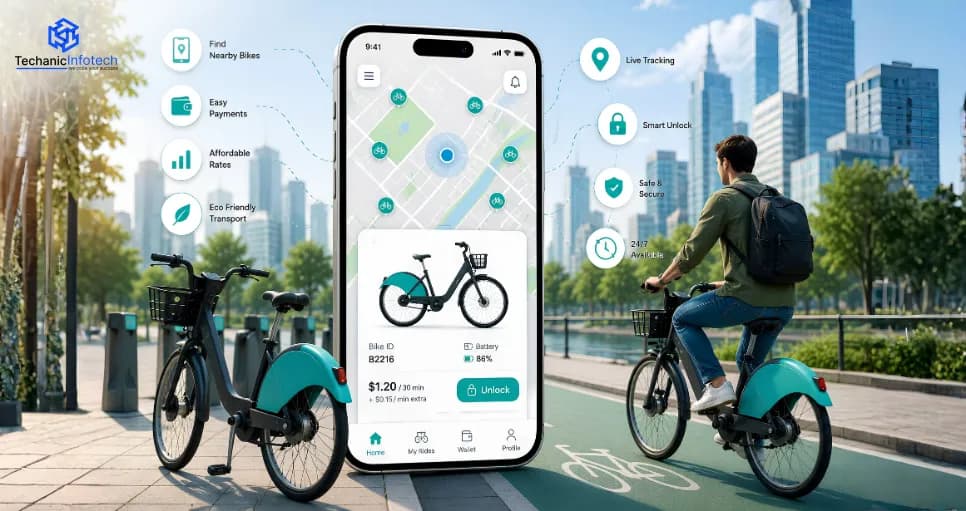
Location-Based Search: The app uses GPS to show available bikes or nearby rental hubs in real-time.
Flexible Choices: Users can select a bike based on their preference, budget, and duration (hourly/daily).
Instant Booking: Once confirmed, all ride or vehicle details are shared instantly with the user for a hassle-free journey.
Want to understand how an on-demand bike rental app actually works? Here’s the complete process in simple steps.
Want to know about the workings of bike rental apps? In this section, we will do step-by-step work on bike rental apps.
Users download the On-Demand Bike Rental App, create an account, and verify details using phone number, email, or social login.
The app detects the user’s live location and shows nearby bikes, docking stations, pricing, availability, and ride duration instantly.
In Bicycle Rental App Development, users unlock bikes through QR scanning, smart locks, OTP codes, or app-based eLock systems.
Most Scooter and Bike Rental App platforms allow hourly, daily, or subscription-based bookings depending on travel requirements and budget.
After completing the ride, users return the bike to a nearby station and make payments using integrated digital payment gateways.
Users can rate the experience, report damaged bikes, request refunds, and contact support directly through the mobile application.
Now that you understand how the platform works, let’s explore why businesses are investing heavily in bike rental app development.
The micro-mobility industry is growing rapidly, and developing a bike rental app has become a profitable opportunity for startups, fleet owners, and mobility businesses.
Here’s how modern Bike Sharing App Development platforms create value for both businesses and users:
Multiple Revenue Opportunities: Generate income through hourly rentals, subscriptions, advertisements, surge pricing, and commission-based booking models.
Smart Fleet Management: Modern mobile app development services help businesses manage GPS tracking, bookings, billing, maintenance, and ride monitoring from one dashboard.
Stronger Brand Presence: Traditional rental businesses can build a digital brand using loyalty programs, push notifications, referral offers, and personalised promotions.
Better Asset Utilisation: Individual owners can list idle bikes on the platform and earn passive income through peer-to-peer rental services.
High-Growth Business Potential: Companies like Lime, Bird, and Uber have already shown how scalable and profitable micro-mobility platforms can become globally.
Affordable Daily Travel: Bike rentals reduce fuel costs, parking expenses, and expensive cab fares for short-distance commuting.
Faster Urban Mobility: Two-wheelers help users avoid traffic congestion and reach destinations more quickly in crowded cities.
Easy Booking Experience: Users can find, unlock, and pay for bikes within seconds using wallets, UPI, debit cards, or credit cards.
Multiple Vehicle Choices: Users can select bicycles, e-bikes, or scooters based on pricing, comfort, and travel preferences.
Real-Time Tracking & Safety: GPS navigation, geo-fencing, and live ride tracking improve safety and make the rental experience more reliable.
If the app experience feels slow or complicated, users usually leave instantly. That’s why businesses should focus on building practical, user-friendly, and scalable features from day one.
If you have already explored top car rental app features, you’ll notice that modern mobility apps now focus heavily on automation, security, real-time tracking, and seamless payments. The same applies to bike rental platforms as well.
The onboarding process should be simple and fast. Users must be able to sign up using email, mobile number, Google, or social media accounts. A smooth registration flow improves user retention and reduces app drop-offs.
Most modern bike rental apps use QR-based unlocking systems. Users simply scan the QR code from the app to unlock the bike instantly. Smart lock integration is especially important for dockless bike-sharing systems.
Real-time GPS tracking helps users locate nearby bikes quickly and improves operational efficiency for businesses. It also helps prevent theft, monitor ride routes, and manage fleet distribution across different areas.
For security purposes, users and bike owners should upload identity proof, licenses, and insurance documents. Admin verification helps create a safer and more trusted rental ecosystem.
Users should be able to book bikes instantly or schedule rides in advance. This feature becomes extremely useful during peak travel hours, tourism seasons, and daily office commuting.
Admins need a centralised dashboard to manage bookings, cancellations, refunds, fleet availability, and rider activity in real time. This helps businesses streamline operations without manual effort.
The app should automatically calculate pricing based on ride duration, distance, vehicle type, or peak demand. Transparent pricing improves trust and minimises payment disputes.
Built-in chat and masked calling features allow users and bike owners to communicate securely without sharing personal phone numbers directly.
A bike rental app should support wallets, UPI, debit cards, credit cards, Apple Pay, Google Pay, and other digital payment methods for frictionless transactions.
Push notifications help businesses keep users engaged through ride reminders, booking updates, offers, discounts, and promotional campaigns.
User reviews help improve service quality and build platform credibility. Admins should also have moderation controls to handle spam or inappropriate reviews.
Quick customer support is critical for handling ride issues, refunds, payment failures, or damaged bike reports. One-tap support significantly improves customer satisfaction and trust.
If you are planning to build a bike rental app, then what is a better way than to analyze the current best rental apps. It will give you an idea of what is best for your app.
Some of the top bike rental apps are listed below:
|
Bike Rental App |
Top Features |
Best For |
|
GoBikes |
GPS tracking, hourly/daily rental options, affordable pricing, easy booking flow |
Budget-friendly rentals for daily commuters |
|
Spinlister |
Peer-to-peer bike sharing, insurance protection, multi-city support, user reviews |
Renting bikes directly from owners |
|
Lime |
Dockless bikes, QR unlocking, electric bikes, ride analytics |
Quick, eco-friendly short-distance travel |
|
RentOnGo |
Wide vehicle options (bikes, scooters), flexible pricing, verified vendors |
Users want multiple rental choices in one app |
|
Citi Bike |
Docking stations, membership plans, map-based availability, and high reliability |
Urban riders seeking consistent and safe city commutes |
|
Lyft Bikes |
Integrated with the Lyft app, e-bikes, station-based rentals, and real-time availability |
Users who prefer app-based transport ecosystems |
|
Yulu |
IoT-enabled e-bikes, smart locks, battery-operated rides, and affordable micro-mobility |
Short rides, campus travel, and last-mile mobility |
|
Ontrack |
Long-term rentals, doorstep delivery, subscription plans, service support |
Students and professionals need monthly rentals |
|
SHRIDE |
Electric scooters & bikes, no fuel cost, pay-as-you-go, location-based availability |
Eco-friendly urban commuting |
|
SmartBike |
QR-based unlocking, membership plans, dock stations, smart tracking |
Safe and structured city bike-sharing |
Seeing successful apps in action gives clarity, but the real challenge is building your own. So now, let’s move into the complete guide to bike rental app development, where we break down how to make a bike rental app from idea to launch.
Building a successful bike rental platform is not only about creating a mobile application. Modern mobility businesses require a combination of scalable software architecture, real-time GPS systems, secure payment infrastructure, and IoT-enabled smart bike integration.
As competition in the mobility industry grows rapidly, businesses must focus on building user-friendly, secure, and operationally efficient platforms. Similar to how to develop a car rental app, bike rental platforms also require proper planning, testing, fleet management, and long-term scalability strategies.
Here’s the complete step-by-step roadmap for successful mobility app development in 2026:
Before starting development, businesses should carefully analyse the market, competitors, and customer behaviour. Research platforms like Lime, Bird, Yulu, and Spinlister to understand what users actually expect from a bike rental app.
A proper SWOT analysis helps identify:
Market gaps
User pain points
Revenue opportunities
Competitor weaknesses
High-demand mobility features
At this stage, businesses should also finalise their operating model:
Self-owned fleet model
Peer-to-peer marketplace
Subscription-based rentals
Dockless bike-sharing system
A strong research phase reduces future operational risks and helps create a clear development strategy.
Once research is completed, the next step is defining the product structure and feature roadmap.
The core goal should always remain simple:
Faster bookings
Easy navigation
Secure payments
Real-time bike tracking
Smooth ride experience
Businesses should first prioritize MVP-level features instead of building everything together. This approach reduces initial costs and improves the mobile app development timeline significantly.
At this stage, companies also decide whether the app will support:
Bikes only
E-bikes
Scooters
Multi-vehicle rentals
Many startups now also combine rentals, delivery, ride-booking, and payments under multi-service super app development models.
In bike rental platforms, user experience directly impacts retention and bookings. If users cannot unlock or book bikes quickly, they usually uninstall the app immediately.
The interface should focus on:
Simple onboarding
Clean map navigation
Quick booking flow
Minimal screen transitions
Clear pricing visibility
Interactive wireframes and clickable prototypes help businesses test the user journey before actual development starts.
The final UI should work smoothly across:
Android devices
iPhones
Tablets
Low-network conditions
The technology stack decides your app’s scalability, speed, and long-term maintenance cost. This section also works as a practical mobile app tech stack guide for businesses planning scalable bike rental platforms.
|
Development Layer |
Recommended Tech Stack (2026) |
Purpose in Bike Rental App Development |
|
Frontend Development |
Flutter, React Native, Next.js |
Cross-platform mobile app development with fast UI rendering and scalable user experience |
|
Backend Development |
Node.js, NestJS, Python, FastAPI |
Real-time APIs, ride management, booking systems, and scalable backend processing |
|
Cloud Infrastructure |
AWS, Google Cloud Platform (GCP), Firebase |
Cloud hosting, auto-scaling, notifications, authentication, and database management |
|
Database Management |
PostgreSQL, MongoDB, Redis |
User data storage, ride history, real-time caching, and high-speed query handling |
|
Real-Time Communication |
WebSockets, Socket.IO, MQTT |
Live ride tracking, smart lock communication, and instant app updates |
|
GPS & Mapping Services |
Google Maps API, Mapbox, OpenStreetMap |
Live navigation, bike location tracking, geo-fencing, and route optimisation |
|
IoT & Smart Lock Systems |
Bluetooth Low Energy (BLE), NB-IoT, RFID |
QR unlocking, remote bike access, smart lock connectivity, and fleet monitoring |
|
Payment Integration |
Stripe, Razorpay, PayPal |
Secure digital payments, subscriptions, wallets, and automated billing |
|
Authentication & Security |
Firebase Auth, OAuth 2.0, JWT, Biometric Authentication |
Secure login, KYC verification, encrypted access, and fraud prevention |
|
AI & Data Analytics |
TensorFlow, Apache Kafka, Power BI |
Dynamic pricing, ride prediction, user analytics, and fleet optimisation |
|
DevOps & Deployment |
Docker, Kubernetes, GitHub Actions |
Continuous deployment, app scalability, server orchestration, and automation |
|
Push Notifications |
Firebase Cloud Messaging (FCM), OneSignal |
Ride alerts, booking updates, promotional campaigns, and reminders |
|
Monitoring & Performance |
Datadog, New Relic, Grafana |
Real-time server monitoring, crash analytics, and performance tracking |
This is one of the most critical stages in bike rental app development.
Without IoT integration, modern bike-sharing platforms cannot operate efficiently.
The app should connect directly with:
GPS devices
Bluetooth smart locks
QR scanners
Geo-fencing systems
Ride monitoring sensors
These systems help businesses:
Track bikes in real time
Prevent theft
Restrict ride zones
Monitor fleet health
Enable remote bike unlocking
IoT-enabled infrastructure also improves operational automation and reduces manual management efforts.
Instead of building a fully advanced platform initially, businesses should launch a Minimum Viable Product (MVP) first.
The MVP usually includes:
User registration
Live maps
QR unlocking
Payment gateway
Ride booking
Push notifications
Launching an MVP helps businesses validate real market demand before large-scale investment.
It also provides valuable user behavior insights that help improve future app versions.
Testing should happen throughout the development lifecycle instead of only before launch.
QA teams usually test:
App speed
Payment security
GPS accuracy
Device compatibility
API performance
Low-network functionality
Both manual and automated testing are important for maintaining platform stability.
Real-user beta testing also helps identify navigation problems, booking issues, and UI confusion early.
Bike rental apps handle sensitive user data, payment details, location history, and ride records. Because of this, security should never be ignored.
Modern platforms usually implement:
SSL encryption
JWT authentication
Multi-factor authentication
Biometric login
Secure payment gateways
Strong security infrastructure improves user trust and protects the platform from fraud or unauthorised access.
After testing and final optimisation, the app is deployed on:
Google Play Store
Apple App Store
Before launch, businesses should optimise:
App screenshots
Keywords
Descriptions
Ratings strategy
ASO performance
Marketing also plays a huge role in early growth.
Most successful mobility startups use:
SEO campaigns
PPC advertising
Referral programs
Influencer partnerships
Hyperlocal marketing
A strong launch strategy helps acquire users faster and improves long-term brand visibility.
Once the development roadmap is clear, the next important question is understanding the actual budget required to build and scale a bike rental platform successfully.
The Bike Rental App Development Cost in 2026 usually ranges between $10,000 and $80,000+, depending on app complexity, IoT integration, GPS tracking, supported platforms, and backend scalability. The overall mobile app development cost also depends on features, UI/UX design, and security systems.
|
Development Stage |
Estimated Cost |
What’s Included |
|
Basic MVP Bike Rental App |
$10,000 – $20,000 |
User login, bike listing, booking system, payments, basic GPS tracking |
|
Standard Bike Rental App |
$20,000 – $40,000 |
Real-time tracking, QR unlocking, push notifications, admin dashboard |
|
Advanced IoT-Enabled Platform |
$40,000 – $80,000+ |
Smart locks, geo-fencing, analytics, fleet management, cloud scaling |
|
UI/UX Design |
$3,000 – $8,000 |
Wireframes, app design, and user journey optimisation |
|
Backend & API Development |
$5,000 – $15,000 |
Server architecture, APIs, database management, scalability setup |
|
GPS & Map Integration |
$2,000 – $6,000 |
Live location tracking, ride navigation, geo-location services |
|
Payment Gateway Integration |
$1,500 – $5,000 |
UPI, cards, wallets, PayPal, Stripe integration |
|
IoT & Smart Lock Integration |
$5,000 – $15,000 |
Bluetooth locks, QR unlock systems, ride sensors |
|
QA Testing & Security |
$3,000 – $7,000 |
Bug fixing, app testing, SSL security, and authentication systems |
|
App Store Deployment & Maintenance |
$2,000 – $6,000 yearly |
Store launch, updates, monitoring, performance optimisation |
Before starting development, choosing the right business model is extremely important because it directly affects your investment, operations, scalability, and long-term revenue. A strong business structure helps businesses manage fleets efficiently, control operational costs, and scale faster in competitive mobility markets.
Modern bike rental businesses usually operate using one of these three proven business models.
This is one of the most popular and low-investment business models in the bike rental industry. In this model, the platform acts as a marketplace where individual bike owners or third-party rental companies list their vehicles for users.
Bike owners register and upload their vehicles on the platform.
Users browse available bikes nearby and rent directly through the app.
The platform earns commission from every successful booking.
Requires lower upfront investment because the business does not own vehicles.
Faster city expansion with minimal operational risk.
Easier to scale compared to fleet-heavy models.
Best For: Startups, Marketplace platforms, Asset-light mobility businesses
This model is commonly preferred by startups following modern mobile app development trends because it allows faster growth with lower operational pressure.
In this model, the company owns and manages the complete fleet of bikes, scooters, or e-bikes directly.
The business controls:
Vehicle quality
Pricing structure
Maintenance
User experience
Operations
The company purchases bikes and deploys them across different locations.
Users rent vehicles through the app on hourly, daily, or subscription-based pricing.
All revenue generated stays within the business ecosystem.
Requires high Capital Expenditure (Capex).
Additional costs include:
Fleet purchase
IoT hardware
GPS systems
Smart locks
Maintenance teams
Best For: Established rental companies, Enterprise mobility businesses, Brands prioritising premium customer experience
Although the initial investment is higher, businesses gain complete operational control and better long-term profit margins.
The hybrid model combines both marketplace flexibility and dedicated fleet ownership.
Many modern mobility startups now use this strategy because it balances scalability and operational control effectively.
The company maintains its own premium fleet.
Third-party vendors and local owners are also allowed on the platform.
Users get more vehicle choices and wider availability.
Better inventory availability
Faster multi-city expansion
Reduced operational pressure
Multiple revenue streams
Best For: Rapidly growing startups, Large-scale mobility platforms, Businesses planning nationwide expansion
This model also aligns well with modern mobility app development strategies, where businesses focus on scalability, flexibility, and diversified service offerings.
A modern bike rental platform can generate multiple recurring revenue streams through subscriptions, commissions, ads, AI-based pricing, and fleet partnerships.
Brands pay to display targeted promotions inside the app using banners, videos, location-based campaigns, and sponsored ride recommendations.
Charge businesses for text, graphic, or video advertisements inside the app.
Offer location-based ads to nearby restaurants, fuel stations, or local stores.
Use AI and Data Analytics for personalised in-app advertising campaigns.
Add sponsored bike listings for vendors wanting higher visibility.
VR and AR ads can improve engagement during promotions and events.
Aggregator platforms earn commissions whenever users successfully book rides through third-party vendors or independent bike owners.
Charge a percentage commission on every completed ride booking.
Add cancellation charges and platform convenience fees for extra revenue.
Offer premium vendor memberships with lower commission percentages.
Use ML-based pricing models during high-demand periods.
This model works similarly to the cost to build a car rental app marketplaces.
Recurring subscription models help generate stable monthly income while improving long-term customer retention and platform loyalty.
Offer daily, weekly, or monthly unlimited ride subscriptions.
Create premium memberships with discounted ride pricing.
Provide exclusive benefits like priority bookings and free cancellations.
Student and corporate plans improve recurring customer acquisition.
Subscription models are among the fastest-growing on-demand app ideas in 2026.
Dynamic pricing automatically adjusts rental charges based on demand, traffic, weather conditions, or special events.
Increase ride prices during festivals, weekends, or peak hours.
AI-powered pricing systems maximize operational profitability automatically.
Geo-fencing helps create city-specific pricing zones dynamically.
Dynamic pricing improves fleet utilization and reduces idle inventory.
Security deposits reduce misuse risks while optional insurance plans generate additional operational revenue.
Collect refundable security deposits before ride confirmation.
Offer damage protection and ride insurance add-ons.
Charge penalties for late returns, theft, or vehicle damage.
Automated systems simplify refund and penalty management.
Partnering with local rental businesses expands inventory without requiring full fleet ownership investments.
Allow third-party vendors to onboard vehicles on the platform.
Generate revenue through onboarding and vendor subscription fees.
Add verified partner badges for trusted fleet providers.
Scale faster across cities without massive fleet investments.
Advanced app features can be monetized separately for users wanting better convenience and personalized experiences.
Offer ride history analytics and travel summaries.
Add premium navigation and route optimization tools.
Provide faster booking and priority support subscriptions.
AI-powered ride recommendations improve user personalization.
Strong operational planning improves profitability and reduces unnecessary business losses in bike rental platforms.
Monitor demand and supply using real-time Data Analytics dashboards.
Use AI and ML for predictive fleet maintenance.
Optimise vehicle distribution using location intelligence systems.
Smart logistics reduces idle bikes and operational inefficiencies.
Offering flexible payment options improves user convenience and increases booking conversion rates significantly.
Support UPI, wallets, cards, subscriptions, and contactless payments.
Enable auto-payments for recurring membership plans.
Offer regional payment methods for faster market penetration.
Secure payment gateways improve trust and transaction success rates.
Modern mobility businesses now use advanced technologies to improve automation, user engagement, and operational scalability.
AI improves route prediction and dynamic pricing systems.
ML helps analyse user behaviour and ride demand patterns.
AR improves navigation and smart parking assistance.
VR can enhance virtual onboarding and promotional campaigns.
Data Analytics supports smarter business decision-making in real time.
A strong monetisation strategy helps businesses build long-term recurring revenue while creating a scalable and profitable mobility ecosystem in 2026.
Building a bike rental platform looks simple from the outside, but in reality, there are many technical and operational challenges behind it. From real-time tracking to payment systems and fleet management, every feature needs proper planning to keep the app stable, secure, and user-friendly.
Many of these problems are also common in car rental app development challenges, especially when businesses scale across multiple cities and manage large vehicle fleets.
One of the biggest problems in bike rental apps is incorrect bike location data. Sometimes the app shows a bike nearby, but users cannot actually find it. This creates frustration and increases booking cancellations.
To solve this issue, businesses should use accurate GPS systems with live location syncing. Real-time tracking helps users find nearby bikes faster while allowing admins to monitor vehicle availability, low battery status, and inactive bikes instantly.
Bike theft and vehicle misuse are major operational concerns in the rental industry. Users may leave bikes outside service zones, damage them, or try to unlock them without permission.
Solution: Smart locks, geo-fencing, and user verification systems help reduce these risks significantly. Businesses should also use driving license verification, ID checks, and ride monitoring systems to improve accountability and platform security.
Bike rental pricing is often based on ride duration, distance, waiting time, deposits, and subscription plans. If pricing is not transparent, users may lose trust in the platform.
Solution: A simple fare calculator and secure payment gateway help solve this problem. Users should clearly see pricing before booking the ride. Supporting UPI, cards, wallets, and automatic payment retries also improves transaction success rates.
Managing hundreds of bikes manually becomes difficult as the business grows. Without proper maintenance systems, damaged vehicles may stay active on the platform and create poor user experiences.
Solution: Businesses should track bike condition regularly using maintenance dashboards and issue reporting systems. Users should also be able to report brake issues, flat tyres, or damaged parts directly inside the app for faster maintenance action.
Expanding a bike rental app to new cities brings additional challenges like higher traffic, operational costs, localised pricing, and server load management.
Solution: To handle growth smoothly, businesses should build scalable backend systems that support multi-city operations, real-time tracking, flexible pricing, and separate city-based management controls without affecting app performance.
If users cannot book or unlock bikes quickly, they usually leave the app within minutes. Complicated onboarding and confusing navigation reduce retention significantly.
Solution: A clean UI/UX design with fast booking flows, easy map navigation, and minimal steps improves overall customer experience. Simple interfaces work better for both daily commuters and first-time users.
Users may experience network issues while unlocking bikes, making payments, or ending rides, especially in crowded or low-network areas.
Solution: Offline ride syncing and lightweight app architecture help maintain smooth operations even during weak internet connectivity. This improves reliability and prevents interrupted ride sessions.
Successfully solving these challenges helps businesses create a more reliable, scalable, and profitable bike rental platform while improving customer trust, operational efficiency, and long-term growth.
If you have been thinking about establishing your own bike rental business, this blog should have cleared your confusion about certain things.
With the right planning, features, tech stack, and pricing model, you can create a bike rental app that delivers convenience for users and efficient management for operators. From real-time tracking to secure payments and fleet monitoring, every component plays a key role in the app’s success.
Partnering with an experienced bike rental app development company ensures you get a reliable, high-performing, and cost-effective solution built for long-term growth. Whether you're aiming to build a bike sharing app or create a full mobility ecosystem, Techanic helps turn your idea into a powerful, revenue-ready product.
Bike rental app development usually costs between $10,000 and $80,000+, depending on features, IoT integration, GPS tracking, and app scalability.
A basic MVP can take around 2–4 months, while an advanced bike rental platform with IoT and smart locks may take 6–9 months.
GPS tracking, QR unlocking, smart payments, booking management, push notifications, and real-time fleet tracking are the most important features.
The aggregator, dedicated fleet, and hybrid models are the most popular business models used by modern bike rental platforms in 2026.
IoT helps businesses enable GPS tracking, smart locks, geo-fencing, ride monitoring, and remote bike unlocking for better fleet control.
Yes, modern bike rental apps support UPI, wallets, debit cards, credit cards, subscriptions, and contactless digital payment systems.
Flutter, React Native, Node.js, Python, Firebase, AWS, GPS APIs, and Bluetooth-based IoT systems are commonly used technologies.
Bike rental apps earn through subscriptions, ride commissions, surge pricing, advertisements, vendor partnerships, and premium memberships.


Abhishek Jangid is the CEO of Techanic Infotech, with extensive experience in mobile app and web development. He specializes in helping businesses turn innovative ideas into scalable digital solutions through strategic planning and modern technology.