Taxi App Development
Carpooling App Development Guide: Features, Cost & Step-by-Step Process
January 8, 2026
January 8, 2026
Traffic congestion, rising fuel prices, and growing environmental concerns are driving people toward smarter and more sustainable commuting solutions.
Carpooling app development has become a high-growth opportunity as traffic congestion and fuel costs continue to rise.
Businesses looking to build a carpooling app can tap into the expanding ride-sharing app development market by offering affordable, eco-friendly commuting solutions.
In this comprehensive carpooling app development guide, we cover everything you need to know core features, development process, estimated cost, monetization strategies, and best practices to help your app stand out in a competitive market.
Developing a carpooling app not only addresses real-world commuting challenges but also unlocks significant business opportunities in the rapidly growing mobility sector.
Below are the key reasons to invest in carpooling mobile app development.
Carpooling significantly reduces the number of vehicles on the road, easing traffic congestion and lowering greenhouse gas emissions.
This supports the global shift toward eco-friendly and sustainable transportation solutions.
Today’s users increasingly prefer ridesharing apps that promote green mobility and responsible commuting.
Carpooling allows users to share fuel, tolls, and parking expenses, making daily travel more affordable.
A carpool app in the USA can effectively target office workers, students, and daily commuters seeking budget-friendly alternatives to taxis or private vehicles.
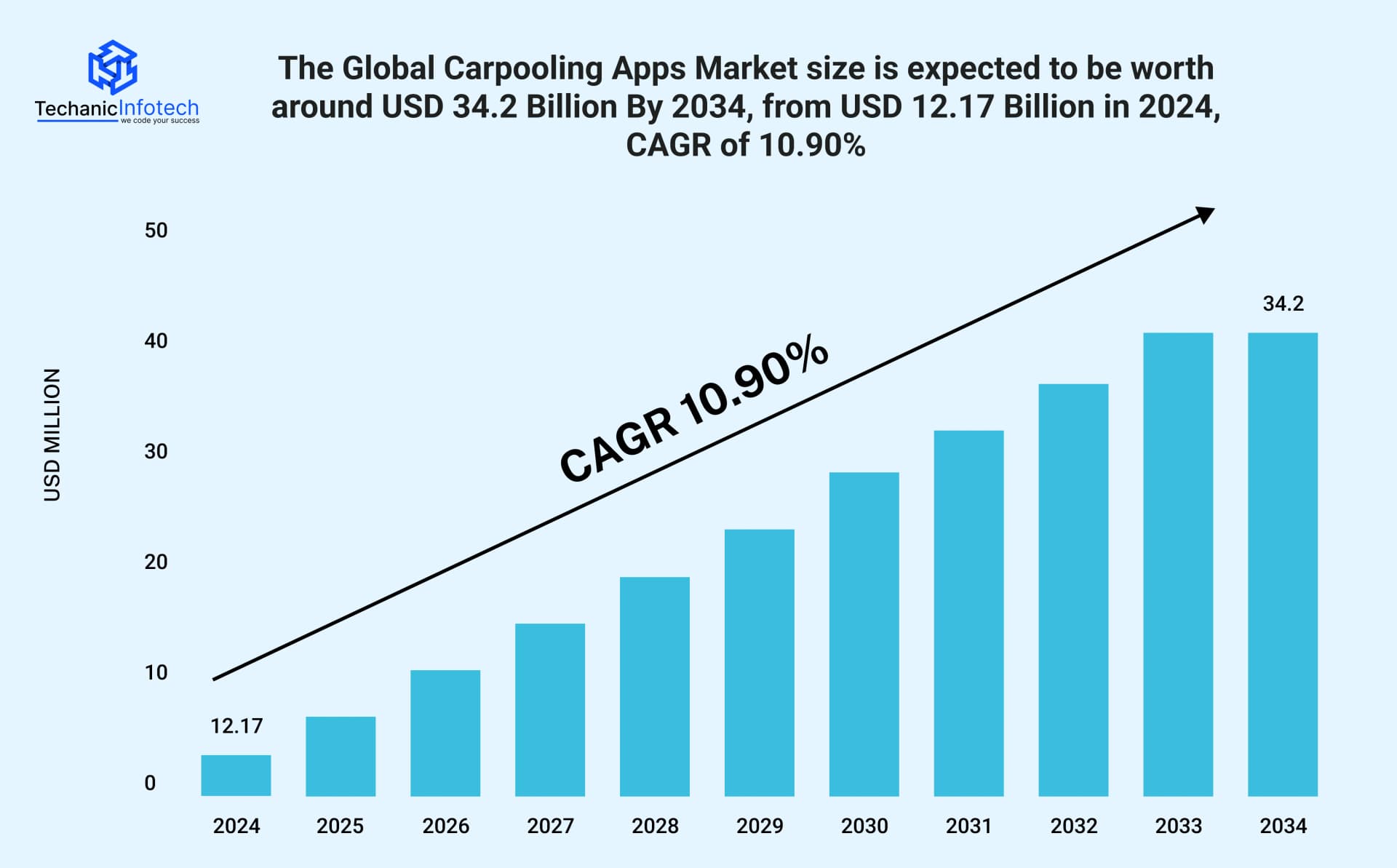
The global carpooling market is expanding rapidly, with a projected CAGR of over 15% by 2030 (Statista).
This steady growth highlights the long-term potential of investing in rideshare and carpooling app development.
Many organizations are adopting corporate carpooling apps to reduce employee commuting costs, improve punctuality, and meet sustainability goals.
Offering both peer-to-peer carpooling and enterprise carpool solutions helps you expand your user base and diversify revenue streams.
Carpooling apps can generate revenue through multiple monetization models, including:
By integrating essential features such as real-time GPS tracking, secure in-app payments, push notifications, ratings & reviews, and admin dashboards, you can build a scalable, user-friendly, and profitable carpooling platform.
Example: A US-based mobility startup developed a carpooling app for daily commuters and achieved 12,000+ downloads in six months while reducing single-occupancy trips by 28%.
A high-performing carpooling app goes beyond basic ride matching.
It combines user-centric mobile app design, secure technology, and proven real-world practices used by leading ridesharing platforms.
Below are the must-have features explained with real-life examples, case studies, and implementation insights.
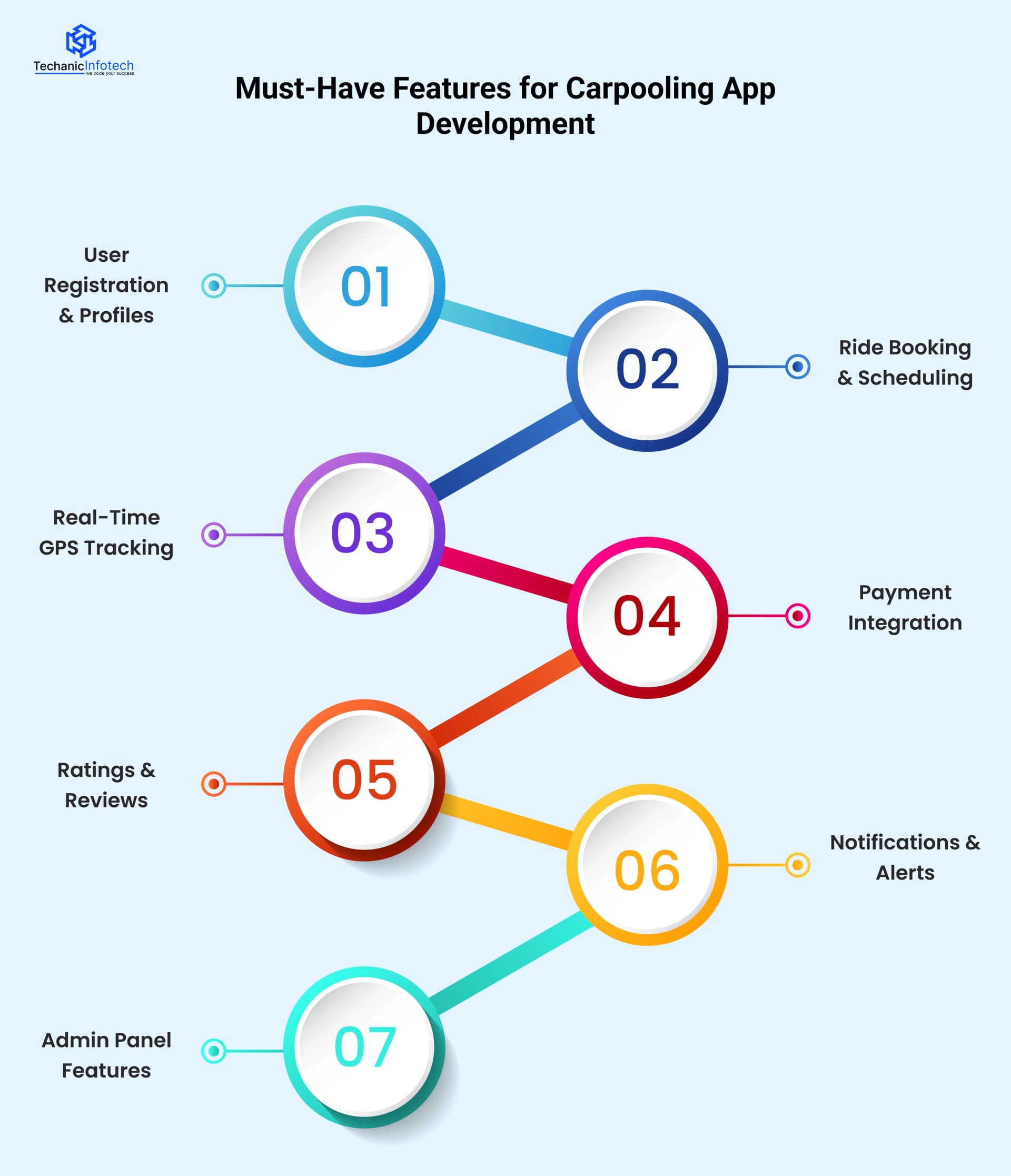
User registration enables riders and drivers to sign up using their email address, phone number, or social media accounts.
A detailed profile typically includes a photo, vehicle details, license verification, and user preferences such as smoking or music choices.
Apps like BlaBlaCar require users to complete verified profiles, including government ID and vehicle information.
This transparency builds trust among users and significantly reduces ride cancellations and safety concerns.
Verified profiles increase trust, improve safety, and encourage repeat usage—key factors in user retention and platform credibility.
This feature in the mobile app enables users to search for available rides, select pickup and drop-off locations, and schedule rides in advance or book instantly.
Advanced filters such as route preferences, time, and pricing enhance the booking experience.
Lyft Shared allows users to schedule shared rides during peak commute hours, making it ideal for office workers traveling along similar routes.
Scheduled carpooling reduces wait times and improves ride-matching efficiency.
Seamless booking and scheduling improve convenience and help optimize vehicle occupancy rates.
Real-time GPS tracking enables users to monitor the driver’s location, estimated arrival time, and route progress.
It also allows ride-sharing platforms to manage navigation and ensure safety.
Uber uses real-time GPS tracking to show the exact location of the vehicle, trip progress, and live ETA.
This feature enhances user confidence and reduces anxiety during rides, especially for first-time users.
GPS tracking increases transparency, improves safety, and helps resolve disputes related to routes or delays.
Secure and flexible payment gateways allow users to pay through credit/debit cards, digital wallets, or UPI.
Automatic fare splitting is especially important for carpooling apps.
Ola Share supports in-app payments with fare splitting, allowing each passenger to pay their portion individually.
This eliminates cash handling and ensures smooth transactions.
Secure digital payments improve user trust and streamline the checkout experience, reducing ride drop-offs.
Ratings and reviews enable users to evaluate drivers and co-passengers based on punctuality, behavior, and ride quality.
These taxi booking app features help maintain platform quality and accountability.
BlaBlaCar’s two-way rating system ensures both drivers and passengers are reviewed, encouraging respectful behavior and high service standards across the platform.
A transparent rating system builds trust, improves service quality, and helps users make informed decisions.
Push notifications keep users informed about ride confirmations, delays, cancellations, payment updates, and driver arrivals.
These alerts improve communication and reduce missed rides.
Waze Carpool sends real-time notifications for pickup times, route changes, and traffic delays, helping commuters plan their journeys more efficiently.
Timely alerts enhance user experience and reduce friction during the ride lifecycle.
The admin panel allows platform owners to manage users, monitor rides, track payments, resolve disputes, and analyze performance metrics through dashboards and reports.
Corporate carpooling platforms like RideAmigos use advanced admin dashboards to track employee participation, carbon emission reductions, and mobile app development cost savings for organizations.
A robust admin panel ensures smooth operations, scalability, data-driven decisions, and regulatory compliance.
Example: A commuter-based carpooling app built with real-time GPS tracking, fare splitting, and push notifications achieved a 4.5+ app rating and high daily active usage among office commuters.
Carpooling apps connect drivers and passengers traveling in the same direction to share rides and costs.
The following are the types of carpooling apps that have their significant features with their user group, one should know.
Commuter-based carpooling apps are designed for people who travel the same route every day, such as home-to-office or college commutes.
Popular examples include BlaBlaCar Daily and Waze Carpool.
On-demand carpooling apps allow users to find shared rides instantly, without fixed schedules.
They work similarly to on-demand app development services but group passengers heading in the same direction. These apps are ideal for last-minute trips and urban travel.
Examples include Uber Pool and Lyft Shared.
Long-distance carpooling apps connect drivers and passengers traveling between cities or states.
Drivers post available seats in advance, and passengers book affordable rides for longer journeys. These platforms are popular for weekend travel and holidays.
Well-known examples include BlaBlaCar and CarpoolWorld.
Workplace carpooling platforms help employees share rides to and from the office.
Often supported by employers, these platforms offer features like route matching, parking benefits, and sustainability tracking. They improve employee convenience while reducing emissions.
Examples include RideAmigos and CommuteHub.
Hybrid ride-sharing and carpooling apps combine private ride-hailing with shared ride options.
Users can choose between solo trips or cost-effective pooled rides. This flexibility makes them popular in busy cities.
Examples include UberX with Uber Pool and GrabShare.
Peer-to-peer carpooling apps directly connect individual drivers with passengers, without owning vehicles.
Drivers decide routes, timing, and pricing, while the app ensures safety through ratings and verification. These platforms encourage community-based travel.
Examples include Scoop and Liftango.
Cost-sharing carpooling apps focus on splitting travel expenses rather than making profits.
Drivers recover fuel and toll costs, while passengers enjoy cheaper rides. These apps promote fairness, affordability, and eco-friendly travel.
A well-known example is BlaBlaCar, which strictly follows cost-sharing principles.
|
Type of Carpooling App |
Features |
User Group |
|
Commuter-based Carpooling Apps |
Recurring rides, route matching |
Daily commuters |
|
On-demand carpooling apps |
Real-time matching, live tracking |
General users |
|
Long-distance carpooling apps |
Trip posting, seat booking |
Intercity travelers |
|
Workplace/enterprise carpooling platforms |
Access control, ride analytics |
Employees |
|
Hybrid ride-sharing & carpooling apps |
Shared rides, dynamic pricing |
Public users |
|
Peer-to-peer (P2P) carpooling apps |
User profiles, ratings |
Community members |
|
Cost-sharing carpooling apps |
Expense split, cost calculator |
General users |
(A workplace carpooling platform developed for a US enterprise helped reduce parking demand by 20% while improving employee punctuality through recurring ride matching.)
Carpooling app development involves creating a smart, user-friendly platform that connects drivers and passengers traveling in the same direction.
The following is the well-planned development process that ensures scalability, security, a smooth user experience, and long-term success in the growing ride-sharing market.
The first step in carpooling app development is understanding user needs, competitors, and market trends in mobile apps.
This phase defines app goals, target users, monetization models, and compliance requirements.
Proper planning reduces development risk and ensures you build a carpooling app aligned with real-world demand.
A well-structured app design focuses on simplicity, safety, and usability.
Designers create wireframes, prototypes, and user journeys for drivers and passengers.
An intuitive interface improves engagement, reduces drop-offs, and ensures smooth ride booking, payments, and navigation throughout the carpooling mobile app.
Choosing the right tech stack ensures scalability, performance, and security.
Developers select frontend frameworks, backend technologies, databases, and cloud infrastructure.
A robust architecture supports real-time GPS tracking, ride matching, payment processing, and future feature expansion without performance issues.
This phase focuses on building essential features like user registration, ride booking, real-time tracking, secure payments, ratings, and notifications.
Backend logic handles ride matching, fare calculations, and data management.
Proper implementation ensures the app performs reliably under high user traffic.
Testing ensures the app is bug-free, secure, and performs well across devices.
QA teams conduct functional, performance, and security testing, including payment and data protection checks.
This step is critical in ride-sharing app development to prevent crashes, ensure compliance, and maintain user trust.
After testing, the app is deployed to app stores and cloud servers.
Post-launch, continuous monitoring, updates, and performance optimization are essential.
Regular maintenance ensures compatibility with OS updates, enhances security, improves features, and keeps the carpooling app competitive in the market.
Choosing the best mobile app tech stack guide for ridesharing apps ensures scalability, real-time performance, secure transactions, and seamless user experiences while supporting rapid growth and long-term operational efficiency.
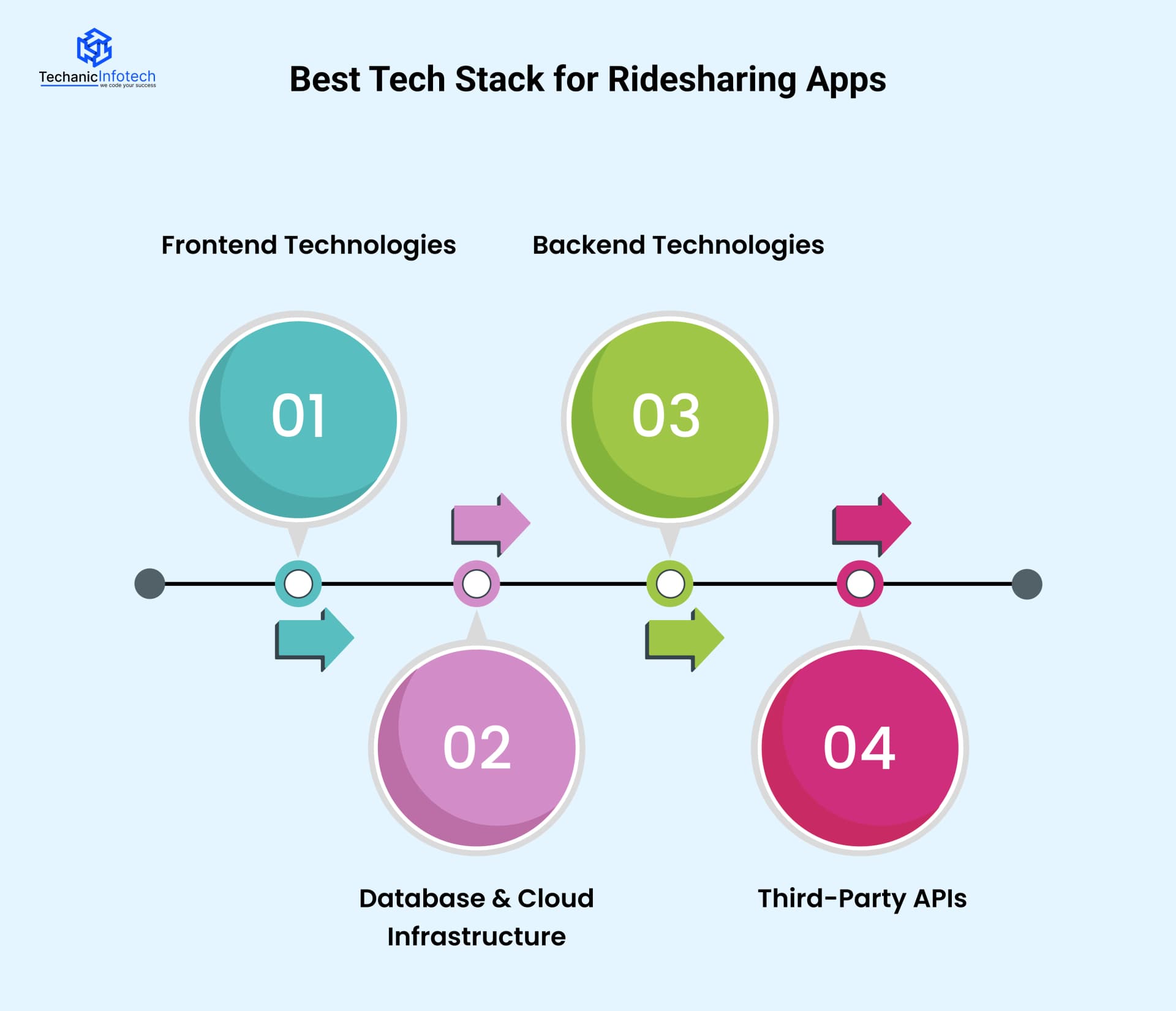
Frontend technologies define how users interact with a ridesharing app.
Popular choices like React Native and Flutter allow cross-platform development with faster time to market, while Swift (iOS) and Kotlin (Android) deliver high performance for native apps.
Backend technologies power the core functionality of ridesharing apps, including ride matching, fare calculation, and real-time communication.
Node.js is ideal for handling concurrent requests, while Python (Django/FastAPI) supports AI-based matching and analytics.
Java Spring Boot ensures enterprise-level security and scalability. A strong backend ensures low latency, data security, and seamless coordination between drivers and riders.
Databases store and manage critical data such as users, trips, payments, and locations.
PostgreSQL and MongoDB are commonly used for structured and flexible data storage, while Redis supports real-time caching.
Cloud platforms like AWS, Google Cloud, and Azure offer auto-scaling, high availability, and disaster recovery, ensuring smooth performance even during peak demand.
Third-party APIs accelerate development and enhance functionality.
Google Maps or Mapbox APIs enable accurate navigation and route optimization, while Stripe, PayPal, or Razorpay handle secure payments.
Twilio and Firebase support OTP verification and push notifications.
Using reliable APIs reduces taxi app development cost, improves app stability, and ensures a better user experience.
Understanding the carpooling app development cost helps businesses plan budgets effectively, comparing basic, medium, and advanced app features, development expenses, and ongoing maintenance for scalable, successful apps.
|
App Level |
Feature |
Development Cost |
Maintenance Cost |
|
Basic App |
User registration, profile management, basic GPS tracking, etc. | $20,000 to $35,000 |
$500–$1,000/month |
|
Medium App |
Real-time ride tracking, fare estimation, secure payments, etc. | $40,000 to $70,000 |
$1,000–$2,500/month |
|
Advanced App |
AI-based ride matching, dynamic pricing, multi-language support | $80,000 to $120,000+ |
$3,000–$6,000/month |
Building a carpooling app is a multi-phase mobile app development process that usually takes 4 to 7 months, depending on the scope and features. The first phase is market research and planning, which takes 1–2 weeks.
The UI/UX design phase follows and typically takes 2–4 weeks. Designers create wireframes, user journeys, and interactive prototypes to ensure a smooth and intuitive experience for both drivers and passengers.
The core development phase lasts 3–5 months. This includes frontend development, backend logic, database setup, real-time GPS tracking, payment integration, and third-party APIs.
After development, testing and quality assurance take 2–4 weeks. This phase ensures the app is bug-free, secure, and performs well under load. Deployment and app store approvals take about one week.
Techanic Infotech is a trusted ridesharing and mobile app development company delivering scalable, secure, and high-performance solutions.
With expertise in modern tech stacks like React Native, Node.js, and cloud platforms, the company builds apps tailored to startups and enterprises.
From ideation and UI/UX design to deployment and post-launch support, Techanic Infotech provides end-to-end services.
With a strong focus on quality, transparency, and innovation, they help businesses succeed in the competitive mobility and transportation market.
Carpooling app development is no longer just a sustainable trend in mobile apps; it is a powerful business opportunity in today’s fast-growing ride-sharing ecosystem.
Success in carpooling app development depends on choosing the right feature set, modern tech stack, and an experienced development partner who understands scalability and compliance requirements.
Whether you are building an MVP or a full-scale enterprise platform, strategic planning helps control development costs while maximizing long-term returns.
With the right execution, carpooling app development can drive revenue, improve urban mobility, and support a more sustainable future.
A carpooling app usually takes 4–7 months, depending on features, platforms, and integrations. Advanced functionality may increase the timeline.
Development costs range from $25,000 for an MVP to $100,000+ for advanced, feature-rich applications.
Yes, carpooling is legal in the USA. However, regulations vary by state, and insurance and compliance requirements must be followed.
Carpooling apps earn through ride commissions, subscriptions, premium features, advertisements, and corporate partnerships.
Carpooling involves shared rides with lower costs, while ride-hailing offers private, on-demand rides at higher prices.


Abhishek Jangid is the CEO of Techanic Infotech, with extensive experience in mobile app and web development. He specializes in helping businesses turn innovative ideas into scalable digital solutions through strategic planning and modern technology.