
Understanding the car rental app development cost is vital for businesses planning to enter or scale in the on-demand mobility space.
As user demand for flexible, app-based car rentals continues to rise across the U.S., companies are investing in smarter, feature-rich platforms.
The cost of car rental app development depends on several factors, including app features, design complexity, technology stack, platform choice, and third-party integrations.
From basic booking functionality to advanced GPS tracking, payment security, and fleet management systems, every element affects the final budget.
This guide breaks down each cost component clearly, helping startups and enterprises plan realistic budgets, avoid hidden expenses, and make development decisions for a competitive 2026 launch.
The car rental app market continues to grow rapidly as more travelers and urban users prefer flexible, on-demand mobility solutions over traditional ownership.
App-based car rentals simplify booking and payment, boosting user adoption worldwide.
With rising tourism, digital booking habits, and efficient fleet management technology, demand for mobile-first services is increasing, directly influencing the cost to develop a car rental app and overall investment in this sector.
Global car rental revenue is projected to reach around USD 106 billion by 2025.
The market is expected to grow at about 5% CAGR through 2030.
By 2030, online bookings could account for 75% of total revenue.
The rental used car apps market may reach USD 204.5 bn by 2034.
North America held roughly 38% market share in 2024.
This car rental app development guide explains how understanding car rental app development cost helps businesses plan budgets and set realistic expectations.
The cost to develop a car rental app typically ranges between $20,000 and $120,000+, depending on factors such as features, platform choice (iOS, Android, or both), UI/UX design, technology stack, and overall app complexity.
This section explains the key factors that shape development expenses, timelines, and feature requirements, offering a clear car rental app pricing breakdown to guide smarter investment decisions.
The type of car rental app you build plays a major role in overall development cost. Peer-to-peer, self-drive rentals, and corporate fleet solutions all require different workflows, permissions, and backend logic.
More complex business models increase development time, integrations, and testing needs.
|
App Type |
Estimated Cost |
|
Basic Car Rental App |
$20,000 – $40,000 |
|
Peer-to-Peer Rental App |
$40,000 – $70,000 |
|
Enterprise Fleet Rental App |
$70,000 – $120,000 |
Core and advanced features directly impact the development budget. Simple booking apps cost less, while apps with real-time availability, pricing rules, and user verification require more development hours.
Feature-heavy apps improve user experience but increase both frontend and backend complexity.
|
Feature Level |
Estimated Cost |
|
Basic Features |
$20,000 – $45,000 |
|
Mid-Level Features |
$45,000 – $80,000 |
|
Advanced Features |
$80,000 – $120,000 |
User interface and experience design influence how easy and appealing your app feels.
Strong mobile app UI/UX design with clean layouts, intuitive navigation, and responsive elements improves conversions.
Custom UI/UX with user research and prototyping costs more than standard templates but delivers better engagement, usability, and long-term user retention.
|
UI/UX Scope |
Estimated Cost |
|
Basic UI Design |
$20,000 – $35,000 |
|
Custom UI/UX |
$35,000 – $65,000 |
|
Premium UX with Testing |
$65,000 – $90,000 |
Choosing between iOS, Android, or both platforms affects development time and cost. Single-platform apps are more affordable, while dual-platform apps require extra development and testing. Cross-platform frameworks can reduce costs while still reaching a wider audience.
|
Platform Choice |
Estimated Cost |
|
Single Platform App |
$20,000 – $50,000 |
|
Cross-Platform App |
$40,000 – $80,000 |
|
Native iOS + Android |
$70,000 – $120,000 |
The backend supports bookings, payments, vehicle availability, and user data. A scalable backend ensures smooth performance during high demand.
Costs rise with real-time syncing, admin dashboards, cloud hosting, and security requirements needed for modern car rental platforms.
|
Backend Complexity |
Estimated Cost |
|
Basic Backend |
$20,000 – $40,000 |
|
Scalable Cloud Backend |
$40,000 – $75,000 |
|
Enterprise-Grade Backend |
$75,000 – $120,000 |
Car rental apps rely heavily on third-party services like payment gateways, GPS tracking, maps, notifications, and analytics. Each integration adds development and testing time.
The more external services you include, the higher the overall app development cost.
|
Integration Level |
Estimated Cost |
|
Essential Integrations |
$20,000 – $35,000 |
|
Multiple APIs |
$35,000 – $65,000 |
|
Advanced Integrations |
$65,000 – $100,000 |
Post-launch maintenance keeps your app secure, updated, and compatible with new OS versions.
Regular updates, bug fixes, and performance monitoring are essential for long-term success, especially after you upload your app to the Play Store. While often overlooked, maintenance is a necessary investment for scaling a car rental app and retaining users.
|
Maintenance Scope |
Estimated Cost |
|
Basic Maintenance |
$20,000 – $30,000 |
|
Ongoing Support |
$30,000 – $60,000 |
|
Full-Scale Maintenance |
$60,000 – $90,000 |
Understanding the car rental app development cost is essential for businesses planning to enter the on-demand mobility market.
Development expenses vary based on features in the mobile app, technology choices, integrations, and long-term scalability needs.
A clear cost overview helps you plan budgets effectively, avoid hidden expenses, and build a reliable app that meets both user expectations and business goals.
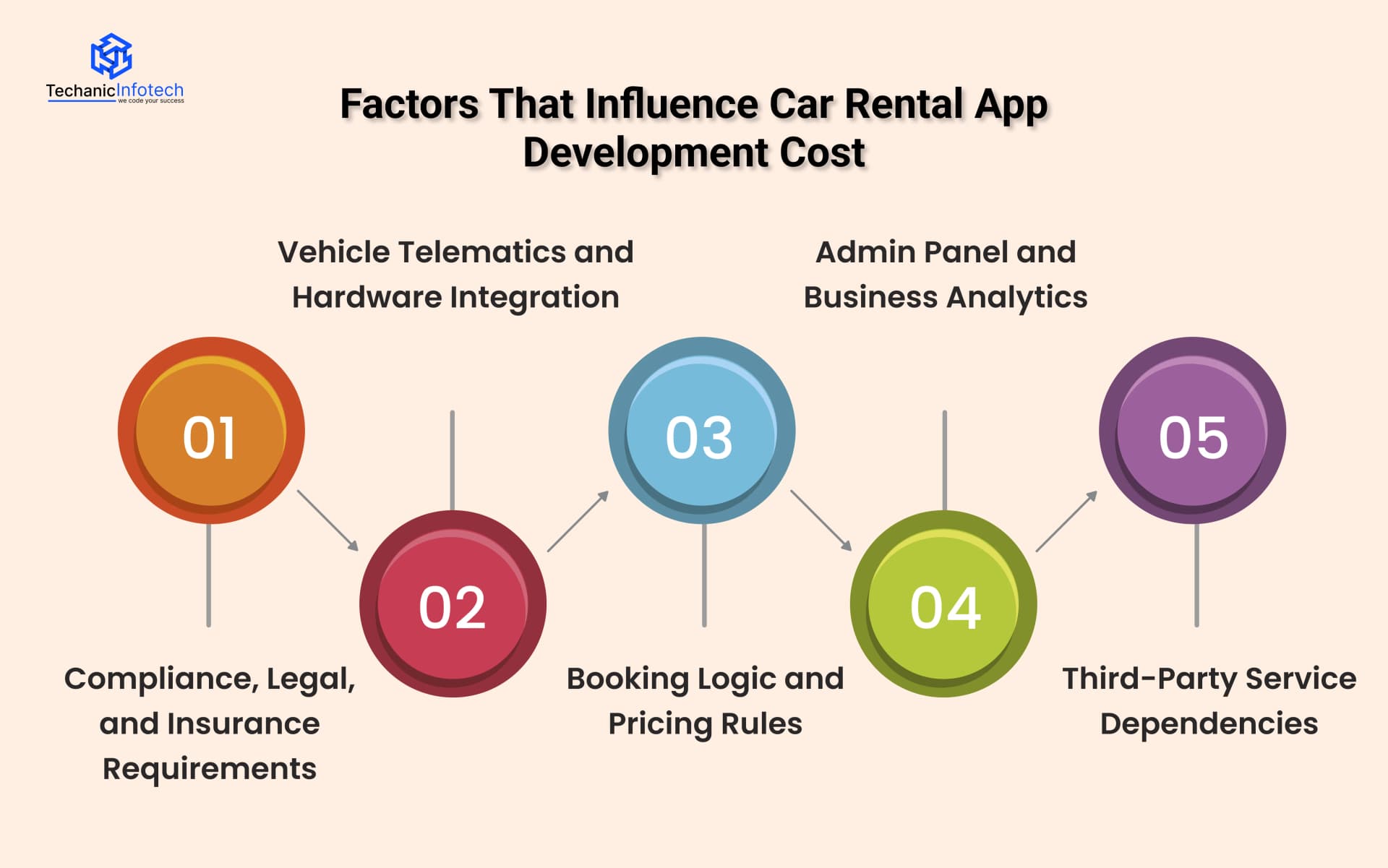
Legal and compliance needs directly affect how much a car rental app costs to build and maintain.
Features like digital agreements, insurance verification, KYC checks, and region-specific regulations add extra development layers.
Since laws vary by state and country, apps often need custom workflows, increasing both development time and overall expenses.
When calculating the cost to develop a mobile app, hardware integrations are often overlooked.
Connecting GPS devices, IoT sensors, or smart locks requires specialized APIs and real-time data handling.
These integrations demand additional testing and maintenance, which raises development complexity and increases the total project cost.
Advanced booking workflows play a major role in car rental app development cost estimation.
Supporting hourly or daily pricing, discounts, surge pricing, penalties, and flexible cancellation policies requires complex backend logic.
The more pricing rules and conditions you support, the higher the development effort and cost.
Admin dashboards influence costs based on their level of control and automation.
Features like real-time reports, revenue tracking, vehicle availability, and user management add development hours.
More advanced analytics and custom reporting tools increase complexity but provide better operational insights and long-term efficiency.
Third-party services are a core part of custom mobile app development for car rental platforms.
Integrations with payment gateways, maps, identity verification, and notifications add licensing fees and ongoing maintenance.
Changes in external APIs can also increase long-term costs, making integrations a key factor in overall development pricing.
Managing development costs is critical when building a car rental app in a competitive market. With the right approach, businesses can reduce expenses without cutting essential features or performance.
Understanding where costs arise helps teams make better decisions and launch a functional, scalable app within a realistic budget.
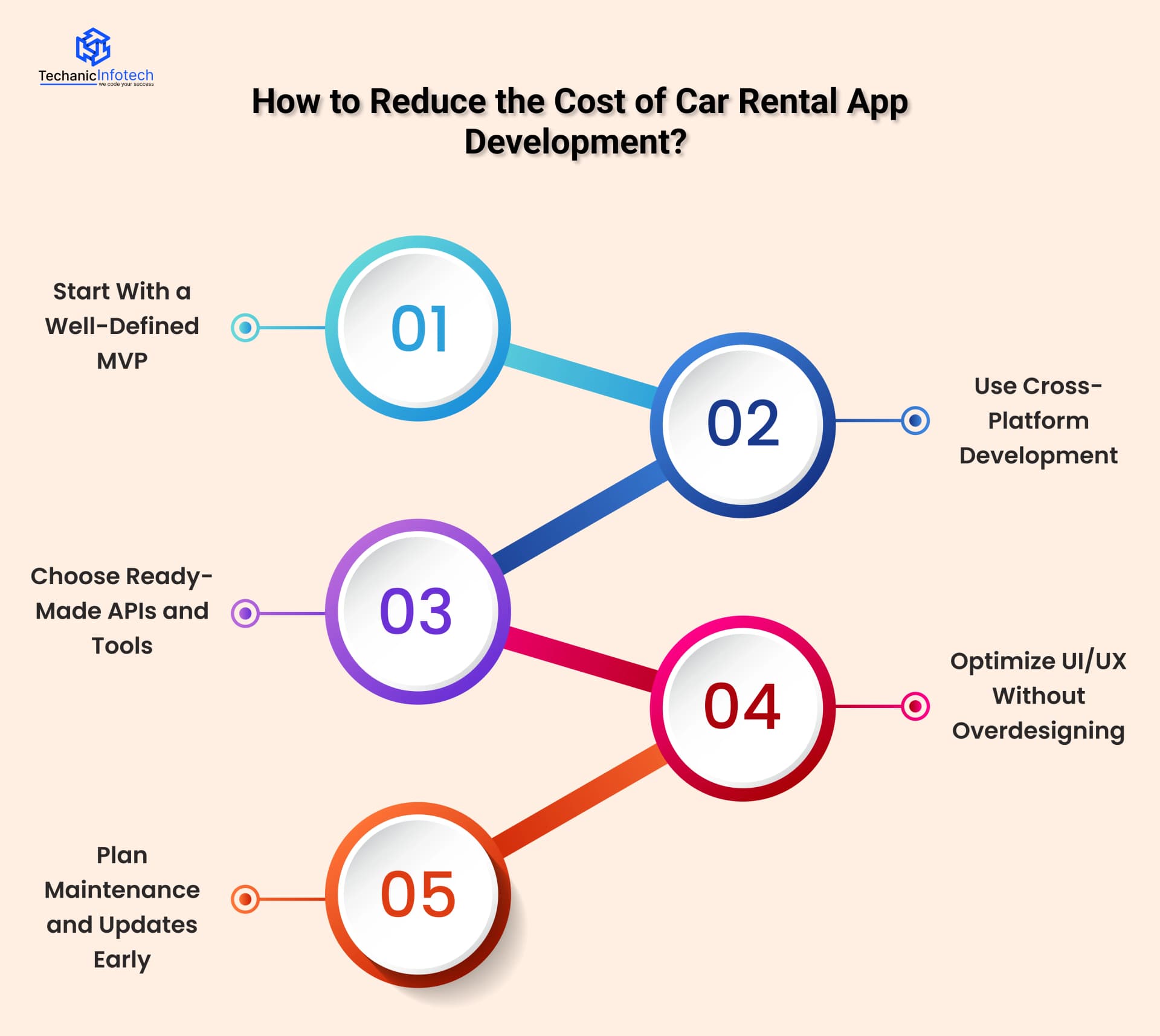
Launching with a minimum viable product is one of the smartest ways to control custom car rental app development while aligning with current mobile app trends.
Focus on essential features like user registration, vehicle listings, booking, and payments. Avoid advanced functionality in the first phase.
A clearly defined MVP reduces development hours, speeds up launch, and lets you validate demand before expanding.
Cross-platform frameworks help lower car rental app development costs in 2026 by allowing one codebase for both iOS and Android.
This approach reduces development time, testing effort, and maintenance work.
For many startups, cross-platform development offers strong performance while keeping budgets under control and accelerating time to market.
Using reliable third-party APIs for payments, maps, notifications, and authentication as part of a strong mobile app tech stack minimizes custom development work.
Instead of building everything from scratch, ready-made tools shorten timelines and reduce testing requirements.
This approach lowers risk, improves security, and helps teams focus resources on core app functionality that drives business value.
A simple, user-friendly design helps reduce the cost to develop a car rental app. Avoid heavy animations, complex transitions, and unnecessary screens during early stages.
Clean layouts and intuitive navigation require fewer design hours and development changes, making it easier to launch quickly without sacrificing usability.
Planning maintenance early prevents unexpected costs after you upload the app to the App Store.
Regular updates, bug fixes, and performance checks keep the app stable and secure.
A well-planned maintenance strategy reduces emergency fixes, lowers long-term expenses, and ensures smoother scaling as user demand grows.
Techanic Infotech stands out as a reliable partner for building powerful and scalable car rental applications.
As an experienced car rental app development company, it understands the complexities of fleet management, real-time bookings, secure payments, and location-based services.
The team focuses on clean UI/UX, strong backend architecture, and seamless third-party integrations to ensure smooth user experiences.
Techanic Infotech follows an agile development approach, allowing faster launches and flexibility for future updates.
With a strong emphasis on performance, security, and customization, the company helps businesses create car rental apps that are easy to manage, user-friendly, and ready to scale as demand grows in a competitive market.
Understanding the car rental app development company is essential for making informed business decisions and avoiding budget overruns.
From planning features and choosing the right technology to managing integrations and post-launch maintenance, every step impacts the final investment.
Businesses that focus on smart planning, phased development, and scalable architecture can significantly reduce unnecessary expenses.
Working with an experienced development partner also helps ensure quality, security, and faster time to market.
As competition in the car rental space continues to grow, investing wisely in app development allows you to build a reliable, user-friendly platform that attracts customers, supports long-term growth, and delivers strong returns without compromising performance or user experience.
The cost usually ranges between $20,000 and $120,000, depending on features, platform choice, backend complexity, integrations, and post-launch support requirements. A basic app costs less, while advanced solutions require a higher investment.
Real-time GPS tracking, dynamic pricing, admin dashboards, payment gateways, user verification, and third-party integrations significantly increase development time and cost due to added complexity and testing.
Yes. Starting with an MVP, using cross-platform development, choosing ready-made APIs, and avoiding over-customization during early stages help reduce costs while maintaining app performance and usability.
Development typically takes 3 to 6 months, depending on app complexity, feature scope, and team size. Advanced or enterprise-level apps may take longer due to testing and integrations.
Yes. Maintenance includes updates, bug fixes, performance optimization, and security checks. Ongoing support is essential for stability and should be planned as part of the overall development budget.


Abhishek Jangid is the CEO of Techanic Infotech, with extensive experience in mobile app and web development. He specializes in helping businesses turn innovative ideas into scalable digital solutions through strategic planning and modern technology.