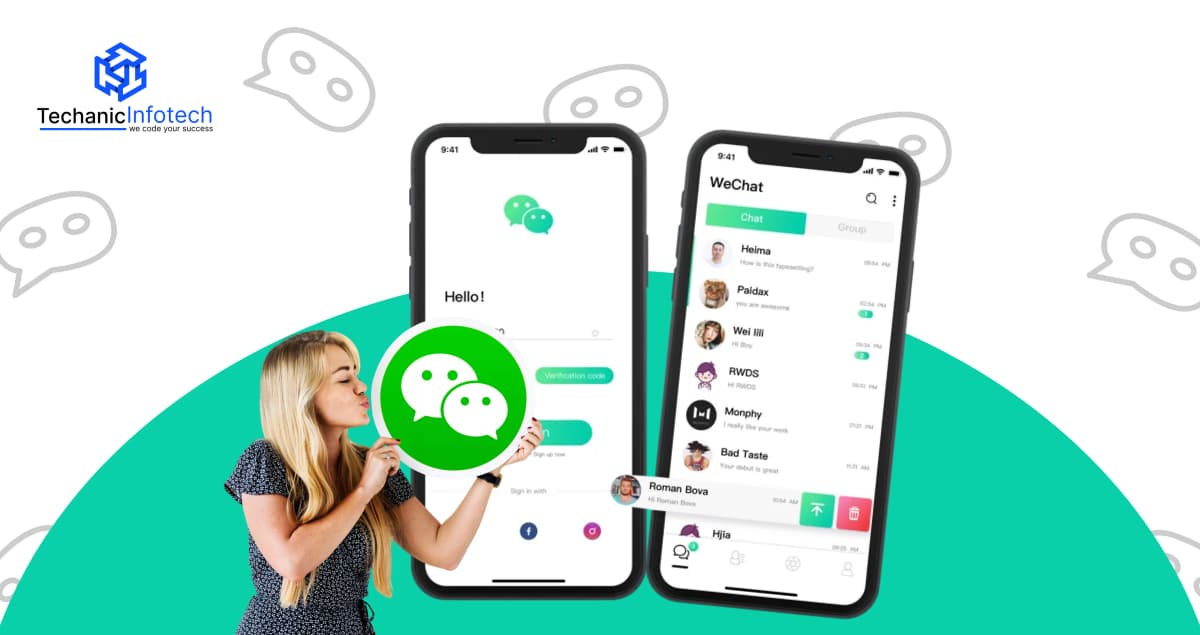
The development costs for apps like WeChat can range from $20,000 to $120,000, depending on the complexity of features and the quality of execution.
At the basic level, a messaging platform with essential functionalities like text chat, voice and video calls, and multimedia sharing would cost between $20,000 and $40,000.
The cost to build an app like WeChat depends on various elements, such as the complexity of features, the development platform, the development team’s location, and the mobile app technology stack.
A basic app may cost $20,000–$40,000, while a full-featured app with advanced features can range from $70,000–$120,000
Whether you're planning a similar app or aiming to develop specific features, understanding the cost to create an app like WeChat is crucial for budgeting and project planning.
Let’s dive into what drives the cost, where you will get answers to your queries like “how much does it cost to build an app like WeChat?” in depth.
Developing an app like WeChat involves a combination of various complex features and technologies, each contributing to the overall development cost.
Below, we will break down the estimated costs for each key feature involved in building an app like WeChat, with the individual cost to make an app like WeChat starting from $20,000 to $120,000 based on complexity.
|
Factor |
Description |
Estimated Cost |
|
Core Messaging Functionality |
Text, image, and multimedia messaging |
$2,000 - $4,000 |
|
Payment Integration |
Secure payment system integration (e.g., WeChat Pay) |
$2,000 - $5,000 |
|
Social Media Features |
News feed, sharing, and media updates (Moments) |
$2,000 - $4,000 |
|
Mini Programs |
Third-party app integration within the platform |
$3,000 - $5,000 |
|
Voice and Video Messaging |
Real-time voice and video communication |
$2,000 - $4,000 |
|
Group Chat Functionality |
Group messaging with file sharing |
$2,000 - $3,000 |
|
User Profile & Account Management |
User profiles, account settings, and privacy |
$1,500 - $3,000 |
Developing a secure, fast, and scalable messaging platform requires integrating APIs, real-time servers, and media streaming protocols. The cost to create an app like WeChat for this feature typically ranges from $2000 to $4000.
The cost to develop an app similar to WeChat includes backend infrastructure, message storage, real-time synchronization, and testing to ensure smooth user communication without latency.
Integrating a secure payment system like WeChat Pay involves complex procedures, including linking user bank accounts, storing payment data securely, and ensuring seamless transactions.
The estimated cost for payment gateway development is $2000 to $5000, depending on the regions you intend to support and the complexity of transaction tracking and processing required.
Social media functionality such as "Moments" (WeChat’s news feed) allows users to share status updates, photos, and videos.
The cost to develop an app like WeChat for implementing these features is around $2000 to $4000, depending on the level of complexity in the content feed, user interactions, and scalability required to handle high volumes of media content.
Mini Programs within WeChat allow third-party developers to create small, lightweight apps inside the platform. The cost to develop mobile app like WeChat infrastructure can range from $3000 to $5000.
This involves developing isolated runtimes for mini-programs, managing app distribution, and ensuring that third-party applications integrate well with WeChat’s core platform.
Voice and video messaging allow users to send and receive voice notes or video calls within the app. These features involve real-time communication protocols and require media processing and storage capabilities.
The app needs to support video compression for efficient transfer, ensure low latency, and manage the media content. Real-time servers and efficient backend infrastructure are essential to enable seamless video and voice communication across devices, ensuring a smooth user experience.
Group chat functionality enables users to create and participate in conversations with multiple participants. Features include file sharing, multimedia embedding (images, videos, audio), and real-time message updates.
It requires robust backend infrastructure to manage large user groups, handle notifications, and ensure smooth syncing across all devices.
Group chat systems must support message persistence, media storage, and the ability to manage group settings such as admins and permissions to ensure a secure and engaging experience for users.
User profile and account management systems allow users to create, update, and maintain personal profiles, including details like name, avatar, status, and privacy settings.
It also includes managing account preferences, password recovery, and integration with third-party sign-ins (e.g., social media accounts). The feature needs secure storage for user data and seamless integration with other app functionalities.
Privacy and data security are key, ensuring that sensitive user information is protected and accessible only to authorized parties.
Push notifications alert users to new messages, events, or updates, keeping them engaged with the app in real time.
These notifications can be used to notify users of new chats, app updates, or important reminders. The system requires integration with notification services and must handle various types of notifications, including in-app and background notifications.
Customizable settings are crucial, allowing users to manage notification preferences, and the feature must be optimized to minimize battery and data consumption.

When working with a total WeChat-like app development budget of $20,000, it's necessary to allocate resources across the multiple factors involved in creating an app like WeChat.
|
Factor |
Description |
Estimated Cost |
|
Feature Complexity & Functionality |
Basic messaging and authentication are inexpensive, but advanced features increase cost. |
$2,000 for basic features, more for advanced |
|
Platform Selection (iOS/Android/Both) |
Developing for both iOS and Android requires separate coding |
$3,000 - $6,000+ for both platforms |
|
UI/UX Design (User Interface & Experience) |
The complexity of UI/UX design, intricate animations, custom graphics, and unique user flows |
$2,000 - $8,000 based on complexity |
|
Backend Infrastructure & Server Costs |
real-time messaging, media storage, video calls, and security |
$3,000 - $5,000+ |
|
Third-Party Integration |
payment gateways, SMS/Email notifications, cloud storage, API usage, or custom integrations |
$1,000 - $5,000+ |
|
Security Features |
encryption, authentication, and rigorous testing |
$2,000 - $6,000+ |
|
Localization & Internationalization |
localization (translation, adapting design) and internationalization (support for various languages) |
$3,000 - $8,000+ per region |
|
Cloud Hosting & Infrastructure Cost |
like AWS, Google Cloud, or Azure are needed to handle storage, real-time communication, and high traffic |
$1,000 - $4,000+ per month |
Basic messaging and user authentication are relatively inexpensive to develop, but advanced features like video calling, payment systems, voice messaging, and real-time updates will add considerable cost to build an app like WeChat due to the complex backend infrastructure and server setup required.
The more interactive and complex the features, the more resources and time the development team will need, thus raising the price.
The cost to make an app like WeChat, including more complex features, affects the overall cost to create a messaging app like WeChat by $2,000 for basic features like text messaging, video calls, and payments
Choosing to develop for both iOS and Android significantly increases the cost to create an app like WeChat compared to targeting just one platform.
Developing native apps for both platforms requires different coding and testing for each, which doubles the work and increases the cost to build an app like WeChat.
Alternatively, using cross-platform development tools like React Native can cut costs to create a social media app like WeChat by using a single codebase, but it may limit performance optimizations.
Developing for a single platform (either iOS or Android) adds $1,500 to $3,000 to the budget, while targeting both platforms adds $3,000 to $6,000+.
A mobile app design with minimal animations and standard navigation is cheaper to develop, while a customized UI with intricate animations, custom graphics, and unique user flows can be costly.
WeChat-like apps usually have a polished interface and seamless user experience, requiring UX/UI designers to create wireframes, prototypes, and user testing, which increases the design costs.
The cost to create an app like WeChat would range from $2,000 to $8,000, depending on the design complexity.
The backend is one of the most expensive parts of an app like WeChat, especially when dealing with real-time messaging, media storage, video calls, and user data management.
The scalability and security of the infrastructure matter greatly, as the app must handle millions of users and maintain high-speed communication.
For apps with advanced functionality, the backend might require cloud infrastructure and robust databases that add substantial cost to develop a messaging app like WeChat.
The effective cost to create a messaging app like WeChat of this feature is $3,000 for a basic backend to $5000+ for a scalable, secure infrastructure that supports video calls, real-time messaging, and media storage.
Many WeChat-like apps rely on third-party services and APIs to offer additional functionalities like payment gateways, SMS/Email notifications, location services, or even cloud-based storage.
Integrating such services comes at a cost, as you may need to pay for API usage, licensing, or even custom integration work.
Meanwhile, the cost to create a social media app like WeChat, affected by the integration of third-party tools, would be $1,000 - $5,000+, depending on the services and integrations required.
The development process also includes thorough testing to ensure that the app functions correctly across different devices, platforms, and network conditions.
Quality assurance (QA) covers everything from functional testing (to verify that features work as expected) to load testing (to check if the app can handle millions of concurrent users). The more rigorous the testing, the higher the cost to develop a messaging app like WeChat.
Security features usually affect the overall mobile app development, like WeChat, which costs $2,000 - $6,000+, depending on the level of testing and the number of devices to be tested.
If you plan to develop a WeChat-like app for different countries, you'll need to invest in localization (translating content, adapting design elements to local cultures) and internationalization (making sure your app supports different languages, date formats, etc.).
This can add substantial costs if you’re targeting multiple countries or regions. This factor usually affects the cost to develop a messaging app like WeChat by $3,000 - $8,000+ for basic localization efforts per region.
While localization can be done incrementally, it still adds a high cost to develop a messaging app like WeChat, especially for apps targeting markets across different continents. These efforts help ensure the app resonates with users worldwide, boosting its success in diverse regions.
Cloud hosting is a critical component for WeChat-like apps, offering the scalability needed to support millions of users.
Cloud platforms like AWS, Google Cloud, or Microsoft Azure provide storage, computing power, and bandwidth essential for real-time messaging, video calls, and media storage.
These services often operate on a pay-as-you-go model, meaning costs can fluctuate depending on the number of active users, data consumption, and server load.
Cloud hosting costs depend on factors like user activity, media storage, and server load, which affect the overall cost to build a messaging app like WeChat with the feature of cloud hosting by $1,000 - $4,000+ per month for cloud hosting (depending on usage).
Developing an app like WeChat, which integrates messaging, social media, payments, and other services, involves a variety of hidden cost to create mobile applications that can quickly accumulate if not planned for.
While you might have an initial development budget, unforeseen expenses can impact the final cost to build a messaging app like WeChat.

To track user behavior, usage patterns, and interactions within the app, you’ll need advanced analytics tools.
Services like Mixpanel, Firebase, or custom-built solutions could cost between $3,000–$5,000 annually, depending on the data volume and complexity.
To ensure that data is never lost, especially for financial transactions or important messages, you’ll need a reliable backup system.
This involves cloud storage solutions, additional servers, and redundancy setups, which can add another $2,000–$4,000 annually.
Integrating third-party vendors can lead to high hidden costs to build an app like WeChat in terms of licensing, setup, and integration.
Each vendor might charge a setup fee of $5,000–$6,000, plus ongoing WeChat clone app development cost for API usage, which can run into the tens of thousands annually, depending on usage volume.
Attracting users to an app like WeChat can be costly, especially in competitive markets.
User acquisition costs could range from $1 to $10 per user, which means millions of dollars for acquiring tens or hundreds of thousands of active users.
Apps dealing with payments, user data, and communications must be legally sound, or they risk lawsuits.
If there’s a data breach, payment failure, or any legal violation, you may face legal fees ranging from $2,000 to $5,000 for litigation or settlement fees, depending on the severity.
To support an app like WeChat, you may need to establish an ecosystem of developers, third-party services, and marketplaces (for in-app purchases, mini-programs, etc.).
Creating this ecosystem, fostering partnerships, and ensuring smooth integration can enhance WeChat-like app development costs with an additional $5,000–$6,000 annually.
Apps like WeChat generate revenue through multiple streams, including advertising, in-app purchases, premium services, and financial services.
By offering a wide range of functionalities, such as messaging, social media, payments, and e-commerce, they monetize user engagement and data.

WeChat generates revenue through in-app purchases, where users buy digital goods such as stickers, games, and subscriptions to premium features. These microtransactions can range from a few cents to hundreds of dollars. The app takes a percentage of each purchase, often between 5%–30%.
WeChat makes money through its integrated mobile payment system, WeChat Pay, which facilitates peer-to-peer transactions, bill payments, and purchases within the app. It charges a small fee (typically 0.1%-0.6%) on each transaction, generating significant revenue from its massive user base.
WeChat displays ads in various formats: banner ads, Moments ads (similar to Facebook’s News Feed), and mini-programs. Advertisers pay for exposure to WeChat’s 1 billion+ users, and the app takes a cut of these advertising fees. The cost for advertisers can range from $0.1 to $3 per click or impression, depending on the target audience.
WeChat supports third-party mini-programs (small apps within the app), where developers can offer services like e-commerce, food delivery, or financial products. WeChat takes a commission from these transactions, often between 5%–20%. This revenue stream has been growing as mini-programs become more popular.
WeChat charges businesses for features like subscription accounts and official accounts that allow companies to communicate with users, send updates, and run customer service. Fees for these accounts can range from $100 to $1,000+ annually, depending on the level of access and services.

Looking to develop an app like WeChat without breaking the bank? Techanic Infotech, a leading social media app development company, offers cost-effective solutions tailored to your needs.
We understand the complexities of building an app with messaging, payment services, social networking, and more, and our team is dedicated to creating a seamless user experience while keeping costs manageable.
From initial planning to post-launch maintenance, we provide end-to-end services that include intuitive UI/UX design, robust backend development, and real-time communication features. Our efficient development process ensures you get high-quality results at a fraction of the cost of larger agencies.
Building an app like WeChat involves a wide range of factors that directly impact the cost. From the complexity of features like real-time messaging, payments, and mini-programs to the choice of platforms (iOS, Android), the overall development can cost anywhere from $20,000 to $120,000 or more.
Key elements such as backend infrastructure, security protocols, and compliance with data protection laws add additional costs, often making the budget more fluid.
While you can reduce the cost to build an app like WeChat by focusing on an MVP (Minimum Viable Product) and outsourcing to cost-effective regions, the scope of features you choose to implement will ultimately determine the final price tag.
Hidden costs like ongoing maintenance, updates, and scaling should also be considered when planning the long-term budget.
Developing an app like WeChat typically costs between $20,000 $120,000+, depending on complexity. For a basic version, you could allocate around $20,000 for essential features like messaging and user profiles.
Key factors include platform (iOS, Android), features (chat, payments, video), and development time. Features like real-time chat could cost $2,000–$4,000, while payment integration may cost an additional $1,000–$5000.
Consider using open-source libraries, focus on MVP (Minimum Viable Product), and outsource development to regions with lower rates. Limiting advanced features like real-time video chat to later stages can save $10,000–$20,000.
WeChat earns through in-app purchases, advertising, and transactions via its payment platform. Monetizing payment services and selling digital goods might generate $1–$5 per user per month.
Hidden costs include server infrastructure, security measures, and ongoing maintenance. For example, servers might cost $2,000–$4,000 annually, while security audits and compliance could add another $2,000–$6,000.


Neha Sharma is a tech expert at heart who loves exploring new technologies and turning complex ideas into easy-to-understand content. With a passion for learning and writing, she enjoys sharing insights on emerging tech, digital products, and innovation that help businesses stay ahead.