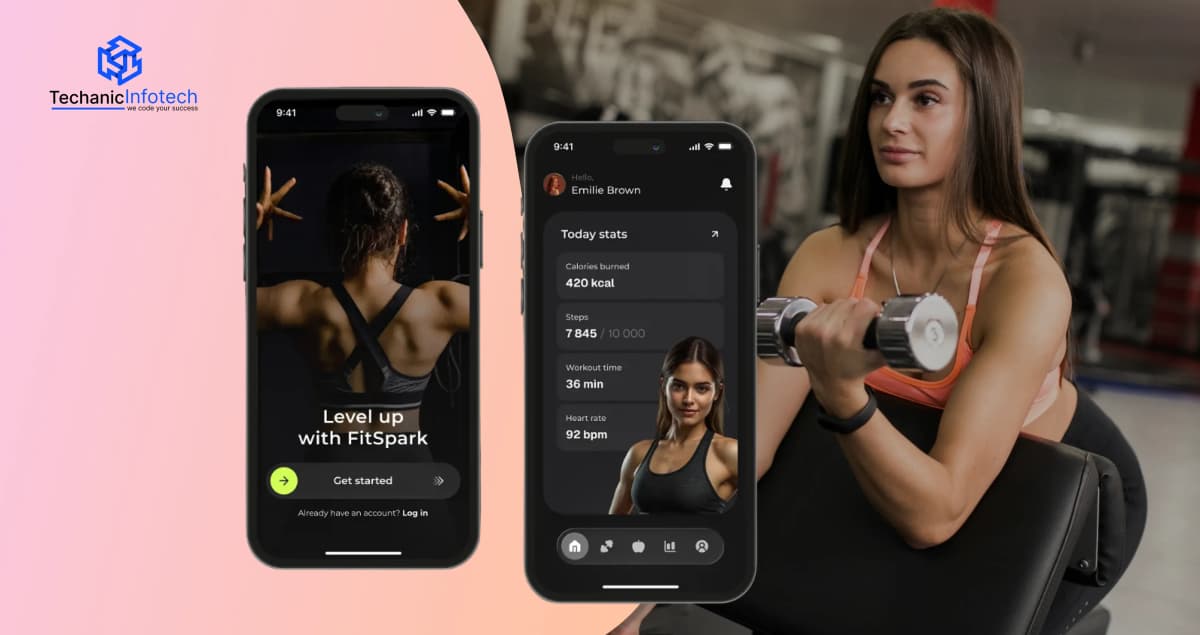
The fitness app market is growing rapidly as more users turn to digital solutions for health tracking, guided workouts, and personalized wellness plans.
On average, fitness app development costs range from $10,000 for a basic MVP to $90,000+ for advanced, feature-rich applications with integrations like wearables, AI-driven insights, and real-time analytics.
From simple workout trackers to sophisticated fitness platforms, costs can differ significantly depending on functionality and scalability requirements.
Understanding the essential features, budget considerations, and development timeline helps you plan effectively, manage resources, and avoid unexpected expenses.
This guide provides a detailed breakdown of fitness app development costs, key features, and realistic timelines to help you make informed decisions and build a scalable, user-friendly fitness application.
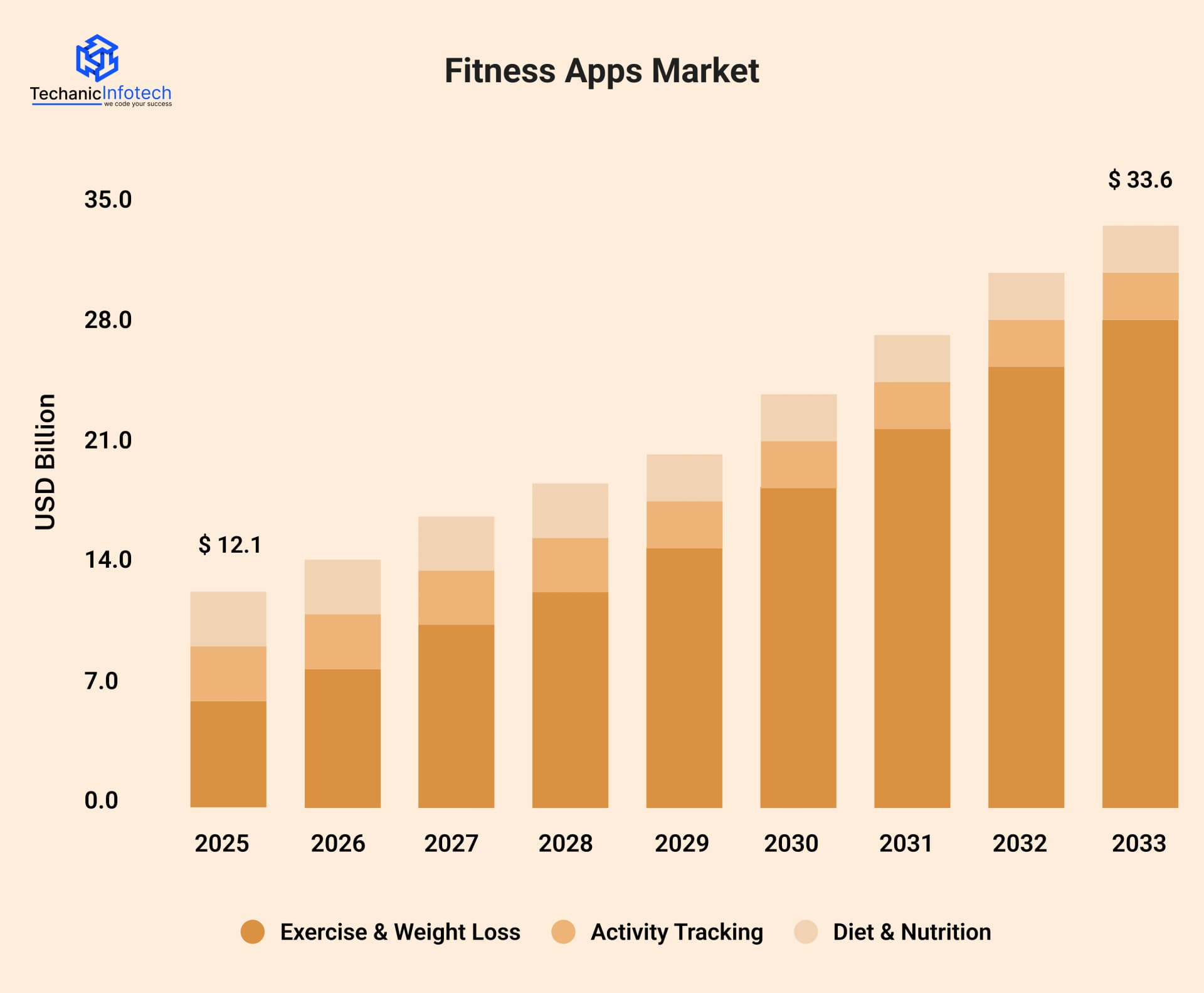
In 2025, the North American fitness app market secured the largest revenue share globally, accounting for 39.82% of the total market value.
The U.S fitness app industry commanded a significant proportion of the North American market in 2025, reinforcing its dominant regional position.
Based on type, the exercise and weight loss segment emerged as the leading category, capturing a substantial 53.69% share of the total revenue of 2025.
In terms of platform, the iOS segment outperformed competing platforms, generating the highest revenue contribution at 51.99% in 2025.
By device category, smartphones maintained a commanding lead, contributing an impressive 66.70% of the overall revenue share in 2025.
Fitness app development cost depends on multiple technical and mobile app design factors.
This table outlines key factors affecting fitness app development, showing features, estimated costs ($2,000–$10,000 per factor), and how each element impacts budget, helping plan a scalable, user-friendly app.
|
Factor |
Description |
Key Features |
Estimated Cost Effected |
|
App Complexity & Feature Set |
Basic to advanced features |
Workout tracking, AI recommendations, live coaching, analytics |
$2,000 – $10,000 |
|
Platform Choice (iOS, Android, or Both) |
Single or multiple platforms |
iOS app, Android app, cross-platform |
$3,000 – $8,000 |
|
UI/UX Design Requirements |
Custom layouts and animations |
Personalized dashboards, smooth animations, accessibility |
$2,500 – $7,000 |
|
Backend Development & APIs |
Server, database, APIs |
User data management, progress tracking, real-time sync |
$4,000 – $6,000 |
|
Third-Party Integrations |
Payment, wearables, analytics |
Payment gateways, wearable integration, health/analytics platforms |
$3,000 – $4,000 |
|
Compliance & Data Security |
GDPR/HIPAA and encryption |
Data encryption, secure login, privacy controls |
$2,500 – $3,500 |
The following are the descriptions of these factors that influence development time, required expertise, and overall budget for building a scalable, secure, and user-friendly application.
The overall complexity of a fitness app plays a major role in determining development cost.
Apps with basic features, such as workout tracking and timers, are more affordable to develop.
Advanced functionalities like AI-driven recommendations, live coaching, detailed progress analytics, and wearable device integration require greater fitness app development effort.
These features significantly increase the overall development cost.
Selecting the target platform greatly affects development expenses.
Developing for a single platform is cost-effective, whereas building separate native apps for both iOS and Android requires more time and resources.
Cross-platform solutions can reduce costs but may limit performance optimization and platform-specific customization.
User interface and user experience design directly impact engagement and retention.
Custom layouts, smooth animations, personalized dashboards, and accessibility features demand skilled designers and multiple revisions.
Investing in high-quality UI/UX design increases development costs but results in better usability, stronger brand identity, and improved user satisfaction.
Backend infrastructure is essential for managing user data, workout plans, progress tracking, and real-time synchronization.
Complex backend systems, cloud hosting, secure databases, and custom API development add to the mobile app development cost.
Scalability and performance optimization further increase development efforts as the user base grows.
Fitness apps often rely on third-party integrations such as payment gateways, wearable devices, health platforms, and analytics tools.
Implementing and maintaining these integrations requires additional development time, testing, and updates.
Licensing fees and compatibility issues can further increase the overall development cost.
Ensuring compliance with data protection regulations like GDPR or HIPAA is critical for fitness apps handling sensitive health data.
Implementing secure authentication, data encryption, privacy controls, and regular security audits increases development costs but protects user information and builds long-term trust and credibility.
Understanding the cost breakdown helps businesses plan budgets effectively and allocate resources wisely.
Fitness app development costs typically range from $10,000 to $90,000+, depending on the app’s complexity and feature set.
The overall budget covers essential stages such as UI/UX design, frontend and backend development, quality assurance testing, deployment, and ongoing maintenance.
Each phase plays a crucial role in shaping the final product and directly influences the total investment required to build a successful fitness app.
A basic fitness app generally costs between $10,000 and $25,000 and focuses on core functionalities such as user sign-up, workout tracking, exercise libraries, timers, and basic progress reports.
These apps feature simple UI/UX design and limited backend requirements, making them ideal for startups and small-scale fitness solutions.
The table below outlines the core features of a basic fitness app along with their estimated development costs.
|
Feature |
Description |
Estimated Cost |
|
User Registration & Profile |
Basic sign-up, login, and profile management |
$2,000 – $4,000 |
|
Workout Tracking |
Tracks exercises and workout sessions |
$2,500 – $5,000 |
|
Timers & Reminders |
Workout timers and notification alerts |
$1,500 – $3,000 |
|
Exercise Library |
Limited workout videos or guides |
$2,000 – $4,000 |
|
Basic Progress Tracking |
Displays calories burned and activity history |
$2,000 – $4,000 |
A mid-level fitness app typically falls within the $25,000 to $60,000 range and includes advanced features such as personalized workout and diet plans, wearable integration, performance analytics, and enhanced UI/UX.
This level requires a more robust backend and is suitable for businesses targeting higher user engagement.
The following table highlights the key features of a mid-level fitness app and their respective development cost distribution.
|
Feature |
Description |
Estimated Cost |
|
Personalized Workout Plans |
Custom plans based on user goals and preferences |
$6,000 – $12,000 |
|
Nutrition Tracking |
Meal logging and calorie calculation |
$5,000 – $10,000 |
|
Wearable Device Integration |
Syncs data from fitness trackers |
$4,000 – $9,000 |
|
Advanced Analytics |
Detailed performance and progress reports |
$4,000 – $8,000 |
|
Enhanced UI/UX Design |
Improved visuals, navigation, and interactions |
$3,500 – $7,000 |
An advanced fitness app usually costs between $60,000 and $90,000 and delivers premium features such as AI-driven fitness recommendations, live trainer sessions, real-time data tracking, cloud-based scalability, and enterprise-grade security.
These apps demand complex architecture, continuous optimization, and are designed for large, global user bases.
The table below presents advanced fitness app features with an estimated breakdown of development costs.
|
Feature |
Description |
Estimated Cost |
|
AI-Driven Recommendations |
Smart workout and health suggestions using AI |
$15,000 – $25,000 |
|
Live Coaching & Video Sessions |
Real-time trainer interaction and streaming |
$12,000 – $20,000 |
|
Real-Time Data Synchronization |
Instant data updates across devices |
$10,000 – $15,000 |
|
Cloud Scalability & Backend |
High-performance infrastructure for large users |
$12,000 – $18,000 |
|
Advanced Security & Compliance |
Data encryption, privacy controls, compliance |
$11,000 – $12,000 |
After launching a fitness app, ongoing costs include server hosting, app maintenance, bug fixes, software updates, third-party service subscriptions, marketing, and customer support.
These expenses ensure smooth performance, security, and continuous user engagement.
Regular maintenance and updates are essential to keep the app running smoothly.
This includes fixing bugs, improving performance, adding new features, and ensuring compatibility with the latest devices and operating system versions.
Fixing app crashes, errors, and glitches ensures a stable user experience, usually costing between $800 - $1,200.
Regularly addressing bugs prevents disruptions, improves reliability, and keeps the app running smoothly across all devices.
Adding new workouts, challenges, or health tools cost $1,200-$1,600 keeps the app fresh and engaging.
Updates attract users, maintain interest, and integrate the latest mobile app development trends or technologies in fitness and wellness.
Enhancing app speed, responsiveness, and battery efficiency ensures seamless usage cost of between $700-$1000.
Optimized performance reduces load times, prevents lag, and creates a smooth, enjoyable user experience.
Updating the app to support the latest iOS and Android versions costs between $400-$700 ensures functionality across all devices.
Compatibility updates prevent crashes and maintain access for all users.
Incorporating suggestions from user reviews costs between $400- $600 additionally helps improve UI/UX, features, and overall satisfaction.
Listening to feedback builds loyalty and strengthens the app’s reputation.
This table outlines the estimated costs required to keep the app stable, compatible, and engaging through regular mobile app maintenance, performance improvements, and feature enhancements.
|
Feature |
Description |
Estimated Cost Range |
|
Bug Fixes |
Fixes crashes, errors, and stability issues across devices. |
$800–$1,200 |
|
Feature Updates |
Adds new workouts, challenges, or health tools. |
$1,200–$1,600 |
|
Performance Optimization |
Improves speed, responsiveness, and battery usage. |
$700–$1,000 |
|
OS Compatibility |
Supports the latest iOS and Android updates. |
$400–$700 |
|
User Feedback Integration |
Enhances UI/UX based on user reviews and feedback. |
$400–$600 |
This phase covers the infrastructure required to run the fitness app reliably, including cloud hosting, database management, server monitoring, scalability, and security measures, ensuring optimal performance, data integrity, and uninterrupted user access.
Paying $300–$500 for platforms like AWS, Google Cloud, or Azure allows reliable data storage and server management.
These fees cover server uptime, scalability, and backend infrastructure maintenance.
Efficient storage and retrieval of user data, workouts, and analytics are crucial.
Proper database management ensures fast access, minimal downtime, and accurate tracking of user progress.
Continuous monitoring prevents downtime, manages server loads, and ensures high availability.
Maintenance helps identify issues before they impact users.
Adjusting server capacity to handle growth or peak traffic ensures the app can support increasing users without performance issues.
Regular backups and robust security protocols protect sensitive user data from breaches, loss, or corruption, maintaining trust and regulatory compliance.
This table represents the infrastructure-related expenses required to support data storage, server reliability, scalability, and security as the user base grows.
|
Feature |
Description |
Estimated Cost Range |
|
Cloud Hosting Fees |
Covers cloud servers, uptime, and backend infrastructure. |
$300–$500 |
|
Database Management |
Manages user data, workouts, and analytics efficiently. |
$600–$900 |
|
Server Maintenance & Monitoring |
Prevents downtime and manages server performance. |
$500–$800 |
|
Scalability |
Handles traffic spikes and user growth. |
$400–$700 |
|
Security & Backups |
Ensures data protection and regular backups. |
$300–$500 |
This phase focuses on promoting the app, attracting new users, and retaining existing ones through strategic campaigns, app store optimization, social media, referrals, paid ads, and personalized engagement.
Optimizing the app’s title, description, keywords, and visuals improves discoverability and organic downloads in app stores.
Running targeted campaigns on Google, Facebook, Instagram, or fitness platforms attracts potential users and boosts visibility.
Engaging content, challenges, and influencer partnerships build community, drive interaction, and increase brand awareness.
Incentivizing users to invite friends or continue using the app encourages growth and retention.
Sending personalized updates, offers, or reminders keeps users engaged, informed, and returning to the app regularly.
This table details the estimated marketing expenses aimed at increasing app visibility, acquiring new users, and retaining existing users through multiple digital channels.
|
Feature |
Description |
Estimated Cost Range |
|
App Store Optimization (ASO) |
Improves discoverability and organic downloads. |
$300–$500 |
|
Paid Advertising |
Runs targeted ad campaigns across digital platforms. |
$900–$1,300 |
|
Social Media Campaigns |
Builds brand awareness through content and influencers. |
$400–$700 |
|
Referral & Loyalty Programs |
Incentivizes users to invite others and stay active. |
$200–$400 |
|
Email & Push Notifications |
Sends personalized engagement messages. |
$200–$300 |
This fitness app development timeline outlines each project phase, highlighting key milestones, estimated durations, and dependencies required to build, test, launch, and scale a high-quality fitness application successfully.
This phase typically takes 1–2 weeks and focuses on defining app goals, target users, and core features.
It includes market and competitor research, fitness trend analysis, and technical planning. The outcome is a clear roadmap, budget, and strategy guiding the entire project.
Over 3–5 weeks, designers create user flows, wireframes, and visual designs. The focus is on intuitive navigation, accessibility, and motivation-driven layouts.
User testing and feedback help refine prototypes, resulting in finalized designs ready for development.
Lasting 8–16 weeks, this phase involves building the app’s frontend and backend. Core features like workout tracking, user profiles, and integrations are implemented.
Agile sprints, code reviews, and scalability planning ensure steady progress and high-quality development.
Conducted over 3–4 weeks, this phase ensures the app works smoothly across devices. It includes functional, performance, security, and usability testing.
Bugs are fixed, data accuracy is verified, and user acceptance testing confirms readiness for launch.
Taking 1–2 weeks, this phase prepares the app to release on App Store & Play Store. App store listings, server setup, analytics, and monitoring tools are finalized.
After submission and approval, the app is launched, user feedback is collected, and post-launch improvements are planned.
Techanic Infotech is known as the fitness app development company offering a top choice for fitness app development due to its deep technical expertise and user-centric approach.
The team specializes in building scalable, secure, and feature-rich fitness applications tailored to diverse business needs.
From workout tracking and wearable integration to AI-driven insights and seamless UI/UX, Techanic Infotech delivers end-to-end solutions.
Their agile development process ensures timely delivery, flexibility, and continuous improvement.
With a strong focus on performance, data security, and engagement, they create apps that users love and trust.
Transparent communication, post-launch support, and proven industry experience make Techanic Infotech a reliable partner for transforming fitness app ideas into successful digital products.
Building a successful fitness app requires strategic planning, thoughtful design, robust development, and ongoing optimization.
Choosing the right development partner plays a critical role in achieving long-term success.
Techanic Infotech combines innovation, technical excellence, and industry knowledge to deliver high-quality fitness applications that meet modern user expectations.
Their structured development approach ensures efficiency, scalability, and reliability at every stage.
From concept to launch and beyond, they focus on creating engaging, secure, and performance-driven apps.
Whether you are a startup or an established enterprise, partnering with Techanic Infotech helps reduce risks, accelerate time-to-market, and ensure your fitness app stands out in a competitive digital landscape.
Fitness app development usually takes 3–6 months, depending on features, platform selection, design complexity, integrations, and testing requirements.
Yes, fitness apps can integrate with wearables like Apple Watch, Fitbit, and Garmin to track steps, heart rate, calories, and activity data.
A well-built fitness app is scalable, allowing new features, users, and integrations to be added without affecting performance or stability.
Fitness apps use encryption, secure APIs, and compliance standards to protect sensitive user health data and ensure privacy and safety.
Yes, Techanic Infotech offers ongoing maintenance, updates, bug fixes, and feature enhancements to ensure long-term app performance and success.


Bharat Sharma is the CTO of Techanic Infotech, bringing deep technical expertise in software architecture, mobile app development, and scalable system design. He leads the engineering team with a strong focus on innovation, performance, and security.