Doctor On Demand App Development
Cost to Develop an App Like Zocdoc: Full Breakdown in 2026
May 7, 2026
May 7, 2026
Key Takeaways
Developing an app like Zocdoc can cost anywhere between $10,000 to $50,000+ depending on features, platform, and complexity.
Major cost factors include app features, UI/UX design, backend infrastructure, third-party integrations, security compliance, and development team location.
Essential features for a doctor appointment app include doctor search, appointment booking, telemedicine integration, payment gateways, and patient reviews.
Cross-platform development using Flutter or React Native can help reduce overall healthcare app development costs.
A healthcare app like ZocDoc can generate revenue through subscriptions, appointment commissions, in-app advertising, and referral partnerships.
Partnering with an experienced healthcare or Mobile App Development Company helps ensure better scalability, security, and long-term app success.
Planning to create an app like Zocdoc?
It’s one of the smartest moves in today’s digital healthcare industry, where people are constantly looking for convenient ways to book doctor appointments and manage healthcare services online.
But there’s one major question:
“How much does it cost to develop an app like ZocDoc?”
The short answer is it depends. Generally, the total ZocDoc-like app development cost can range from $10,000 to $50,000 or more.
Several factors influence the final cost, including app complexity, features, supported platforms, and development approach.
Whether you want to build a simple doctor appointment scheduler or a complete healthcare platform, understanding these expenses beforehand helps you plan your budget more effectively.
In this blog, we’ll explain the key factors affecting the cost to develop a doctor appointment app like ZocDoc and help you understand what to expect before starting your project.
Zocdoc is one of the leading doctor-on-demand platforms that simplifies finding and booking healthcare appointments online.
Founded in 2007, the platform quickly became a major player in healthcare technology by helping users search and connect with healthcare providers based on specialty, location, insurance coverage, availability, and patient reviews.
Patients can instantly book appointments for both in-person consultations and telehealth services.
Some of its major features include:
Doctor Search & Discovery
Real-Time Appointment Booking
Telemedicine Integration
Insurance Verification
Patient Ratings & Reviews
The platform has become a trusted healthcare solution for millions of users by offering greater flexibility and convenience.
Over time, it expanded into video consultations, insurance verification systems, and advanced healthcare tools, increasing its value for both patients and healthcare providers.
Its success has inspired many entrepreneurs and startups to invest in doctor on-demand App features and healthcare app solutions.
Working with an experienced doctor on demand app development company can help businesses enter the growing telehealth market faster
There are several strong reasons to build a healthcare application similar to Zocdoc.
As digital healthcare demand continues to grow, investing in a doctor-on-demand app has become a highly profitable opportunity.
The demand for virtual healthcare services increased significantly after COVID-19 accelerated telemedicine adoption worldwide.
According to healthcare industry reports, telehealth usage grew rapidly between 2019 and 2024, and the industry continues to expand.
Businesses that understand how to build a Telemedicine App can enter a rapidly growing market while solving real healthcare accessibility challenges.
Patients often face problems such as:
Long waiting times
Difficulty finding available doctors
Manual appointment scheduling
Insurance-related confusion
A doctor appointment app solves these issues by giving users quick access to healthcare providers based on their requirements.
Patients can search, compare, and book appointments within seconds using their smartphones.
This convenience improves patient satisfaction and increases user retention.
A doctor-on-demand app can generate revenue through several monetization models.
Charge healthcare providers a fee for every successful appointment booked through the platform.
Offer premium subscriptions with additional features like appointment reminders, priority booking, analytics, and virtual consultations.
Display healthcare-related ads and sponsored content inside the app.
Healthcare applications continue to perform well because the demand for digital medical services keeps increasing.
Traditional healthcare appointment booking can be time-consuming and frustrating.
Patients often need to:
Make multiple calls
Verify insurance manually
Wait for appointment confirmations
A healthcare app removes these inefficiencies by offering instant booking and better healthcare accessibility.
Users can also select providers based on:
Specialty
Gender
Location
Reviews
This creates a more personalized healthcare experience.
One of the biggest advantages of healthcare platforms like ZocDoc is scalability.
As your app grows, you can:
Add more healthcare specialties
Expand to multiple cities or countries
Introduce AI-powered healthcare features
Launch multilingual healthcare services
This makes healthcare app development a sustainable long-term business opportunity.
Generally, the cost to build an app like Zocdoc ranges from $10,000 to $50,000+.
The overall cost mainly depends on:
Features & functionality
App complexity
Platform selection
UI/UX design
Backend infrastructure
Third-party integrations
Security compliance
Maintenance requirements
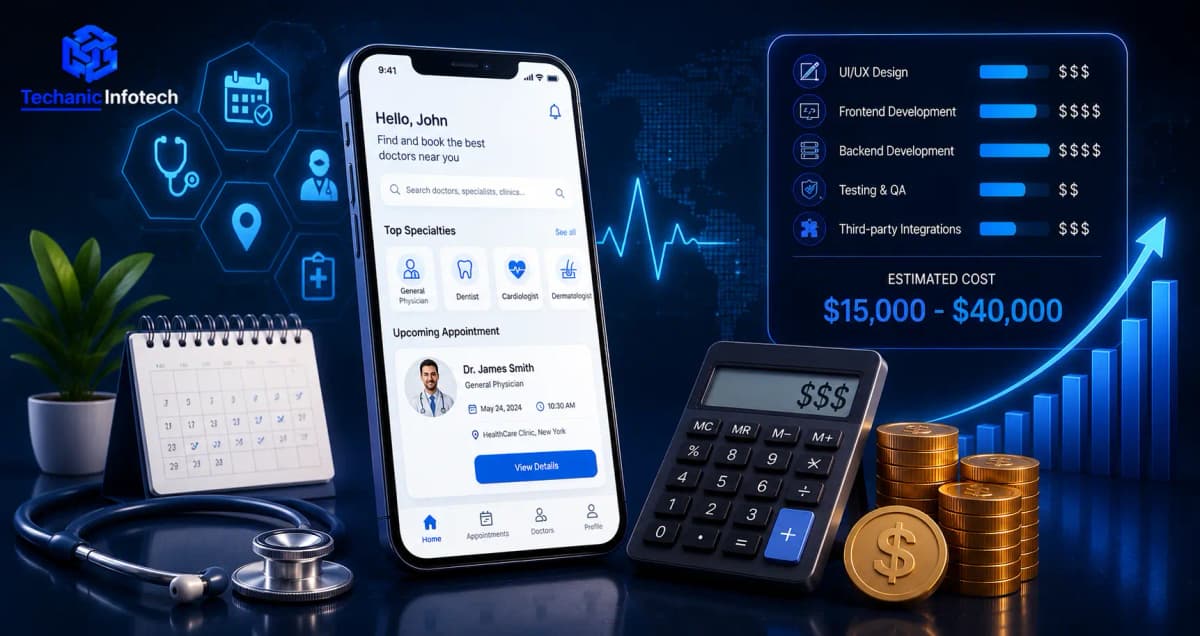
Below is an estimated development cost breakdown:
|
Development Phase |
Estimated Cost Range |
Description |
|
UI/UX Design |
$2,000 - $8,000 |
User-friendly healthcare app interface |
|
Frontend Development |
$5,000 - $15,000 |
iOS, Android, or cross-platform development |
|
Backend Development |
$5,000 - $15,000 |
Database, authentication, appointment systems |
|
Appointment Booking System |
$3,000 - $7,000 |
Real-time scheduling functionality |
|
Payment Integration |
$2,000 - $5,000 |
Secure payment gateway integration |
|
Telemedicine Integration |
$2,000 - $6,000 |
Video consultation features |
|
Quality Assurance & Testing |
$2,000 - $5,000 |
App testing and bug fixing |
|
Deployment & Launch |
$1,000 - $3,000 |
Play Store & App Store deployment |
|
Maintenance & Updates |
$1,000 - $5,000/year |
Ongoing support and updates |
These figures are estimated and can vary depending on project scope.
To get accurate pricing, it’s always recommended to consult an experienced mobile app development company.
Several factors influence the total development cost of a healthcare app.
Let’s explore the major ones.
The more advanced features your app includes, the higher the development cost.
Basic features:
User registration
Doctor search
Appointment booking
Advanced features:
Video consultations
AI-based doctor recommendations
Real-time chat
EHR integrations
Prescription management
Adding AI-based capabilities using AI App Development Guide strategies can increase both development time and cost.
Choosing between iOS and Android directly impacts your development budget.
Developing separate apps for both platforms increases overall expenses.
Using cross-platform frameworks like Flutter or React Native can help reduce development costs while maintaining quality.
Related Topics:
Hybrid App Development Cost
iOS App Development Guide
Mobile App Tech Stack Guide
Healthcare apps require clean, user-friendly, and intuitive interfaces.
Better UI/UX design improves:
User engagement
Retention rates
User satisfaction
Complex animations, personalized dashboards, and custom healthcare interfaces increase design costs.
You can also follow best practices from the mobile app design guide while designing healthcare applications.
Backend infrastructure manages:
Patient records
User authentication
Appointment management
Notifications
Third-party integrations
Since healthcare apps handle sensitive medical data, security becomes extremely important.
A scalable and secure backend requires proper architecture and development expertise.
Third-party APIs increase app functionality but also increase development complexity.
Common integrations include:
Payment gateways
Insurance verification systems
Video conferencing APIs
Calendar integrations
Push notifications
Integrating advanced services requires additional testing and maintenance efforts.
Post-launch maintenance includes:
Bug fixes
Security updates
Performance optimization
Feature upgrades
Maintenance costs generally range between 10–20% of the original development cost annually.
Following best practices from mobile app maintenance and mobile app testing helps improve long-term app performance.
The location of your development team significantly affects project pricing.
|
Region |
Hourly Rate |
|
North America |
$80 – $150/hr |
|
Western Europe |
$60 – $120/hr |
|
Eastern Europe |
$30 – $70/hr |
|
India |
$20 – $50/hr |
Hiring experienced developers from cost-effective regions can reduce the total app development budget.
The development timeline depends on app complexity, features, and platform selection.
On average, developing a healthcare app like ZocDoc takes around 3 to 9 months.
|
Development Phase |
Time Estimate |
|
Research & Planning |
2–4 Weeks |
|
UI/UX Design |
3–5 Weeks |
|
Frontend Development |
4–8 Weeks |
|
Backend Development |
4–8 Weeks |
|
Appointment & Payment Integration |
2–4 Weeks |
|
Telemedicine Integration |
2–4 Weeks |
|
Testing & QA |
3–6 Weeks |
|
Deployment & Launch |
2–3 Weeks |
Building an MVP first using how to build a minimal viable product strategies can reduce both development time and initial investment.
So, “How do apps like Zocdoc make money?”
When developing a doctor-on-demand app like ZocDoc, one of the most important parts of the business model is understanding how the platform will generate revenue.
Healthcare apps like ZocDoc offer several monetization opportunities while still delivering value to patients, healthcare providers, and medical institutions.
How it works:
The platform charges healthcare providers a commission for every successful appointment booked through the app. This fee can either be a fixed amount or a percentage of the consultation fee.
Why it works:
This revenue model allows the platform to earn money from every transaction, making it highly scalable as the number of users and appointments increases over time.
How it works:
Doctors, clinics, and hospitals pay monthly or annual subscription fees to list their services on the platform. Premium subscriptions may include additional features like better visibility, analytics, appointment management tools, and priority listings.
Why it works:
Subscription-based revenue creates consistent monthly income and helps maintain stable cash flow for the platform’s operations and future growth.
How it works:
Basic services such as doctor search, appointment booking, and patient reviews are offered for free. Patients can pay for premium features like instant consultations, priority booking, virtual healthcare access, or specialized medical services.
Why it works:
The freemium approach attracts a larger user base while generating additional revenue from users willing to pay for premium healthcare experiences.
How it works:
Healthcare-related advertisements such as medical products, insurance plans, wellness services, and healthcare programs can be displayed inside the app.
Why it works:
With a growing number of active users, in-app advertising becomes a strong passive income source without negatively affecting the overall user experience.
How it works:
The platform can partner with pharmacies, diagnostic centers, insurance providers, wellness companies, and healthcare brands. Whenever users purchase services or products through referrals, the platform earns a commission.
Why it works:
This strategy creates additional revenue streams while building strong partnerships with complementary healthcare businesses.
Developing an app like Zocdoc can be a profitable business opportunity in today’s growing healthcare technology market.
While the development cost depends on various factors like features, platform selection, integrations, and security requirements, investing in healthcare technology offers long-term growth potential.
By understanding the development process and partnering with an experienced healthcare app development company like Techanic Infotech, businesses can create scalable healthcare applications that improve patient experiences and streamline medical services.
The cost to develop an app like Zocdoc generally ranges between $10,000 to $50,000+ depending on app complexity, features, integrations, platform selection, and development team location.
On average, developing a doctor-on-demand app takes around 3 to 9 months. The timeline mainly depends on the number of features, app design, third-party integrations, and overall project scope.
A doctor appointment app usually includes features like doctor search, appointment booking, telemedicine integration, payment gateway, push notifications, patient reviews, and insurance verification. Businesses can also explore Doctor On-Demand App Features for more functionality ideas.
Both iOS and Android platforms are important for healthcare app development. Many businesses prefer cross-platform frameworks like Flutter or React Native to reduce costs and launch apps on both platforms faster.
Yes, HIPAA compliance is extremely important for healthcare apps that store or manage patient medical data, especially in the United States. It helps protect sensitive healthcare information and improves app security.
Yes, telemedicine features such as video consultations, live chat, remote prescriptions, and virtual healthcare services can easily be integrated into a doctor-on-demand app.
Apps like ZocDoc generate revenue through subscription plans, appointment booking commissions, in-app advertising, telemedicine consultation fees, and referral partnerships with healthcare providers.
Popular technologies used for healthcare app development include Flutter, React Native, Node.js, Firebase, AWS, and WebRTC. You can also explore Mobile App Tech Stack Guide for detailed technology insights.
A clean and user-friendly UI/UX design improves patient engagement, app usability, and user satisfaction. It also helps users book appointments and access healthcare services more easily.
Businesses can reduce development costs by creating an MVP first, using cross-platform development frameworks, prioritizing essential features, and hiring experienced offshore development teams.


Abhishek Jangid is the CEO of Techanic Infotech, with extensive experience in mobile app and web development. He specializes in helping businesses turn innovative ideas into scalable digital solutions through strategic planning and modern technology.