Dating apps are more popular than ever. Whether Tinder, Bumble, or other services like Hinge, Match, and Coffee Meets Bagel, romantic connections are being sought and found by the click of a mouse.
There’s a wide gap between a great idea and an actual solution for millions of people around the globe. Searching for a solution in the Market with millions using these types of apps, your app could turn out to be very profitable indeed!
But creating a successful dating app is about more than just swiping and chat features. It needs to be both friendly and secure, pretty and ever-renewing.
Most of the time, people are fast-tracking their way or missing out on some vital parts that will reflect the longer-lasting performance of the app.
Major mistakes—like inadequate research, inferior algorithms, or no plan for scaling up – can result in low engagement and disgruntled users.
With this blog post, we are going to try to look at the dating app development process from a different point of view and list a set of common dating app design mistakes that you do not want your own particular app to be associated with
Building a dating app is a more complex process than what can be understood through chatting up on Tinder. It’s all about giving users a safe, seamless, and purposeful experience to inspire trust and interaction. The key factors need to be understood in advance of designing, enabling long-term success and minimizing costly dating app startup mistakes.
One of the critical features to think about is UX. They want an easy-to-use product, with minimal wait or hassle, and that looks good in the process. A bad UI will frustrate your users and cause uninstalls.
Data privacy is equally crucial, especially for concerns like why dating startups are failing? Or more like it. The sensitive personal data the apps handle is more than just photos, messages, and location. Learn why one violation can tarnish your image and put your business at risk for legal repercussions.
Performance and scalability should also be your main priorities. Your app should be able to manage heavy traffic as your user base expands. User trust can be directly impacted by crashes and downtime caused by a lack of scalability.
Lastly, knowing your target market and having a well-defined monetization strategy guarantees that your software will continue to be lucrative in addition to drawing in users.
You may build a solid basis for your dating app by taking these elements into account. The ultimate goal of any successful dating app is to provide users with a sustainable, entertaining, and safe experience while avoiding typical development faults.
Building a dating app can be exciting, but many developers make simple mistakes that hurt user trust and app performance. To help you succeed, here are common mistakes to avoid while developing a dating app.
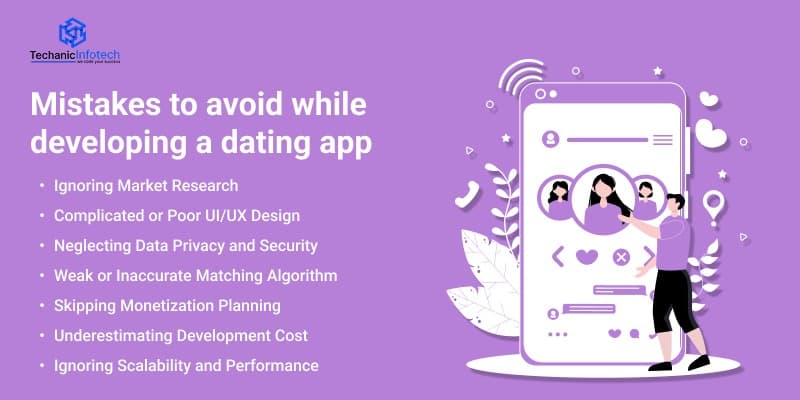
One of the most common errors made by developers is to neglect market research. Your app runs the risk of becoming simply another platform in a crowded industry if you don't understand your target customers, competitors, and market needs.
Research aids in determining the aspects that users truly appreciate and the things that current apps lack. For example, some users may seek serious connections, while others may prefer casual friendships. The tone, features, and style of your app are determined by these findings.
Analysis of competitors is also essential. Examine popular applications like Hinge, Bumble, and Tinder to see what works and what doesn't. Considering dating app ideas seems important to enable you to cover market gaps and distinctively position your software.
Early user input, focus groups, and surveys can identify important behavioral trends.
Simplicity and ease of use are key components of a successful dating app. The user experience can be ruined by an interface that is slow, confusing, or cluttered. An overabundance of elements, superfluous animations, or complicated navigation are dating app development mistakes made by developers.
Users are kept interested, and interactions are made simple with a clear, simple design. Sending messages, exploring profiles, and registering should all be quick and easy processes. Users can concentrate on connecting rather than figuring out how the app functions thanks to clear icons, consistent colors, and logical flow.
Make sure all devices are responsive as well. Since many people alternate between tablets and smartphones, the design should be flexible. Before launching your app, test its UI with actual users to identify usability problems early.
The most important lesson is to keep your design responsive, user-focused, and straightforward. Even if an app has a fantastic concept, a poorly designed UI/UX can result in high uninstall rates, while a well-designed UI/UX can significantly increase engagement.
One of the main issues for users of dating apps is privacy. They trust your platform to protect their private information, including images, chat histories, and personal details. Neglecting data security can have disastrous results.
Important security features like encryption, safe logins, and two-factor authentication are frequently overlooked by developers. Some even disregard privacy regulations like GDPR or store data on unreliable servers.
You need to use safe APIs, dependable hosting, and encrypted communication to protect users. Give people the option to manage who can access their personal data or profiles. Use moderation tools to identify scams, harassment, and phone profiles.
To find vulnerabilities before hackers do, regular security audits are essential.
Any courting app's matchmaking algorithm is its fundamental component. Users quickly lose interest if they are presented with irrelevant matches. Given that their matching methodology doesn't take into account enough user preferences or behavioral data, many apps fail.
To provide consistent results, a robust algorithm should examine a variety of variables, such as location, age, interests, and app usage. By learning from user activities like swipes, likes, and chat histories, artificial intelligence (AI) and machine learning (ML) can improve accuracy.
Additionally, it allows visitors to use criteria like hobbies, location range, or lifestyle choices to further refine their results. Users are kept interested by a system that is adaptable and changing.
Ignoring how to make money while concentrating only on downloads is another typical error related to dating apps. It is important to have a well-defined monetization plan from the outset.
The majority of popular dating apps have a freemium business model, where users can get basic services for free but have to pay for premium benefits like unlimited swipes, super likes, or sophisticated filters. Virtual gifts, memberships, and in-app advertisements are additional ways to make money.
Balance is crucial. Users may become irritated if your software is overloaded with advertisements or has too few functions. On the other hand, providing too much for free may make operations difficult to maintain.
A reasonable budget is necessary while developing a dating app. Many entrepreneurs underestimated their costs, which resulted in apps that are either unfinished or of low quality.
UI/UX design, backend infrastructure, algorithm development, third-party integrations, testing, and marketing are among the costs. Features like video calls and AI chatbots in dating app raise the price.
A basic dating app typically costs between $25,000 and $50,000, while a feature-rich, cross-platform version can cost up to $100,000.
Recurring costs are also increased by post-launch repair. Updates, security patches, and bug fixes are continuous requirements rather than one-time jobs.
Your dating app needs to function smoothly even when thousands of people are using it at once. Early on, developers frequently neglect scalability, which results in crashes when traffic spikes.
Your app can expand easily if you use scalable cloud technologies like AWS or Firebase. Improve code, databases, and pictures to speed up load times. To guarantee stability, test your app frequently under various load scenarios.
User retention is directly impacted by performance. Users will delete your app right away if it freezes or takes too long to load.
Starting your app is just the first step. User engagement declines as a result of many developers' inadequate post-launch assistance and updates.
Individual tastes and trends are always changing. Data analysis, feedback monitoring, and frequent app updates with new features and enhancements are all necessary.
In addition, there are numerous challenges in dating apps like server monitoring, content control, and bug patches, which are also part of maintenance. Frequent updates not only improve user experience but also demonstrate your brand's dependability and activity.
Creating a successful dating app takes more than just a great idea; it requires smart planning, user-focused design, and the right technology. Here are some key points to remember when building a dating app to ensure lasting success.
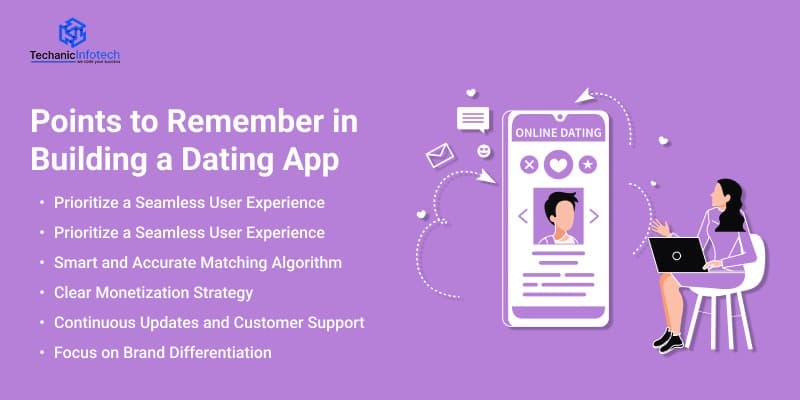
The user experience should be your first concern when creating a dating app. Whether a consumer keeps using the app or uninstalls it within minutes is determined by their initial impression. Users are at ease discovering matches and conversing because of a clear UI, simple navigation, and quick performance.
Steer clear of overcrowding the screen with extraneous features. Make sure the design is both aesthetically pleasing and easy to use. Make sure the registration procedure is easy so users can join up in a matter of seconds using their email address or social media. Your user retention will increase with a more seamless onboarding process.
Optimizing performance is equally important. Users may become more irritated by even a brief delay when sending messages or loading profiles. To guarantee seamless operation, test your app frequently on various devices and operating systems.
While a slow or unclear interface turns consumers away, a well-thought-out design keeps them interested for longer. Offering clever features like swipe animations, AI-based recommendations, and customized notifications would further improve the experience.
In the world of dating apps, data security and privacy are non-negotiable. Users share highly personal information, including photos, preferences, and chat histories. Any breach or misuse can permanently damage your brand’s credibility.
Implement end-to-end encryption for all messages and data exchanges. Use secure login options like OTP verification or social sign-in to minimize fake accounts. Multi-factor authentication and encrypted cloud storage add another layer of protection.
Regular security audits are essential to detect and fix vulnerabilities early. Partnering with cybersecurity experts or using reliable frameworks ensures compliance with global privacy regulations like GDPR or CCPA.
Give users control over their privacy, allowing them to block, report, or hide their profiles. Transparency also builds trust; display clear privacy policies explaining how user data is stored and used.
The core of each dating app revolves around the matching algorithm. When users sign up for the service in the hopes of finding compatible matches, interest rapidly declines if your algorithm is unsuccessful.
The algorithm that you use should take into account a number of variables, including interests, behavior, preferences, and activity patterns, rather than just geography or gender. Enhancing match accuracy can be greatly aided by machine learning (ML) and artificial intelligence technology (AI).
For instance, the system you have can adjust and present more relevant recommendations if a user frequently likes profiles with comparable interests or particular characteristics. Retention and satisfaction rates are increased by this customized experience.
Add adjustable parameters such as distance, age range, or lifestyle choices to guarantee equity and variety. These maintain the significance of matches while giving users more control over their gaming experience.
It's crucial to consider how you'll make money without compromising user experience before releasing your dating app. Because they prioritize growth over long-term profitability, many startups fail.
The most popular dating app monetization strategies is the freemium model, which allows users to access basic functions for free while premium capabilities (such as limitless swipes, super likes, or sophisticated filters) are only accessible through paid plans.
In-app ads are another option, but they must be positioned properly to prevent irritating consumers. Virtual gifts, memberships, and event-based services like online speed dating are additional lucrative concepts.
To find out which features or pricing structure your audience prefers, run A/B tests. To encourage free users to become paying clients, provide trial periods or one-time promotions.
Starting your dating app is only the first step. You must constantly upgrade it with fresh functionality, performance enhancements, and bug fixes in order to stay competitive and current.
User expectations change rapidly; in a few months, something that seems new today might look out of date. Frequent updates let consumers know that your software is active, evolving, and focused on their needs. To maintain high levels of engagement, introduce fresh designs, gamification elements, or better filters.
In addition to upgrades, prompt customer service is essential. Users may encounter problems, including payment errors, phony profiles, or unsuccessful login attempts. Credibility and user trust are increased with a prompt and amiable support system, whether by email, in-app chat, or FAQs.
Keeping an eye on social media and app store reviews provides insightful information about what needs to be improved.
Platforms like Tinder, Bumble, and Hinge dominate the dating app market. Your app needs to provide distinctive value that appeals to a certain audience to stand apart.
Clearly identify your target market before beginning development. Are you targeting professionals, pet owners, gamers, or individuals looking for committed relationships? You can draw in devoted people who have similar goals and interests by using niche targeting.
The name, logo, tone, and content of your brand should all represent the values and way of life of your target market. A compelling brand narrative distinguishes you from rivals and fosters emotional ties.
To increase user attractiveness, include special features like voice prompts, personality-based matches, or video dating. To increase visibility, combine this with a unified social media, SEO, and app store optimization strategy.
While developing a dating app offers huge potential, it also comes with certain challenges and constraints. Here are the major limitations to consider during dating app development to help you plan effectively and avoid future setbacks.
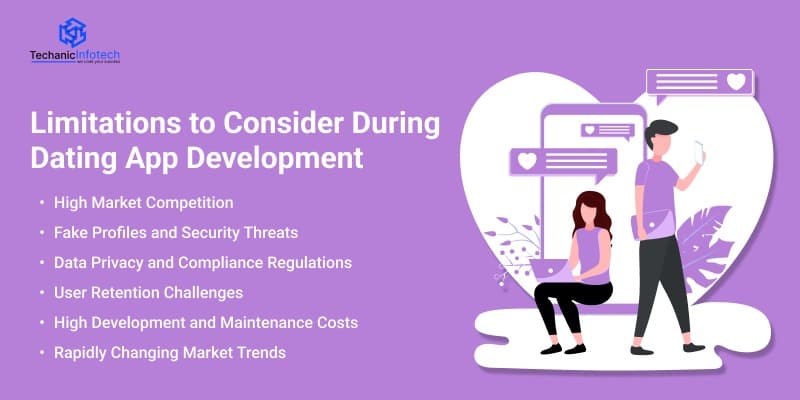
Perhaps the most competitive industry in mobile app development is the dating app sector. Global platforms like Tinder, Bumble, and Hinge make it far more difficult for new apps to draw in users. Many entrepreneurs fail to discover their distinctive value offer because they undervalue this difficulty.
Launching a generic app frequently results in low downloads and little engagement because users already have other trustworthy platforms. Developers must concentrate on specialist targeting—making apps for particular populations like professionals, pet owners, or people seeking committed relationships—to get around this.
Your app may stand out with effective branding, a clear message, and unique features like compatibility tests, video profiles, or AI-based matching. In a congested market, attracting and keeping users requires a well-thought-out marketing strategy.
Managing fraudulent profiles, scams, and catfishing is one of the main obstacles in dating app development. These undermine consumer confidence and harm the reputation of the dating app development company.
To verify user validity, developers must incorporate reliable verification mechanisms like phone number authentication, photo verification, and even real-time selfie checks. Tools for machine learning (ML) and artificial intelligence (AI) can also be used to identify strange behavior patterns, accounts used for spam, and questionable activity.
Furthermore, safeguarding people against online dangers is essential. Hackers frequently target dating apps in an effort to steal personal data or take advantage of lax privacy controls. We must set up real-time moderation, two-factor authorization, and end-to-end encryption.
Giving consumers power over their privacy settings, visibility preferences, and data-sharing choices fosters confidence and is another benefit of transparency.
Data privacy compliance is a crucial constraint because dating apps handle enormous volumes of sensitive and personal data. Laws like the CCPA in California, the GDPR in Europe, and other local data protection acts must be followed by developers.
Even if the software is used worldwide, non-compliance might result in harsh fines and legal issues. This implies you must clearly define how data is collected, processed, and kept. Maintaining openness requires regular audits and encryption techniques.
Implementing features that comply with these rules without sacrificing usability is another difficulty. For instance, it should be simple for consumers to request transparency reports or completely remove their data.
Managing data flows across borders is likewise challenging. Your backend systems must adhere to each state you service because different nations have different privacy regulations.
One of the biggest obstacles to the success of dating apps is user retention. Curiosity typically leads people to download dating apps, which they quickly stop using. Users immediately deactivate the app if they are bored or are unable to locate appropriate matches.
Put an emphasis on satisfaction and engagement to counter this. To entice users to return, incorporate gamification features like fun challenges, compatibility scores, or daily prizes. AI-powered recommendations and tailored alerts also aid in sustaining attention.
Authentic interaction is another aspect. Use voice messages, interest-based groups, or icebreaker prompts to promote genuine conversations.
But even with these initiatives, ongoing innovation is necessary to sustain steady involvement. The software has to be updated with new features, designs, and experiences because dating habits change quickly.
It costs a lot of money to develop a dating app. The app's complexity, design, technology stack, and intended features all affect the price. While complex apps with AI, video calling, and premium memberships might cost over $100,000, a basic version may cost between $25,000 and $50,000.
Continuous maintenance, such as bug fixes, feature updates, and security enhancements, adds continuous costs beyond initial development. Long-term expenses are further increased by marketing initiatives, server hosting, and customer service.
You must first identify your minimal viable product (MVP) in order to manage this. Before investing in expansion, you can test the market and get feedback by starting with key functionality. Effective budgeting and quality control are guaranteed when you collaborate with a reputable development firm.
Compared to most app categories, the dating sector is evolving more quickly. User expectations are always changing due to social behaviors, relationship trends, and new technology. Things that are popular now, like AI matches or swiping mechanics, might not be relevant tomorrow.
To be relevant, developers need to keep up with new technologies like virtual dating, video profiles, and AR-based matchmaking. Market share and user interest decline when innovation is lacking.
Accurately forecasting user behavior is another drawback. Relying on out-of-date metrics or features can make the app seem obsolete because dating preferences vary in tandem with cultural and social shifts.
Staying ahead requires ongoing user feedback, data-driven insights, and dating app trends analysis. Frequent upgrades and contemporary UI refreshes guarantee that your app meets user expectations.
|
Limitation |
Description |
Key Takeaway |
|
High Market Competition |
A crowded industry requiring strong branding and innovation |
Focus on niche and uniqueness |
|
Fake Profiles |
Threatens trust and app integrity |
Use AI-based verification |
|
Data Privacy Compliance |
Legal requirement for user safety |
Follow GDPR, CCPA, and local laws |
|
User Retention |
Hard to keep users engaged |
Gamify and personalize experiences |
|
Development Cost |
High setup and maintenance expenses |
Start with MVP and scale smartly |
|
Market Changes |
Rapidly evolving user preferences |
Innovate continuously |
It's thrilling and difficult to develop an application that allows for dating. Online dating is becoming more and more popular worldwide, but your ability to strike a balance between innovation, security, and user pleasure will determine how successful you are. Time, money, and reputation can all be saved by avoiding widespread errors like disregarding market research, having subpar UI/UX, or having inadequate data protection.
It takes more than just coding to create an app; it also entails comprehending user behavior, protecting privacy, and regularly updating features to satisfy contemporary demands. A sustainable dating platform is built on strong matchmaking algorithms, data security, and efficient monetization.
A well-thought-out strategy can make your app stand out despite obstacles like fierce competition, phony profiles, and changing trends.
Developing a dating app typically costs between $25,000 and $100,000+, depending on design complexity, features, and technology used.
On average, developing a feature-rich dating app takes 4 to 6 months, including design, development, and testing phases.
Essential features include profile creation, chat/messaging, AI-powered matching, verification, push notifications, and data security options.
Focus on niche targeting, unique features like video dating or gamification, and exceptional user experience to attract and retain users.
Dating apps handle sensitive user data. Strong privacy measures ensure user trust, prevent breaches, and maintain compliance with global data protection laws.


Abhishek Jangid is the CEO of Techanic Infotech, with extensive experience in mobile app and web development. He specializes in helping businesses turn innovative ideas into scalable digital solutions through strategic planning and modern technology.