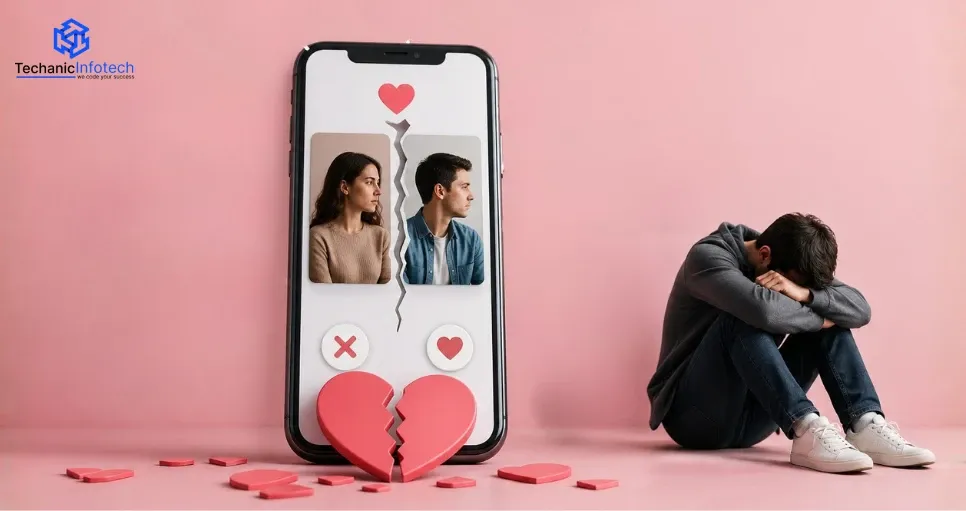
An online dating startup sounds like a lot of fun. An app to help people find love. But under the hood, it’s cutthroat. Dating giants Bumble and Tinder are laying off workers and losing steam, with Bumble most recently slashing its workforce by 30% due to user fatigue.Users cite exhaustion, ghosting, and insincerity. And in a ruthless market, a niche or poorly built online dating startup has little hope of capturing hearts or generating revenue.In this blog, we’ll go over the top 10 reasons why online dating startups fail, how you can dodge the common mistakes, and how Techanic Infotech can ensure your dating app is a success.
The dating industry is thriving but not for every founder. With more users than ever and an accelerating shift towards digital-first relationships, the online dating market is worth billions. Yet hundreds of dating startups fail every year. The causes of failure are often easy to find. The same fatal errors can be spotted across a wide range of startups. If you’re an entrepreneur, product lead, or investor trying to develop a dating app, these are the reasons to learn and avoid in order to build a successful product.
The 10 Most Common Reasons Dating Startups Fail: What Not To Do
Perhaps the single biggest reason why dating app startups fail is the lack of product-market fit.
The online dating space is saturated. Users have a plethora of apps like Grindr, Tinder, Bumble to use, you name it each dominating its particular segment or niche.
If your app does not solve a particular unmet need or better serve a particular audience than the competition, you will disappear into obscurity.
Most dating app startups fall into the trap of trying to build a product for everyone, rather than narrowing their focus on a niche and growing from there.
The more generic the app, the harder it is to stand out from the sea of competitors.
Key Tip: Pick a dating app idea and cater to them. Whether that is pet lovers, travelers, single parents, career-focused millennials, or anything in between, know your audience and prove there is a demand for your product before starting development.
If a dating app’s user experience (UX/UI) is bad, your dating app will not retain users, regardless of how good the concept is.
UX and UI design are fundamental to the success of a product, and for a dating app, it is especially crucial.
If your app is a pain to use, users will abandon it in droves. According to surveys, 70+% of users delete an app within 1 week if the user experience is poor.
Poor navigation, long sign-up processes, weak onboarding, and slow load times all drive people away and can be huge dating app challenges to overcome.
Additionally, users might not discover the killer features your app has to offer if they cannot easily navigate it.
Key Tip: Test early and often. Perform usability tests with real users, and iterate on onboarding flows, swiping mechanics, and match displays.
Dating apps often launch with freemium services and “scale to solve revenue.” Without a dating app monetization strategy, the startup quickly runs out of runway.
If you push too hard on subscription prompts or include invasive ads, you risk increasing churn. However, if you don’t monetize early enough, you may never recoup your investment.
Value-based monetization is key think about features people will really pay for, like advanced search filters, video dating, or verified profiles.
Key Tip: Test tiered pricing plans and consider time-limited feature unlocks. Don’t put paywalls on your core features too early.
Scaling a dating app’s user activity is critical. If your backend struggles during peak hours or location-based services become unreliable, your users will become frustrated and leave. This is why many dating apps fail in the market to impress users.
Common technical challenges:
The matching algorithm generates irrelevant matches
Location services are buggy
Messaging causes crashes
Slow response during peak hours
These bugs make your dating app feel unprofessional, even if you have the best concept.
Key Tip: Invest in scalable cloud infrastructure, like AWS or Azure. Technical testing and load balancing should be your priority early on.
In a world with headline-grabbing data breaches around every corner, privacy is a must.
Dating apps store sensitive info (photos, location, preferences, chat history) and payment data. Any data leak/misuse can wipe out your brand.
Users lose trust in the app, as high-profile data privacy/security breaches with Ashley Madison, Coffee Meets Bagel decimated user trust.
Startup founders have zero room for error. One glaring reason why dating apps fail is not making data security a top priority from day one.
Key Tip: End-to-end encryption, safe payment gateways, a clear privacy policy, and regular security audits are a must.
Dating apps are, well, supposed to lead to real-world dates and relationships, but many fail here.
Apps that only succeed in engaging users virtually (swiping, chatting) but not in the real world will suffer high churn.
Users leave after getting bored or drained without ever actually meeting (or after trying dates that are lackluster).
Date suggestions, video chat, or event-based meetups can help close the gap between initial online attraction and offline connection, one of the defining reasons why dating apps fail.
Key Tip: Facilitate safe and timely real-life meetings with features like shared calendar integrations, local “date spots” recommendations, or even “video first” introductions.
Swiping can be fun – at first. Soon, users experience “choice overload” or decision fatigue.
The paradox of choice results in shallow conversations, ghosting, and lower engagement over time. Consumers are looking for quality, meaningful connections, not endless options.
Dating apps that focus on curation over quantity have better retention.
Key Tip: Introduce interest-based matching, AI-powered recommendations, or a compatibility quiz to limit/curate potential matches.
UX that works in New York City may not resonate with Tokyo or Mumbai- a key reason why online dating startups fail internationally. Dating cultures and preferences vary significantly by region/country/culture/language.
Copy-pasting a Western UX for an Asian/Middle Eastern dating app will likely struggle. Similarly, a dating app that doesn’t optimize for platform updates (Android vs. iOS, 5G, AI, etc.) will feel dated.
Key Tip: Localization is deeper than just language. Design, imagery, tone of voice, product flow, and matching logic should all be adjusted based on the target market.
Stay on top of platform trends to integrate modern tech where it adds value.
Dating apps have an average CPI of $2 – $6, one of the highest across app categories. If you don’t have a viral loop or referral program, paid acquisition can bleed you dry. A lot of dating startups burn through their budgets on Meta or Google Ads with no return if their targeting is off.
If they don’t know who their niche or value proposition is, then paid acquisition won’t work- another prevalent reason for the failure of dating apps.
Key Tip: Build community-driven features that incentivize users to invite others. Invite-only access tiers, influencer referral programs, or in-app rewards for friend invites are great examples.
Dating apps need the network effect to work. The more people on the platform, the more likely someone is to find a match. If your app only makes money when users are single, swiping, and never making meaningful connections, then you will kill long-term trust and retention.
Users know if an app is holding them back from their end goal of finding a match and will ditch it for a better experience. This misalignment is a hidden but powerful reason why dating apps fail.
Key Tip: Build mechanics that incentivize successful connections, such as testimonials, friend referrals, or couple milestones.
Okay, let’s be real: building a dating app is kind of like a first date. It’s thrilling, full of potential, but with an element of risk. But like with any successful relationship, steering clear of basic dating app faux pas can help make sparks fly.
Serious about not becoming the undiscovered tombstone of ''would-been-great-but-never-scaled” ideas? Then buckle up.
We’ve got your go-to dating startup survival handbook right here. By following the anti-patterns to avoid, you can defy the grim odds that befall over 99.9% of new apps.
Let’s turn that startup “red flag” into a fairy tale success story together:
We’ve all met a founder who falls for their own idea way more than the real users. Don’t go overboard and build a pure spec app, either. Ask yourself the hard questions: What exactly are your audience’s motives to join your app? Long-term relationships? Casual fun? Looking for specific niches like pet lovers or gourmet chefs? How else do you stand apart from the swiping competition?
Be brutally honest, stick to the dating app trends, and let that guide your feature list and UX design. The moment you center on solving a real problem authentically will be the moment you escape the alternative fate of going nowhere.
Pro Tip: Host micro-surveys, user focus groups, and A/B test early features. Don’t move forward without this validation.
One of the ultimate downfalls of mobile dating apps that lack solid revenue streams: “let’s just go after users now and worry about making money later” mental model. Spoiler: it will never be “later”.
Whether you choose subscriptions, advertising, in-app purchases, or something else, make sure your monetization strategy aligns with your user value, not works against it.
Need assistance? Check the cost to develop a dating app and start projecting your budget like a champ.
Alright, nobody’s going on a second date with a clunky app. But how many mobile dating app failures have we seen because of dev negligence, testing, and a total disregard for performance optimization?
If your dating app has bugs, latency, slow loading times, or shoddy location technology, then you’re sure to find yourself in the news.
Prioritize performance tuning, security audits, responsive design, and scalable infrastructure.
There’s nothing worse than high load times or poor reliability when you’re looking for love online, especially if you’re mobile-first.
Extra Bonus Tip: Consider tools like Instabug or Firebase Crashlytics to leverage real-time feedback and prevent them from surfacing at scale.
Believe it or not, your New York launch strategy might bomb in Tokyo. The cultural fit, humor, expression, and even basic dating norms can vary wildly. Localization and being culturally sensitive should be in your top 3 if you even dream of an international launch.
Don’t want to be another casualty in “dating app fails across the globe”? Understand your target regions and tailor your app to their unique needs.
Pro Tip: Use in-app language switcher and location-based user journeys for personalization.
Buying users only to lose them with no retention? That’s like buying flowers for someone who only likes you when you’re paying. Yet, that’s exactly how many apps go bust. CAC (Customer Acquisition Cost) skyrockets without organic user flow or monetization to sustain it.
How do you avoid this trap? By creating your viral mechanics.
Offer incentives for referrals, gamified achievements, or even have early invite-only periods that users want to spread.
It’s a more sustainable way to lower CPMs (cost per install) and outlast the marketing budget of most apps. Save yourself from joining the tragic dating app failures statistics.
Need some ideas? Observe how Bumble added incentives for sharing referrals outside the app. Real-world rewards and community building go a long way.
Most importantly, don’t forget the reason people are here: love.
Make it personal. Features that make your users happy, feel safe, and form real connections with compatible singles are what make platforms stand out.
Screens-only view towards engagement metrics is a one-way ticket to bust. It’s one of the primary reasons most apps in the dating vertical fail.
Design the product that users will proudly share with friends. Give them the tools to make real connections, and they’ll return to your app to share with more people.
A fun idea: build a couple of milestone trackers, or a “success story wall” as social proof.
Creating a successful dating app is no easy task. It requires careful planning, execution, and scalability.
At Techanic Infotech, the best dating app development company, we have extensive experience in developing high-performance dating apps that are designed with the end-user in mind.We understand the intricacies of the dating app market and work closely with our clients to create custom solutions that fit their specific niche and business objectives.
We specialize in building feature-rich apps with intelligent matchmaking algorithms, intuitive UI/UX, and scalable backend infrastructure.
With Techanic Infotech’s expertise and experience in the field, we can help you create a dating app that stands out from the crowd and generates revenue.
Dating apps can and do fail. However, most of these apps fail due to preventable mistakes: not solving the right user pain points, not having a solid monetization strategy, or not having a sustainable, secure infrastructure to scale the app. It is just as possible for a dating app to be a resounding success. Developing a Dating app with the right team, app idea, and business strategy is a solid formula for success.
There are many reasons why dating apps can fail, but by being aware of them, you can design and build the right systems to retain your users, monetize your app, and scale globally.
Our blog will provide you with the necessary resources, dating market analysis, and proven success frameworks that will help you beat the competition.
Partner with an expert company like Techanic Infotech to build and launch your mobile dating app.
Lack of product-market fit is the biggest reason. Apps that don’t solve a specific problem need to fail to retain users.
Critical. High churn kills growth. Without retention, even high downloads won’t translate into long-term success.
A strong dating app should aim for 25–30% Day 1 retention and consistent weekly engagement.
It typically takes 4–9 months depending on features, complexity, and testing cycles.
A clear niche, strong UX, smart matching algorithms, and unique value propositions like safety or community focus.
By increasing active users, encouraging referrals, and ensuring balanced user demographics for better matching.
Massive. Without trust (privacy, safety, authenticity), users churn quickly and don’t return.
Yes, and often more than generic ones. Niche apps solve specific problems and build stronger communities.
Techanic Infotech helps you build a successful dating app by offering end-to-end development, from market research and UX design to scalable backend systems and monetization strategy. Their team focuses on creating high-performance, secure, and user-centric apps tailored to your niche, ensuring better user retention and long-term growth.


Abhishek Jangid is the CEO of Techanic Infotech, with extensive experience in mobile app and web development. He specializes in helping businesses turn innovative ideas into scalable digital solutions through strategic planning and modern technology.