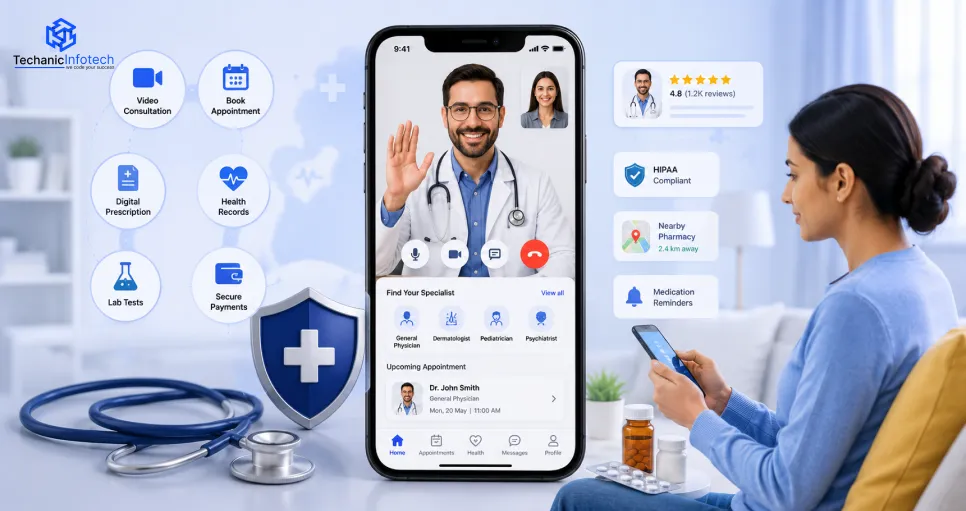
Doctor On Demand App Development
20 Must Have Doctor On Demand App Features for Healthcare Startups in 2026
June 8, 2026
June 8, 2026
Healthcare has changed dramatically over the last few years. Patients no longer want to spend hours traveling to clinics, waiting in long queues, or scheduling appointments weeks in advance. They want fast, convenient, and reliable access to healthcare services from anywhere.
This shift has fueled the growth of doctor on demand applications, making telemedicine one of the fastest-growing segments in healthcare technology.
According to market research reports, the global telehealth market has crossed $120 billion and is expected to continue growing rapidly over the next decade. Rising smartphone adoption, improved internet connectivity, and increasing demand for remote healthcare services are driving this growth.
For healthcare startups and businesses planning to enter this market, building the right platform is crucial. The success of a telemedicine platform often depends on the features it offers to both patients and healthcare providers.
In this article, we'll explore the most important doctor on demand app features, real-world examples, development considerations, and the features that can help your platform stand out in a competitive market.
If you're planning to build a telemedicine platform, working with an experienced Doctor On Demand App Development Company can help ensure that your product meets both user expectations and healthcare compliance requirements.
A doctor on demand app is much more than a video calling platform.
It serves as a complete healthcare ecosystem where patients, doctors, pharmacies, laboratories, and administrators interact through a single system.
The right feature set improves:
User experience
Patient retention
Doctor engagement
Healthcare accessibility
Revenue generation
Regulatory compliance
Let's look at the essential and advanced features every healthcare startup should consider.
The onboarding process should be quick and frictionless.
Patients should be able to register using:
Mobile number
Google account
Apple ID
Social media login
Multi-factor authentication can also improve account security while protecting sensitive healthcare information.
A patient profile serves as the foundation of personalized healthcare.
The profile should store:
Personal details
Medical history
Allergies
Current medications
Previous consultations
Insurance information
This helps doctors make informed decisions during consultations.
Trust plays a huge role in healthcare.
Each doctor profile should display:
Qualifications
Certifications
Experience
Areas of specialization
Consultation fees
Availability
Ratings and reviews
Patients are more likely to book appointments when they can verify a doctor's expertise.
Users should be able to quickly find the right healthcare professional.
Useful filters include:
Specialty
Gender
Language
Consultation type
Experience level
Availability
Price range
This significantly improves appointment conversion rates.
An efficient scheduling system is one of the most important doctor on demand app features.
Users should be able to:
View doctor availability
Book appointments instantly
Reschedule consultations
Cancel appointments
Receive confirmations
Real-time synchronization prevents double bookings and scheduling conflicts.
Doctors need tools to manage their schedules effectively.
A built-in calendar helps providers:
Block unavailable dates
Manage consultation slots
Schedule follow-up appointments
Avoid appointment overlaps
Video consultation is the heart of any telemedicine platform.
The feature should provide:
HD video quality
Stable connections
Screen sharing
File sharing
Session recording where permitted
End-to-end encryption
Healthcare regulations require secure communication channels for patient consultations.
Not every patient has access to high-speed internet.
Audio consultations provide an alternative for users in low-bandwidth areas while maintaining accessibility.
Patients often have simple questions that don't require a full consultation.
Chat functionality allows:
Follow-up communication
Prescription clarification
Symptom updates
Health guidance
This improves engagement and patient satisfaction.
Digital prescriptions simplify the healthcare experience.
Doctors can:
Generate prescriptions digitally
Send prescriptions instantly
Track medication history
Reduce paperwork
Patients benefit from faster access to medications and fewer prescription errors.
Integrating Electronic Health Records allows healthcare providers to access patient data from multiple systems.
Benefits include:
Better diagnosis
Improved treatment planning
Faster consultations
Reduced administrative work
This feature is especially valuable for large healthcare networks.
Patients should have access to:
Consultation history
Prescriptions
Medical reports
Lab results
Treatment plans
Having everything stored in one place improves continuity of care.
A seamless payment experience improves conversions.
Common payment options include:
Credit cards
Debit cards
UPI
Mobile wallets
Net banking
Insurance payments
Transparent pricing should always be displayed before consultation booking.
Insurance integration can remove friction during the payment process.
Patients can:
Verify coverage
Check eligible consultations
Submit claims
Access reimbursement information
This feature is becoming increasingly important in enterprise healthcare solutions.
After receiving a prescription, users should be able to order medicines directly from partner pharmacies.
Benefits include:
Faster medication access
Improved treatment adherence
Better patient convenience
Many diagnoses require laboratory testing.
Allowing patients to book diagnostic services directly from the app creates a complete healthcare ecosystem.
Users can:
Schedule tests
View reports
Share results with doctors
Artificial intelligence is transforming telemedicine.
An AI symptom checker can:
Analyze symptoms
Suggest possible conditions
Recommend appropriate specialists
Prioritize urgent cases
While AI cannot replace doctors, it can help streamline patient triage.
Integration with wearable devices allows real-time health monitoring.
Popular integrations include:
Apple Health
Google Fit
Fitbit
Samsung Health
Doctors can access:
Heart rate data
Activity levels
Sleep patterns
Blood pressure readings
This provides a more comprehensive view of patient health.
Push notifications help improve engagement.
They can be used for:
Appointment reminders
Prescription alerts
Health tips
Follow-up consultations
Promotional campaigns
The key is maintaining relevance without overwhelming users.
Healthcare accessibility improves when users can communicate in their preferred language.
Multilingual support helps:
Increase trust
Improve patient understanding
Expand market reach
Improve user retention
This feature is particularly valuable for platforms serving multiple regions.
A successful telemedicine platform must support healthcare providers as effectively as it supports patients.
Doctor-specific features include:
Consultation management
Earnings dashboard
Schedule management
Prescription generation
Patient history access
Analytics and reports
Availability settings
Consultation notes
These tools improve productivity and provider satisfaction.
The admin panel acts as the control center of the platform.
Essential admin features include:
User management
Doctor verification
Content moderation
Revenue management
Analytics dashboard
Security monitoring
Complaint resolution
Marketing management
A strong admin panel ensures smooth platform operations.
One of the most successful examples in telemedicine is Teladoc.
The company initially focused on a few core features:
Appointment scheduling
Video consultations
Digital prescriptions
As adoption increased, the platform expanded with:
Chronic care management
Behavioral healthcare
AI-powered services
Remote patient monitoring
Health device integrations
The biggest lesson for healthcare startups is that successful platforms often begin with essential features and expand strategically based on user needs.
Launching with a focused MVP is often more effective than building dozens of features from day one.
The development cost depends heavily on the complexity of features and compliance requirements.
|
App Type |
Estimated Cost |
|
MVP Telemedicine App |
$10,000 - $40,000 |
|
Mid-Level Solution |
$40,000 - $80,000 |
|
Enterprise Healthcare Platform |
$80,000 - $200,000+ |
Features that significantly impact costs include:
Video consultation infrastructure
AI symptom checking
EHR integration
Insurance verification
Wearable integrations
Advanced analytics
For a detailed breakdown, you can explore our guide on the Cost to Develop a Doctor On Demand App.
Many healthcare startups make the mistake of adding too many features during the initial launch.
Instead, focus on:
Core healthcare workflows
User experience
Compliance requirements
Scalability
Security
Start with essential features and gradually expand based on user feedback.
This approach reduces development costs and speeds up time to market.
The demand for virtual healthcare services continues to grow, making telemedicine one of the most promising healthcare technology sectors.
The success of your platform depends heavily on selecting the right doctor on demand app features.
Features such as appointment scheduling, video consultations, e-prescriptions, secure payments, medical records management, AI symptom checking, and wearable integrations can significantly improve patient experience and platform growth.
Whether you're building an MVP or a large-scale healthcare ecosystem, focusing on user needs, compliance, and scalability will help position your platform for long-term success.
If you're planning to launch a healthcare solution, partnering with an experienced Doctor On Demand App Development Company can help transform your idea into a secure, scalable, and market-ready platform.
Video consultations, appointment scheduling, doctor profiles, e-prescriptions, secure payments, and medical records management are considered essential features.
Most successful MVPs launch with 8 to 12 core features focused on consultation, scheduling, communication, and payments.
A doctor on demand app is a type of telemedicine app focused primarily on connecting patients with healthcare providers for virtual consultations.
Development costs typically range from $10,000 to over $200,000 depending on complexity, features, compliance requirements, and integrations.
HIPAA compliance helps protect sensitive patient information and ensures healthcare organizations meet legal privacy requirements.
Yes. Modern healthcare platforms frequently integrate with Apple Health, Google Fit, Fitbit, and other wearable technologies.
Credit cards, debit cards, digital wallets, UPI, net banking, and insurance payments are commonly supported.
AI is not mandatory, but features such as symptom checking, patient triage, and predictive analytics can improve efficiency and user experience.
An MVP generally takes 3 to 6 months, while advanced healthcare platforms may require 6 to 12 months or more.
The future includes AI-powered diagnostics, remote patient monitoring, wearable integrations, personalized healthcare recommendations, and expanded telemedicine adoption worldwide.


Neha Sharma is a tech expert at heart who loves exploring new technologies and turning complex ideas into easy-to-understand content. With a passion for learning and writing, she enjoys sharing insights on emerging tech, digital products, and innovation that help businesses stay ahead.