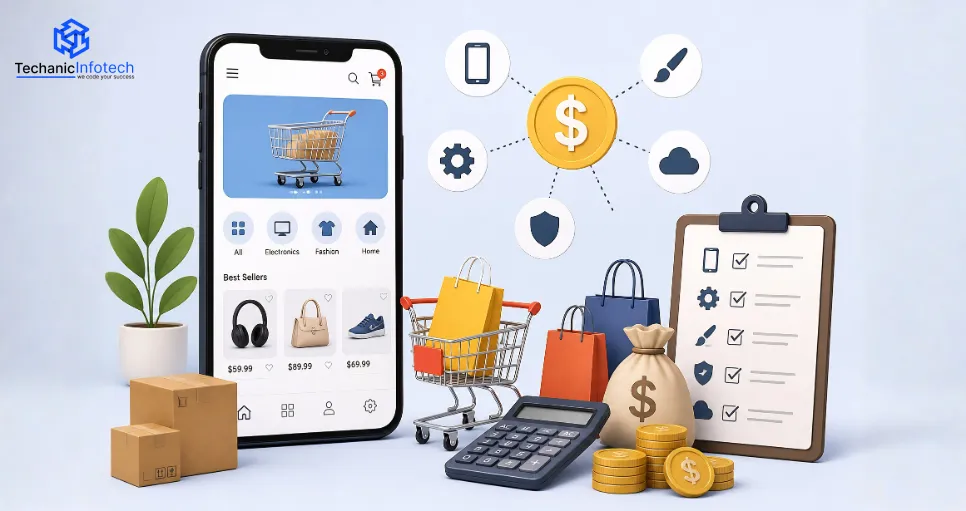
The cost of e-commerce app development is one of the burning questions in the e-commerce industry. The growing e-commerce app market seems to compel investors to invest in this industry.
In this blog, we will delve into what each of these components contributes toward the eCommerce application development costs and give you tips on how to manage your budget.
If you happen to be a startup or an established brand, a fair understanding of these factors will allow you to make better decisions and set reasonable expectations regarding your e-commerce venture.
E-commerce applications allow businesses to sell products and services online through mobile telephones or tablets.
The app provides a top-notch shopping experience to its users by allowing them to browse through products to buy, list orders, and even manage their accounts through their mobile phones.
It is becoming an irrefutable fact that eCommerce mobile apps have become more than a need to the consumer. This is the time to capture the booming mobile shopping market and a wider audience.
While building an eCommerce app, businesses have to integrate features like an intuitive user interface, safe payment gateways, catalogues of products, push notifications, and order tracking.
All of these will surely add to the complete cost to develop an eCommerce app, but that will be for later.
Before that, we are going to talk about how eCommerce apps work:
Customers download the app and surf through different categories or search filters to locate particular products.
The app provides personalized recommendations based on past purchases, search history, or user interest.
When a customer finds a product they wish to purchase, they add it to their shopping cart, view more information, or bookmark it for later.
Customers download the app and surf through different categories or search filters to locate particular products.
The app provides personalized recommendations based on past purchases, search history, or user interest.
When a customer finds a product they wish to purchase, they add it to their shopping cart, view more information, or bookmark it for later.
Customers input shipping details, redeem discounts or promo codes, and go ahead with secure payment modes to finalize the purchase.
The app processes payments through built-in, secure payment gateways such as credit cards, mobile wallets, or other online payment methods.
Post-purchase, customers are sent an order confirmation as well as tracking information to keep track of the delivery status.
The application tracks the levels of stock and maintains the availability of products in real time.
Manages return or exchange, updating customers about the process.
Once the user receives the product, they can submit their review.
Knowing how each of these steps works will guide businesses in creating an eCommerce app that offers a seamless and enjoyable shopping experience while also managing the cost to develop an eCommerce app efficiently.
Today, in the era of technology, it's no longer just a trend to have your eCommerce store be available through an app, often, it's indispensable.
As more shoppers buy online on their mobile devices, creating an eCommerce app allows companies to engage with more consumers and provide an uninterrupted, tailored shopping experience.
Not only does it enhance user interaction, but it also increases customer loyalty and sales.
Below are some of the main advantages of creating an eCommerce application for businesses:
Improved User Experience: Mobile apps offer a quicker, more user-friendly shopping experience with simple navigation, quicker checkout, and relevant recommendations.
More Visibility to the Brand: An application will keep your brand in front of your customers constantly, and thereby increase the branding recall and recall.
Improved Customer Interaction: Push notifications enable companies to directly interact with customers, update them about new offerings, offers, and promotions.
Increased Conversion Rates: With options such as one-click buys and stored preferences, eCommerce apps facilitate customers to make transactions with ease, thus increasing conversion rates.
Personalization: With apps, a customer can get a customized shopping experience depending on their liking, browsing history, and previous purchases, leading to more effective marketing and enhanced customer satisfaction.
Offline Accessibility: Certain eCommerce app features are offline-accessible so that customers have the ability to browse and even purchase without Internet connectivity.
Customer Loyalty: Numerous apps have loyalty programs, rewards, or promotions that reward repeat purchases and customer loyalty.
Seamless Integration: eCommerce applications can be integrated into your current inventory management, payment gateways, and shipping systems to automate your business processes.
Competitive Advantage: A well-planned app has the ability to set your company apart from the competition, which might still be using old-school websites, providing an innovative shopping experience.
By investing in a high-quality eCommerce app, businesses can empower their digital presence, recover their invested cost to build an eCommerce app and improve overall customer satisfaction, leading to increased sales and long-term success.
One of the huge questions that every investor who is interested in this industry has is "How much does it cost to build an eCommerce app?”
Valid enough, the cost to create an eCommerce app can go from $20,000 to $300,000+. There is no fixed price to it. The lower end of this spectrum usually includes simpler apps with minimal functionality and fewer sophisticated features.
At the higher end, apps built from scratch with complex features, multi-platform support, and highly secure payment gateways can drive the development cost substantially.
| Feature | Estimate |
| Basic eCommerce App | $20,000 - $40,000 |
| Intermediate eCommerce App | $40,000 - $100,000 |
| Advanced eCommerce App | $100,000 - $150,000 |
| Enterprise-level eCommerce App | $200,000 - $300,000 |
Many factors play a huge role in increasing or decreasing the overall eCommerce app development cost. It’s high time to know about them so that you can make a better decision.
There are different elements affecting the eCommerce app development cost, and it can significantly alter the final budget.
Each factor, from app complexity to ongoing maintenance, contributes significantly to how much it costs to create an eCommerce app.
Here is a complete overview of the development cost of eCommerce app determinants and an explanation of how they contribute to development costs.
The perceived complexity of the app is directly related to the cost of eCommerce app development.
A straightforward eCommerce app with features like product listings, a shopping cart, and payment gateways will be pocket-friendly compared to an app with advanced functionality like real-time tracking, artificial intelligence, or augmented reality.
The more features and detailed functionality, the more expensive the development of the eCommerce app.
| Factor | Description | Cost Estimate |
| Simple eCommerce | Basic features like product listings, shopping cart, and payment gateways | $5,000 - $15,000 |
| Advanced Functionality | Features like real-time tracking, AI, and augmented reality | $20,000 - $50,000+ |
Many factors play a huge role in increasing or decreasing the overall eCommerce app development cost. It’s high time to know about them so that you can make a better decision.
Looks are the most critical factor for user experience, and ease of navigation will play an important role in making it catchy and smooth. This is why people choose to work with the leading mobile app development company to get a visually appealing app without hurting their budget.
High-end customised designs do enhance the user experience but do come with a cost, thereby increasing the e-commerce app development cost greatly. Animations, responsive layouts, and UX research are just some of the factors that drive up the cost for design and development.
| Factor | Description | Cost Estimate |
| Basic Design | Simple, standard designs with minimal customization | $3,000 - $7,000 |
| High-End Custom Design | Unique, custom designs with animations and responsive layouts | $10,000 - $30,000+ |
| UX Research | In-depth UX research for optimized user experience | $5,000 - $15,000 |
Want to know more about app features & functionalities?
The more features you build and the more functionalities you want to have in your app, the more it will increase the cost to make an e-commerce app.
Key features will consist of product listings, search, shopping cart, and payment provisioning, whereas more advanced features will include wish lists, product recommendations, and user reviews, which can well drive up the value.
That complexity on each feature means a longer and more expensive development time.
| Factor | Description | Cost Estimate |
| Basic Features | Product listings, search, shopping cart, payment provisioning | $5,000 - $12,000 |
| Advanced Features | Wish lists, product recommendations, live chat, user reviews | $15,000 - $35,000+ |
| Complexity | More advanced features require more development time | $20,000 - $50,000+ |
The location of your development team would have a lot of bearing on the cost to build an e-commerce app.
You might find a higher cost of hire for a developer in North America or Western Europe than for an Eastern European, Indian, or Southeast Asian developer.
You might think about offshore development as a way to reduce cost overall, but as we know, with offshore development there can be issues with quality and communication.
| Factor | Description | Cost Estimate |
| North America/Western Europe | Higher labor costs for developers | $50 - $150/hr |
| Eastern Europe/India/Southeast Asia | Lower labor costs for developers | $20 - $50/hr |
| Offshore Development | Potential quality and communication issues | Variable |
Hence, security features are built with all these in mind, emphasizing e-commerce specialization, given their incorporation of proprietary models that deal with highly sensitive user data and financial transactions.
With features that can range from SSL encryption, secure payment gateways, and two-factor authentication, effective solutions can always ensure customer information security.
Cost additions for building these security measures into the e-commerce development will have to be expected, as this remains one of the highlights in building trust with users.
| Factor | Description | Cost Estimate |
| Basic Security | Basic security features like SSL encryption | $2,000 - $5,000 |
| Advanced Security | Secure payment gateways, two-factor authentication | $10,000 - $25,000+ |
| Trust & Protection | Ensures customer trust through secure transactions | $5,000 - $15,000 |
Deciding on iOS app development, Android app development, or cross-platform development is a tough decision to make. This is a major factor in analyzing the overall cost to create an e-commerce app.
Developing for both platforms adds to the total cost because apps need to be designed and tested independently. Alternatively, employing a cross-platform framework can save costs but may still need extra time for optimization.
| Factor | Description | Cost Estimate |
| iOS Only | Development for the iOS platform | $10,000 - $30,000 |
| Android Only | Development for just the Android platform | $10,000 - $30,000 |
| Both iOS & Android | Development for both platforms (more time, testing, and design) | $25,000 - $60,000+ |
| Cross-Platform | Development for both platforms using frameworks like React Native or Flutter | $20,000 - $45,000+ |
The back end is needed for handling data, transactions, and user actions. Creating a strong backend structure that communicates with databases, payment gateways, and other third-party services may drive the cost of developing an e-commerce app higher.
Complicated backend systems take longer, more skills, and more resources to make them scalable and secure.
| Factor | Description | Cost Estimate |
| Simple Backend | Basic backend handling user data, transactions | $5,000 - $10,000 |
| Complex Backend | Advanced backend with scalability, third-party service integrations | $15,000 - $40,000+ |
| Scalable Infrastructure | Strong backend to handle high traffic, users, and transactions | $20,000 - $50,000+ |
Comprehensive testing is necessary to make the app function smoothly on various devices, platforms, and user scenarios.
Testing and quality assurance (QA) guarantee the app is bug-free and runs at its best. The more sophisticated the app, the greater the cost to develop an eCommerce app for rigorous testing and QA processes.
| Factor | Description | Cost Estimate |
| Basic Testing | Simple testing for functional apps on common devices | $2,000 - $5,000 |
| Comprehensive QA | Detailed testing across multiple devices, OS versions, and scenarios | $5,000 - $15,000 |
| Advanced QA | Rigorous, exhaustive testing including load testing and performance checks | $10,000 - $25,000+ |
To develop a completely functional eCommerce application, third-party service integrations such as payment gateways, CRM systems, logistics companies, and social networking sites are mandatory.
Every integration contributes to the eCommerce app development cost because of extra coding, testing, and troubleshooting involved.
| Factor | Description | Cost Estimate |
| Basic Integration | Integration with payment gateways and simple APIs | $2,000 - $5,000 |
| Advanced Integration | Multiple integrations (CRM, social networks, logistics, etc.) | $10,000 - $30,000+ |
| Custom Integrations | Highly customized and complex integrations | $15,000 - $50,000+ |
Following the initial release, regular maintenance and updates are required to maintain the app in good working condition. This comprises bug fixes, OS compatibility patches, and additions of new features.
The cost to build an eCommerce app doesn't end at the launch; it goes on with frequent maintenance and updates to guarantee long-term functionality and user satisfaction.
| Factor | Description | Cost Estimate |
| Regular Maintenance | Bug fixes, updates for new OS versions, minor feature additions | $2,000 - $5,000/year |
| Extensive Updates | Frequent updates, feature upgrades, compatibility with new devices | $5,000 - $15,000/year |
| Major Overhaul | Complete redesign, new features, or significant functionality updates | $10,000 - $30,000/year |
As your business expands, your eCommerce app must support more users and transactions.
Developing the app with scalability in mind takes more planning and sophisticated backend infrastructure, which increases the cost to develop an e-commerce app. More investment is needed upfront to make scalable apps grow with your business.
| Factor | Description | Cost Estimate |
| Basic Scalability | Basic infrastructure to handle moderate user traffic | $5,000 - $15,000 |
| Advanced Scalability | Infrastructure that handles rapid growth and large-scale transactions | $20,000 - $50,000+ |
| Highly Scalable | Full enterprise-level architecture for massive user bases and traffic | $50,000 - $100,000+ |
Although this is not a part of the development process, marketing expenses for releasing the app are a consideration. App store optimization (ASO), pre-launch marketing campaigns, and paid advertising can contribute substantially to the overall cost.
A good marketing plan ensures the app reaches the intended audience and increases initial downloads, which adds to the eCommerce app development cost.
| Factor | Description | Cost Estimate |
| Pre-launch Marketing | Social media, app store optimization, influencer campaigns | $5,000 - $20,000 |
| Post-launch Marketing | Paid ads, promotions, and campaigns to boost downloads | $10,000 - $50,000+ |
| Full Marketing Campaign | Comprehensive marketing strategy covering all channels | $30,000 - $100,000+ |
When you’re about to launch an eCommerce app, one of the first things that comes to mind is the eCommerce app development cost. But not all eCommerce apps are created equal, and the cost to develop an eCommerce app can vary greatly depending on the type of app you want to build.
In this guide, we’ll go through the different types of eCommerce apps and help you understand what to expect in terms of cost. We’ll also highlight some things to consider that can affect the overall cost to build an eCommerce app, so you can plan accordingly.
If you want a simple eCommerce platform with basic features like product listings, shopping carts, and payment gateways, then a basic eCommerce app might be the way to go.
These apps don’t have a lot of bells and whistles so they are more affordable to build. The cost to build an eCommerce app in this category can range from $5,000 to $15,000 depending on design, number of products, and features.
A marketplace app connects buyers and sellers on one platform, like eBay or Etsy. You’ll need to include more advanced features such as multi-vendor support, user accounts, payment processing and maybe even ratings and reviews.
This type of app is more complex, so cost to develop an eCommerce app in this category will be $20,000 to $50,000 depending on the functionality and number of third-party integrations required.
If your business model is subscription-based-think Netflix, Spotify, or a subscription box service, then a subscription-based app might be the way to go.
These apps come with features like recurring billing, customer profiles, and content or product delivery management. Cost to create an eCommerce app with these features will be $15,000 to $40,000.
On-demand apps are designed to provide services exactly when you need them.
Commonly used for things like ordering food, getting a ride, or booking home services, these apps are very convenient.
To work well, these apps must include real-time tracking to show where your service is, geo-location to find you easily, and quick payment options to make transactions smooth.
They might also need to connect with other services to help with deliveries.
Creating an on-demand eCommerce app can cost between $25,000 and $60,000. The exact cost depends on how detailed and advanced the app's features are.
Social commerce focuses on using social media platforms to sell products.
Examples like Instagram and Facebook enable users to shop directly from their feed, making the shopping experience seamless and interactive.
The development cost for a social commerce app varies. It depends on how well the app integrates with social media and how personalized the shopping experience is.
Costs for these apps generally range from $20,000 to $50,000, reflecting the level of social media integration and customization involved.
B2B eCommerce apps are designed for business-to-business transactions, which means they handle large orders and have complicated pricing structures. These apps also need to effectively manage customer relationships and integrate smoothly with large company systems.
Unlike typical online stores, B2B eCommerce apps are more complex and often require unique solutions tailored to each business that uses them. This level of customization can make developing these apps quite costly.
The cost to create a B2B eCommerce app usually falls between $30,000 and $70,000. This price range depends on the specific features the app needs and the technical requirements for its backend systems.
In the online shopping scene, a few apps have become big names because they're easy to use, have lots of products, and bring new ideas to the table.
These apps show what a good mobile shopping platform should look like.
If you want to make your own app, you might ask how much it cost to build a shopping app as good as these big ones?
Amazon stands as one of the world's most dominant and well-liked online shopping platforms.
Amazon has transformed e-commerce through its extensive product range, quick delivery methods, and tailored shopping experience.
The app boasts an easy-to-use interface that lets customers browse, buy, and follow their purchases without hassle.
With perks like custom suggestions, voice-activated search, and built-in payment choices, Amazon continues to be the go-to option for countless users worldwide.
Cost to Clone: $200,000-$300,000+
eBay ranks among the planet's best-known platforms offering both auction-style and set-price listings.
The app enables users to purchase and sell a wide array of items, from rare finds to gadgets, giving it a special place in the e-commerce world.
eBay's app comes loaded with features such as live bidding, item monitoring, and safe payment methods, making it a must-have tool for buyers and sellers alike.
Cost to Clone: $50,000-$120,000+
Alibaba stands out in the B2B scene, bringing together global makers and suppliers with customers.
The app aims to back large-scale buys and big deals, which suits companies well.
Alibaba's built-in shipping and payment choices help smooth out cross-border trade.
Cost to Clone: $60,000-$150,000+
Etsy sells handmade, old, and special items, giving artists, makers, and small shops a place to sell.
The app looks clean and has features that help people find special items without much trouble.
Etsy makes shopping smooth for people who want unique things. You can change product options, pay safely, and get suggestions just for you.
Cost to clone: $70,000 - $150,000
The Walmart app brings together online shopping and the good things about real stores.
The app lets customers buy from a huge selection of products, and also gives them choices like picking up their purchases at the store or having them delivered.
Walmart has worked on connecting its app with its brick-and-mortar stores. It offers features such as comparing prices, finding your way around stores, and making returns simple. This makes the app a must-have for people who shop at Walmart.
Cost to Clone: $100,000-$200,000+
Instacart has caused a revolution in grocery shopping. It lets people buy from stores near them and get groceries at home.
The app gives you a shopping experience just for you. It has lists made for you and helps you plan meals.
Instacart cares a lot about making things easy for users. You can see where your order is in real time. It works with many grocery stores. This has made Instacart the app most people use to buy groceries.
Cost to Clone: $50,000 - $120,000+
The Shopify app helps people who want to start businesses create and run their online stores.
It gives you tools to manage products, send out orders, and help customers. This makes it simple for businesses to have their own online shops.
Shopify's app is a full system. It gives small businesses all the tools they need to do well selling things online.
Cost to Clone: $100,000 - $200,000
Wish is known for big price cuts on all kinds of things, from gadgets to clothes.
The app's straightforward layout and deal-centric approach make it a hit with people who love a good bargain.
Wish has an impact on shoppers seeking discounted items becoming their preferred app due to its knack for suggesting personalized deals and offering limited-time sales.
Cost to Clone: $50,000-$70,000
Zalando is one of Europe's leading eCommerce platforms with a focus on fashion and lifestyle products.
The app's well-organized design makes it well-liked among its users for fast delivery and personalized shopping experiences.
Zalando features dynamic pricing, returns management, and product recommendations, which all contribute to making the overall experience of the shopping platform easy to grasp and interactive for anyone into fashion.
Cost to Clone: $70,000 to $150,000+
By knowing how much it costs to develop an eCommerce app to clone them, you can make better decisions on what features and functionalities you would like in your app.
Whether it's Amazon's personalization or Zalando’s design, each app has its own lessons in building a successful eCommerce platform.
Now you have a good grasp of the cost part, time to talk about how to recover the eCommerce app development cost.
When you're planning to launch an eCommerce app, one of the most important things to think about is how your app will generate income.
Building an app is expensive, so you need to make sure it can keep making money over time. There are several common ways to earn money through eCommerce apps. Each method has its own benefits. Let's take a closer look at them:
This is the simplest and most direct way for eCommerce apps to make money. You earn by selling products directly to customers through your app. Major companies like Amazon, eBay, and Shopify use this model.
Your earnings mainly depend on how many items you sell and their prices. As you gain more customers and offer a wider variety of products, your profits can grow significantly.
Revenue Potential: High, especially if you expand rapidly and your products match what the market wants. However, success also depends on effective marketing strategies and attracting a lot of users.
If your business offers services or products that people pay for on a regular basis, using a subscription model can help you earn money consistently. Customers make payments either monthly or yearly.
This approach is ideal for businesses that provide digital goods, memberships, or subscription boxes.
Take companies like Dollar Shave Club or meal kit services like Blue Apron, for instance. These businesses charge customers a specific amount each month or year for their products or services.
Revenue Potential: This model provides income that is steady and dependable.
With the freemium model, you can offer your app for free, allowing anyone to download and use it at no cost. However, certain advanced features require payment to access.
This strategy works well for apps that provide additional benefits such as exclusive products, faster delivery options, or VIP memberships.
Consider apps like Spotify or LinkedIn. They use the freemium model by giving users free content while offering paid upgrades for a more enhanced experience.
Revenue Potential: The potential ranges from moderate to high.
If your eCommerce application has a huge number of users, you can make money with ads. You can make use of display ads, video ads, or even sponsored posts.
Most free apps rely on ads as the major source of revenue, where companies can have targeted ads run to the app users.
This model is most suitable when your app has a high and active number of users with regular traffic. Applications such as Facebook or Instagram are perfect illustrations of this revenue model.
Revenue Potential: Moderate to high.
You can earn commissions with affiliate marketing by marketing other people's products.
For instance, if you run an eCommerce app that sells beauty products, you can suggest third-party products via affiliate links and receive a commission for every sale made via your app.
It is a good model if you do not wish to hold inventory but still earn money via your app.
Revenue Potential: Moderate. Passive income is certainly possible with affiliate marketing, but it will very much depend upon traffic and conversions.
Here, you play the role of a platform to link buyers with sellers, and you charge a commission for each sale facilitated on your app.
This is practiced in marketplaces such as eBay, Etsy, or even Uber for services.
You don't necessarily have to deal with the products yourself, but will need to pay attention to delivering a seamless experience to buyers and sellers.
Revenue Potential: High. Provided you can attract and hold on to buyers and sellers, this model has the potential to be profitable.
At Techanic Infotech, we have expertise in developing cost-effective eCommerce apps that cater to your specific business requirements.
As a top-ranked eCommerce app development company, we blend state-of-the-art technology with budget-friendly solutions to create quality apps that boost sales and improve user engagement. From a basic online shop to a feature-packed platform, our seasoned team ensures that your app is easy to use, scalable, and secure.
We are committed to delivering smooth user experiences without breaking the eCommerce app development cost for you, making your app shine in today's competitive market. Let us help bring your eCommerce vision to life!
In summary, knowing the eCommerce app development cost is important when mapping out your app's journey. From simple storefront apps to sophisticated, feature-packed platforms, the cost can range widely based on the features, design, platform, and integrations you select.
By thoroughly assessing your business requirements and budget, you can make the right decisions to ensure that your app not only offers an excellent user experience but also yields a good return on investment.
Whether you're developing a basic app or a bespoke solution, working with the right development team is essential to developing a successful eCommerce app that meets your objectives and budget.
Creating an eCommerce app can cost different amounts depending on several factors. The complexity of the app, the features, design quality, location, and much more.Plus, things like adding third-party services, security features, and regular maintenance add to the overall cost.
A basic eCommerce app with key features such as product listings, a shopping cart, and payment options usually costs between $20,000 and $150,000+. If you want special designs, more advanced features, or the app to work on more than one platform, the costs can go up from $150,000-$300,000.
Yes, there are ways to lower the cost of developing an eCommerce app. One way is to choose a simpler design and fewer features. Using a cross-platform framework can also save money. Hiring developers from regions with lower costs or using ready-made solutions and templates can further reduce expenses.
The time it takes to develop an eCommerce app depends on how complex it is. A basic app might take about 2 to 3 months to complete. However, apps with more features and customization can take 6 months or even longer. Good planning and clear communication with your development team can help make sure the app is finished on time.
Usually, the initial cost to make an eCommerce app only includes the first build. Regular maintenance, bug fixes, and updates are additional costs. It’s important to plan for these long-term expenses because regular updates are needed to keep the app working well, secure, and compatible with new operating systems.
The cost depends on app complexity, features, design quality, development platform, third-party integrations, and developer location.
A basic app may cost around $20,000 to $150,000, while advanced apps with custom features can go beyond $300,000.
Yes, you can reduce costs by starting with an MVP, limiting features, and using cross-platform development frameworks.
A simple app may take 2–3 months, while a complex app with advanced features can take 6 months or more.
Features like real-time tracking, AI recommendations, multiple payment gateways, and custom UI/UX design can increase costs.
Yes, high-quality and custom UI/UX design requires more time and resources, which increases the total cost.
Yes, integrating services like payment gateways, APIs, analytics tools, and shipping systems can add to the cost.
Yes, ongoing maintenance, updates, bug fixes, and security improvements require additional investment.
Yes, using frameworks like Flutter or React Native can reduce development costs by allowing a single codebase for multiple platforms.
Define your business goals, budget, and features clearly, then choose between native or cross-platform development based on your needs.


Abhishek Jangid is the CEO of Techanic Infotech, with extensive experience in mobile app and web development. He specializes in helping businesses turn innovative ideas into scalable digital solutions through strategic planning and modern technology.