Mobile App Development
How to Build a Roadside Assistance App: Features, Cost & Development Process
January 8, 2026
January 8, 2026
Imagine being stuck on a deserted road late at night with a flat tire and no help in sight. This exact problem is how roadside assistance services came into existence, to offer quick help when drivers need it the most. Earlier, finding a tow truck or mechanic meant endless phone calls and long waiting times. Today, technology has changed that experience completely.
With the rise of smartphones, the on-demand roadside assistance app has become a reliable solution for emergencies like breakdowns, battery issues, or towing. Businesses are now investing in roadside assistance app development to deliver faster, location-based support through a vehicle assistance mobile app or emergency roadside service app.
From understanding towing app features to estimating its development cost, this guide covers everything you need to know about building a roadside assistance app in a simple and practical way.
The roadside assistance industry is growing steadily as drivers increasingly rely on mobile solutions for help during breakdowns and emergencies.
The global vehicle roadside assistance market was valued at around USD 26.3 billion in 2023 and is expected to continue expanding at a compound annual growth rate (CAGR) of around 5 % through the next decade as more drivers seek convenient support services.
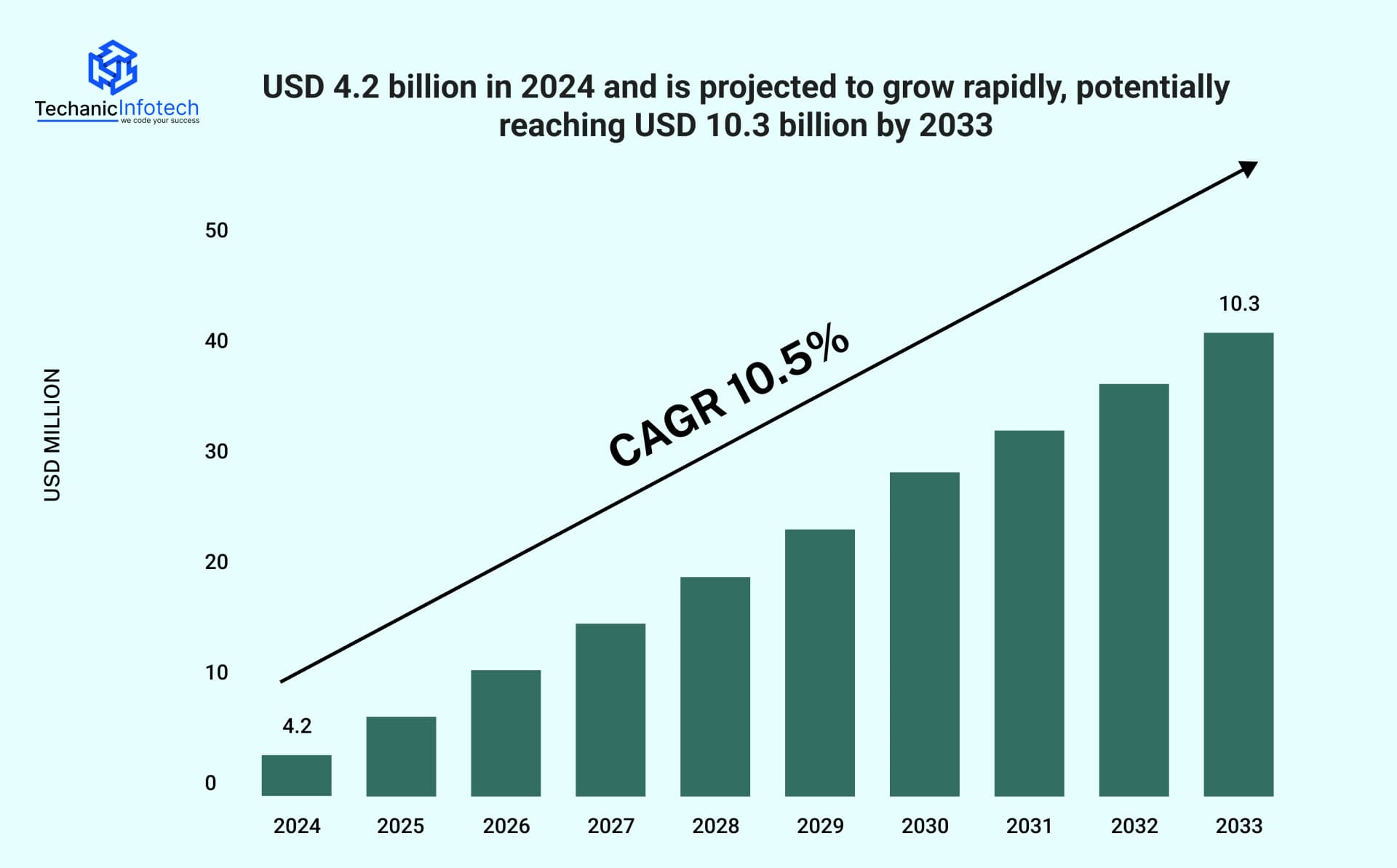
Mobile apps are playing a key role in this growth. According to recent research, the global roadside assistance app market reached approximately USD 4.2 billion in 2024 and is projected to grow rapidly, potentially reaching USD 10.3 billion by 2033 as smartphone adoption and on-demand services expand.
Several trends are shaping the market:
Rising vehicle ownership means more breakdowns and higher demand for rapid support.
Smartphone penetration and mobile connectivity drive adoption of app-based service booking.
Subscription and pay-per-use models make services more accessible and flexible.
Technology integration, like GPS tracking and real-time dispatching, improves response times and user satisfaction.
These trends show that digital roadside support isn’t just a convenience, it’s becoming an expected part of modern driving experiences.
A roadside assistance app is a mobile-based platform designed to help drivers get immediate support when their vehicle breaks down or faces an emergency on the road. Instead of calling multiple service providers or waiting for help, users can request assistance directly through an app.
Whether it’s a flat tire, engine trouble, battery jump-start, or towing, the app connects drivers with nearby service professionals in real time. This makes it a practical solution for modern, on-the-go users who expect quick and reliable help.
Sign Up or Log In: Users register using their phone number, email, or social login to access the app.
Select Assistance Type: The user chooses the required service, such as towing, flat tire help, fuel delivery, or battery jump-start.
Share Live Location: The app automatically detects the user’s location using GPS for accurate service matching.
Get Matched with a Provider: The nearest available service provider is assigned, and the user can track them in real time.
Receive Assistance & Pay: Once the service is completed, users make in-app payments and receive service confirmation.
A successful roadside assistance app focuses on speed, accuracy, and ease of use.
Below are the essential features that ensure a smooth experience for users, service providers, and admins.
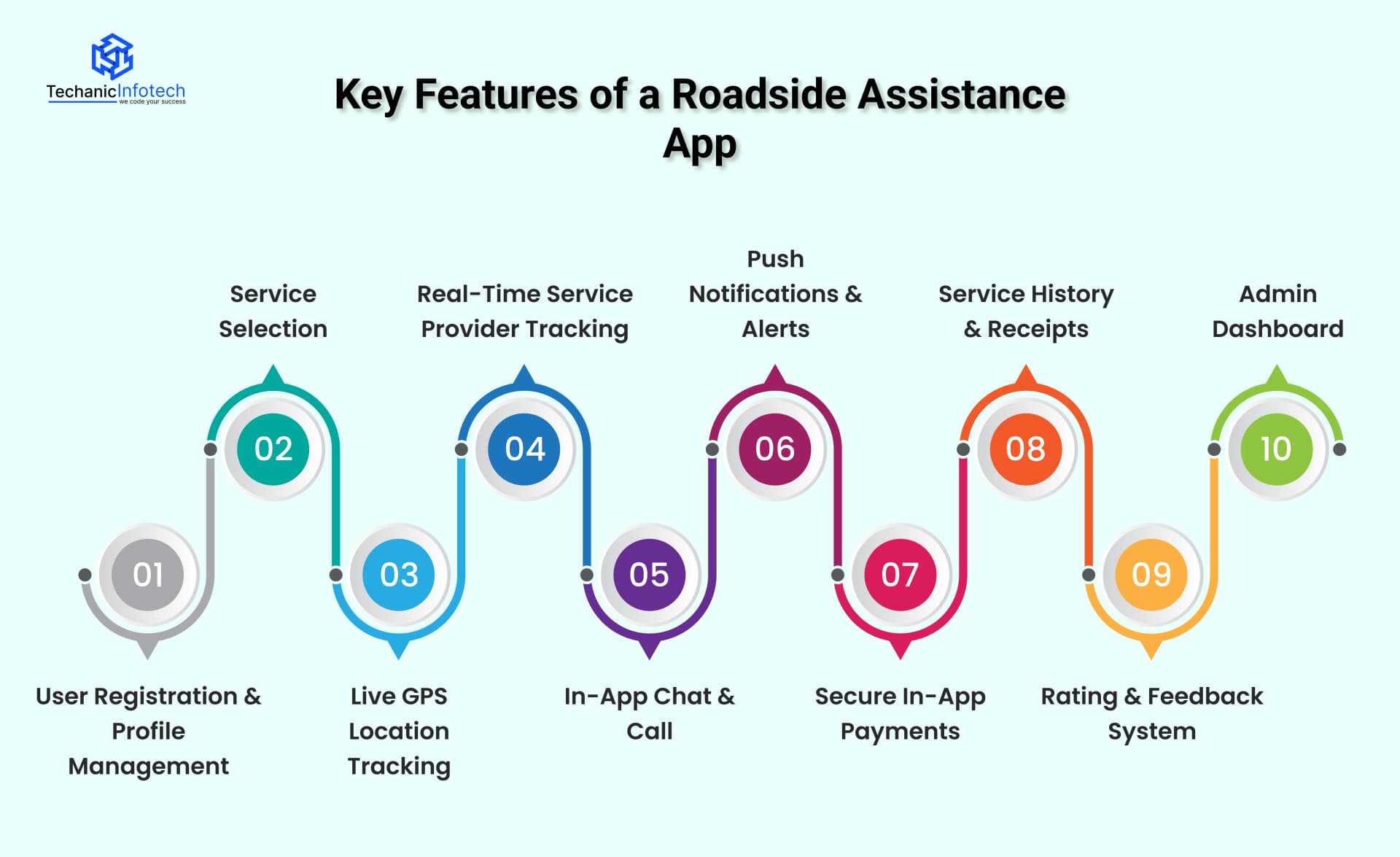
User Registration & Profile Management: Simple sign-up using a phone number, email, or social login, along with profile details and vehicle information.
Service Selection: Users can choose assistance types such as towing, flat tire help, fuel delivery, battery jump-start, or minor repairs.
Live GPS Location Tracking: Automatically detects the user’s location and helps match them with nearby service providers.
Real-Time Service Provider Tracking: Users can track the assigned technician or tow truck live until they arrive.
In-App Chat & Call: Enables direct communication between users and service providers for quick coordination.
Push Notifications & Alerts: Sends updates about request status, provider arrival time, and service completion.
Secure In-App Payments: Supports multiple payment options like cards, wallets, or UPI for seamless transactions.
Service History & Receipts: Users can view past requests, payments, and download invoices.
Rating & Feedback System: Allows users to rate service providers and share feedback to maintain service quality.
Admin Dashboard: Enables admins to manage users, providers, pricing, requests, and analytics efficiently.
Together, these features help build a reliable, user-friendly roadside assistance app that delivers fast support during emergencies.
Building a successful roadside assistance app requires more than just coding. It involves planning, understanding user pain points, choosing the right features, and executing the development process carefully.
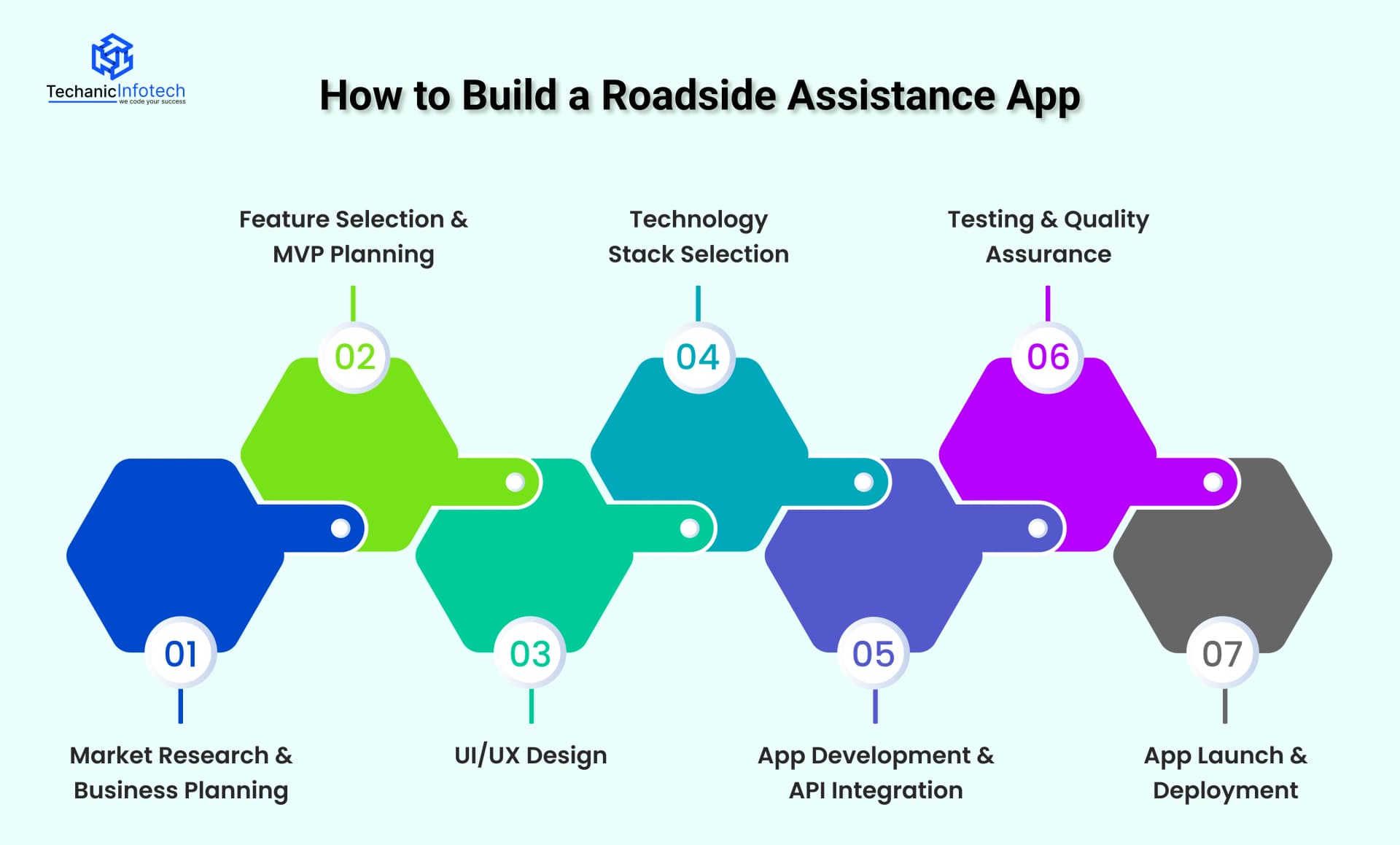
Below is a clear, step-by-step roadside assistance app development guide, explained in simple language.
The first step in roadside assistance app development is understanding the market. This includes studying your target users, competitors, and regional demand.
You need to identify common roadside problems such as towing, flat tires, fuel delivery, or battery jump-starts and analyze how existing apps solve them. Business planning also involves deciding your revenue model, subscription, pay-per-use, or partnerships with insurance companies.
|
Step |
Description |
|
Target Audience Analysis |
Identify who will use the roadside assistance app and their common pain points |
|
Competitor Research |
Analyze existing roadside assistance apps to understand gaps and opportunities |
|
Service Scope Definition |
Decide which services to offer, such as towing, fuel delivery, or battery jump-start |
|
Revenue Model Planning |
Choose monetization models like subscription, pay-per-use, or partnerships |
|
Regional Demand Study |
Understand location-based demand and service availability |
|
Business Roadmap |
Define short-term and long-term growth strategy |
Once research is complete, the next step is deciding the roadside assistance app features. Instead of building everything at once, most businesses start with an MVP (Minimum Viable Product). An MVP includes only essential mobile app features like service requests, live location tracking, provider matching, and payments.
This stage plays a big role in controlling roadside assistance app development cost and speeding up time to market.
|
Feature Category |
Description |
|
Core Features |
Essential features required for app launch and basic functionality |
|
User Safety Features |
Emergency contact, real-time tracking, and alerts |
|
Payment Features |
In-app payments, pricing visibility, and receipts |
|
Provider Features |
Job acceptance, navigation, and availability status |
|
Admin Controls |
User management, pricing rules, and analytics |
|
Future Enhancements |
Advanced features planned for later app versions |
A roadside assistance app is often used during emergencies, so the design must be simple and intuitive. UI/UX design focuses on making the app easy to navigate, even for first-time users. Clear buttons, minimal steps, readable text, and quick access to emergency services are key.
Good design improves trust and ensures users can request help quickly through the vehicle assistance mobile app.
|
UI/UX Element |
Purpose |
|
User Flow Mapping |
Defines how users move from app launch to service request |
|
Wireframing |
Creates basic screen layouts without visual styling |
|
Emergency CTA Buttons |
Ensures quick access to roadside assistance |
|
Navigation Structure |
Keeps the app simple and easy to use during emergencies |
|
Color & Typography |
Improves readability and user focus |
|
Prototyping |
Tests the real app experience before development |
|
Usability Testing |
Validates ease of use with real users |
Choosing the right mobile app technology stack ensures performance, security, and scalability. This includes selecting technologies for frontend (Android/iOS), backend, database, cloud hosting, GPS maps, and payment gateways. The tech stack directly impacts the cost to build a roadside assistance app and future scalability..
A well-planned stack also reduces long-term maintenance issues and supports smooth integration with third-party services. It ensures the app can handle real-time requests without performance drops.
|
Technology Layer |
Purpose |
|
Frontend (Android/iOS) |
Builds user and service provider apps |
|
Backend Framework |
Handles business logic and service requests |
|
Database |
Stores user, provider, and service data |
|
Maps & GPS APIs |
Enables live location tracking and navigation |
|
Payment Gateway |
Supports secure in-app payments |
|
Push Notification Service |
Sends real-time updates and alerts |
|
Cloud Infrastructure |
Ensures scalability and high availability |
|
Security Tools |
Protects data and prevents unauthorized access |
This is where the actual mobile app development process begins. Developers build the user app, service provider app, and admin panel. APIs are integrated for maps, payments, notifications, and real-time tracking.
If your app includes towing services, this phase also overlaps with tow truck app development features like driver availability and navigation.
Smooth API integration ensures the app works reliably during real emergencies.
|
Development Area |
Description |
|
User App Development |
Builds customer-facing roadside assistance app |
|
Provider App Development |
Develops app for tow truck drivers and technicians |
|
Admin Panel Development |
Manages users, services, pricing, and analytics |
|
API Integration |
Connects maps, payments, notifications, and third-party services |
|
Real-Time Tracking |
Enables live location updates and service tracking |
|
Payment Processing |
Handles transactions and billing |
|
Notification System |
Sends service status updates to users and providers |
Before launch, the app must go through rigorous testing. This includes functional testing, performance testing, security testing, and usability testing. Since users rely on the app in urgent situations, even small bugs can lead to poor experiences.
Testing helps ensure the on-demand roadside assistance app performs well under real-world conditions.
|
Testing Type |
Purpose |
|
Functional Testing |
Verifies that all features work as expected |
|
Performance Testing |
Checks app speed and load handling |
|
Security Testing |
Identifies vulnerabilities and data risks |
|
GPS & Location Testing |
Validates accuracy of location tracking |
|
Payment Testing |
Ensures secure and error-free transactions |
|
Device Compatibility Testing |
Tests app on different devices and OS versions |
|
User Acceptance Testing |
Confirms app meets real user expectations |
The final step is deploying the app on app stores and cloud servers. After launching the app on the Play Store or App Store, monitoring performance, fixing bugs, and collecting user feedback are essential. Regular updates help improve features and maintain reliability.
A soft launch or beta release can help identify early issues before full-scale rollout. Post-launch analytics also guide future improvements and feature enhancements.
|
Deployment Step |
Description |
|
Server Setup |
Prepares cloud infrastructure for live usage |
|
App Store Submission |
Publishes apps on Google Play and App Store |
|
Compliance Checks |
Ensures app meets platform and legal guidelines |
|
Monitoring & Analytics |
Tracks performance, usage, and errors |
|
Bug Fixes & Optimization |
Resolves issues post-launch |
|
Feature Updates |
Adds improvements based on user feedback |
|
Maintenance & Support |
Ensures long-term app stability |
The cost and timeline to develop a roadside assistance app depend on factors such as feature complexity, technology choices, and overall project scope.
On average, development costs range between $15,000 to $100,000, whether you’re building a basic MVP or a fully scalable solution. Along with app development cost, the development timeline typically ranges from 3 to 6 months, depending on the app’s functionality and customization level.
A simple roadside assistance app with essential features like service requests, GPS location tracking, and basic payment integration can be developed within 8 to 12 weeks, keeping costs on the lower end. However, adding advanced capabilities such as real-time provider tracking, separate apps for service providers, and enhanced security layers increases both development time and cost.
The timeline is also influenced by your development approach. A phased or MVP-based rollout helps control expenses and allows faster market entry, while rapid development may require larger teams and higher budgets.
|
Development Stage |
Estimated Cost (USD) |
Timeline |
|
Market Research & Planning |
$1,500 – $5,000 |
1–2 weeks |
|
Feature Selection & MVP Planning |
$2,000 – $6,000 |
1–2 weeks |
|
UI/UX Design |
$2,500 – $8,000 |
2–3 weeks |
|
App Development & API Integration |
$6,000 – $45,000 |
8–14 weeks |
|
Testing & Quality Assurance |
$1,500 – $6,000 |
2–3 weeks |
|
App Launch & Deployment |
$1,000 – $4,000 |
1 week |
Roadside assistance apps use multiple revenue streams to stay profitable while offering convenient, on-demand services to users.
Below are the most common ways these apps generate income, explained in simple terms.
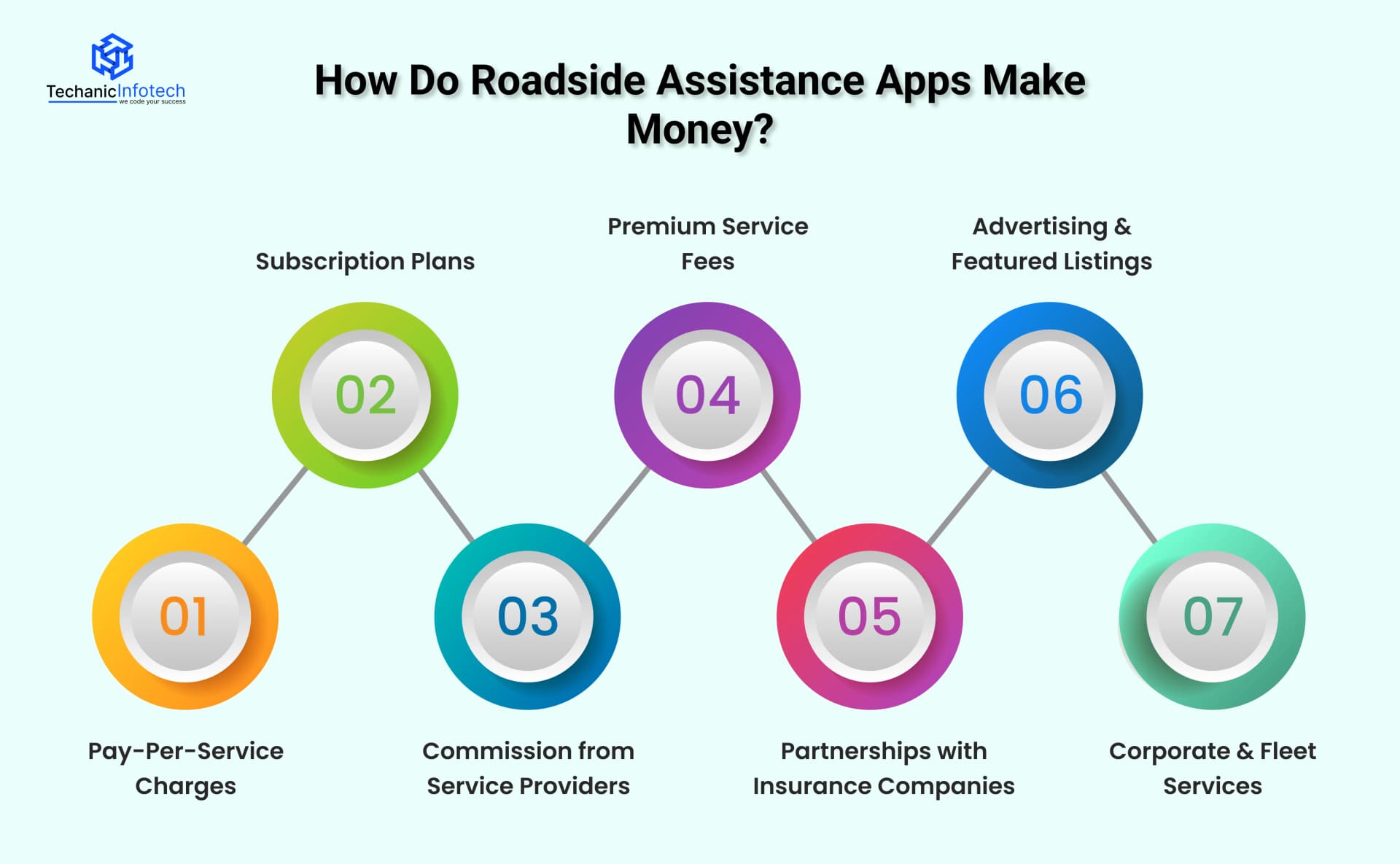
Pay-Per-Service Charges: Users pay a fixed or variable fee each time they request services like towing, battery jump-start, fuel delivery, or tire replacement. This is one of the most direct and widely used monetization models.
Subscription Plans: Many apps offer monthly or annual subscription packages that include a certain number of roadside services. Subscriptions provide steady revenue and encourage long-term user retention.
Commission from Service Providers: Roadside assistance platforms often charge service providers a commission for every job completed through the app. This model works well when the app has a large and active user base.
Premium Service Fees: Users can pay extra for faster response times, priority assistance, or long-distance towing. These premium add-ons increase average order value.
Partnerships with Insurance Companies: Apps partner with insurance providers or automobile brands to offer bundled roadside assistance services, generating revenue through contracts or referrals.
Advertising & Featured Listings: Local garages, mechanics, or towing services can pay for featured placements or promotions within the app to increase visibility.
Corporate & Fleet Services: Businesses managing vehicle fleets pay for bulk roadside assistance plans, creating an additional B2B revenue stream.
By combining multiple monetization models, roadside assistance apps can build sustainable revenue while offering reliable emergency support to users.
Techanic Infotech is a trusted mobile app development company with proven experience in building scalable, secure, and high-performance on-demand applications.
We understand the real challenges involved in roadside assistance platforms, such as real-time tracking, emergency workflows, and seamless communication between users and service providers. Our team follows a practical, feature-first approach to ensure faster launches and cost-effective development.
From UI/UX design and technology selection to development, testing, and post-launch support, we handle the complete app lifecycle. With a strong focus on performance, security, and future scalability, Techanic Infotech helps businesses build reliable roadside assistance apps that deliver real value to users and grow with market demand.
Roadside assistance apps have transformed the way drivers handle vehicle emergencies by offering quick, reliable, and location-based support. With the growing demand for on-demand roadside assistance app development services, investing in a towing app presents a strong business opportunity.
From choosing the right features and technology to understanding development costs, timelines, and monetization models, every decision plays a key role in long-term success. A well-planned app not only improves user safety and convenience but also creates sustainable revenue streams.
By focusing on user needs, performance, and scalability, businesses can build a dependable roadside assistance app that stands out in today’s competitive market.
A roadside assistance app is a mobile platform that helps drivers request emergency vehicle services like towing, battery jump-starts, fuel delivery, or tire replacement in real time using GPS and mobile connectivity.
On average, it takes 3 to 6 months to develop a roadside assistance app, depending on features, design complexity, and integrations.
The development cost usually ranges between $15,000 to $100,000, based on whether you’re building a basic MVP or a full-featured, scalable solution.
Key features include user registration, service selection, GPS tracking, real-time provider matching, in-app payments, notifications, and an admin dashboard.
Yes. These apps make money through pay-per-service fees, subscriptions, commissions from service providers, premium services, and partnerships.
For better efficiency and scalability, most platforms use separate apps for users and service providers along with an admin panel.
Absolutely. With the right technology stack and architecture, these apps can scale easily to support more users, services, and locations.
Yes. A well-designed roadside assistance app can support towing, fuel delivery, battery assistance, tire services, and more within a single platform.


Neha Sharma is a tech expert at heart who loves exploring new technologies and turning complex ideas into easy-to-understand content. With a passion for learning and writing, she enjoys sharing insights on emerging tech, digital products, and innovation that help businesses stay ahead.