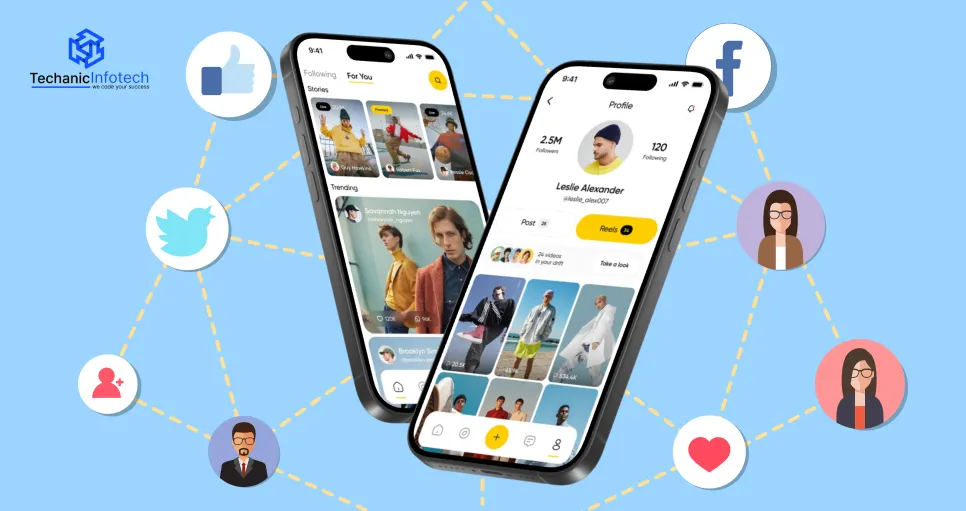
Building a scalable social media app for millions of users is a huge challenge, but it's also an exciting opportunity to reach them.
To build a social media app that can handle users, developers must focus on creating a solid infrastructure, ensuring smooth performance, and keeping the user experience top-notch.
This means leveraging the right technologies like cloud services, microservices, and AI to make the app scalable.
With the right approach, your social media platform can not only survive but thrive in an ever-changing landscape.
In this blog, we’ll explore why social media app development is important, the features to focus on, the development process, and the challenges you’ll need to overcome to build a platform that stands out.
As of 2023, there are more than 4.7 billion active social media users across the globe. This represents nearly 60% of the world’s population, and the user base is expected to continue growing rapidly in the coming years.
Social media advertising revenue is projected to surpass $230 billion by 2025. With platforms like Facebook, Instagram, TikTok, and YouTube becoming prime channels for advertising,
Users spend an average of 2.5 hours a day on social media. This level of engagement demonstrates the increasing importance of social platforms in daily life.
The social commerce market is expected to reach $1.2 trillion by 2025. Social media platforms like Instagram and Facebook are increasingly integrated with shopping features.
More than 40% of global social media users are between the ages of 18 and 34. This demographic is particularly influential in shaping trends, driving content creation, and engaging with brands
High-performance social media app development has become more crucial as these platforms shape how we communicate, share information, and connect globally.
With billions of active users, the influence and potential of social media continue to expand, making social media app an essential tool for businesses, individuals, and communities alike.
The following are the key reasons that make it important to consider steps to develop a social media app in this digital world.
Social media has completely transformed how we connect, enabling users to communicate, collaborate, and share experiences with people from all over the world.
It removes geographical boundaries, creating global communities where users can interact in real-time, share ideas, and engage in cultural exchanges, all without the need for physical proximity.
For businesses, social media offers an affordable and powerful tool for marketing and customer engagement.
Through targeted ads, influencer collaborations, and organic content, businesses can boost brand awareness, foster customer loyalty, and drive sales.
Social media allows brands to reach a massive audience, interact directly with consumers, and grow their presence cost-effectively.
Social media platforms are essential for real-time communication, providing immediate access to news, trends, and events worldwide.
Whether breaking news, viral trends, or live updates, platforms like Twitter, Facebook, and Instagram offer fast, efficient ways to stay informed.
This speed has made social media the go-to source for immediate information dissemination.
Social media offers individuals a platform to share their ideas, opinions, and creative works with a global audience.
Whether posting personal achievements, artistic creations, or everyday thoughts, social media enables self-expression and allows users to build their identity.
This fosters a sense of belonging and connection with others who share similar interests.
Social media has become a powerful tool in shaping modern culture. Viral challenges, trends, and movements spread rapidly, influencing everything from fashion and music to politics and social change.
Platforms like Instagram, TikTok, and Twitter are central to the creation and dissemination of cultural shifts, amplifying voices and movements on a global scale.
To build a social media app, it's crucial to include key features that enhance user interaction, content creation, privacy, and overall engagement.
Below are five essential features in social media apps to consider in the development process:
One of the most critical features in any high-performance social media app is secure user authentication.
Users need to feel confident that their personal information is protected when using the platform.
Implementing secure login methods such as multi-factor authentication (MFA), biometric logins (like fingerprint or face recognition), and integration with third-party login options can streamline the registration process while ensuring security.
A personalized experience is key to keeping users engaged and satisfied. Social media apps should offer customizable user profiles, allowing users to showcase their interests, hobbies, and social circles through photos, bios, and links.
Personalization can go beyond profiles with content recommendation algorithms that suggest posts, groups, and friends based on user behavior and preferences.
The content feed is the heart of any social media app. It’s where users scroll through posts, pictures, videos, and stories from their friends, influencers, and brands.
A well-designed feed should be dynamic and visually appealing, with smooth scrolling and easy-to-navigate interfaces.
The feed should support a wide range of content types, from text and images to videos, live streams, and stories, encouraging users to share their experiences in creative ways.
Push notifications are a vital feature for keeping users engaged with your app. Notifications alert users to important activities such as new followers, messages, comments, or updates from groups and pages they follow.
The key is to ensure that notifications are relevant and not overwhelming, where users should have the option to customize which alerts they receive.
As social media platforms grow, maintaining privacy and ensuring safe interactions are top priorities.
Offering robust privacy settings allows users to control who can view their posts, interact with them, and see their personal information.
Features such as blocking, reporting, and content filtering ensure that users feel safe on the platform.
Additionally, content moderation tools are necessary to enforce community guidelines and prevent harmful content from being posted.
Developing social media apps usually requires a strategic approach, from defining a niche to selecting the right tech stack for a mobile app and creating a social media app with user friendly design.
This step-by-step section on creating a social media app properly outlines the key phases involved in making an app a successful or scalable platform.
The first step in developing a social media app is conducting thorough market research. Understand your target audience and competitors.
Define the unique value proposition of your app: what problem will it solve or what need will it fulfill?
Identify trends, assess user preferences, and pinpoint features that will differentiate your app from others. Clear insights from research will guide the design, features, and marketing strategy.
Selecting the right technology stack is crucial for the app's performance and scalability. Choose frameworks that can efficiently handle the app's requirements.
For mobile development, consider React Native or Flutter for cross-platform compatibility.
On the backend, Node.js, Django, or Ruby on Rails are strong contenders, while cloud solutions like AWS, Google Cloud, or Azure offer reliable hosting and storage solutions.
Also, ensure database scalability with options like PostgreSQL, MongoDB, or Firebase.
The user interface (UI) and user experience (UX) design are critical to making social media app intuitive and engaging.
Begin by creating wireframes and prototypes that showcase the layout, design elements, and flow of the app. Focus on simplicity, easy navigation, and a seamless experience across devices.
Get support from the mobile app design guide to create visually appealing and functional interfaces. The goal is to make the app aesthetically pleasing while prioritizing usability.
With your tech stack and designs in place, it's time to start developing core features. These include user registration and authentication, profile creation, content sharing (text, images, videos), commenting, notifications, and a personalized content feed.
Implement robust security features such as data encryption, multi-factor authentication, and privacy settings.
Each feature should be carefully developed and tested to ensure performance, security, and a smooth user experience from the start.
The backend is the backbone of any social media app. Set up your server, APIs, and database structure to handle user data, content, and interactions.
This stage involves integrating your app’s features with backend services for data storage, user management, and content delivery.
You’ll also need to implement push notification systems, social sharing capabilities, and any third-party integrations (such as Google or Facebook login). A well-structured backend is key to app stability, security, and social media app scalability.
Testing is crucial to ensure your social media app functions properly across all devices and platforms.
Perform a combination of manual and automated testing to identify bugs, performance issues, and usability flaws.
Test for load capacity, especially if you expect high user traffic. Also, check for security vulnerabilities, especially with sensitive data like personal information and messages.
Ensure the app performs smoothly in real-world scenarios to avoid frustrating users post-launch.
After thorough testing, it’s time to launch scalable Android apps on the Play Store and App Store. Before launch, create a pre-launch marketing strategy to generate buzz.
Use social media campaigns, influencer partnerships, and targeted ads to attract early users. Once launched, monitor user feedback, fix any issues promptly, and continuously improve the app.
Regularly update your app with new features, security patches, and content to keep users engaged and retain them long-term.
Custom mobile app development involves overcoming various technical, ethical, and business challenges.
From ensuring user privacy to maintaining engagement and social media app scalability, developers must tackle numerous issues to build a social media app that meets user needs.
One of the biggest challenges is ensuring user privacy and securing personal data. Social media apps collect vast amounts of sensitive data, such as location, communication, and personal preferences.
With increasing concerns over data breaches and misuse of personal information, developers need to implement strong encryption methods, secure authentication protocols, and comply with privacy regulations (like GDPR).
As the user base grows, social media platforms need to scale efficiently. A sudden increase in traffic can slow down the platform, making it unresponsive or unreliable.
Developers must focus on optimizing the social media app architecture, using cloud services, and incorporating load balancing, data caching, and efficient database management to ensure the platform remains fast and responsive, no matter how many users it serves.
Keeping users engaged and retaining them on the platform is a significant challenge. With so many social media apps competing for attention, it’s important to create features that stand out and keep users coming back.
Developers need to consider social media app design for making interactive interfaces, push notifications, gamification elements, and personalized content feeds that align with users’ interests.
Social media platforms face the challenge of moderating user-generated content. Offensive, harmful, or inappropriate content can quickly become a major issue, both in terms of user experience and legal liability.
Implementing automated content moderation tools, like AI-based systems, alongside manual review processes, is vital.
Monetizing a social media app without alienating users is a tricky balancing act. Ad-based revenue models are common, but excessive ads or poorly targeted ones can lead to a bad user experience.
Developers must explore different monetization strategies like premium subscriptions, in-app purchases, or partnerships while ensuring the app remains user-friendly.
Partnering with the best social media app development company, Techanic Infotech helpful in developing your app ensures that you are working with a team of experts who understand the intricacies of the social media app development process.
From creating user-friendly interfaces to implementing secure data practices, Techanic Infotech brings innovative solutions tailored to your needs.
Their expertise in designing scalable, engaging platforms ensures that your app can grow with your user base. They focus on enhancing user experience while optimizing app performance.
Whether it's developing interactive features, maintaining privacy standards, or ensuring seamless integration, Techanic Infotech provides end-to-end services.
Their technical proficiency, combined with a user-centric approach, guarantees a social media app that stands out in the competitive market.
Building a successful and scalable social media app requires a thoughtful approach to both technology and user experience.
From selecting the right tech stack to ensuring data security and creating engaging features, every step in the development process plays a crucial role in the app's long-term success.
Social media apps for millions of users with growing market demand, social media platforms present vast opportunities for innovation. However, developers need to overcome challenges like scalability, user engagement, and monetization.
By collaborating with a professional development company like Techanic Infotech, you can ensure your social media app development process is done with a focus on scalability, security, and performance.
With their expertise, you can build a social media app that not only attracts users but also keeps them engaged, ensuring long-term success in a competitive digital landscape.
Whether you aim to build an app like Instagram or launch a new concept, Techanic Infotech is ready to help you bring your vision to life.
To start, define your target audience and niche. Then, choose the right tech stack, design an engaging UI/UX, and plan essential features like user profiles, content sharing, and real-time notifications.
Technologies like cloud services, microservices, React Native or Flutter for cross-platform apps, and backend frameworks like Node.js or Django are essential for building scalable social media apps.
Use scalable cloud hosting, data caching, load balancing, and optimize your social media app architecture for performance. Testing for high-traffic scenarios is crucial for ensuring your app can handle millions of users.
Key challenges include managing user privacy and data security, ensuring app scalability, keeping users engaged, moderating content, and finding effective monetization strategies without hurting the user experience.
The development timeline varies based on features and complexity, but it typically takes several months to design, develop, test, and launch a fully functional and scalable social media app.


Neha Sharma is a tech expert at heart who loves exploring new technologies and turning complex ideas into easy-to-understand content. With a passion for learning and writing, she enjoys sharing insights on emerging tech, digital products, and innovation that help businesses stay ahead.