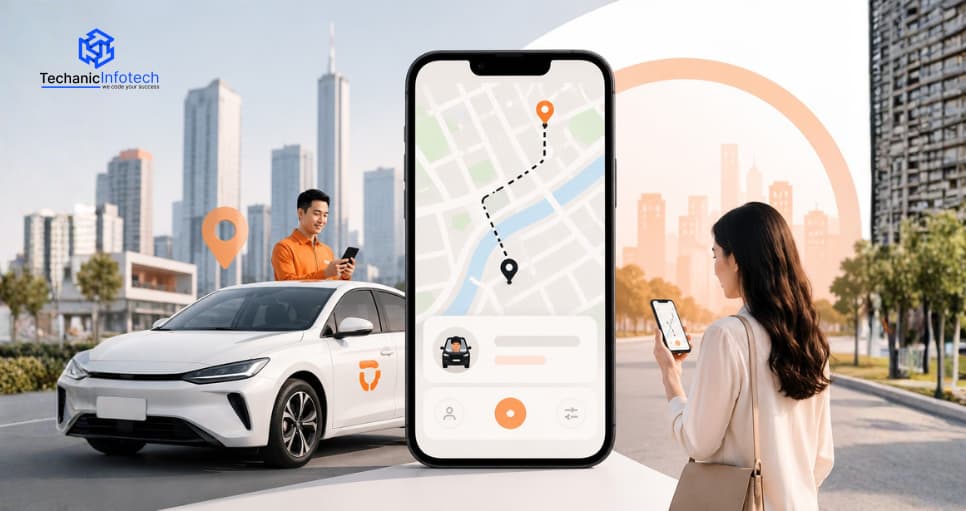
The ride-hailing industry is transforming urban transportation, creating massive opportunities for entrepreneurs and businesses worldwide. According to industry projections, the global ride-hailing market is expected to surpass $260 billion by 2030, with more than 2.3 billion users relying on ride-booking services for their daily travel needs.
This rapid growth has inspired many businesses to develop apps similar to DiDi, one of the world's leading mobility platforms serving hundreds of millions of users across multiple countries.
However, building a successful ride-hailing platform requires much more than connecting riders with drivers. Modern users expect real-time GPS tracking, secure digital payments, intelligent ride matching, transparent pricing, and advanced safety features within a seamless mobile experience.
If you're planning to create an app like DiDi, understanding the development process, required features, market opportunities, challenges, and investment costs is essential. This comprehensive guide explains everything you need to know about building a scalable ride-hailing platform, from market research and feature planning to technology selection, monetization strategies, and launch preparation.
Whether you're a startup founder, transportation business owner, or entrepreneur exploring the mobility sector, this guide will help you understand how to build a successful ride-hailing solution and compete in this rapidly expanding market.
DiDi is not simply a taxi app; it's a mobility superpower that has overturned the daily travel of millions of people.
After being just a taxi-hailing service in China, DiDi expanded its empire in a very short time to become a one-stop shop for urban transportation.
The company went from private cars and bike sharing to food delivery and financial services, creating an ecosystem that is based on the two pillars of efficiency and user convenience.
The company didn't experience wonderful growth by chance; it was a result of a data-driven approach and a deep understanding of local markets.
If you are aiming at building a taxi booking app, watching DiDi’s evolution is nothing less than a masterclass on how to scale up from a single service to a worldwide phenomenon.
Building a taxi booking app like DiDi requires strategizing and planning with a thorough knowledge of the ride-hailing ecosystem. The road from concept to launch is multi-phase, each milestone standing at the crucial point of your app's success.
You are not merely developing an app but creating an all-encompassing transportation solution that links drivers, passengers, and businesses together onto one seamless platform.
Let’s get to know it all:
Conduct in-depth market research in your target area before you develop an app like DiDi.
Understanding taxi app market trends , competitor analysis, and user preference data will steer your entire technique.
Analyze the present players in your market. What are they doing right? Identify areas where you can fill in the gaps.
Evaluate pricing models, service offerings, and user grievances to create your key differentiators.
Research local regulations and licensing requirements for ride-hailing services in your targeted regions. Varying rules voiced across regions might be concerning driver requirements, vehicle standards, or operational permits.
Choose the revenue model that aligns with your market positioning and growth.
Commission-based models can be efficient in established markets, whereas subscription models might be appropriate for less developed regions.
Think of many sources of income: ride commissions, delivery services, advertising partnerships, and premium features.
The diversification of income helps to generate a stable income and, at the same time, reduces the dependency on a single revenue source.
Firstly, clearly identify your target audience. What are you aiming at: riders that are conscious of the budget, premium customers, or specific demographics?
Your business model should be the reflection of these decisions in all features and services without any inconsistency.
Design a technical infrastructure that could support your business from the first day to the end of the timeline.
Cloud-based solutions offer that flexibility and cost-effectiveness, which is very attractive to a ride-hailing platform that is growing fast. This infrastructure will support a scalable taxi app design from the first day to the end of the timeline.
Decide between native and cross-platform development that is most suitable for your budget and timeline.
Native apps have a higher level of efficiency, while cross-platform solutions are more cost-effective.
For real-time location updates, trip data, and user information, make sure that the database architecture is efficient.
For scalability, and also for easier maintenance as your business gets bigger, go for a microservices architecture.
Develop three core applications: passenger app, driver app, and admin panel.
Each component serves different user needs while maintaining seamless integration across the entire ecosystem.
The passenger app focuses on booking convenience, trip tracking, and payment processing.
User experience should be intuitive, allowing ride booking in just a few taps.
The driver app emphasizes navigation, earnings tracking, and trip management features.
Drivers need efficient tools to maximize their earning potential while providing excellent service.
The admin panel provides comprehensive control over operations, analytics, and user management.
Administrators require detailed insights to make data-driven decisions about platform optimization.
Implement GPS tracking and mapping services for accurate location detection and routing.
Real-time location updates ensure passengers can track their rides while drivers navigate efficiently.
Integrate multiple payment gateways to accommodate various user preferences and regional payment methods.
Secure payment processing builds trust while reducing transaction friction for users.
Develop a robust matching algorithm that connects passengers with nearby drivers quickly.
Smart matching considers factors like distance, driver ratings, and estimated arrival times.
Build comprehensive safety features, including driver background checks, real-time trip sharing, and emergency buttons.
User safety should be your top priority throughout the entire ride experience.
Implement data encryption and secure authentication to protect user information and transaction data.
Security breaches can destroy user trust and damage your platform's reputation permanently.
Create a rating and review system that maintains service quality while providing feedback loops.
Two-way ratings help maintain standards for both drivers and passengers.
Do extensive app testing and make sure the performance is checked and consistent across various devices, different operating systems, and network conditions.
In essence, the user experience of your app should be the same irrespective of whether a user is using low hardware or connectivity with limitations.
Test real-world situations such as heavy usage periods, bad network conditions, and unusual cases.
Allowing the customers to use the product to the full extent will not only attract and please customers, but it will uncover any weaknesses of the product before the user experience is compromised.
Collect comments from the beta users to get hints about the usability issues and the lack of features.
Insight from real user feedback is usually the source of problems being found when internal testing fails.
Control the demand at the start, and start with a limited geographic area and a phased launch.
Slow increase in territory will give you the moment to sort the operational challenges and also grow a great user base on the other side.
Start marketing campaigns targeting captains and passengers at the same time.
The dynamics of two-sided marketplaces are such that balanced growth is essential to keep the equilibrium.
Design incentive programs for the first users so that they can encourage testing and initial excitement creation.
Pricing at discounts and extra bonuses at the beginning will fuel users' sign-ups in the battle with other apps.
Keep track of your most important performance indicators such as user acquisition, retention, and satisfaction metrics.
The insights gained through the use of data come from compositions for features and for correcting the strategy of the business.
Realize that user feedback and market conditions are always changing, and these should be taken into consideration when app updates are being planned and implemented.
The regular updating is an arrow showing that the app developer is committed to the user's comfort every time.
Grow steadily but still keep the service quality and operational efficiency at the same level.
The growth should be more of the sustainable kind as opposed to rapid expansion that would compromise the user experience.
You are required to use taxi app features properly while working on an app like DiDi, which is the key element in getting and retaining users.
These features differentiate successful platforms from mediocre ones, creating value for passengers, drivers, and your business simultaneously.
Let’s get to know the features:
Advanced GPS tracking provides accurate location services for both passengers and drivers throughout their journey.
Users can track their ride in real-time, see the driver's location, the estimated arrival time, and route progress.
This feature builds trust and reduces anxiety by keeping passengers informed about their trip status.
The system should work efficiently even in areas with poor network connectivity, ensuring consistent service quality.
An intelligent matching system connects passengers with the most suitable nearby drivers based on multiple factors, including distance, driver ratings, vehicle type preferences, and estimated pickup time.
This algorithm optimizes for both speed and quality, ensuring passengers get quick pickups while drivers receive profitable ride requests.
Machine learning capabilities improve matching accuracy over time by analyzing user behavior patterns and preferences.
Flexible payment integration supports various methods, including credit cards, digital wallets, cash payments, and regional payment solutions.
Users appreciate having choices that match their preferences and financial habits.
The system should handle transactions securely while supporting multiple currencies for international operations.
Automatic payment processing eliminates friction, while split payment options accommodate group travel scenarios.
Built-in navigation helps drivers reach destinations efficiently using real-time traffic data and route optimization algorithms.
The system suggests the fastest routes while avoiding traffic congestion, construction zones, and road closures.
Voice-guided directions keep drivers focused on the road while integrated mapping reduces dependency on external navigation apps.
Route optimization saves time and fuel costs for drivers.
Comprehensive rating mechanisms maintain service quality by allowing passengers and drivers to evaluate each other after completed trips.
The system encourages accountability while helping users make informed decisions about their ride partners. Detailed review options beyond simple star ratings provide valuable feedback for service improvement.
This feature helps identify top-performing drivers and address service quality issues proactively. It is a pretty common feature that can be seen in many top taxi booking apps.
Localization features make your app accessible to diverse user bases by supporting multiple languages and cultural preferences.
This includes translated interfaces, localized currency displays, and region-specific payment methods.
Cultural adaptation goes beyond translation to include appropriate imagery, color schemes, and user interaction patterns.
Multi-language support significantly expands your potential user base in multicultural markets.
Comprehensive safety tools include emergency contact sharing, panic buttons, ride sharing with trusted contacts, and integration with local emergency services.
Passengers can share trip details with family members automatically, while emergency buttons provide quick access to help when needed.
Driver safety features include incident reporting tools and direct communication with support teams. These features build trust and encourage platform usage.
Pre-booking capabilities allow users to schedule rides in advance for important appointments, flights, or events.
The system should handle scheduling efficiently while sending reminders to both passengers and drivers.
Advanced booking helps drivers plan their schedules while giving passengers peace of mind for time-sensitive trips. Integration with calendar applications streamlines the scheduling process for regular users.
The ride-hailing industry offers unique advantages for entrepreneurs looking to establish profitable, growth-oriented ventures.
Here are some amazing benefits for businesses to develop an app like DiDi:
Commission-based earnings grow automatically with increased ride volume, creating passive income streams that expand with your user base.
Unlike traditional businesses requiring physical expansion, digital platforms scale efficiently across multiple markets without proportional cost increases.
Ride-hailing apps can easily expand into adjacent services like food delivery, package shipping, and logistics solutions.
This diversification reduces business risk while maximizing platform utilization and creating additional revenue streams from existing user bases.
Comprehensive user data provides valuable insights into transportation patterns, user preferences, and market trends.
This information enables data-driven decision-making while creating opportunities for targeted marketing and premium service offerings that increase profitability.
Developing a ride-hailing platform creates valuable intellectual property and technical capabilities that can be licensed or adapted for other markets.
The technology becomes a long-term asset that appreciates in value while providing competitive advantages.
Building a ride-hailing platform involves much more than creating a passenger and driver app. Businesses need scalable architecture, real-time GPS tracking, secure payment systems, route optimization, and robust admin controls to ensure smooth operations.
Partnering with an experienced taxi booking app development company helps reduce development risks, accelerate time-to-market, and create a reliable platform capable of handling thousands of daily ride requests. A well-developed taxi app can improve customer satisfaction, increase driver retention, and support long-term business growth.
The cost to develop an app like DiDi depends on multiple factors, including feature complexity, technology stack, third-party integrations, security requirements, platform selection, and development team location.
A basic MVP cost to build a taxi app with essential ride-booking functionality requires a lower investment, while a fully-featured platform with advanced analytics, AI-powered matching, loyalty programs, and enterprise-grade security requires a significantly larger budget.
Typically, the cost to build a taxi booking app like DiDi ranges between $10,000 and $90,000+, depending on project scope and customization requirements.
|
Development Component |
Estimated Cost (USD) |
|
UI/UX Design |
$2,000 – $8,000 |
|
Passenger App Development |
$4,000 – $20,000 |
|
Driver App Development |
$4,000 – $20,000 |
|
Backend Development |
$5,000 – $25,000 |
|
Admin Panel |
$2,000 – $10,000 |
|
Third-Party Integrations |
$1,000 – $5,000 |
|
Testing & Quality Assurance |
$1,000 – $7,000 |
|
Security Implementation |
$1,000 – $8,000 |
|
Total Estimated Cost |
$10,000 – $90,000+ |
The final investment depends on your business goals, target market, scalability requirements, and custom feature requirements. Working with an experienced taxi booking app development company can help optimize costs while ensuring long-term platform reliability and growth.
So, you want to create an app like DiDi? That's a fantastic goal. But let's be real, you're not just building a simple app.
You're building an entire ecosystem, a digital network that connects people, places, and payments, all in real time. It's a huge undertaking, but it's totally achievable with the right strategy.
But before you can develop an app like DiDi, you need to understand the battlefield. The on-demand ride-hailing world is full of potential, but also some serious hurdles. Here are five of the biggest challenges you'll face and how to overcome them.
Imagine this: a rider taps to book a ride, and a driver has to be matched instantly, with their location updating every second on a map.
That's a lot of data flying around. The biggest challenge in building a system like this is ensuring everything works smoothly and in real time without lag.
If your app is slow or the map isn't accurate, people will abandon it instantly.
The Solution
To make an app like DiDi, you need a powerful back-end. We're talking about a system built to handle millions of simultaneous requests.
You need to use advanced GPS and mapping APIs that provide hyper-accurate data. We solve this by using scalable cloud infrastructure and sophisticated real-time databases that can handle the massive flow of location data without breaking a sweat.
You're not just attracting riders; you're also trying to bring in and retain drivers.
This is the classic "chicken and egg" problem. How do you get riders to use an app with no drivers?
How do you get drivers to sign up for an app with no riders? It's a tough balance to strike.
The Solution
The key is to start with a focused strategy. Don't try to launch in an entire city at once. Pick a small, high-density area and offer strong incentives.
For drivers, this could mean better commission rates or bonuses. For riders, it might be heavily discounted first rides.
Once you build a strong, loyal base in one area, you can then build an app like DiDi by gradually expanding outward.
People are trusting your app with their safety. This is non-negotiable. Many taxi apps fail due to a lack of safety measures.
Both riders and drivers need to feel secure. From vetting drivers to ensuring a safe ride, a single negative incident can destroy your brand's reputation.
The Solution
Safety must be built into the core of your app.
This means integrating features like in-app emergency buttons, real-time trip sharing with loved ones, and a rigorous driver verification process that includes background checks.
You also need a robust two-way rating system to hold everyone accountable and a dedicated support team ready to handle any issues that arise.
Handling money seems simple, but it's not.
You need to integrate secure payment gateways that work for your target market, whether that's credit cards, mobile wallets, or even cash.
You also need a transparent and fair commission system for drivers, with a reliable payout schedule. Any hiccup here and you'll lose trust on both sides of the marketplace.
The Solution
The best approach is to partner with a trusted payment provider that offers a multi-currency, secure system.
We integrate all the major payment options to ensure a smooth transaction. You also need a clear and automatic system for calculating and transferring driver earnings.
This kind of reliability is what will set you apart when you develop an app like DiDi.
You start with a few hundred users, but what happens when you have millions? Your app needs to be able to handle explosive growth without crashing or slowing down. The infrastructure you choose on day one will determine your success in the long run.
The Solution
This is where our expertise truly shines. When we develop an app like DiDi, we use a modular and scalable architecture from the very beginning. This means your app can grow with your business.
We build the app on a solid foundation that allows for seamless expansion, whether you’re adding new features or launching in a new city.
Your app will be ready to handle the demand, no matter how fast you grow.
Building a successful app like DiDi requires careful planning, substantial investment, and expert development capabilities. The ride-hailing market offers tremendous opportunities for entrepreneurs willing to create innovative transportation solutions that serve their local markets effectively.
Success depends on understanding user needs, implementing essential features, and maintaining high service quality while scaling operations efficiently. With proper planning and execution, your taxi booking app can capture significant market share while building a profitable, sustainable business.
The key is starting with a clear vision, choosing the right development partner, and focusing on creating exceptional user experiences that differentiate your platform from existing competitors. When you make a taxi booking app like DiDi with the right approach, you're building more than just an app; you're creating a comprehensive transportation ecosystem
The development cost typically ranges from $10,000 to $90,000+, depending on features, complexity, and integrations.
A taxi booking app usually takes 2 to 8 months, depending on project scope and requirements.
Essential features include GPS tracking, ride booking, payments, driver management, ratings, and safety tools.
Yes, launching in one city helps validate your business model before expanding to larger markets.
Taxi apps earn through ride commissions, surge pricing, subscriptions, advertisements, and cancellation fees.
Flutter, React Native, Node.js, and cloud-based infrastructure are popular choices for scalable taxi apps.
GPS tracking improves ride accuracy, passenger safety, route optimization, and overall user experience.
A taxi booking app development company ensures faster development, scalability, security, and industry-standard features.


Abhishek Jangid is the CEO of Techanic Infotech, with extensive experience in mobile app and web development. He specializes in helping businesses turn innovative ideas into scalable digital solutions through strategic planning and modern technology.