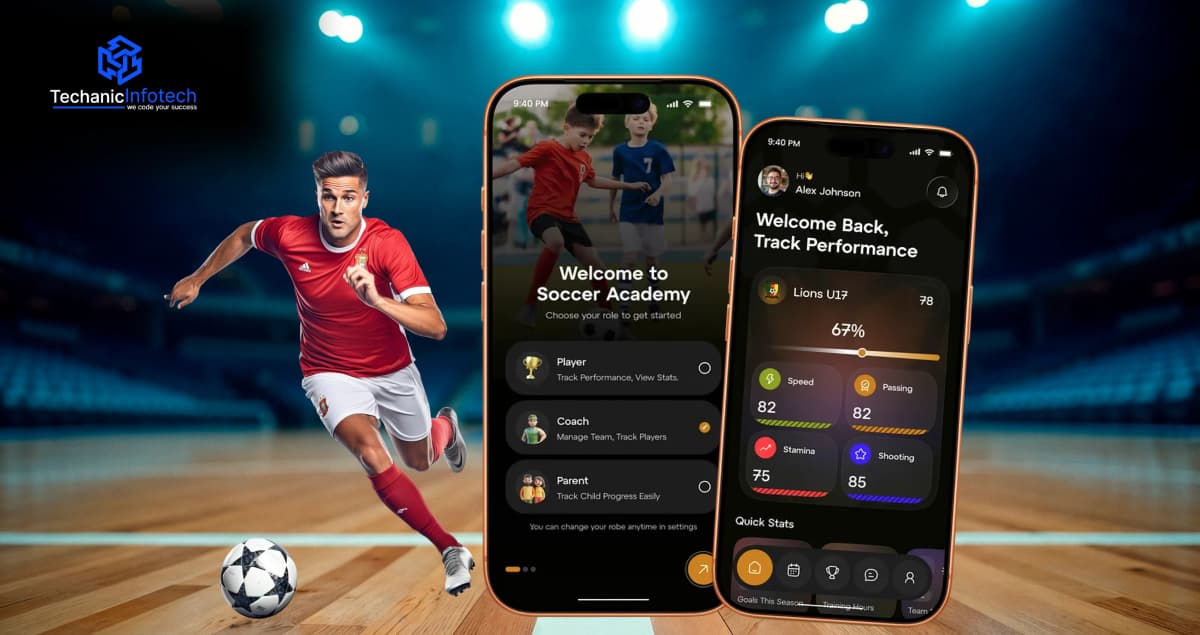
Fantasy Sports App Development
How to Develop a Soccer Mobile App: Features, Cost & Development Process
February 4, 2026
February 4, 2026
Soccer is the world’s most popular sport, engaging billions of fans across continents, leagues, and age groups.
With the rapid growth of smartphones, soccer enthusiasts now expect instant access to live scores, match updates, statistics, and exclusive content through mobile apps.
Creating a soccer mobile app allows businesses, startups, and sports organizations to tap into this massive digital audience.
A well-designed soccer app not only delivers real-time information but also builds strong fan communities, drives engagement, and opens multiple revenue streams.
From live match tracking to fantasy leagues and coaching tools, soccer apps serve diverse user needs.
With the right strategy, features, and technology stack, a soccer mobile app can become a scalable, profitable, and long-term digital asset.
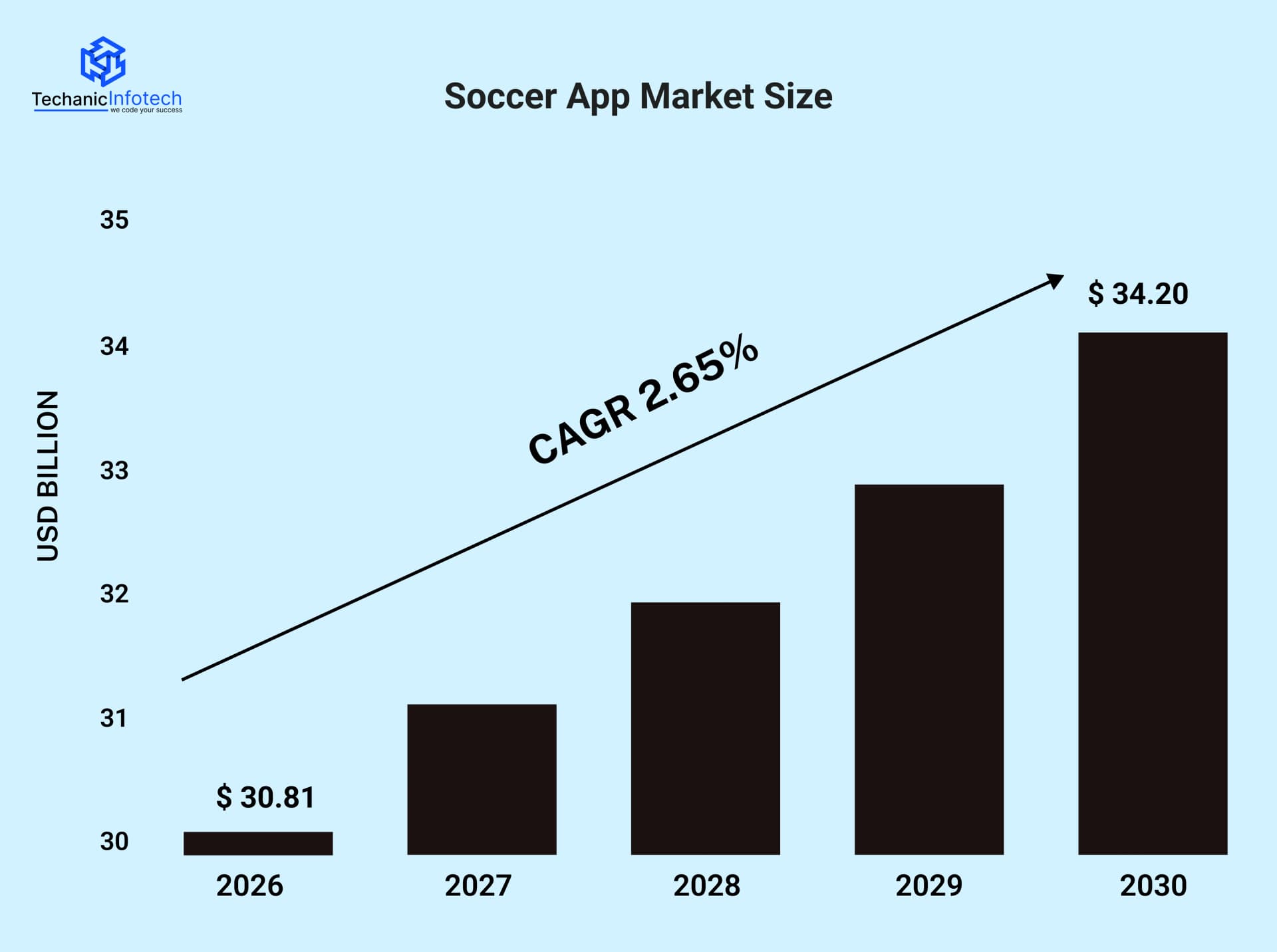
By 2026, the soccer market is projected to generate US$30.81 billion in revenue.
By 2030, the market is expected to expand at a 2.65% CAGR, reaching US$34.20bn by the end of the year.
The United Kingdom is an3ticipated to be the largest revenue contributor worldwide, with US$6.44bn in 2026.
In 2026, the soccer market’s average revenue per user (ARPU) is forecast at US$15.56
The total user base is projected to grow to 1.9bn users by 2030.
User penetration within the soccer market is expected to reach 25.1% in 2026.
Soccer has a massive global fanbase that demands instant match updates, live scores, and personalized content directly on mobile devices, driving consistent app usage.
The rise of fantasy leagues and esports has increased demand for interactive soccer apps that offer predictions, player analytics, and competitive gameplay experiences.
Fans prefer real-time notifications, live commentary, and video highlights, making mobile apps more convenient than traditional TV or websites.
Clubs, leagues, and brands use soccer apps to build loyal communities, engage fans directly, and deliver exclusive content and merchandise.
Growth in mobile streaming technology enables fans to watch matches anywhere, increasing reliance on feature-rich soccer mobile applications.
Data-driven insights, statistics, and AI-powered predictions make soccer apps valuable tools for fans, coaches, and analysts alike.
Soccer mobile apps come in various types, including live score apps, fantasy soccer platforms, team and league management apps, training and coaching apps, and streaming apps.
The following are the types that serve different user needs while supporting diverse engagement and monetization goals.
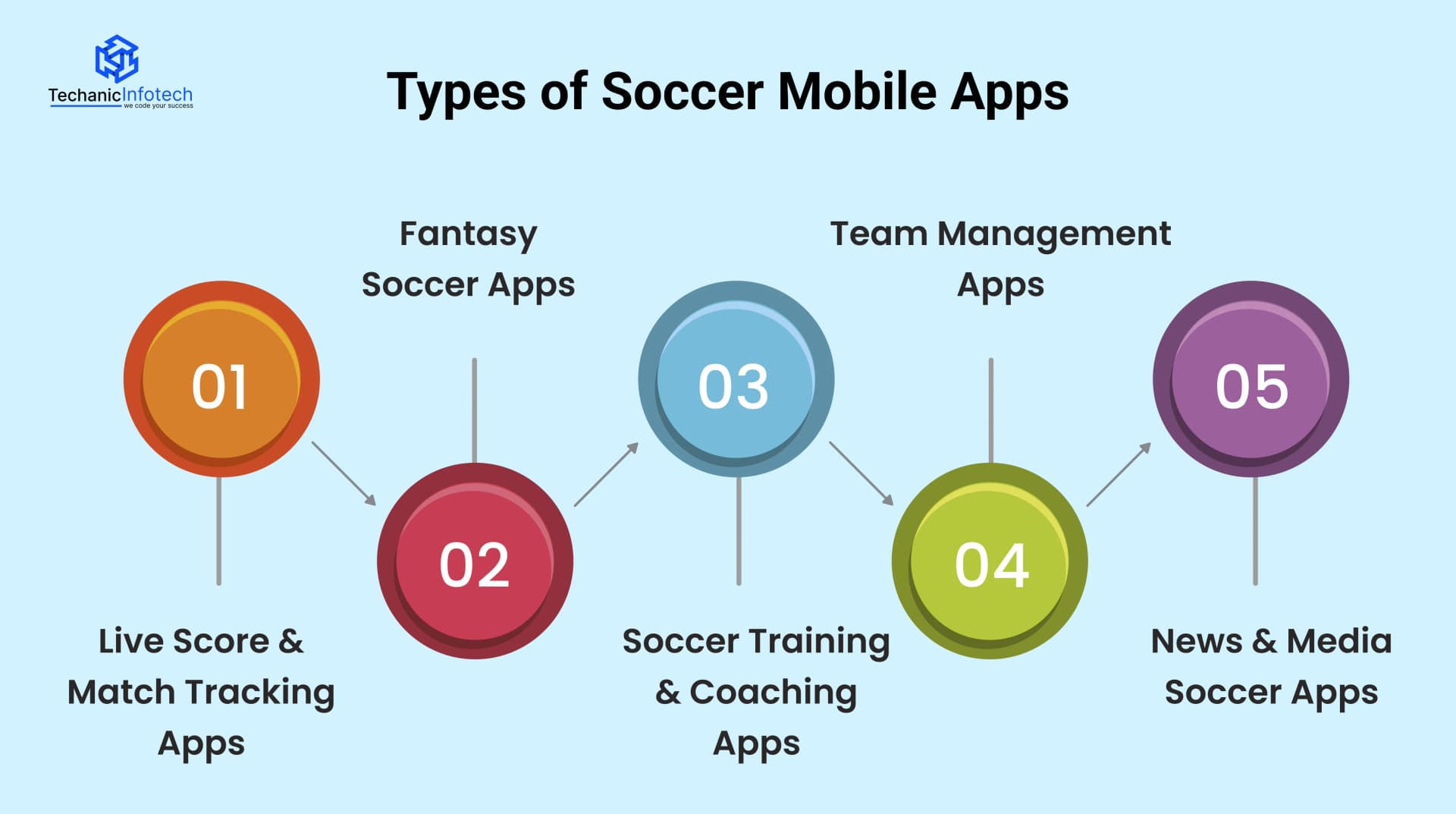
These apps deliver real-time match scores, detailed live commentary, advanced statistics, confirmed lineups, injury updates, and instant push notifications, enabling fans to follow multiple matches, teams, and leagues worldwide with accuracy and convenience.
Fantasy soccer apps allow users to build virtual teams, analyze player form and performance data, compete in public or private leagues, apply predictive analytics, earn rewards, and demonstrate strategic thinking and deep football knowledge.
Designed for players and coaches, these apps provide structured training drills, expert video tutorials, personalized fitness programs, performance tracking, skill assessments, and tactical insights aimed at improving technique, conditioning, and overall match performance.
Team management apps support clubs and coaches by centralizing player information, match scheduling, attendance monitoring, payment tracking, internal communication, and performance analytics, helping teams operate efficiently and make data-driven decisions.
These apps offer comprehensive football coverage, including breaking news, match previews, post-match analysis, transfer updates, expert opinions, interviews, and rich multimedia content, all personalized to match user interests and favorite teams.
Key features of a soccer mobile app include live scores, match schedules, real-time notifications, player and team statistics, video highlights, and user personalization.
These mobile app features enhance usability, keep fans engaged, and deliver a seamless soccer experience.
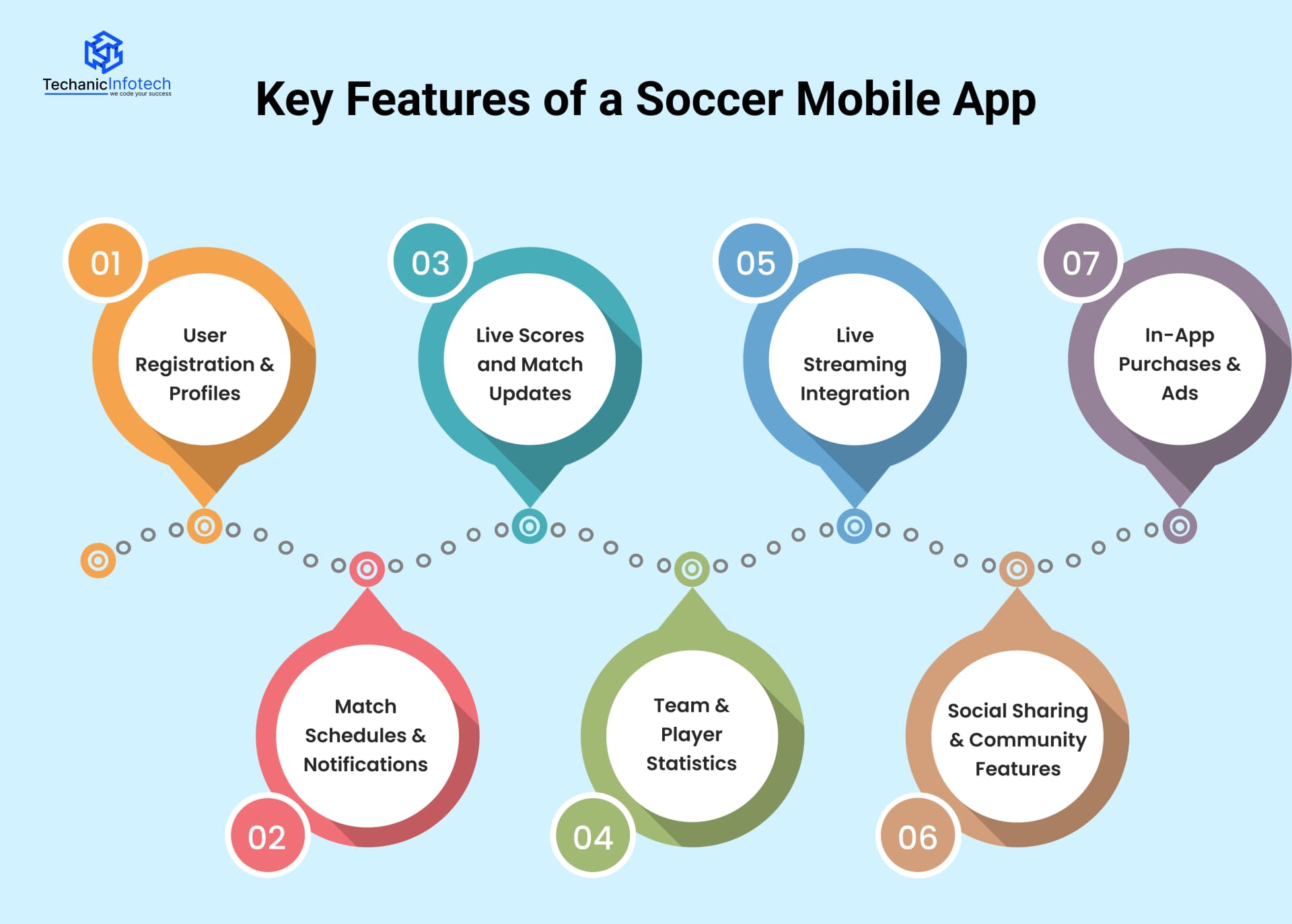
Users can securely register using email or social accounts and create rich, personalized profiles.
These profiles store preferences such as favorite teams, leagues, notification settings, and languages, and provide a seamless experience across devices.
The app delivers fast, accurate live scores with detailed updates for goals, assists, fouls, cards, substitutions, and injuries.
Real-time commentary and visuals ensure fans stay fully connected to every moment of the match.
Detailed match schedules display fixtures, kick-off times, venues, referees, and competition stages.
Smart, customizable notifications alert users about upcoming matches, live events, score changes, and final results instantly.
Comprehensive statistics provide deep insights into team performance and individual player metrics.
Users can explore match stats, season trends, comparisons, heatmaps, and historical data for better analysis and understanding.
Integrated live streaming enables users to watch matches directly within the app via licensed broadcasters.
Features like multi-angle viewing, highlights, replays, and pause-resume options enhance the overall viewing experience.
Fans can share live reactions, match highlights, and results on social media platforms.
Interactive community features such as live chats, polls, comments, and fan groups create a vibrant social football ecosystem.
The app supports monetization through targeted advertisements and optional in-app purchases.
Premium plans may offer ad-free usage, exclusive live streams, advanced analytics, and personalized content access.
Advanced soccer mobile apps stand out by offering AI-powered insights, real-time analytics, live streaming, personalized content, fantasy league integration, and smart notifications.
These features help app owners boost user engagement, differentiate their app, and support long-term growth.
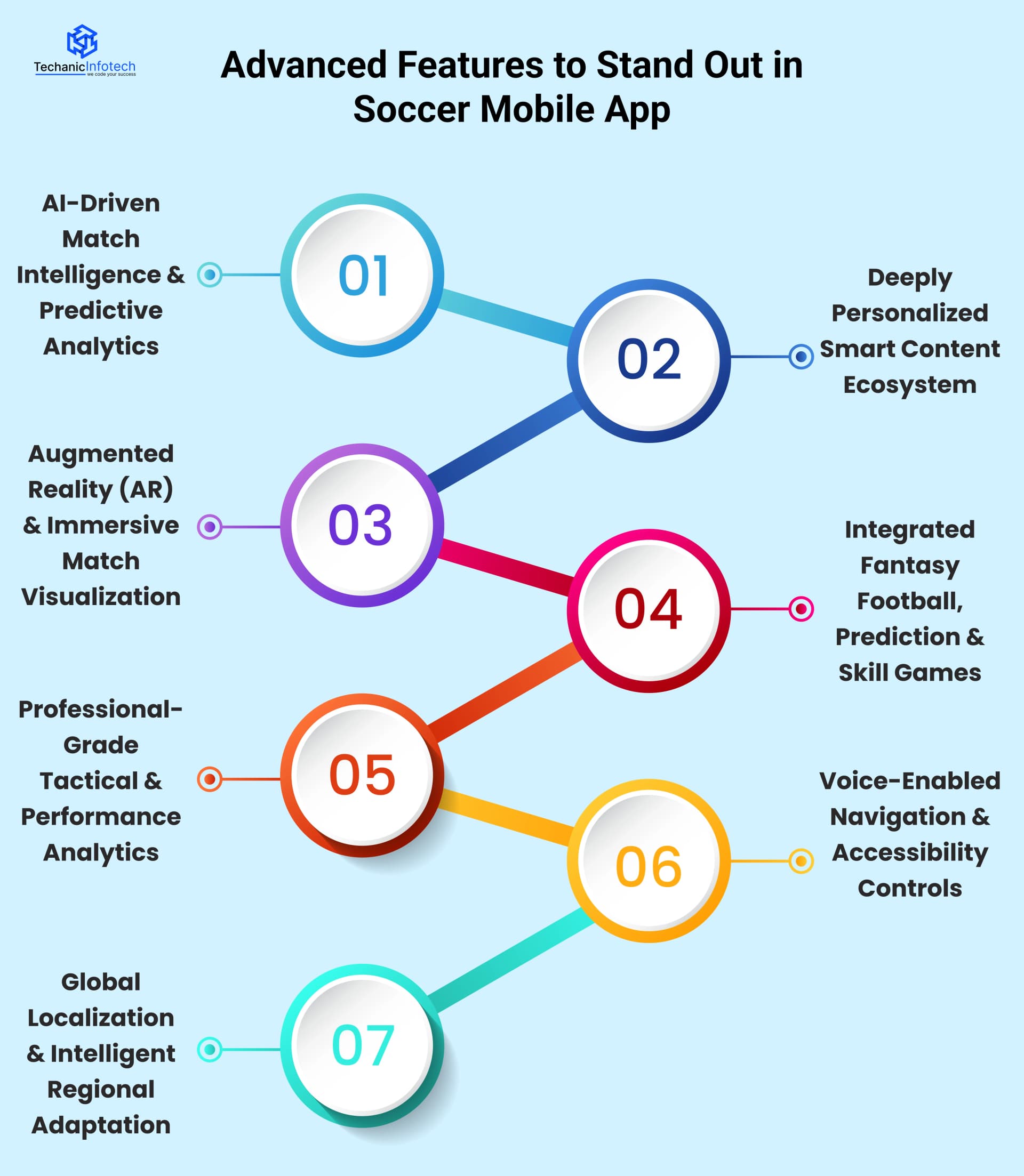
The app leverages advanced machine learning algorithms to process live match data, historical statistics, player fitness, and tactical patterns.
It delivers predictive insights such as win probabilities, expected goals, momentum shifts, and player impact ratings, offering fans expert-level analysis in real time.
Using behavioral analytics and user preferences, the app automatically curates a customized feed of news, highlights, tactical breakdowns, and social content.
Each user experiences a unique interface focused on their favorite clubs, competitions, players, and viewing habits.
AR technology enables users to interact with live match data by visualizing formations, player movement, and performance metrics in their physical environment.
This feature transforms raw statistics into immersive, engaging, and educational visual experiences.
The app combines fantasy leagues, score predictions, and skill-based mini-games within one platform.
Live scoring, global leaderboards, private leagues, and achievement rewards drive competition, social interaction, and long-term user retention.
Advanced analytics tools present metrics such as xG, pressing efficiency, pass networks, possession maps, and player heatmaps.
These insights cater to analysts, coaches, and passionate fans seeking a deeper understanding of match strategies and performance or mobile app development trends.
Built-in voice assistance allows users to request live scores, upcoming fixtures, or player stats hands-free.
Accessibility features such as voice narration, adjustable text sizes, and contrast modes ensure inclusive use for all audiences.
The app supports multiple languages, regional formats, and localized content delivery.
Time zones, league priorities, commentary styles, and notifications adapt automatically based on the user’s location and preferences.
Choosing the right mobile app tech stack for a soccer mobile app is critical for performance, scalability, real-time updates, and long-term maintenance.
Below is a well-enhanced, structured explanation suitable for assignments, reports, or app planning.
The frontend is responsible for delivering a responsive, visually appealing, and intuitive user experience.
Cross-platform frameworks such as Flutter and React Native enable developers to build a single codebase that runs efficiently on both Android and iOS platforms, reducing development time while maintaining near-native performance and smooth animations.
The backend forms the core logic of the app, handling user authentication, data processing, and API management.
Technologies like Node.js, Django, or Spring Boot are widely adopted due to their robustness, scalability, and ability to process high-frequency real-time sports data efficiently.
Soccer apps demand ultra-low latency communication for live scores and in-game events.
Implementing WebSockets, Socket.IO, or Firebase Realtime Database enables instant data synchronization, ensuring users receive updates the moment an event occurs in the field.
Efficient data storage is essential for managing match data, player statistics, and user profiles.
Relational databases such as PostgreSQL or MySQL ensure data integrity and structured querying, while MongoDB or other NoSQL databases support high-volume, flexible match-event storage.
Reliable third-party sports data APIs provide accurate live scores, fixtures, team details, and player statistics.
Additional integrations with social media platforms, payment gateways, and analytics services extend functionality and improve overall user engagement.
For in-app match streaming, protocols like HLS, RTMP, and WebRTC are used to deliver adaptive, high-quality video content.
Integration with licensed streaming partners ensures smooth playback, minimal buffering, and compliance with broadcasting rights.
Cloud service providers such as Amazon Web Services (AWS), Google Cloud Platform, and Microsoft Azure offer scalable infrastructure, load balancing, and global content delivery networks.
These services allow the app to handle traffic spikes during major tournaments without performance degradation.
Push notification systems like Firebase Cloud Messaging (FCM) and Apple Push Notification Service (APNs) enable the timely delivery of match alerts, goals, breaking news, and personalized updates, enhancing user retention and engagement.
Developing a feature-rich and engaging soccer mobile app requires strategic planning, meticulous execution, and iterative testing to deliver an exceptional user experience.
The following step-by-step guide outlines a comprehensive mobile app development lifecycle designed to create a scalable, high-performance app for soccer enthusiasts worldwide.
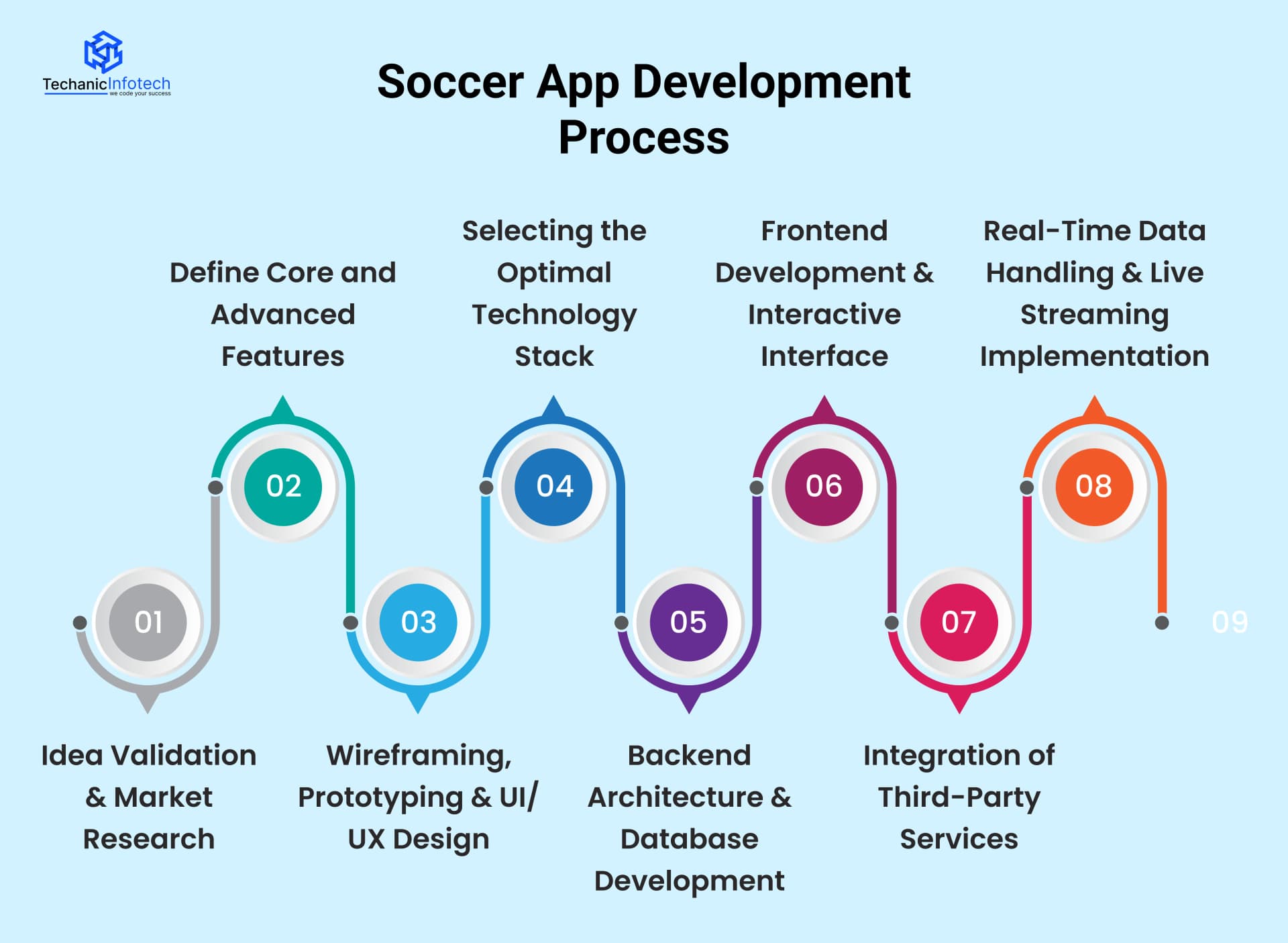
Begin by conducting in-depth market analysis to understand target users, competitors, and emerging trends in sports apps.
Identify gaps in the market and define a unique value proposition to ensure the app addresses real user needs and stands out from competitors.
Outline the essential and advanced functionalities, such as live scores, match schedules, player and team statistics, live streaming, social sharing, AI-driven predictions, augmented reality visualizations, fantasy leagues, and in-app purchases.
Prioritize features for the Minimum Viable Product (MVP) to ensure a timely, market-ready launch.
Develop detailed wireframes and interactive prototypes to visualize app flow, screen layouts, and user journeys.
Emphasize intuitive navigation, responsive mobile app design, visually engaging interfaces, and interactive elements that enhance fan engagement and retention.
Choose the right technologies for frontend, backend, databases, APIs, live streaming, push notifications, and cloud hosting.
Ensure the stack supports real-time performance, scalability, security, and cross-platform compatibility for both Android and iOS devices.
Design a robust backend infrastructure to manage user accounts, match updates, analytics, and content delivery.
Implement relational (PostgreSQL, MySQL) or NoSQL (MongoDB) databases to efficiently store structured and unstructured data with high reliability.
Develop the mobile application interface using frameworks such as Flutter or React Native for a seamless cross-platform experience.
Integrate APIs, real-time score updates, streaming features, and interactive UI elements to deliver a smooth, engaging fan experience.
Integrate essential third-party services such as live score APIs, social media sharing, secure payment gateways, streaming providers, and analytics tools.
These integrations enhance functionality, provide rich content, and improve overall user engagement and monetization opportunities.
Implement low-latency data delivery using WebSockets, Socket.IO, or Firebase Realtime Database for instant match updates.
Integrate HLS, RTMP, or WebRTC for high-quality, adaptive live streaming that works seamlessly across different network conditions.
Soccer mobile apps earn revenue through ads, subscriptions, premium features, partnerships, and merchandise.
Understanding these monetization elements helps app owners estimate revenue, select the right model, and plan sustainable long-term growth.
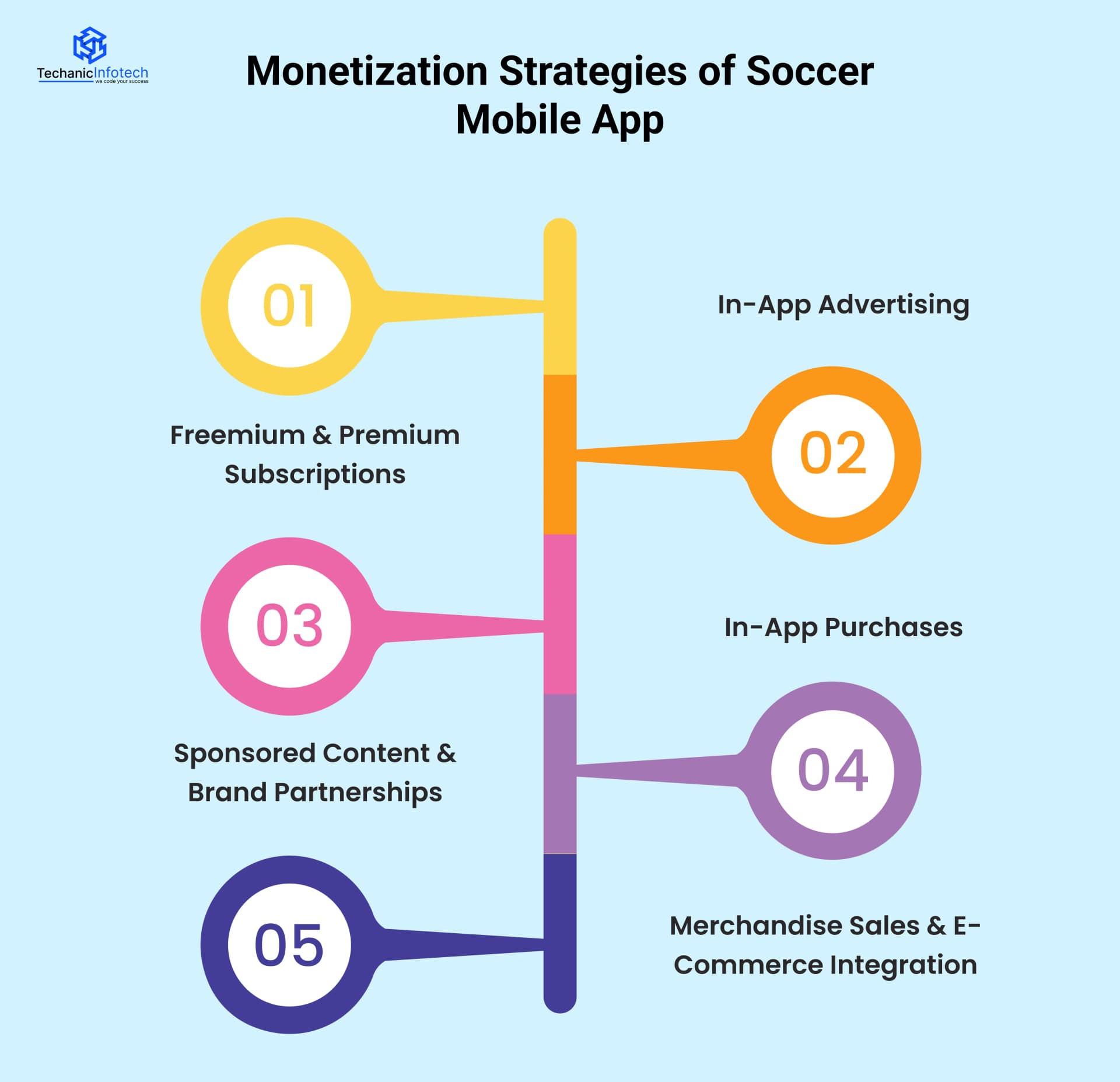
Integrate dynamic banner ads, interstitials, or rewarded video advertisements seamlessly within the app.
This strategy generates continuous revenue from impressions and clicks, allowing users free access while monetizing engagement effectively.
Offer a tiered approach where the basic app is free, giving users access to essential features.
Premium subscriptions unlock advanced benefits such as ad-free experiences, exclusive content, detailed statistics, and live streaming, providing consistent, predictable revenue.
Enable users to buy virtual items, collectibles, or premium content, such as digital player cards, match highlights, or fan merchandise.
In-app purchases enhance engagement while creating additional monetization opportunities.
Collaborate with brands, teams, and sports organizations to deliver sponsored content, promotions, or co-branded campaigns.
This strategy generates revenue while providing fans with relevant offers, campaigns, or exclusive insights.
Integrate an e-commerce platform for fans to purchase official jerseys, merchandise, and event tickets directly within the app.
This approach not only generates revenue but also strengthens the connection between fans and their favorite teams.
Creating an app involves multiple mobile app development cost factors, including app features, platform choice, design complexity, and development team location.
Understanding these elements helps estimate the overall budget and plan development effectively.
For $10,000–$30,000, this package delivers essential features like live scores, match schedules, push notifications, and a simple, intuitive UI/UX.
Ideal for MVPs or small-scale apps, it enables rapid launch, early user engagement, and validation of core functionalities.
The following is the basic app development table that covers essential features for an MVP or small-scale soccer app, enabling rapid launch and early user engagement.
|
Features Included |
Description |
Price Range |
|
Live Scores |
Real-time match score updates |
$3,000 – $6,000 |
|
Match Schedules |
Fixtures & match timings |
$2,000 – $5,000 |
|
Push Notifications |
Match alerts & notifications |
$2,000 – $4,000 |
|
Basic UI/UX Design |
Simple and intuitive interface |
$7,000 – $9,000 |
|
User Registration |
Login and profile management |
$3,000 – $8,000 |
|
Total Cost |
$10,000 – $30,000 |
Priced at $30,000–$55,000, this tier includes a polished, visually appealing interface,
detailed player and team statistics, social sharing, in-app purchases, and robust analytics.
Perfect for enhancing engagement, retention, and providing a richer, interactive user experience.
Given that the table of intermediate packages is ideal for enhancing engagement with richer features, polished design, and interactive user experiences.
|
Features Included |
Description |
Price Range |
|
Advanced UI/UX Design |
Visually appealing interface |
$5,000 – $10,000 |
|
Player & Team Statistics |
Detailed performance metrics |
$7,000 – $9,000 |
|
Social Sharing |
Content sharing on social platforms |
$5,000 – $8,000 |
|
In-App Purchases |
Premium features & subscriptions |
$6,000 – $8,000 |
|
Analytics Integration |
User engagement tracking |
$4,000 – $6,000 |
|
Total Cost |
$30,000 – $55,000 |
At $55,000–$90,000+, this premium package integrates live streaming, AI-driven predictions, AR experiences, fantasy leagues, blockchain collectibles, and professional analytics dashboards.
Designed for immersive fan experiences, it maximizes engagement, monetization, and long-term loyalty.
The Advanced package table represents a high-end, immersive fan experience with live streaming, AI insights, AR features, and blockchain collectibles.
|
Features Included |
Description |
Price Range |
|
Live Streaming |
Real-time match broadcasts |
$7,000 – $10,000 |
|
AI-Based Predictions |
Smart insights & analytics |
$8,000 – $12,000 |
|
Fantasy Leagues |
Interactive fantasy gameplay |
$10,000 – $13,000 |
|
AR Fan Experiences |
Immersive augmented reality |
$5,000 – $11,000 |
|
Blockchain Collectibles |
NFTs & digital assets |
$9,000 – $12,000 |
|
Total Cost |
$55,000 – $90,000+ |
For $5,000–$15,000 per year, this service ensures continuous app support with bug fixes, performance optimization, OS updates, security patches, and minor feature improvements.
The approach of mobile app maintenance is helpful in keeping the app stable, secure, and fully optimized for a seamless user experience.
This Annual maintenance table ensures your app remains stable, secure, and optimized with bug fixes, updates, and minor feature improvements.
|
Features Included |
Description |
Price Range |
|
Bug Fixes |
Issue resolution & stability |
$1,500 – $4,000 |
|
Performance Optimization |
Speed & efficiency improvements |
$1,500 – $3,500 |
|
OS & Security Updates |
Compatibility & protection |
$1,000 – $3,000 |
|
Minor Feature Enhancements |
Small improvements |
$1,000 – $2,500 |
|
App Monitoring |
Continuous performance checks |
$1,000 – $2,000 |
|
Total Cost |
$5,000 – $15,000 / year |
With an annual cost of $2,000–$10,000, this covers integration with live score APIs, payment gateways, streaming services, and analytics tools.
Enables real-time updates, secure transactions, and advanced functionality, ensuring accurate and premium app experiences for users.
The following table shows third-party services that ensure real-time data, secure transactions, streaming, and analytics for a premium user experience.
|
Features Included |
Description |
Price Range |
|
Live Score APIs |
Real-time data feeds |
$500 – $2,000 |
|
Payment Gateways |
Secure transactions |
$500 – $2,000 |
|
Streaming APIs |
Video content delivery |
$500 – $3,000 |
|
Analytics Tools |
Performance insights |
$500 – $2,000 |
|
Cloud Services |
Hosting & scalability |
$500 – $1,000 |
|
Total Cost |
$2,000 – $10,000 / year |
Budgeting $3,000–$10,000, this includes app store optimization, social media campaigns, influencer partnerships, and promotional initiatives.
Designed to boost visibility, drive downloads, and strengthen user retention for a highly effective launch and sustained growth.
Following is the table shows that a focused marketing strategy boosts app visibility, drives downloads, and strengthens user retention during launch and growth phases.
|
Features Included |
Description |
Price Range |
|
App Store Optimization |
Improve app visibility |
$500 – $2,000 |
|
Social Media Campaigns |
Paid & organic promotion |
$1,000 – $3,000 |
|
Influencer Marketing |
Brand awareness & reach |
$500 – $2,000 |
|
Paid Advertising |
User acquisition campaigns |
$1,000 – $2,500 |
|
Launch Promotions |
Campaigns & special offers |
$1,000 – $2,500 |
|
Total Cost |
$3,000 – $10,000 |
Techanic Infotech is known as the best mobile app development company specializing in building high-performance,scalable, and feature-rich soccer mobile applications designed to deliver an immersive fan experience.
Our team creates cross-platform apps with seamless UI/UX, incorporating live scores, match schedules, detailed player and team statistics, and real-time notifications.
We integrate advanced features such as live streaming, AI-powered predictions, AR visualizations, fantasy leagues, and secure in-app purchases to enhance user engagement.
With robust backend architecture, cloud hosting, and third-party API integrations, our apps ensure high reliability, fast performance, and scalability.
Post-launch, we provide continuous support, maintenance, and feature updates, ensuring long-term user satisfaction and app success.
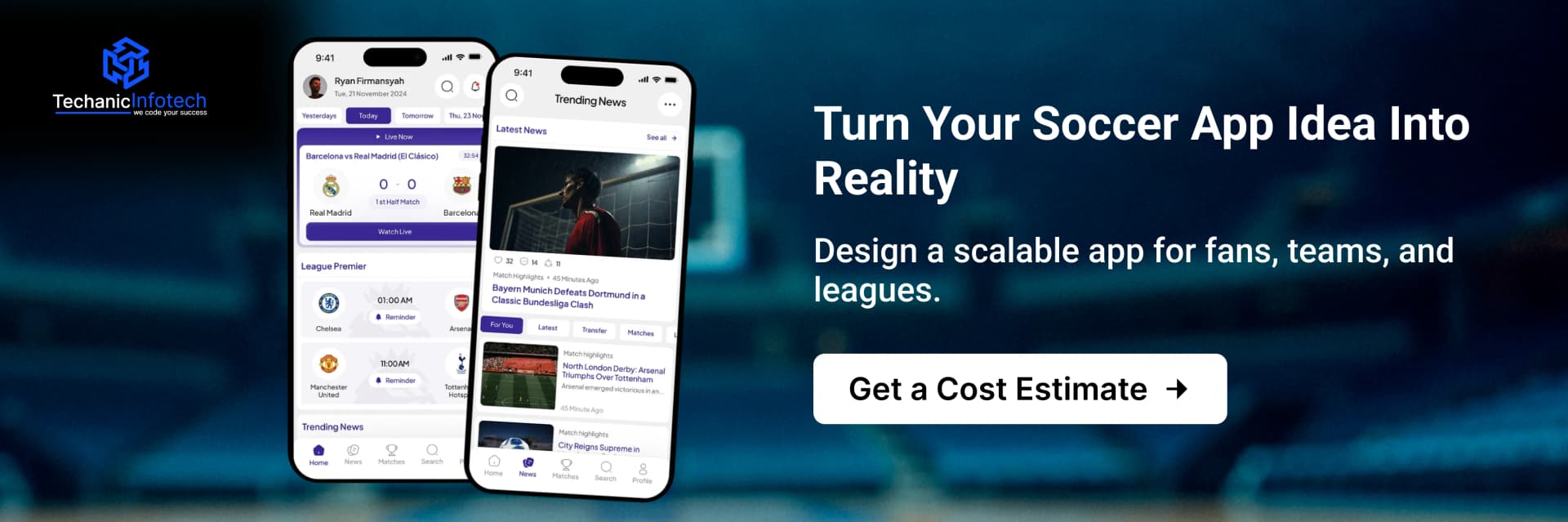
Creating a successful soccer mobile app requires strategic planning, an optimized technology stack, and a focus on delivering a superior fan experience.
By integrating live scores, match schedules, player statistics, AR experiences, and AI predictions, the app engages users at every step.
Monetization strategies such as in-app advertising, subscriptions, in-app purchases, sponsored content, and merchandise sales provide sustainable revenue streams.
Development costs vary widely, from $20,000 for a basic MVP to $120,000 or more for advanced applications with live streaming, fantasy leagues, and blockchain-enabled collectibles.
Partnering with experienced developers ensures reliability, scalability, and timely delivery. Regular updates, performance monitoring, and marketing enhance retention, resulting in a competitive, high-performing soccer app.
Development typically takes 4–6 months for basic apps and 8–12 months for advanced apps with live streaming, AI features, AR visualizations, and fantasy league integration.
Yes, live streaming can be integrated using HLS, RTMP, or WebRTC protocols. Partnering with licensed streaming providers ensures seamless, high-quality video within the app.
Revenue can be generated through in-app advertisements, premium subscriptions, in-app purchases, sponsored content, and merchandise sales, offering multiple monetization channels without compromising user experience.
Costs range from $20,000 for a basic app to $120,000 or more for advanced solutions featuring live streaming, AI analytics, AR, and post-launch maintenance.
Yes, by leveraging cloud infrastructure, multi-language support, optimized APIs, and scalable backend architecture, the app can handle high concurrent traffic globally while providing real-time updates.


Shailendra is a dedicated professional known for his strong client-focused approach and clear understanding of business needs. He brings a thoughtful understanding of client needs and focuses on building long-term relationships through clear communication and quality-driven work. With a blend of strategic thinking, content expertise, and a hands-on approach, Shailendra plays a key role in shaping content that aligns with both business goals and user expectations.