Classified App Development
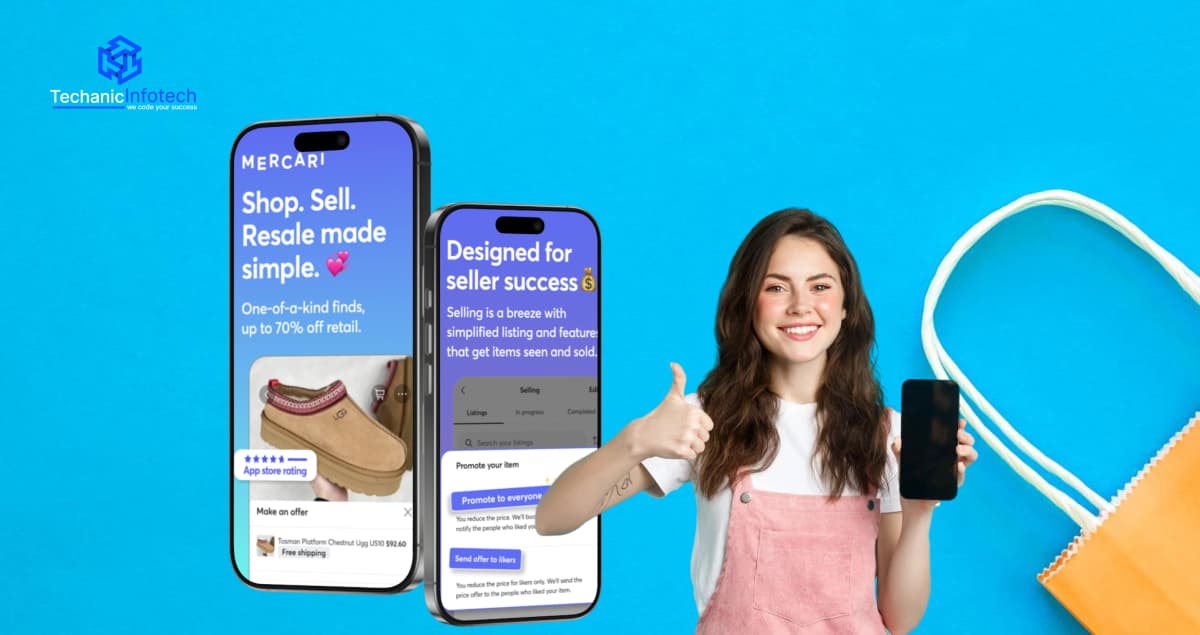
How to Develop an App like Mercari | Features, Cost & Process
January 17, 2026
January 17, 2026
Platforms like Mercari have successfully tapped into this shift by enabling users to sell unused items quickly while offering buyers affordable alternatives.
Mercari app development is not just about building a buying-and-selling platform; it involves creating a trusted ecosystem where users feel safe transacting with strangers.
Entrepreneurs and enterprises aiming to create an app like Mercari must understand its business model, technical architecture, and development roadmap.
This blog provides a complete breakdown of Mercari-like app development, covering market research, core features, technology stack, development process, cost estimates, challenges, and why choosing the right app development company is crucial for success.
To successfully build an app like Mercari, the platform must include features that balance simplicity, trust, and scalability.
User onboarding should be quick and frictionless. Mercari-style apps allow users to sign up via email, phone number, or social accounts.
Profiles showcase transaction history, ratings, and reviews, helping buyers and sellers build credibility.
Identity verification and profile completeness significantly improve trust and platform safety.
Sellers should be able to list products effortlessly by uploading images, writing descriptions, setting prices, and selecting categories.
Mobile app features, like auto-fill suggestions, draft saving, and image optimization, simplify the listing process.
Effective product management has a direct impact on seller satisfaction and platform engagement.
A robust search system enables users to quickly find products by keyword, category, price range, location, brand, and condition.
Smart filters and sorting options improve discoverability, increase session duration, and boost conversions, making them critical Mercari app features.
Real-time messaging enables buyers and sellers to communicate, negotiate prices, and clarify product details.
Push notifications alert users about new messages, order updates, and promotional offers, ensuring continuous engagement and faster transaction cycles.
Integrated payment gateways ensure safe and smooth transactions.
Most Mercari-like apps use an escrow-style wallet system, where funds are held until the buyer confirms receipt. This protects both parties and enhances platform trust.
A transparent rating and review system allows users to evaluate each other after transactions.
This feature reduces fraud, improves accountability, and encourages honest behavior across the marketplace.

Selecting the right mobile app tech stack is crucial for building a scalable, secure, and high-performing marketplace application.
For cross-platform development, React Native or Flutter are preferred choices, offering faster development cycles and consistent UI across iOS and Android.
For native performance optimization, Swift (iOS) and Kotlin (Android) can be used.
Backend frameworks such as Node.js, Django, or Ruby on Rails efficiently handle APIs, authentication, business logic, and real-time communication.
These technologies support scalability and seamless third-party integrations.
PostgreSQL manages structured data like transactions, payments, and user profiles.
MongoDB efficiently handles unstructured data such as product listings, chat logs, and activity feeds.
Cloud platforms like AWS, Google Cloud, and Microsoft Azure provide hosting, storage, auto-scaling, and load balancing, ensuring high availability and performance during traffic spikes.
Secure payment gateways such as Stripe, PayPal, Apple Pay, and Google Pay facilitate transactions. Tools like Firebase support push notifications, analytics, and crash monitoring.
This technology stack aligns with modern mobile app development standards and ensures future scalability.
Developing a scalable and trustworthy resale marketplace like Mercari requires a well-defined, experience-driven mobile app development process.
Below is a detailed step-by-step breakdown of the Mercari-like app development process followed by experienced marketplace app development teams.
The development journey begins with a comprehensive requirement analysis and business discovery phase.
This step focuses on understanding the business vision, revenue goals, and target audience while aligning technical feasibility with market demand.
Key activities include defining user personas (buyers, sellers, and admins), identifying core and advanced features, outlining monetization strategies, and selecting compliance requirements.
Technical consultants also assess scalability needs, security standards, and integration requirements.
Once requirements are finalized, the focus shifts to user experience (UX) and interface design (UI).
The objective is to create a clean, intuitive, and conversion-focused design that minimizes friction for both buyers and sellers.
Designers craft user flows for onboarding, product listing, search, chat, checkout, and order management.
Special attention is given to mobile-first design principles, accessibility standards, and visual hierarchy. It's also suggested to follow the best mobile app design guide that explains how to properly design the app with advanced features.
The Minimum Viable Product (MVP) phase focuses on building essential features required to launch the marketplace and validate the concept in real-world conditions.
Core MVP features typically include user registration, profile management, product listing, search and filters, in-app messaging, secure payments, and order tracking.
Launching an MVP reduces time-to-market, controls development costs, and provides actionable insights based on actual user behavior, enabling informed decisions for future enhancements.
This stage involves building scalable APIs, managing databases, implementing authentication systems, and handling payment workflows.
Developers design the backend architecture to support high traffic, real-time messaging, and secure transactions.
Admin panels are created for user management, content moderation, dispute handling, and analytics.
Cloud infrastructure and microservices architecture are often implemented to ensure reliability, performance optimization, and future scalability as the platform grows.
To streamline operations and enhance user experience, multiple third-party services are integrated into the platform.
These include payment gateways, shipping providers, push notification services, analytics tools, and customer support systems.
Escrow-based payment systems are configured to hold funds securely until transaction completion.
Shipping APIs automate label generation and tracking updates. Analytics tools provide insights into user behavior, conversion rates, and revenue performance.
Before launch, the application undergoes rigorous testing and quality assurance to ensure stability, performance, and security.
QA teams conduct functional testing, usability testing, performance testing, and cross-device compatibility checks.
Security audits are performed to identify vulnerabilities, ensure data encryption, and validate compliance with payment and data privacy regulations.
Bug fixes and performance optimizations are implemented based on test results. This step is essential for delivering a reliable, secure, and user-ready marketplace app.
The final step involves deploying the application to production environments and publishing it by following the instructions on how to upload an app to the Google Play Store and Apple App Store, following platform guidelines.
Post-launch, continuous monitoring, user feedback analysis, performance tracking, and feature enhancements are carried out.
Ongoing maintenance, updates, and scalability planning ensure long-term success and sustained growth in a competitive resale marketplace ecosystem.
The mobile app development cost for an app like Mercari typically ranges from $20,000 to $120,000, depending on feature complexity, scalability needs, and development approach.
This range covers everything from a lean MVP to a fully scalable, enterprise-grade resale marketplace.
A basic Mercari-style MVP costs between $20,000 and $40,000 and includes core features such as user registration, product listings, basic search and filters, in-app chat, secure payment integration, and order management.
This option is ideal for startups looking to validate their idea, test user demand, and gather feedback quickly without heavy upfront investment.
A mid-level Mercari-like app typically costs $50,000 to $80,000. It includes advanced search and filtering, escrow wallet systems, push notifications, seller verification, ratings and reviews, and admin dashboards.
Built for growth, this version supports higher traffic, improved performance, and stronger security, making it suitable for expanding businesses and regional marketplaces.
A fully featured Mercari clone costs $100,000 to $120,000 and includes AI recommendations, fraud detection, advanced analytics, multi-language support, cloud auto-scaling, and regulatory compliance.
This solution is designed for enterprises targeting large-scale or global markets, with a focus on reliability, automation, and long-term scalability.
Building a Mercari-like marketplace involves overcoming technical, operational, and trust-related challenges that need to be considered.
The following are the challenges that one should consider while developing an app like Mercari:
Establishing trust is critical in peer-to-peer marketplaces where users transact with strangers.
Preventing fake listings, identity fraud, and payment scams requires robust user verification, moderation systems, rating and review mechanisms, and continuous monitoring to maintain platform credibility.
Handling financial transactions demands high security and regulatory compliance.
Integrating reliable payment gateways, implementing escrow systems, ensuring data encryption, and adhering to PCI standards are essential to protect user data and build confidence in payment processes.
As the user base and listings grow, the platform must maintain consistent performance.
Scalable cloud infrastructure, optimized databases, load balancing, and efficient APIs are required to handle increased traffic without downtime or degraded user experience.
Sustaining user engagement is challenging in competitive marketplaces.
Ensuring enough active buyers and sellers, offering personalized recommendations, timely notifications, loyalty programs, and seamless UX are vital to maintaining liquidity and repeat usage.
Marketplace apps must comply with regional data protection and e-commerce regulations.
Implementing secure data handling practices, user consent management, and compliance with laws such as GDPR ensures legal safety and strengthens user trust.
Choosing the best classified app development company, like Techanic Infotech, to build an app like Mercari means partnering with a team that understands both marketplace dynamics and scalable mobile technology.
With proven expertise in developing C2C and B2C marketplace apps, Techanic Infotech delivers feature-rich solutions, including secure payments, real-time chat, product listings, ratings, and seamless user experiences.
Their team focuses on clean UI/UX, high performance, and robust backend architecture to ensure your app can scale as users grow.
From ideation and wireframing to development, testing, and post-launch support, they follow an agile, transparent development process.
Techanic Infotech also prioritizes data security, API integrations, and cross-platform compatibility, ensuring reliability across devices.

The resale economy is rapidly transforming how people buy and sell products.
This creates opportunities to build Mercari-like marketplaces. A successful app needs more than product listings.
It must include secure payments, user verification, advanced search, and smooth communication.
Steps like market research, business model planning, choosing the tech stack, designing UI/UX, and adding key features are essential.
By solving challenges like fraud, compliance, and liquidity, and working with an expert development company, businesses can build a reliable and scalable Mercari-like app.
The cost to develop a Mercari-like app typically ranges from $20,000 to $120,000, depending on features, complexity, scalability, and integrations. A basic MVP starts at $20,000, while a fully featured enterprise-grade app can reach $120,000.
Essential features include user registration, product listing, advanced search and filters, in-app chat, secure payments with escrow, ratings and reviews, notifications, and an admin panel for moderation and analytics.
For cross-platform apps, React Native or Flutter is recommended. Backend frameworks like Node.js, Django, or Ruby on Rails, along with databases like PostgreSQL and MongoDB, and cloud infrastructure like AWS or Google Cloud, ensure scalability and reliability.
Development time depends on the feature set and complexity. A basic MVP can take 3–4 months, a mid-level app around 5–7 months, and a fully featured enterprise app may take 8–12 months for development, testing, and deployment.
Implementing user verification, ratings and reviews, secure payment gateways, moderation tools, and fraud detection mechanisms helps build trust. Continuous monitoring and adherence to data privacy laws are also critical for user confidence.


Neha Sharma is a tech expert at heart who loves exploring new technologies and turning complex ideas into easy-to-understand content. With a passion for learning and writing, she enjoys sharing insights on emerging tech, digital products, and innovation that help businesses stay ahead.