Software Development
Legacy System Maintenance: Complete Guide for Modern Businesses (2026)
April 9, 2026
April 9, 2026
Key takeaways
Legacy systems are essential but often lead to rising legacy system maintenance costs due to outdated technology and increasing complexity
Replacing systems entirely is not always necessary, gradual modernization is a more cost-effective and low-risk approach
Strategies like modular modernization, cloud migration, and automation help reduce costs without disrupting daily operations
Regular system audits and performance monitoring help identify inefficiencies and optimize long-term maintenance expenses
Improving integration with modern tools using APIs and middleware extends the lifespan of legacy systems
A well-planned legacy system transformation strategy ensures better scalability, security, and long-term business growth
Many businesses today still depend on legacy systems to run critical operations, but maintaining them is becoming more expensive every year.
In fact, organizations spend up to 60–80% of their IT budgets on maintaining outdated systems, leaving very little room for innovation. Rising legacy system maintenance costs, security risks, and integration challenges make it harder to scale and adapt to modern demands.
At the same time, completely replacing legacy systems is not always practical. It can be costly, time-consuming, and risky for daily operations.
So, what’s the solution?
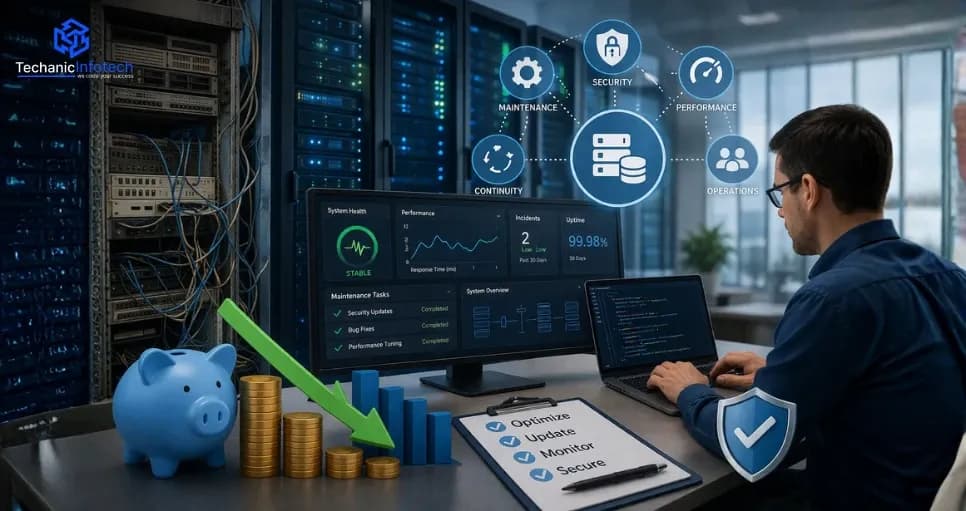
The key lies in reducing legacy system maintenance costs without disrupting business continuity. With the right strategies like modular modernization, cloud migration, and automation, businesses can optimize performance while controlling expenses.
In this guide, we’ll break down:
What legacy systems are and why they’re expensive
The real cost drivers behind legacy system maintenance
Practical strategies to reduce costs without downtime
How to build a long-term legacy system modernization strategy
A legacy system refers to outdated software or IT infrastructure that is still actively used within an organization. These systems were often built using older technologies that may no longer be widely supported.
Despite their age, legacy systems remain valuable because they often contain critical business logic and historical data that organizations depend on.
Common examples include:
Old enterprise resource planning (ERP) systems
Banking or financial transaction platforms
Manufacturing management software
Healthcare information systems
Maintaining these systems requires continuous legacy system support and maintenance, which can become increasingly expensive as technology evolves.
The cost of maintaining legacy systems can grow rapidly over time. Several factors contribute to rising legacy system maintenance costs.
Legacy systems often run on outdated programming languages or frameworks that are no longer widely used. This makes it difficult to find developers who can maintain the system.
Many legacy systems were built years ago without proper documentation. As original developers leave the organization, understanding the system becomes difficult.
Legacy systems often struggle to integrate with modern applications or cloud services, increasing the complexity of maintenance.
Older systems may not meet modern security standards, requiring additional effort to maintain compliance and protect sensitive data.
Because of these challenges, organizations must adopt cost-effective legacy system management strategies to maintain performance while controlling expenses.
Before planning modernization or upgrades, businesses should identify whether their legacy systems are becoming a financial burden.
Common warning signs include:
Increasing maintenance costs every year
Slow system performance
Difficulty integrating new technologies
Security vulnerabilities
Limited scalability
When these issues begin affecting productivity, organizations should consider enterprise legacy system optimization strategies.
Understanding where mobile app development costs come from helps organizations plan better strategies for optimization.
Typical legacy system maintenance cost categories include the following:
Infrastructure Costs: Older systems often require specialized hardware or on-premise infrastructure that is expensive to maintain.
Developer and Support Costs: Finding developers skilled in outdated technologies can be expensive.
Downtime and Productivity Loss: Legacy systems may experience downtime, which directly affects business operations.
Security and Compliance Expenses: Older systems require additional monitoring and security patches to maintain compliance with modern regulations.
Organizations must analyze these cost factors when planning a legacy system transformation strategy.
|
Factor |
Legacy System Upgrade |
Legacy System Replacement |
|
Definition |
Improving or modifying the existing system while keeping the core architecture intact |
Building a completely new system to replace the old legacy platform |
|
Initial Cost |
Lower upfront investment since only selected components are upgraded |
Higher upfront cost due to full redevelopment and migration |
|
Implementation Time |
Faster implementation because only certain modules are updated |
Longer development timeline as the entire system is rebuilt |
|
Operational Disruption |
Minimal disruption since the system continues running during upgrades |
Higher risk of disruption during migration and deployment |
|
Technology Improvements |
Limited improvements depending on the existing architecture |
Enables adoption of modern technologies and architectures |
|
Scalability |
Moderate scalability improvements depending on upgrades |
High scalability with modern cloud-native infrastructure |
|
Integration Capability |
May still face integration challenges with modern applications |
Easier integration with modern platforms and APIs |
|
Risk Level |
Lower risk because existing systems remain functional |
Higher risk during migration, especially with data transfer |
|
Long-Term Maintenance |
Maintenance costs may still remain relatively high |
Maintenance costs usually reduce due to modern architecture |
|
Best Use Case |
Suitable when the legacy system still supports core business functions |
Ideal when the system is outdated and cannot support future growth |
Maintaining legacy systems can become increasingly expensive as technologies evolve and business needs grow. However, replacing an entire system immediately is not always practical or necessary.
The following strategies help businesses manage legacy system support and maintenance more efficiently while preparing for long-term modernization.
A comprehensive system audit is the first step in identifying inefficiencies and unnecessary expenses in existing infrastructure. Many organizations continue spending on outdated systems simply because they lack clear insights into how those systems perform.
During an audit, IT teams evaluate several aspects of the system, including overall performance, security vulnerabilities, integration challenges, and redundant processes that may no longer be required.
For example, older systems may contain unused modules, outdated integrations, or duplicated workflows that increase maintenance complexity.
Key areas typically analyzed during a system audit include:
System performance and response time
Security vulnerabilities and outdated patches
Redundant or unused components
Integration issues with modern platforms
A detailed audit helps organizations understand which parts of the system require immediate attention and which components can remain stable. This evaluation provides valuable insights needed for legacy IT infrastructure optimization and supports long-term planning for modernization.
Completely replacing a legacy system can disrupt operations and require significant financial investment. Instead, many organizations adopt a modular modernization approach where individual components of the system are upgraded gradually.
With this approach, businesses identify specific modules that require improvement and modernize them without affecting the rest of the system.
For example, companies may choose to update the user interface while keeping the backend system intact. Similarly, they might replace outdated APIs or migrate certain functionalities to modern microservices architecture.
Examples of modular modernization include:
Upgrading the user interface to improve user experience
Migrating selected system components to cloud platforms
Replacing outdated APIs with modern integration layers
This strategy allows businesses to modernize their systems step by step while maintaining operational continuity. Over time, modular modernization helps create a more flexible and scalable system without requiring a full replacement.
Cloud migration is one of the most effective ways to reduce infrastructure costs associated with legacy systems. Many traditional systems rely on on-premise hardware that requires constant maintenance, power consumption, and physical space.
By migrating legacy applications to cloud platforms, organizations can significantly reduce infrastructure expenses while improving scalability and reliability.
Some major benefits of cloud migration include:
Reduced hardware maintenance and infrastructure costs
On-demand scalability for growing workloads
Improved disaster recovery and data backup capabilities
Cloud environments also support better system monitoring and automation tools, making app maintenance easier. As a result, cloud adoption plays a major role in legacy application modernization strategies.
Legacy systems often struggle to communicate with modern applications and services. Integration challenges can increase maintenance complexity and slow down business operations.
Modern integration technologies such as middleware platforms and API gateways can help bridge this gap. These tools allow legacy systems to connect with modern applications without requiring complete system replacement.
By improving system integration, businesses can extend the lifespan of their legacy systems while improving efficiency and functionality. This approach also supports enterprise legacy system optimization, allowing organizations to adopt new technologies gradually.
Manual maintenance tasks can significantly increase operational costs. Automation tools help reduce the time and resources required for system maintenance.
For example, automated monitoring tools can continuously track system performance and detect issues before they affect users. Patch management systems automatically apply security updates, reducing the risk of vulnerabilities. Performance optimization tools can also identify bottlenecks and recommend improvements.
Common automation tools include:
Automated monitoring and alert systems
Patch and update management platforms
Performance optimization and diagnostics tools
By automating routine maintenance tasks, organizations can reduce manual intervention and improve overall efficiency in legacy system support and maintenance.
Many legacy systems rely on outdated database architectures that slow down system performance and increase maintenance requirements. Optimizing database performance can significantly improve system reliability and reduce downtime.
Several techniques can help improve database efficiency, including query optimization, indexing improvements, and archiving old data that is no longer actively used. By reducing unnecessary database load, organizations can improve system performance and reduce operational costs.
These improvements play a key role in enterprise legacy system optimization, ensuring that
legacy platforms remain stable and efficient.
Finally, organizations should adopt a structured legacy software modernization strategy to guide long-term transformation efforts. Instead of making random upgrades, businesses should develop a clear roadmap for gradually modernizing their systems.
A strong modernization strategy may include:
Application re-platforming to modern infrastructure
Code refactoring to improve performance and maintainability
Cloud migration for scalability and cost reduction
API-based integration with modern digital platforms
By following a structured modernization approach, organizations can transform legacy systems gradually without disrupting daily operations. This strategy ensures long-term sustainability while effectively reducing legacy system maintenance costs.
Managing legacy systems effectively requires a strategic approach that balances operational stability with modernization efforts.
Organizations that succeed in controlling legacy system maintenance costs typically follow a set of practical best practices that help maintain system performance while preparing for future upgrades.
Not every legacy system needs immediate modernization. Businesses should first focus on systems that directly affect core operations such as financial processing, customer management, or supply chain systems.
By prioritizing these critical systems, organizations can allocate resources more efficiently and ensure that essential services remain reliable while planning upgrades.
Many legacy systems suffer from poor documentation, especially if they were developed many years ago. Maintaining clear documentation of system architecture, workflows, and integrations helps developers understand the system more easily.
Good documentation reduces troubleshooting time and simplifies legacy system support and maintenance, ultimately lowering maintenance costs.
Continuous monitoring tools play an important role in detecting performance issues before they cause major disruptions.
Monitoring helps IT teams identify system bottlenecks, security risks, or unusual activity early. This proactive approach supports enterprise legacy system optimization and reduces the likelihood of unexpected downtime.
Replacing legacy systems all at once can create operational risks. A gradual modernization approach allows organizations to improve systems step by step without disrupting business operations.
This method supports a sustainable legacy system transformation strategy while keeping systems stable and functional.
At Techanic Infotech, we help businesses modernize and optimize their legacy systems while maintaining operational stability.
Our mobile app development company focuses on cost-effective legacy system management, enabling organizations to reduce maintenance expenses without interrupting critical workflows. By combining system audits, modular modernization, and cloud migration strategies, we assist enterprises in improving performance, security, and scalability.
From legacy system support and maintenance to full legacy application modernization, our approach ensures that existing infrastructure continues to deliver value while gradually transitioning toward modern technologies.
This balanced strategy allows businesses to implement a sustainable legacy system transformation strategy and prepare their IT environment for future innovation.
Legacy systems may be old, but they still hold immense value for modern businesses. The real challenge is not replacing them overnight but managing them smartly.
By adopting strategies like system audits, modular modernization, cloud migration, and automation, organizations can significantly reduce legacy system maintenance costs while keeping operations stable.
The key is to take a balanced approach, upgrade what’s necessary, optimize what’s working, and gradually modernize without disrupting core business processes.
Businesses that follow a structured legacy system transformation strategy not only reduce costs but also improve performance, security, and scalability for the future.
A legacy system is outdated software or infrastructure still used by organizations to run critical operations, often built on older technologies that are difficult to maintain or upgrade.
A legacy system is outdated software or infrastructure still used by organizations to run critical operations, often built on older technologies that are difficult to maintain or upgrade.
Legacy system maintenance costs are high due to outdated technologies, lack of skilled developers, integration issues, and increased security and compliance requirements.
Legacy system maintenance costs are high due to outdated technologies, lack of skilled developers, integration issues, and increased security and compliance requirements.
Businesses can reduce costs through system audits, cloud migration, modular modernization, automation, and improving system integration with modern tools and APIs.
Businesses can reduce costs through system audits, cloud migration, modular modernization, automation, and improving system integration with modern tools and APIs.
Upgrading is ideal for reducing costs with minimal disruption, while replacement is better when the system can no longer support business growth or modern requirements.
Upgrading is ideal for reducing costs with minimal disruption, while replacement is better when the system can no longer support business growth or modern requirements.
Legacy system modernization is the process of upgrading existing systems using modern technologies like cloud, APIs, and microservices without completely rebuilding them.
Legacy system modernization is the process of upgrading existing systems using modern technologies like cloud, APIs, and microservices without completely rebuilding them.
Cloud migration reduces infrastructure costs, improves scalability, enhances performance, and provides better backup and disaster recovery capabilities.
Cloud migration reduces infrastructure costs, improves scalability, enhances performance, and provides better backup and disaster recovery capabilities.
Common risks include security vulnerabilities, poor performance, high maintenance costs, and difficulty integrating with modern technologies.
Common risks include security vulnerabilities, poor performance, high maintenance costs, and difficulty integrating with modern technologies.
Modular modernization involves upgrading specific parts of a legacy system step-by-step instead of replacing the entire system at once
Modular modernization involves upgrading specific parts of a legacy system step-by-step instead of replacing the entire system at once
Automation reduces manual work by handling monitoring, updates, and performance checks, improving efficiency and lowering operational costs.
Automation reduces manual work by handling monitoring, updates, and performance checks, improving efficiency and lowering operational costs.
Industries like banking, healthcare, manufacturing, and government sectors heavily depend on legacy systems for critical operations.
Industries like banking, healthcare, manufacturing, and government sectors heavily depend on legacy systems for critical operations.
Legacy systems should be reviewed regularly and updated based on performance, security risks, and business requirements.
Legacy systems should be reviewed regularly and updated based on performance, security risks, and business requirements.
Yes, using APIs, middleware, and integration platforms, legacy systems can connect with modern applications without full replacement.
Yes, using APIs, middleware, and integration platforms, legacy systems can connect with modern applications without full replacement.


Abhishek Jangid is the CEO of Techanic Infotech, with extensive experience in mobile app and web development. He specializes in helping businesses turn innovative ideas into scalable digital solutions through strategic planning and modern technology.