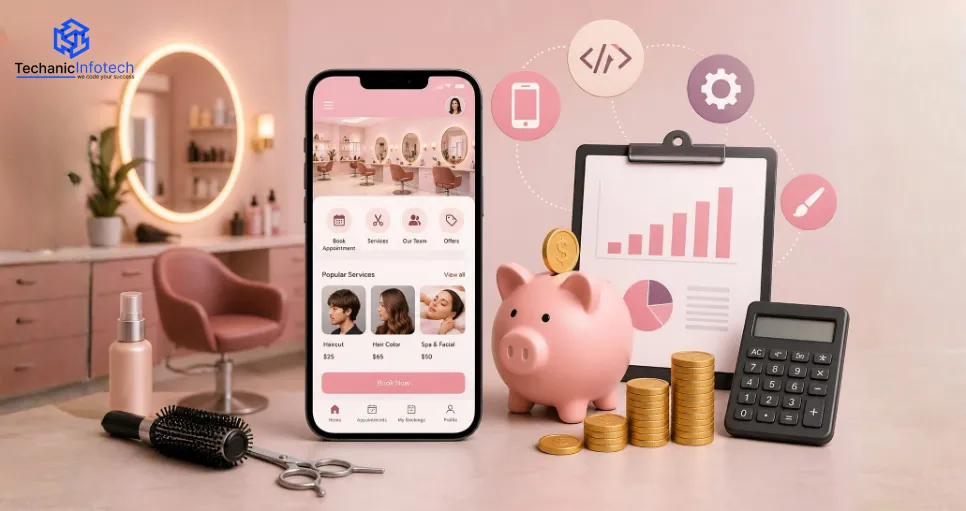
Want to know how much it costs to create an app like a salon app? You’re not alone.
The global salon app market size was valued at around $155.60 billion in 2022 and is expected to grow at a CAGR of 8.0% from 2023 to 2030.
With such a soaring number, it is obvious that people want to develop a salon app and are constantly wondering about the cost to develop a salon app.
Well, the overall cost to build a salon app can be from $10,000 to $250,000 or more, the cost can change as per features, complexity, and development team location.
But this isn’t all.
In this blog we will explore the cost to build an on-demand beauty salon application and various factors that affect the cost.
Have you ever dreamed that booking a salon appointment could be easier?
You're in luck! Beauty salon apps are here to help!
It's a digital solution that lets you schedule an appointment, browse services, and even discover new beauty trends- all from your phone!
With just a few clicks, you can book a haircut, a facial, or any treatment you may desire.
You can even schedule appointments, receive reminders, and even pay directly from the app.
Most of the apps will also have features like loyalty rewards, promotions, and customer reviews to ensure you make the best decision.
In a nutshell, a beauty salon app is designed to make your salon experience smooth and enjoyable!
Now, this ease of use is what is driving the demand for salon apps. So, if you want to create a salon app, you need to know the cost, this is what our next section is about:
Planning to develop a salon app?
Let's talk about How much does it costs to create a salon app?
There may be some variation in costs here, generally between $10,000 and $250,000.
This depends on the complexity & features etc.
If you want simple functions like appointment booking and payment, this would cost you the former part of the range mentioned.
However, if you prefer custom functionalities, like holding virtual consultations or integrating social networking functionality, you can expect a significant budget on your end.
Don't forget the running costs!
Updates, maintenance, and marketing also cost a lot.
Overall, salon apps are a good investment if you want to maximize the satisfaction of your customers while making the most of your bookings.
So, is now the time to take the plunge? Here is a breakdown for your help:
|
Price Range |
Estimated Cost ($USD) |
Description |
|
Low |
$10,000 - $30,000 |
Suitable for startups or salons with a limited budget. Offers basic features like appointment booking, online scheduling, and client management. |
|
Medium |
$30,000 - $100,000 |
Ideal for established salons looking for more features and customization. Includes features like appointment booking, online scheduling, client management, marketing tools, and reporting. |
|
High |
$100,000 - $250,000 |
Perfect for large salon chains or those seeking a premium experience. Offers extensive features, high customization, and integrations with other business systems. |
To be clear, this is just an estimate.
To get a detailed description of the overall cost, you can consult with a top mobile app development company.
As we said, several factors affect the beauty salon cost.
Want to know about them?
Let’s understand all of them in the next section.
Factors Affecting the Cost to Create a Salon App
To approach your plans to develop a salon app, you must understand what may have an impact on the total cost.
Every choice you make-from your tech stack to the complexity of the features- will impact your budget.
So, let's break down some key elements that influence the cost to create a salon app so you know what to expect.
The location of your development team can influence the final price. It is another area to pay close attention to find out the right price.
Location greatly affects how much does it cost to create a salon app.
In case, you'll be working with a team of developers from the US, Canada, or Western Europe, their services are expensive because of their higher hourly charges.
For that reason, developers in Eastern Europe, India, and Southeast Asia charge relatively much less for similar quality.
Balancing price against quality, as not always cheaper means the best; the choice also determines how much does it cost to build a salon application.
|
Location |
Average Hourly Rate |
Estimated Total Cost to Develop a Salon App |
|
US/Canada |
$100 - $250/hr |
$30,000 - $50,000+ |
|
Western Europe |
$60 - $150/hr |
$20,000 - $40,000 |
|
Eastern Europe |
$40 - $75/hr |
$15,000 - $30,000 |
|
India/Southeast Asia |
$20 - $50/hr |
$10,000 - $25,000 |
The tech stack you opt to build the salon app will significantly influence your overall costs.
Do you need a simple application with real-time booking integrations or payment gateway interfaces?
If yes, then a simple application with main features can be built upon the cost-effective frameworks React Native or Flutter.
But if you need complex functionalities or require a native app for both iOS and Android, the price will increase.
So the cost to build a salon app depends on the tech choices and how much custom functionality you need.
An extremely important part of user experience: designing your beauty salon app.
The more polished and intuitive your design is, the more it will cost.
A simple design with just basic branding can keep things pretty low-cost, whereas a premium design with custom illustrations, animations, and flows can increase the cost massively.
Good design is what would make or break the users' interaction with the application, so it needs to be appealing, functional, and easy to use.
The cost to create a salon app would reflect the quality and complexity of the design.
Here is a small breakdown of how design affects the cost:
|
UI/UX Design Aspect |
Description |
Impact on Cost |
|
Custom Design vs. Template Design |
Custom designs are created from scratch to reflect unique branding and user needs, while templates use pre-made UI elements. |
Custom Design: High (requires extensive design and development work). Template Design: Low (faster to implement, less customization). |
|
Design Complexity (Simple vs. Complex) |
Simple designs with minimalistic UI are quicker to implement, while complex designs involve more custom elements, animations, and advanced interactions. |
Simple Design: Low (fewer screens, basic UI components). Complex Design: High (custom transitions, multiple screens, advanced animations). |
|
Prototyping and Wireframing |
Wireframes are basic outlines of the app's layout, and prototypes are interactive versions of the design that help with user testing. |
Wireframing: Medium (necessary for clarity but less detailed). Prototyping: High (interactive and detailed testing, increases design iterations). |
|
User Research & Testing |
Conducting user research (surveys, focus groups) and usability testing to refine the app’s design based on real user feedback. |
High (time-consuming, requires specialized expertise and tools for research and testing). |
|
Responsive Design (Multi-Device Support) |
Designing the app to be fully functional across multiple devices (smartphones, tablets, desktops) can increase development time. |
Medium-High (requires design adjustments for different screen sizes and resolutions). |
|
Animations & Microinteractions |
Adding animations or small, interactive elements (e.g., button hover effects, loading animations) can make the app feel more polished. |
Medium-High (requires both design and development effort, especially for fluid, high-quality animations). |
|
Visual Design Quality (High vs. Low) |
High-quality, polished visual design with custom graphics, icons, and illustrations takes more time compared to using basic, standard designs. |
High-Quality Design: High (custom illustrations, high-res visuals, unique icons). Basic Design: Low (standard icons, minimal graphics). |
|
Accessibility Features |
Designing with accessibility in mind (e.g., color contrast, screen reader compatibility, adjustable font sizes). |
Medium (requires additional design considerations to meet accessibility standards). |
Another thing that may make your salon app cost high would be its complexity.
Do you want booking and scheduling or payment gateways and loyalty programs, with push notifications and other features?
All of these advancements represent more code, more testing, and longer development timelines-and, again, cost.
When you ask, "How much does it cost to create a salon app?" Remember that the more complex your application is, the more expensive it will be.
The app features you choose will significantly influence your salon app development cost.
Essential features like appointment booking, calendar management, and user profiles are relatively simple and cost-effective to implement.
However, if you want advanced features like virtual consultations, customer reviews, or integrated marketing tools, this can increase both the development time and cost.
Think about which features are essential for your app and prioritize those to keep the cost in check.
Here's a table outlining different beauty app features and how they might affect the overall cost of developing a beauty app.
|
Feature |
Description |
Impact on Cost |
|
User Profiles & Account Management |
Allows users to create personal profiles, store preferences, and track beauty history (e.g., skin types, treatments). |
Medium - Basic user authentication is inexpensive, but custom features (e.g., skin analysis) may raise costs. |
|
Video Consultations |
Enables users to have live video consultations with beauty experts or dermatologists. |
High - Requires real-time video streaming, server infrastructure, and security protocols. |
|
Augmented Reality (AR) Filters |
Users can try on makeup, hair colors, or skincare products virtually using AR. |
Very High - AR technology is advanced and costly to integrate. May also require custom development or third-party services. |
|
Product Recommendations |
Personalized beauty product suggestions based on user preferences, skin type, and previous purchases. |
Medium - Requires algorithm development or integration with recommendation engines. |
|
Appointment Booking & Scheduling |
Lets users book appointments with beauty professionals or salons. |
Medium - Involves backend development for calendar integration, real-time availability tracking, and notifications. |
|
Payment Gateway Integration |
Secure system for users to make payments for products or services directly within the app. |
Medium - Involves integrating third-party payment processors (e.g., Stripe, PayPal), which comes with setup and transaction fees. |
|
Push Notifications & Alerts |
Sends users reminders for appointments, promotions, or product restocks. |
Low - Relatively inexpensive, but may require custom alerts and notifications based on user behavior. |
|
AI-Powered Skin Analysis |
Uses AI to analyze users' skin conditions and recommend suitable products or treatments. |
Very High - Development of AI-driven tools involves significant investment in machine learning models and data processing. |
Once you have your salon app live, the costs are not over.
Maintenance and updates are necessary to keep your app running smoothly and securely. Regular updates, bug fixes, and adapting to new OS versions will add to your costs on an ongoing basis.
For maintenance, you would budget around 15-20% of the initial development cost annually.
Add the fact that when adding features or making updates of considerable magnitude, the price will also increase.
Probably one of the biggest decisions that you have to make early on is which platform the app will be for.
Do you want to go for Android app development services , iOS app development services , or Hybrid app development services?‘
This choice makes a difference not only in the costs of developing a salon app but also in how widespread your audience is, your user experience, and your interaction with your customers at your salon.
Besides, the platform you use will make a difference in the design and functionality of your app in managing updates or even customer support.
That's why each of your choices should be carefully measured with pros and cons attached to them.
So, these are some of the factors that might decide on How much does it cost to create a beauty salon app.
Now, the question is…
To build an application for your beauty salon does indeed cost a lot of money, but that is not necessary to break the bank over it.
There are numerous ways through which you can cut down your expenses while developing an app without compromising on quality.
Now let's dig into a few ways you can keep costs down while not sacrificing the core features your salon needs:
Instead of trying to build some large, feature-heavy application right away, consider starting by launching what's known as an MVP.
This is an app version that contains only the bare minimum of the needed features to satisfy your salon's primary needs - something like booking appointments and processing payments.
By focusing on core functionality, you can test the waters and get some feedback from your customers.
This method enables you to skip features that may not be relevant to your business and save money during the development phase.
Instead of developing a separate app for iOS and Android, seek to go for cross-platform development.
With the support of frameworks such as Flutter or React Native, you develop one application that will work simultaneously on both platforms. You save time and money.
Testing hours spent on coding and update hours were significantly reduced. Therefore, you reach out to a wider audience without having to pay for two separate builds.
It is very tempting to add bells and whistles of all kinds—customer loyalty programs, AI-based recommendations, virtual makeup try-ons—and so on to a beauty salon app.
But these features jack the price up pretty fast.
Focus on the basics your customers need to have immediately: appointment booking, payment processing, and basic customer profiles, for instance.
Once the app is live and you have enough traction, you'll be able to roll out additional features over time.
The key to managing your cost to create an on-demand salon app is to choose the right development team.
Although you may be tempted to take the low-cost option, consider hiring a team that has experience in mobile app development.
This will save you a penny in the long term since the right team will get things right the first time hence not requiring costly adjustments or delays.
Look for teams that already have experience in similar projects or an aligned portfolio with your needs.
If you are looking for a cost-effective approach, then consider hiring a freelance developer or a small development agency.
Developing a backend infrastructure from scratch is costly. You can therefore rely on cloud-based services such as Amazon Web Services (AWS), Google Cloud, and Microsoft Azure.
These services offer scalable and secure solutions for hosting your app's data, user information, and much more.
Cloud services are usually pay-as-you-go. You only pay for what you use. This might help you save a cost, especially if this is going to be a small salon application and you anticipate modest traffic early on.
Just take a look at how you reduce the salon app development cost through this table:
|
Strategy |
Description |
Cost Impact |
|
Minimum Viable Product (MVP) |
Start with a basic version of your app to test the essential features before adding extras. |
Low initial cost, scalable over time. |
|
Cross-Platform Development |
Use frameworks like Flutter or React Native to build one app for both Android and iOS. |
Lower development and maintenance costs. |
|
Focus on Core Features |
Prioritize essential features like booking and payments, then add advanced features later. |
Saves time and resources in the early stages. |
|
Choose the Right Development Team |
Hire a skilled development team or freelance developers to avoid costly mistakes and delays. |
More efficient development and fewer revisions. |
|
Cloud Services for Backend |
Use cloud-based hosting for scalable, cost-efficient data storage and management. |
Flexible, cost-effective backend management. |
As a beauty salon owner, launching an app can help you not only streamline operations but also open up new revenue streams.
The beauty industry is thriving, and with the right monetization strategies, your app can start earning for you while providing value to your customers.
Let’s dive into some of the best ways you can turn your salon app into a profitable asset:
Charging a small booking fee over the appointment made through the salon app is one of the most direct and best monetization strategy.
This fee can either be a flat rate or a percentage of the service charge, depending on what your business will find most acceptable.
Charge fees for premium features. In this, you can add benefits for users who commit to a subscription. These benefits may include:
If you are into selling beauty products whether it is shampoos, skincare items or makeup then you can generate revenue via these apps by allowing them to make direct purchases from within this app.
You can suggest personalized product recommendations based on their history of visits or preferences too.
If your beauty salon app has an active user base, advertising and affiliate marketing come into play.
Join other beauty brands or services related to your business, such as hair care, makeup, or wellness products, and include ads or promotions within your app.
You receive commissions on any sales generated through the app.
Loyalty programs are a win-win.
They encourage repeat business while offering your clients rewards for their continued support.
You can integrate loyalty points or rewards directly into your app. You can also sell digital gift cards within the app, making it easy for customers to gift services to friends or family.
As virtual consultations become more prominent in most industries, it would be an excellent source of income to monetize your app through online beauty consultations.
This could include skincare advice, hairstyle consultations, and even makeup tutorials wherein clients pay for a live, personalized session with one of your experts through video chat or messaging.
Partner with makeup artists, photographers, and even fitness trainers from around your local neighborhood.
You're going to list their services in your application and you'll get some extra revenue by receiving commissions on each booking made from your app.
More and more consumers seek convenience and personalization. Therefore, the booming industry of beauty salons calls for a great opportunity to make a beauty salon app.
If you want to develop a salon app without breaking the bank, then, Techanic Infotech is your best bet as a top salon app development company.
At Techanic Infotech, we have experts to help you develop an application within your budget without compromising quality.
Let us bring your vision to life and capture the growing demand in the beauty industry- cost-effectively and efficiently.
Building a beauty salon application can be a real change of game for your company, bringing convenience to its customers and streamlining all the operations of the salon.
All those different factors that affect the overall cost of development, that is, the choice of the desired platform, the complexity of needed features, design, and the location of the team, would be necessary for planning expenses.
Whether you are looking for the most basic app or want a customized version, Techanic Infotech will take care of the output designed to suit your pocket.
With expert guidance and a cost-effective approach, you can step into the future of salon management at a cost-effective price.
Salon app development typically costs between $10,000 and $250,000 depending on features, platform, and complexity.
Costs vary due to design quality, feature set, third-party integrations, and the location of the development team.
A basic MVP with booking and payment features can start from $10,000 to $30,000.
Start with an MVP, use cross-platform frameworks, focus on essential features, and choose a cost-effective development team.
Advanced features like AR try-ons, AI recommendations, video consultations, and custom UI/UX significantly increase costs.
Yes, cross-platform apps reduce development and maintenance costs by using a single codebase for Android and iOS.
Maintenance, hosting, updates, and security patches typically cost 15–20% of the initial development cost annually.
Development usually takes 3 to 9 months depending on complexity, features, and testing requirements.
Yes, by starting with a basic version and scaling gradually based on business growth and user demand.
Popular options include Flutter, React Native, Node.js, and cloud platforms like AWS or Google Cloud for scalability.


Neha Sharma is a tech expert at heart who loves exploring new technologies and turning complex ideas into easy-to-understand content. With a passion for learning and writing, she enjoys sharing insights on emerging tech, digital products, and innovation that help businesses stay ahead.