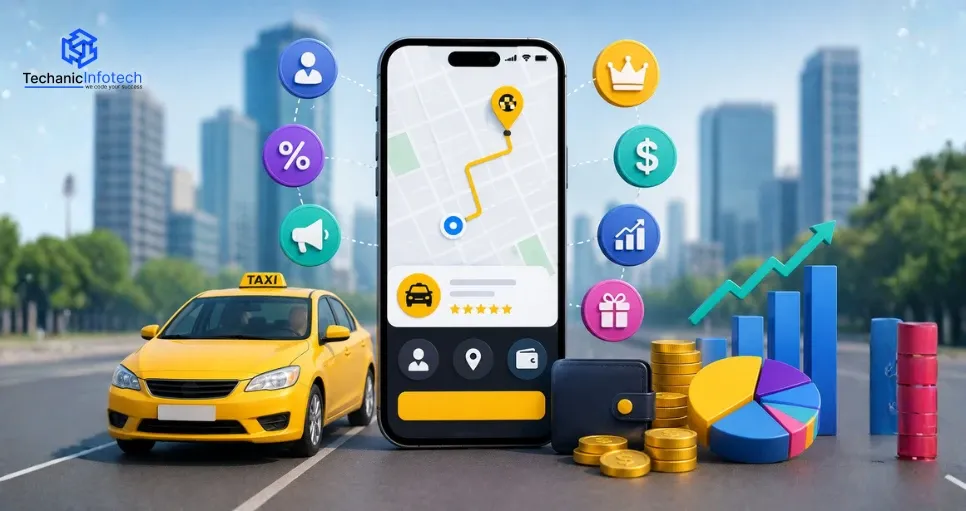
In the on-demand era, building a taxi booking app is no longer a matter of offering rides–building a successful business is the goal.
Taxi app monetization involves making your app a sustainable source of revenue while making an impact on users and drivers.
Between commission-based revenues, subscription-based models, and advertising within apps, there are several methods of monetizing your taxi booking app.
Learning these strategies ensures you maximize revenue, boost user interaction, and remain competitive in a rapidly growing market.
As a startup or a seasoned transport business, discovering the correct monetization strategy assures that your investment in a taxi app translates into profitability in the long run. Discover how to monetize your taxi booking application effectively and strategically.
Taxi app monetization is the techniques and tactics you employ to earn money from your taxi booking application. Whether you desire constant income or scalable growth, it is essential to learn how to monetize effectively.
When you design a taxi booking app, there are various means of making it a successful platform. From commission-based revenues to subscription models and in-app offers, the appropriate monetization strategy helps your app not only gain popularity but also provide regular revenues.
By adopting the appropriate revenue models, you can effectively monetize your taxi booking app, optimize user engagement, and establish a viable business.
Key takeaway: When developing a taxi booking app , integrating several monetization strategies, such as ride commissions, premium features, and advertising, maximizes profitability without sacrificing user experience
In the competitive ride-hailing landscape today, it's imperative that you learn about taxi booking app monetization strategies to make your platform a money-making machine.
Strategic monetization helps ensure that your app not only survives on operational expenses but also grows profitably, with a seamless and enjoyable user experience.
Let’s get to know some benefits of monetizing your taxi app:
Monetizing your taxi app enables you to come up with various sources of income, either through commissions, subscription models, or in-app advertisements.
A well-organized taxi app monetization model ensures consistent cash inflow, enabling you to reinvest in app development, marketing, and driver incentives.
Consistent revenue also facilitates scaling the business without undermining the quality of service.
Adequate taxi app monetization strategies can enhance user activity through the provision of value-added services like priority booking, loyalty schemes, or paid subscription.
When users perceive real value from the payments they make, they tend to remain active, thus enhancing app retention rates while also enhancing profitability.
Incorporating monetization strategies allows your application to finance ongoing technology improvements, ranging from AI-based route optimization to real-time monitoring and targeted promotions.
Investing in taxi app features enriches passenger and driver experiences, establishing a competitive advantage in the ride-hailing industry while facilitating sustainable growth.
A profitable app with transparent taxi booking app monetization tactics becomes appealing to partners, advertisers, and investors.
Opportunities for collaborations, such as in-app promotions, brand alliances, or corporate collaborations, can create additional revenue streams, further adding to profitability without decreasing user experience.
With monetization of your taxi app being a priority, let's discuss the various taxi app monetization models that can transform your ride-hailing platform into a sustainable and extremely lucrative enterprise.
Developing a successful ride-hailing business means building a financially rewarding taxi app.
Taxi app monetization models determine how your app makes money without disappointing drivers and passengers.
Selecting the correct strategy might make or break your long-term success in the taxi booking industry.
App developers and entrepreneurs need to wisely study the market, users, and competitors.
Let us discuss the best alternative monetization models for your taxi-hailing application.
The most prevalent taxi app monetization strategy is the commission-based model.
In this system, the platform generates revenue by taking a percentage of every ride at a fee as a commission on drivers.
This guarantees the app makes money proportionally to the number of rides taken, equating the app's success with that of its driver partners.
By correlating revenue with ride activity, this model inherently encourages the platform to provide a high-quality service for repeat passengers.
Benefits:
Guarantees a regular revenue stream for the app without directly billing passengers.
Encourages the sign-up of drivers since they only pay when they earn.
Scalable as more rides are taken.
Example: Uber, one of the best taxi booking apps , takes a fixed percentage of all rides as commission, which makes up a substantial portion of its income.
This method is one of the most successful taxi app monetization strategies for sustainable growth.
Another highly used taxi app monetization method is adding a small service or booking fee per ride. This is as opposed to commission fees, which are usually paid by drivers and are often paid by passengers.
It serves to subsidize the cost of running the app platform. This taxi app monetization strategy is most effective when paired with smooth, transparent payment systems so that passengers are able to realize the value of the service.
Benefits:
Generates a secondary revenue source outside of driver commissions.
May be dynamic, varying depending on demand, location, or time.
Tip: Integrating booking fees with surge pricing allows your taxi booking application monetization models to dynamically adjust to peak demand effectively.
Others use subscription-based taxi app monetization strategies where drivers pay a flat monthly or yearly fee to become a part of the platform.
This one eliminates the platform's risk of unpredictable commission earnings based on variable ride volume and delivers consistent revenue, no matter what ride volume occurs. It also makes the app more professional in that serious players are encouraged to join.
Benefits:
Guarantees consistent revenue no matter what the ride volume.
Incentivizes drivers to remain active on the platform.
It can be supplemented with premium features such as analytics, priority support, or search visibility.
It's a dynamic taxi app monetization model that also fosters driver loyalty and engagement in the long run.
Adding ads to your app is yet another creative taxi app monetization technique. By adding advertisements to the user interface, like banners, interstitials, or short video ads, you can earn money without directly charging passengers.
This approach not only diversifies revenue streams but also helps balance the overall taxi app development cost, making your investment more sustainable.
Apart from being a source of money, in-app advertising can be personalized to advertise local companies, making it a win-win situation for advertisers as well as passengers.
Benefits:
Gathers passive revenue without directly charging customers.
Provides a platform for local businesses to reach surrounding passengers.
Can be complemented with loyalty programs to encourage ad interaction.
Tip: Make sure ads do not interfere with the user experience to ensure app retention.
Surge pricing or dynamic pricing is a very powerful taxi app revenue model. This type of model dynamically alters ride prices in real-time according to real-time demand and supply.
With data analytics and AI, your app determines high-demand areas and times, then charges customers more during peak periods or events.
Not only does this strategy pull in the most possible revenue, but it also stabilizes supply and demand by incentivizing more drivers to work in high-demand timeframes.
Benefits:
Fares rise automatically when demand is high or supply is limited.
Drivers are incentivized to accept rides during peak hours, optimizing service availability.
Example: Uber and Lyft employ AI-driven dynamic pricing to optimize earnings. This model is among the most lucrative taxi booking app monetization models.
Providing high-end features to riders is an emerging taxi app monetization trend.
Amenities such as luxury cars, expedited pickups, and subscription ride passes appeal to customers who are willing to pay more for comfort, ease, or time savings. This approach can also be seen in carpooling app development.
Segmenting services into a low-end and high-end bracket means your app has more appeal to a wider audience and more revenue overall.
Benefits:
Improves user experience while earning more revenue.
Urges passengers to pay for convenience, comfort, or time-saving attributes.
This strategy is among the most versatile taxi app monetization tactics available for income source diversification and building premium service offerings.
Combining loyalty schemes and cashback is another creative taxi app monetization scheme.
With every trip rewarded with points or discounts for the passenger, apps can increase usage engagement and promote repeat rides.
Moreover, collaborations with banks, stores, or other service companies can also enhance monetization by providing users with special offers or cashback.
Benefits:
Enhances retention and engagement.
Provides opportunities for retail or payment platform partnerships.
Can be indirectly monetized through partner or affiliate arrangements.
It is an effective method to fortify taxi app booking monetization schemes without actually raising the cost of rides directly.
Partnership with brands, hotels, restaurants, or online shopping platforms unveils a new revenue channel through affiliate marketing.
This taxi app monetization tactic transforms your app from a mere transport service- it evolves into an offer and experience platform connected with passenger journeys.
For example, providing airport transfers via hotel collaborations may offer users an extra level of convenience in addition to generating supplementary revenue.
Benefits:
Increases revenue channels beyond passenger rides.
Establishes brand credibility and awareness.
This is one of the new alternative monetization strategies for your taxi app that relies on partnerships to achieve maximum profitability.
With the proper privacy protections, ride-hailing apps can leverage anonymized user and ride data as a source of revenue.
This model of taxi app monetization enables you to sell insights regarding traffic patterns, peak hours, and commuter behavior to city planners, researchers, or advertisers.
By responsibly monetizing data, your platform generates value that extends beyond movement.
Benefits:
It costs money without compromising user experience.
Can enable predictive analytics or city transport solutions.
This approach is a futuristic taxi app monetization strategy that turns operational data into a valuable asset.
Special event pricing schemes enable your app to take advantage of festivals, concerts, or sporting events.
This taxi app pricing model provides premium, in-demand rides during the time and even event-themed packages, if needed.
It allows paying passengers who prefer convenience or ensured service to do so while providing the platform with meaningful revenue.
Benefits:
Grabs high-demand times with low risk.
Attracts users who are willing to pay for convenience.
This is one of the examples of taxi booking app monetization models that has balanced profitability and convenience for users.
The proper taxi app monetization models are essential to make your ride-hailing app successful in a competitive market.
The suitable approach weighs revenue maximization against user satisfaction and driver retention, and effective taxi app design , since user experience plays a key role in retention. Knowing market trends, rider behavior, and your app's value proposition will guide you in selecting a model that can scale well.
The following are a few points worth considering:
Understanding your users comes first. Identify whether they have a preference for low-cost rides, high-end services, or subscription options.
This understanding is helpful in crafting taxi app monetization designs that directly connect to passenger inclinations while maximizing profit possibilities.
Learn from the top apps that operate their taxi app monetization strategies.
Look for gaps or opportunities where your platform can provide added value, perhaps in the form of innovative ride choices or improved pricing models, to get and keep users.
Determine if your app will mainly depend on drivers' commissions or subscription charges.
Platforms that rely solely on driver commissions without exploring other revenue streams risk losing profitability, which is another reason why taxi apps fail .
Both taxi app monetization models have their own strengths: commissions increase with the volume of rides, whereas subscriptions offer consistent revenue irrespective of fluctuations.
The optimal taxi app monetization models focus on a frictionless experience. Do not burden passengers with too many fees or advertisements.
A well-balanced approach guarantees high retention, good word-of-mouth, and long-term profitability.
Implement surge pricing or peak-hour charges where necessary.
This technique is in line with how taxi ride apps earn revenue, maximizing earnings during busy hours and incentivizing drivers to remain online.
Collaboration with companies, events, or online shops provides an additional revenue source.
These taxi app monetization techniques enable you to earn money through partnerships and offer extra benefits for passengers.
No model is perfect from the start. Continuously monitor ride data, revenue, and user feedback to refine your taxi app's money strategy.
Iteration ensures your monetization approach evolves with new taxi booking app trends and passenger expectations.
To turn an idea for a taxi app into a successful reality takes more than code-it takes clever monetization, frictionless user experience, and scalable solutions. That's where Techanic Infotech enters the picture. With our expertise as a top taxi booking app development company , we are experts at creating apps with successful taxi app monetization strategies designed in accordance with your business objectives.
From subscription and commission-based models to dynamic pricing strategies, we make sure your app generates revenue while both drivers and passengers remain happy. Join forces with us to bring your ride-hailing concept to life as a market-ready, high-performing platform.
Selecting the optimal taxi app monetization strategies is key to establishing a successful ride-hailing company. Knowing the target market, analyzing competitors, and knowing where the money comes from makes you adopt the best taxi app monetization strategies.
The likes of commission-based fees, subscription plans, dynamic pricing, and strategic alliances can greatly increase profitability.
But success comes with a combination of revenue generation and seamless user experience, being responsive to trends in the market, and constantly innovating features of the app.
With a strategically thought-out strategy, your taxi booking app will mature into a high-performing, sustainable platform, keeping both passengers and drivers engaged while maximizing income.
Taxi app monetization refers to strategies used to generate revenue from a ride-hailing application.
Popular models include commissions, subscriptions, surge pricing, in-app ads, and booking fees.
Taxi apps earn money through ride commissions, premium features, advertisements, and partnership programs.
It provides scalable revenue by charging drivers a percentage from every completed ride.
Surge pricing increases ride fares during peak demand periods to maximize revenue and driver availability.
The right strategy helps improve profitability, user retention, and long-term business growth.


Abhishek Jangid is the CEO of Techanic Infotech, with extensive experience in mobile app and web development. He specializes in helping businesses turn innovative ideas into scalable digital solutions through strategic planning and modern technology.