Video Streaming App Development
How Much Does It Cost to Develop a Video Streaming App?
January 22, 2026
January 22, 2026
Video streaming applications have become a core part of digital consumption, powering entertainment, education, fitness, live commerce, and enterprise communication.
From Netflix-like OTT platforms to live streaming apps and eLearning portals, businesses increasingly rely on video to engage users at scale.
Factors such as infrastructure scaling, bandwidth consumption, security, and ongoing maintenance can significantly change total costs over time.
Understanding what drives these cost variations is critical for startups and enterprises planning sustainable growth. Usually, the cost of developing a video streaming app ranges from $20,000 to $120,000+ that may fluctuate as per its complexity.
This guide breaks down video streaming app development costs, explores how budgets evolve at scale, and provides practical insights into features, technology choices, hidden expenses, and optimization strategies, helping you plan a future-ready streaming platform with confidence.
The cost to build a video streaming app typically starts from $20,000 for a basic MVP and can scale up to $120,000+ depending on features, platforms, and scalability requirements.
A simple app with on-demand video playback, user authentication, and admin controls costs less, while apps supporting live streaming, AI recommendations, DRM security, and global delivery require higher investment.
Initial development cost usually covers UI/UX design, frontend and backend development, basic cloud setup, and testing.
However, this is only the foundation. As user numbers grow, infrastructure, CDN usage, storage, and third-party services begin to influence the budget heavily.
The following is the table that shows the cost to build a video streaming app according to the complexity of the application.
|
App Complexity |
Estimated Cost |
|
Basic MVP Video Streaming App |
$20,000 – $35,000 |
|
Mid-Level App (Live + VOD) |
$40,000 – $80,000 |
|
Advanced Scalable Platform |
$90,000 – $120,000+ |
Understanding this cost range helps businesses align expectations and plan development in phases rather than overspending upfront.
The following are the essential mobile app features that directly influence the initial development cost of a streaming app, shaping its functionality, scalability, user experience, and long-term platform reliability.
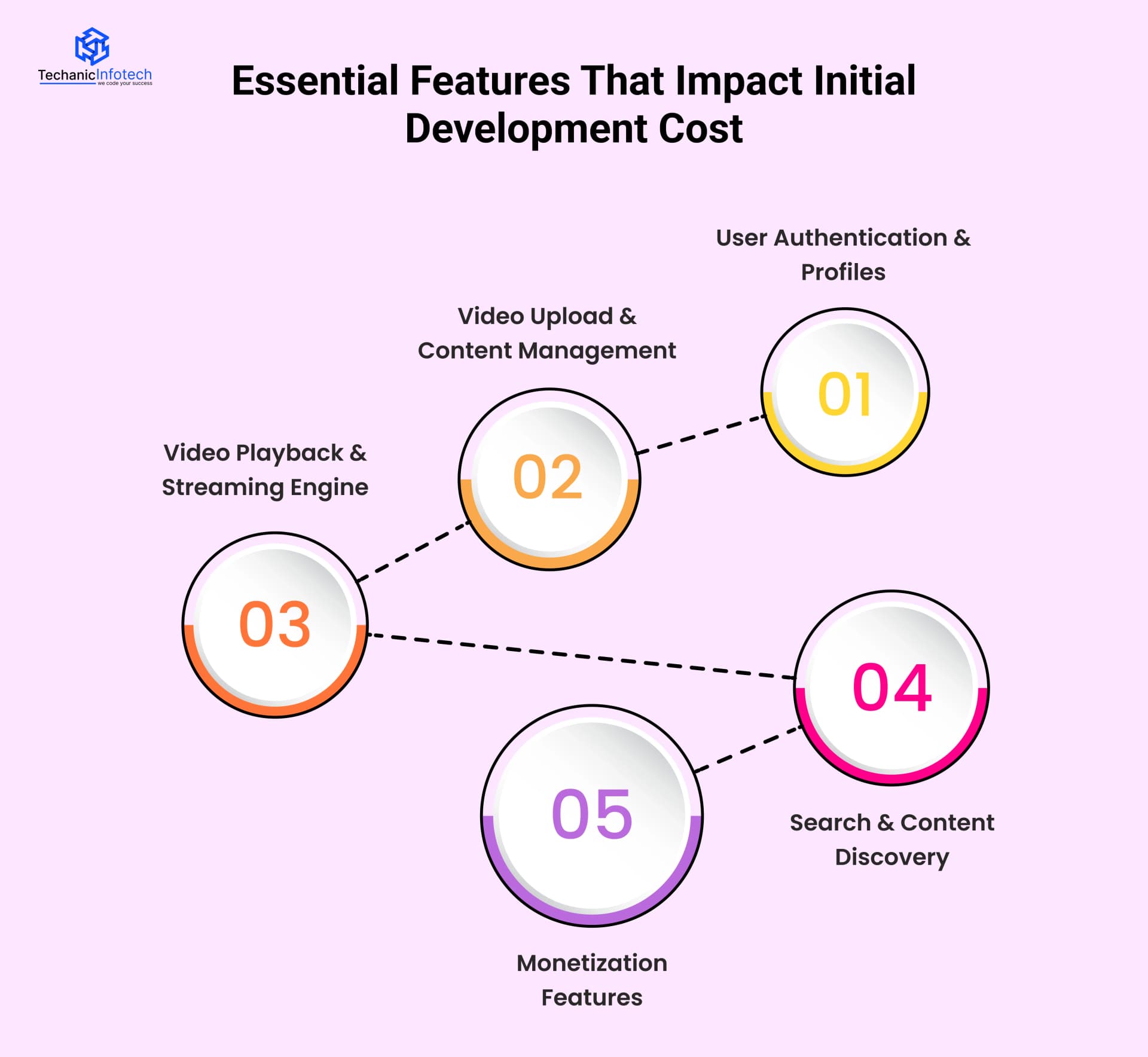
User login, registration, and profile management form the foundation of any streaming app.
Features like social login, multi-profile support, parental controls, and role-based access increase development time.
Secure authentication systems also require encryption and compliance with data protection standards, slightly increasing initial costs but ensuring user trust and platform stability.
A robust content management system allows admins to upload, organize, tag, and schedule videos.
Support for multiple formats, resolutions, thumbnails, and metadata adds complexity.
The more control you need over content workflows, the higher the backend development effort and mobile app development cost.
Smooth playback with adaptive bitrate streaming, buffering control, and device compatibility is critical.
Implementing HLS/DASH protocols, custom video players, and error handling directly affects development complexity and testing effort.
Advanced search, filters, categories, and personalized recommendations improve user experience but require indexing logic and backend optimization.
Even basic discovery features add to development time when scalability is considered.
Subscription plans, ads, pay-per-view, or in-app purchases require secure payment gateway integration, transaction handling, and compliance with app store policies, adding noticeable cost during initial development.
|
Feature |
Importance |
% of Budget |
Approx. Cost |
|
UI/UX Design |
High |
12% |
$2,400 |
|
Core Functionality (MVP) |
Very High |
30% |
$6,000 |
|
Backend/API Development |
Very High |
20% |
$4,000 |
|
Frontend Development |
High |
18% |
$3,600 |
|
Testing & QA |
High |
10% |
$2,000 |
|
Deployment & DevOps |
Medium |
5% |
$1,000 |
As a streaming platform expands, operational expenses grow alongside its audience.
Infrastructure demands, data transfer, storage capacity, security measures, and performance optimization become increasingly complex and costly.
With user growth, server workloads intensify. Streaming platforms depend on scalable cloud resources for computing, databases, and storage.
These usage-based services can cause recurring monthly costs to exceed initial development investments.
|
Aspect |
Details |
Cost Impact |
Estimated Cost |
|
Scalable Computing |
Auto-scaling servers to handle growing user traffic |
High |
$2,500 |
|
Managed Databases |
User data, metadata, subscriptions |
Medium–High |
$1,800 |
|
Cloud Storage (Core) |
Media assets and platform data |
Medium |
$1,700 |
|
Total |
|
|
$6,000 |
Video streaming is bandwidth-intensive. CDNs improve global content delivery and reduce latency, but their pricing is tied to data consumption.
Reaching international audiences significantly increases ongoing delivery costs.
|
Aspect |
Details |
Cost Impact |
Estimated Cost |
|
CDN Services |
Global content delivery and high-latency streaming |
Very High |
$3200 |
|
Data Transfer |
Outbound video streaming traffic |
High |
$1800 |
|
Total |
|
|
$5,000 |
HD and 4K content require substantial storage.
As libraries expand, expenses rise steadily, especially when factoring in backups, redundancy, and long-term data retention.
|
Aspect |
Details |
Cost impact |
Estimated Cost |
|
HD Content Storage |
Standard video library storage |
Medium |
$1,800 |
|
4k content storage |
High-capacity storage for Ultra HD videos |
Medium–High |
$1,200 |
|
Backup & Redundancy |
Replication, disaster recovery, retention |
Medium |
$1,000 |
|
Total |
|
|
$4,000 |
Larger platforms face higher piracy risks. Implementing DRM, watermarking, and advanced security frameworks introduces additional setup fees and recurring licensing costs.
|
Aspect |
Details |
Cost Impact |
Estimated Cost |
|
DRM Licensing |
Content protection and access control |
High |
$1,500 |
|
Watermarking |
Anti-piracy and content tracking |
Medium |
$900 |
|
Security Frameworks |
Encryption and secure streaming |
Medium |
600 |
|
Total |
|
|
$3,000 |
Ensuring consistent, high-quality streaming for large audiences requires load balancing, caching strategies, and real-time monitoring tools, further increasing operational and mobile app maintenance expenses.
|
Aspect |
Details |
Cost Impact |
Estimated Cost |
|
Load Balancing |
Distributes traffic evenly |
Medium |
$800 |
|
Caching Strategies |
Reduces buffering and server load |
Medium |
$600 |
|
Real-Time Monitoring |
Performance tracking and alerts |
Medium |
$600 |
|
Total |
|
|
$2,000 |
Selecting the right mobile app tech stack guide plays a crucial role in determining development cost, performance efficiency, scalability, and long-term maintenance of a video streaming platform.
Each choice directly affects both upfront investment and future operational expenses.
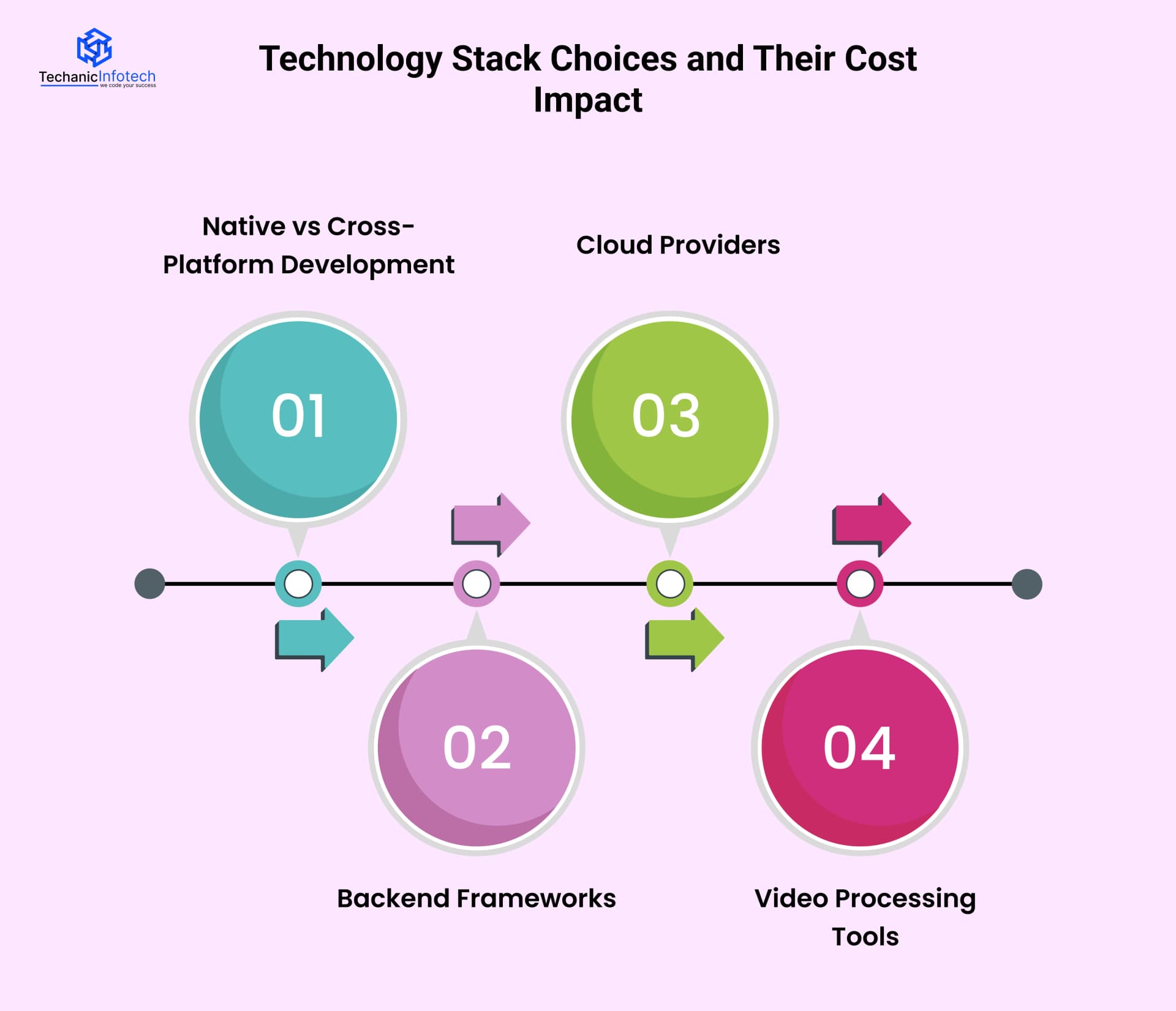
Native development delivers superior performance, smoother user experience, and better access to device-specific features.
However, building separate apps for iOS and Android increases development time and cost.
Cross-platform frameworks reduce initial expenses by sharing codebases but may require performance tuning as the platform scales.
Choosing scalable backend frameworks such as Node.js, Java, or Python ensures the system can handle high traffic and concurrent users efficiently.
While robust frameworks may require higher initial setup costs, poor backend decisions can result in performance bottlenecks, increased maintenance efforts, and costly rewrites in the future.
Cloud platforms like AWS, Google Cloud, and Microsoft Azure offer scalable infrastructure with pay-as-you-go pricing.
However, costs vary significantly for storage, bandwidth, video streaming, and CDN services.
Selecting the right provider early helps optimize performance while preventing unexpected cost escalations at scale.
Video encoding, transcoding, and compression tools directly impact streaming quality and operational expenses.
Automated processing pipelines improve efficiency and consistency but require higher compute resources.
Efficient tool selection balances video quality, processing speed, and infrastructure costs to support smooth, scalable content delivery.
As video streaming apps scale, rising user demand drives higher infrastructure, bandwidth, storage, security, and performance optimization costs, making ongoing operations increasingly complex and expensive.
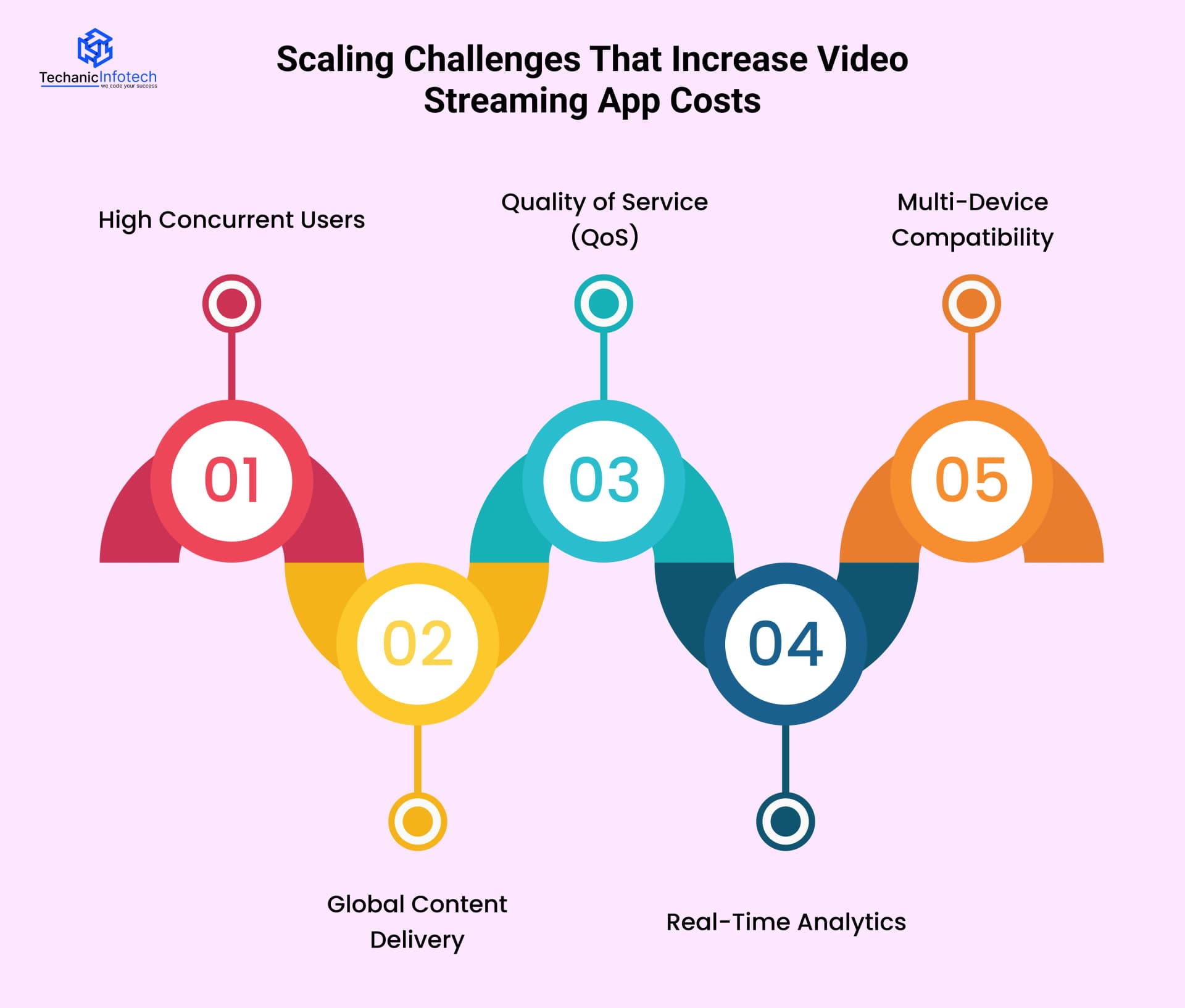
Managing thousands or even millions of simultaneous viewers requires high-availability servers, intelligent load balancing, and dynamic auto-scaling infrastructure.
These systems ensure uninterrupted streaming but significantly raise infrastructure and operational expenses as traffic grows.
Delivering seamless video experiences across multiple regions demands a globally distributed CDN, regional cloud deployments, and adherence to local data sovereignty laws, adding both architectural complexity and ongoing cost.
Ensuring consistent HD or 4K playback with minimal buffering requires high-bandwidth networks, advanced video transcoding, and performance optimization layers, all of which substantially increase processing and delivery costs.
Capturing and analyzing viewer behavior, engagement metrics, and streaming performance at scale requires robust data pipelines, real-time dashboards, and analytics platforms that generate continuous operational expenses.
Supporting seamless playback across smart TVs, web browsers, mobile devices, and tablets demands extensive cross-platform development, rigorous testing, and ongoing optimization, leading to higher maintenance and support costs.
These hidden and recurring costs from platform maintenance and third-party service fees to legal compliance and customer support can materially impact the total cost of ownership and should be carefully accounted for in any long-term business plan.
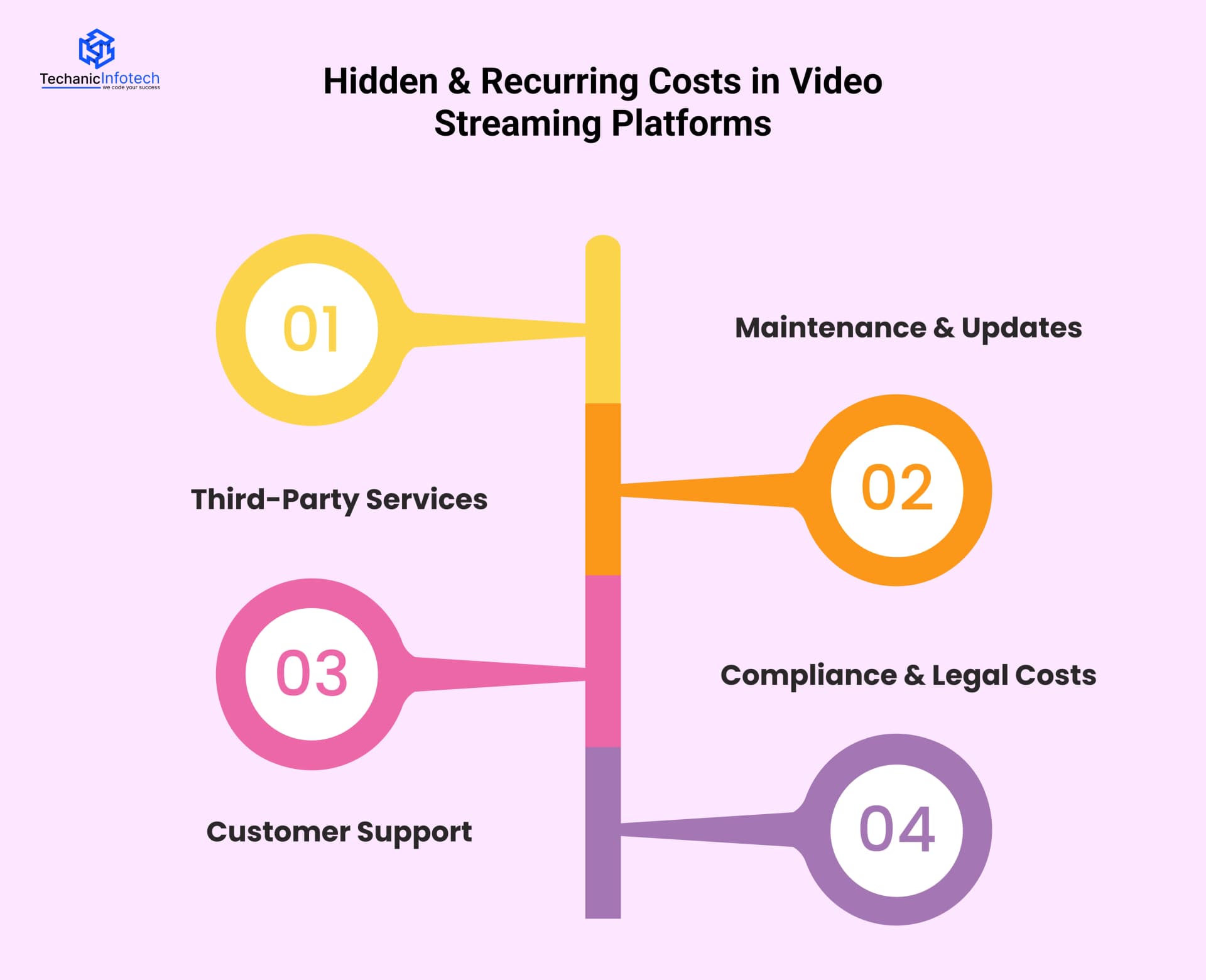
Ongoing maintenance includes bug fixes, security updates, performance improvements, and feature enhancements, requiring continuous developer involvement and quality assurance resources throughout the platform’s lifecycle.
Integrations such as payment gateways, DRM solutions, analytics platforms, cloud storage, and notification services operate on subscription or usage-based pricing, contributing to steadily increasing recurring operational costs.
Meeting regulations like GDPR, COPPA, and regional content laws requires legal consultations, compliance audits, documentation updates, and technical adjustments, adding unavoidable and ongoing legal expenses.
As the platform scales, businesses must invest in customer support teams, moderation tools, ticketing systems, and community management solutions to maintain service quality and user satisfaction.
Cost optimization strategies help streaming apps scale efficiently by reducing infrastructure, bandwidth, and storage expenses while maintaining performance, security, and a high-quality user experience.
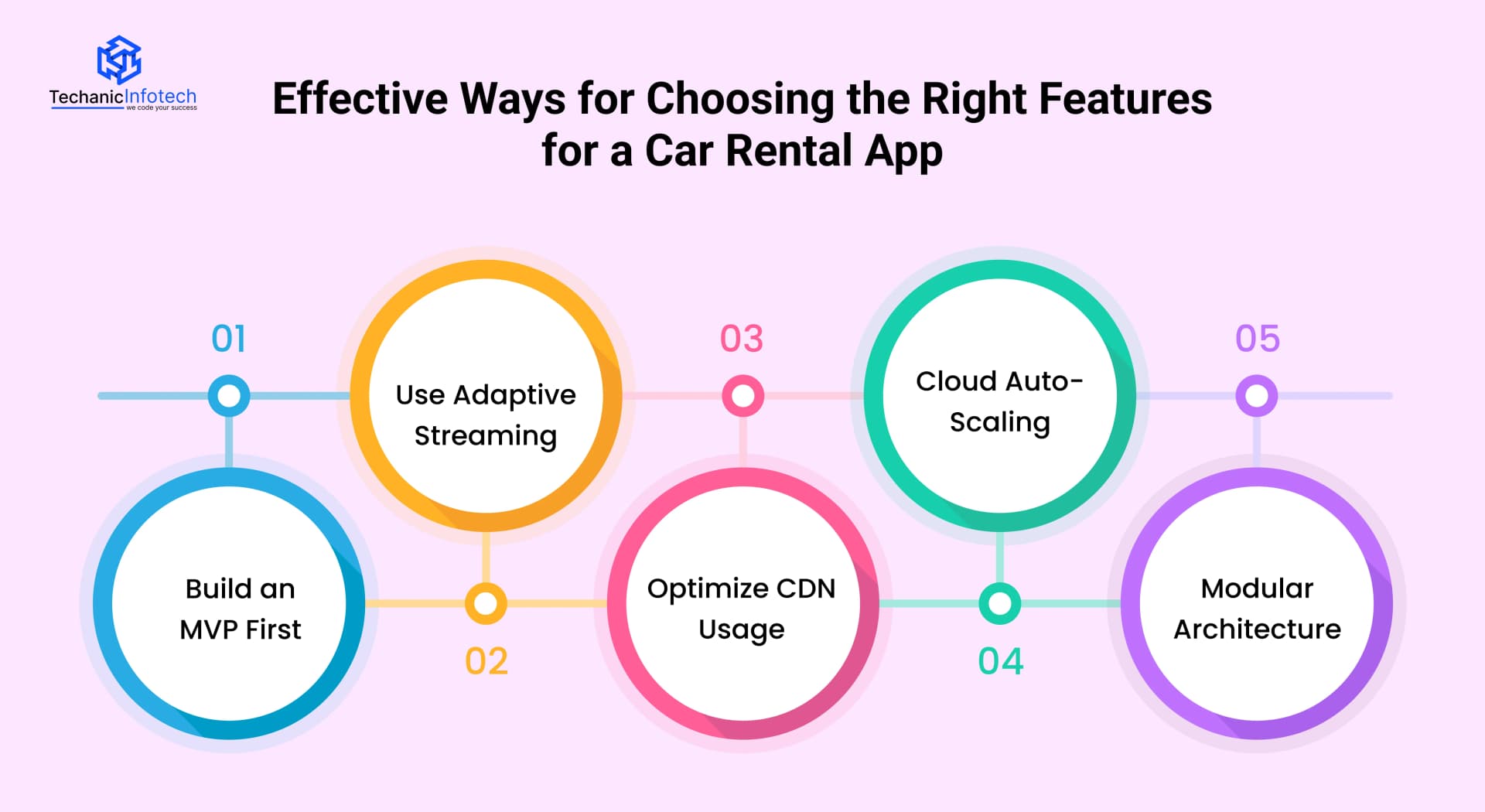
Launching a minimum viable product with essential features reduces upfront investment, validates market demand, gathers user feedback, and minimizes financial risk before committing to full-scale development.
Adaptive bitrate streaming dynamically adjusts video quality based on device capability and network conditions, reducing unnecessary bandwidth usage while maintaining a smooth and consistent viewing experience.
Strategic content caching, regional distribution, and intelligent traffic routing help reduce latency, improve playback speed, and significantly lower data transfer and bandwidth-related costs.
Cloud auto-scaling automatically adjusts computing resources according to real-time demand, ensuring optimal performance during traffic spikes while preventing unnecessary spending on idle infrastructure.
A modular architecture allows individual components to scale independently, enabling faster upgrades, reduced system dependencies, and lower long-term costs without rebuilding the entire platform.
This breakdown explores the estimated costs of developing a video streaming app across different platform types, highlighting key factors that influence overall budget and investment decisions.
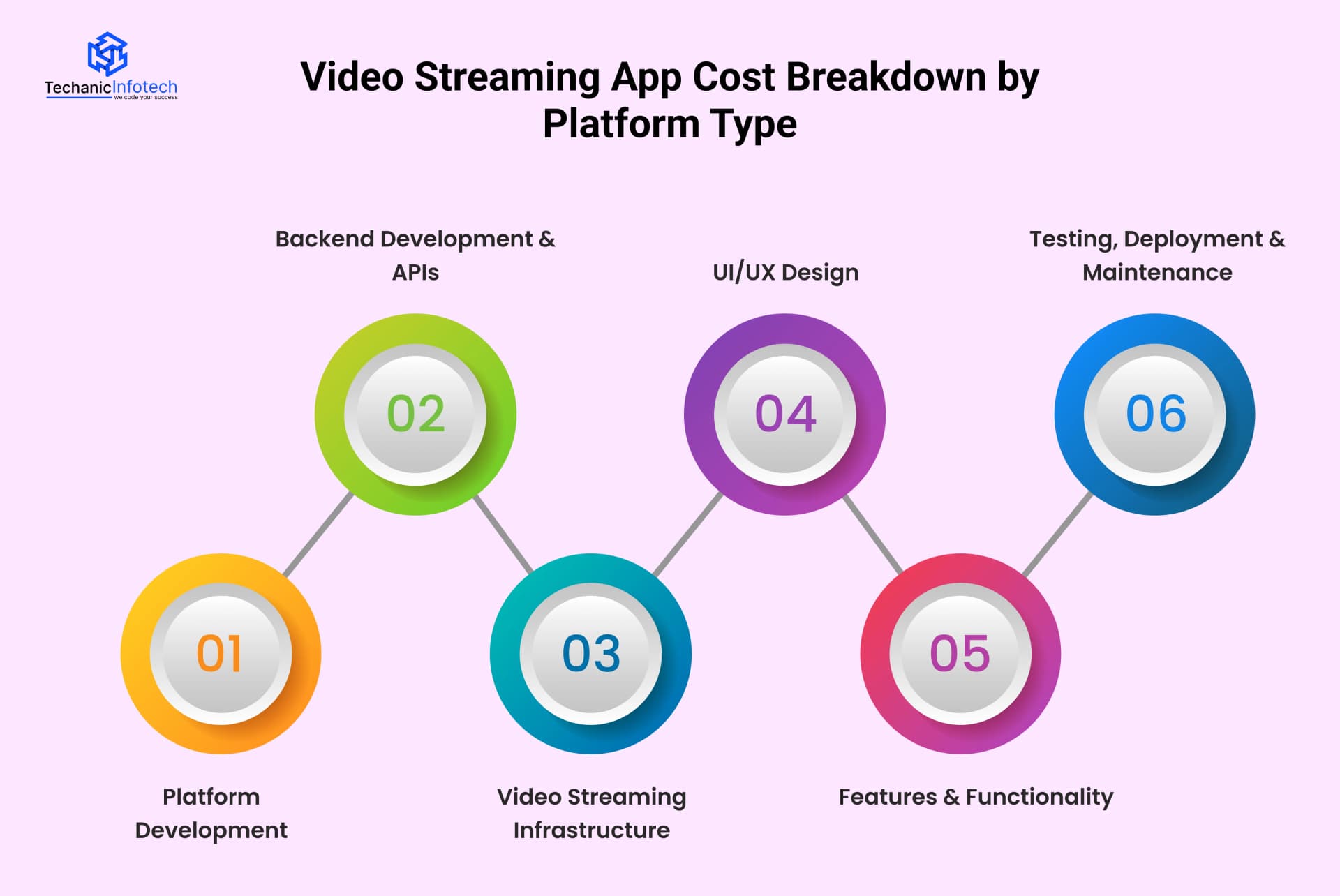
Platform development accounts for $7,000 of the total budget and focuses on building the user-facing applications.
This includes developing an Android app ($3,000), an iOS app ($3,000), and a basic web application ($1,000).
These platforms allow users to register, browse content, and stream videos smoothly.
Backend development is allocated $4,000 and serves as the backbone of the streaming app.
This budget covers user authentication, profile management, content access control, and API development for mobile and web platforms.
Spending $4,000 on backend development ensures scalability, data security, and smooth synchronization between platforms, enabling the app to handle growing users and content efficiently.
The video streaming infrastructure is budgeted at $3,000, covering cloud storage, video hosting, CDN integration, and adaptive bitrate streaming.
The cost also includes bandwidth optimization and basic video security to prevent unauthorized access.
Allocating $3,000 ensures minimal buffering, stable playback, and a high-quality viewing experience for users, even during peak usage.
UI/UX design is assigned $2,000, focusing on creating an intuitive and visually appealing interface.
Mobile app design guide includes proper usage of the design layouts, icons, color schemes, and interactive elements for both mobile and web platforms.
By investing $2,000 in UI/UX, the app becomes easier to navigate, more engaging, and user-friendly.
Features and functionality are allocated $2,500 and include essential tools such as search, categories, watch history, favorites, playlists, and push notifications.
This budget also supports basic analytics to track user engagement and content performance.
Spending $2,500 ensures the app remains competitive while maintaining smooth performance.
Testing, deployment, and maintenance are budgeted at $1,500. This includes functional testing, performance testing, and bug fixing to ensure stability across devices and operating systems.
Deployment covers app store submission, compliance with guidelines, and launch support. Initial maintenance ensures quick resolution of post-launch issues and minor updates.
Allocating $1,500 helps deliver a reliable product, reduces the risk of crashes or negative reviews, and ensures a smooth launch experience for users.
Estimating your video streaming app development budget involves analyzing features, platform choice, design complexity, development team rates, infrastructure, and ongoing maintenance costs to plan effectively.
Clearly identifying essential features versus optional enhancements helps control project scope, prevent budget overruns, and ensure development resources are focused on delivering maximum initial value.
Selecting mobile, web, smart TV, or cross-platform development directly impacts design complexity, testing requirements, development timelines, and overall project budget.
Accurately forecasting user growth helps plan server capacity, bandwidth usage, CDN requirements, and cloud expenses, preventing performance issues and unexpected infrastructure costs.
Choosing subscriptions, advertising, or transaction-based revenue models influences payment processing, analytics requirements, and compliance needs, directly affecting development and ongoing operational costs.
Including future scalability, performance optimization, infrastructure upgrades, and maintenance expenses in early planning ensures sustainable growth and prevents costly system redesigns later.
Techanic Infotech is the best video streaming app development company, specializing in building scalable, secure, and high-performance video streaming applications tailored to your business goals.
From startups launching an MVP to enterprises developing Netflix-like platforms, our team delivers end-to-end solutions covering strategy, design, development, deployment, and maintenance.
We focus on optimized video streaming app development cost by carefully selecting the right tech stack, cloud infrastructure, and monetization model.
Our expertise spans on-demand video streaming app cost optimization, live streaming, DRM integration, AI-powered recommendations, and multi-device compatibility.
With a user-first design approach, robust backend architecture, and future-ready scalability, we ensure your platform performs seamlessly even as your audience grows.
Techanic Infotech also emphasizes long-term value by minimizing video streaming app development expenses through modular architecture and efficient cloud usage.
Partner with us to transform your streaming idea into a reliable, engaging, and revenue-driven digital platform.
Understanding video streaming app development cost is essential for building a platform that scales sustainably.
While initial costs may range from $20,000 to $120,000+, real expenses evolve with user growth, infrastructure demands, bandwidth usage, and maintenance needs.
Factors such as features, technology stack, cloud services, and security significantly influence long-term investment.
By planning carefully, launching an MVP, and adopting smart cost optimization strategies, businesses can control budgets without compromising performance or user experience.
A well-structured cost breakdown helps avoid hidden expenses and ensures future scalability.
Whether you are building an MVP or an enterprise-grade platform, informed budgeting decisions are the foundation of a successful, profitable video streaming application.
The average video streaming app development cost ranges from $20,000 for an MVP to $120,000+ for advanced, scalable platforms with live streaming, DRM, and global delivery.
Key factors include features, platform type, cloud infrastructure, CDN usage, security, video quality, scalability requirements, and ongoing maintenance expenses.
As users grow, costs increase due to higher bandwidth consumption, cloud infrastructure usage, storage expansion, CDN fees, security upgrades, and performance optimization needs.
Yes, by building an MVP, using adaptive bitrate streaming, optimizing CDN usage, leveraging cloud auto-scaling, and adopting a modular architecture.
Initial development usually excludes long-term maintenance. Ongoing costs include updates, security patches, third-party services, infrastructure, compliance, and customer support.


Bharat Sharma is the CTO of Techanic Infotech, bringing deep technical expertise in software architecture, mobile app development, and scalable system design. He leads the engineering team with a strong focus on innovation, performance, and security.