AI-driven fitness app development trends are redefining how people train, track progress, and stay motivated in 2026.
As users demand smarter and more intuitive wellness tools, today’s apps are evolving from basic activity trackers into intelligent coaching systems that respond like a real trainer.
In the middle of this shift, AI-driven fitness app development trends are powering features that can read movement patterns, learn user habits, and adjust workouts instantly.
This level of personalization makes training feel smoother, faster, and far more effective.
With predictive insights, adaptive routines, and deeper biometric integration, AI is transforming digital fitness into a connected wellness experience built around real-time data and user-first design.
The AI fitness app market is expanding rapidly as more users seek smarter, on-demand wellness solutions.
With AI fitness app trends in 2026 pushing personalization and real-time coaching forward, the industry is moving beyond basic tracking and stepping into a new era of data-driven, adaptive fitness experiences.
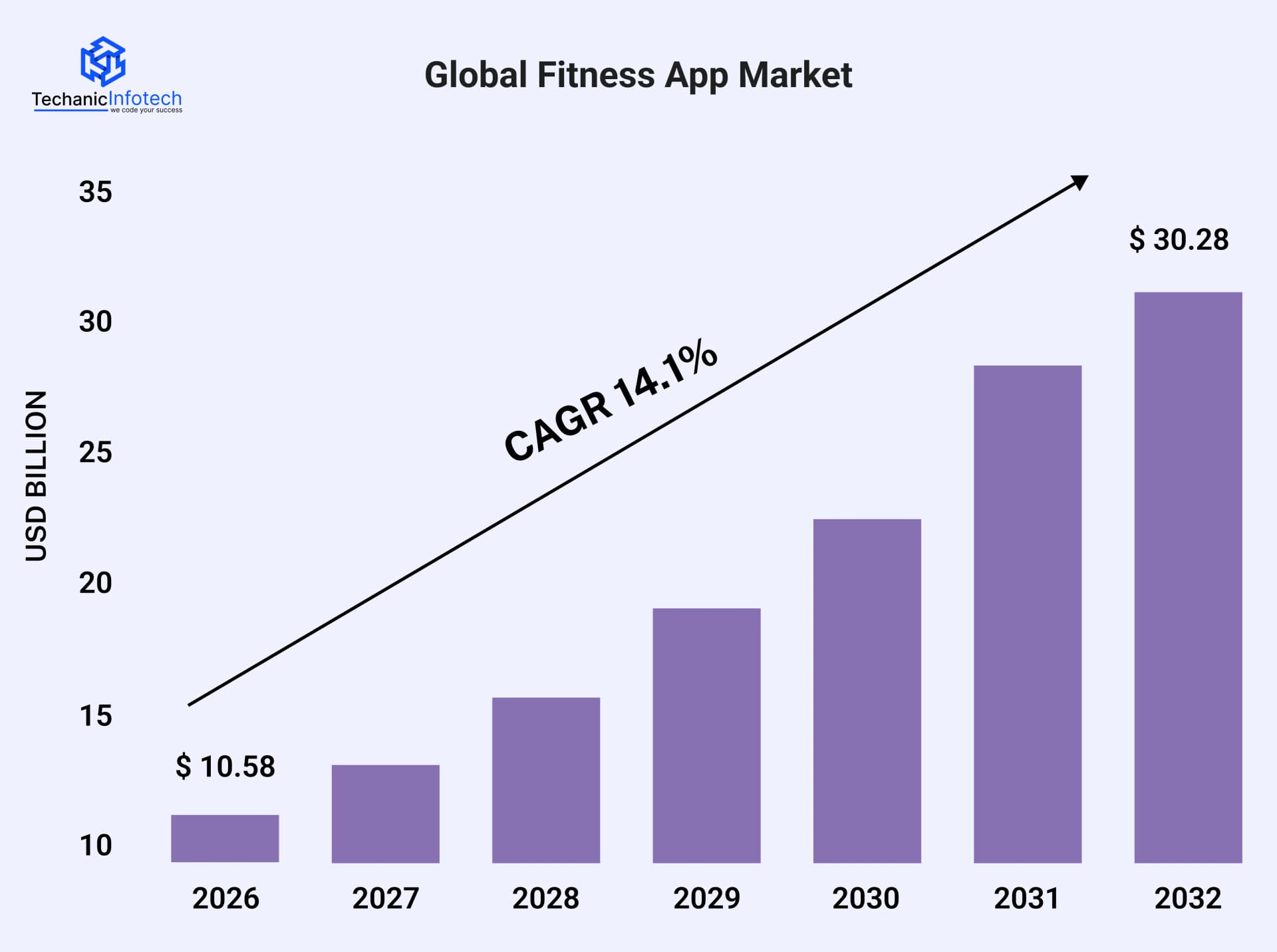
The global fitness app market was valued at approximately USD 10.58 billion in 2024 and is projected to reach USD 30.28 billion by 2032, growing at a CAGR of 14.1%.
The U.S. segment alone hit approximately USD 3.76 billion in 2024 and may reach USD 10.65 billion by 2032.
Overall global market is expected to grow to ~USD 13.81 billion in 2026.
AI-in-fitness tech is valued at about USD 9.8 billion in 2023, with forecasts up to ~USD 46.5 billion by 2030.
An AI-driven fitness app uses artificial intelligence to personalize workouts, analyze user data, and enhance training results.
With the rise of AI-powered fitness app development, these apps now deliver smarter guidance, real-time adjustments, and highly tailored fitness experiences that match each user’s goals and performance.
User Data Collection: The app gathers details like goals, activity level, biometrics, and workout history to build an initial fitness profile.
Real-Time Activity Analysis: AI tracks movements, pace, heart rate, and patterns to understand performance during each workout session.
Adaptive Workout Recommendations: The system adjusts exercises, intensity, and duration instantly based on user feedback and real-time progress.
Predictive Insights Generation: AI forecasts future performance, potential plateaus, and improvement areas using long-term data trends.
Personalized Feedback Loop: The app provides tailored tips, corrections, and motivation to help users stay consistent and improve faster over time.
Fitness apps are built to simplify training, track progress, and keep users motivated. These features in fitness apps work together to create a seamless, personalized experience that supports long-term health and wellness.
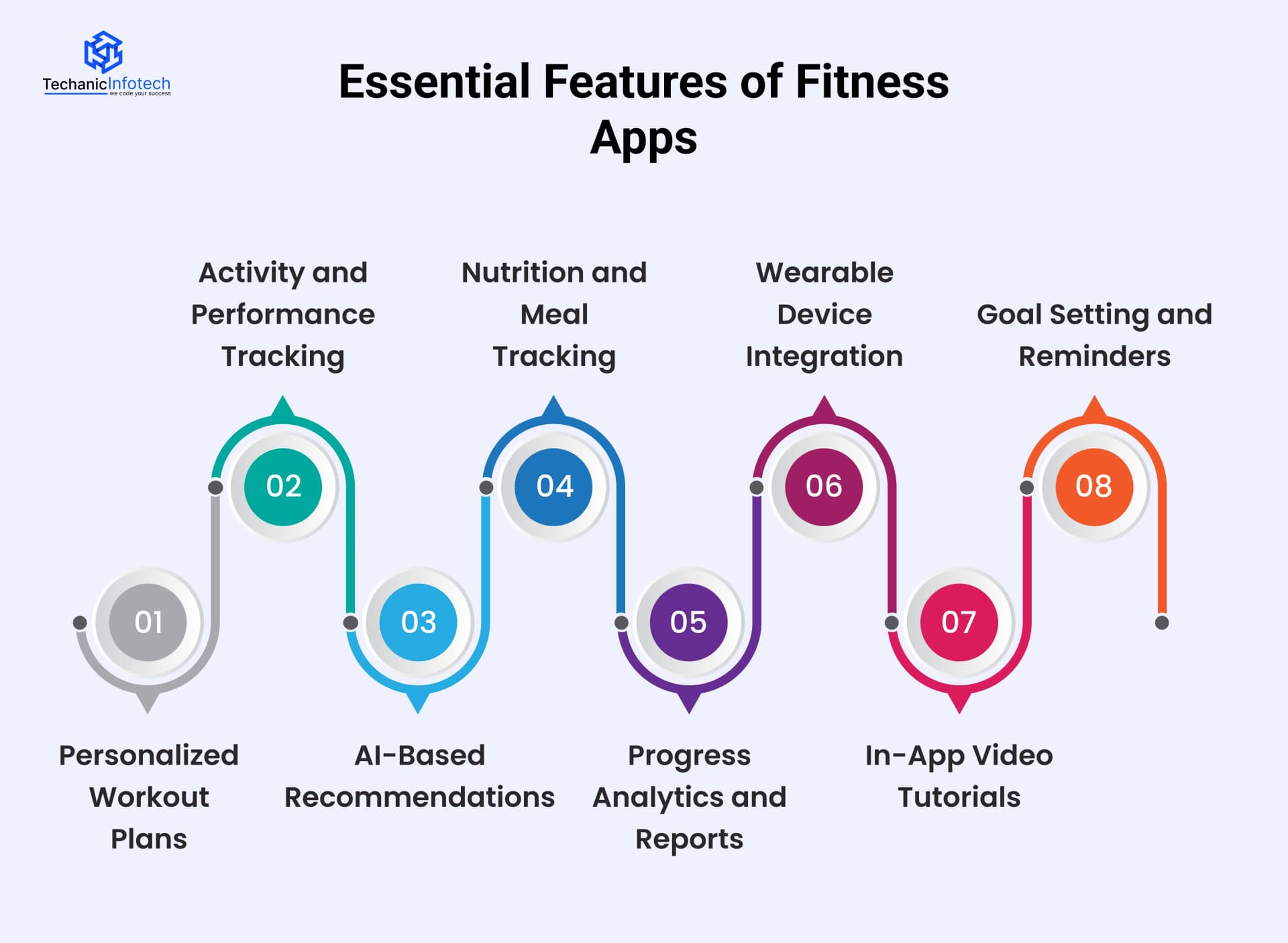
Customized routines adapt to user goals, fitness levels, and performance data. The app adjusts intensity and exercises over time to deliver more effective, targeted training that keeps users progressing consistently.
Tracks steps, calories, distance, and workout metrics in real time. Users can view daily trends and monitor progress with AI features in fitness apps that make tracking more accurate and engaging.
Provides smart suggestions for workouts, intensity changes, and nutrition. These insights use artificial intelligence in fitness apps to evaluate behavior patterns and deliver perfectly timed adjustments for better results.
Logs meals, counts calories, and tracks macros for better eating habits. Users receive personalized meal plans, healthy recipe ideas, and nutrition insights tailored to their goals and daily lifestyle.
Offers visual charts and long-term performance trends. Users can see improvements in endurance, strength, weight, and activity levels through detailed progress reports that keep motivation high and goals clear.
Connects with smartwatches and trackers to collect biometric data. This wearable-integrated fitness app development approach helps capture heart rate, sleep, and movement insights for deeper, real-time wellness feedback.
Provides high-quality exercise demonstrations for proper form and safety. Users can follow guided videos, learn techniques, and complete workouts confidently without guessing or risking injury.
Helps users set achievable fitness targets and stay consistent. Timely reminders, streak notifications, and motivational prompts encourage routine-building and long-term commitment to daily activity.
AI is transforming how fitness apps personalize training, track performance, and support long-term wellness.
These breakthroughs highlight the most impactful AI-driven fitness app development trends, shaping smarter, more intuitive platforms that adapt to every user’s needs and goals.
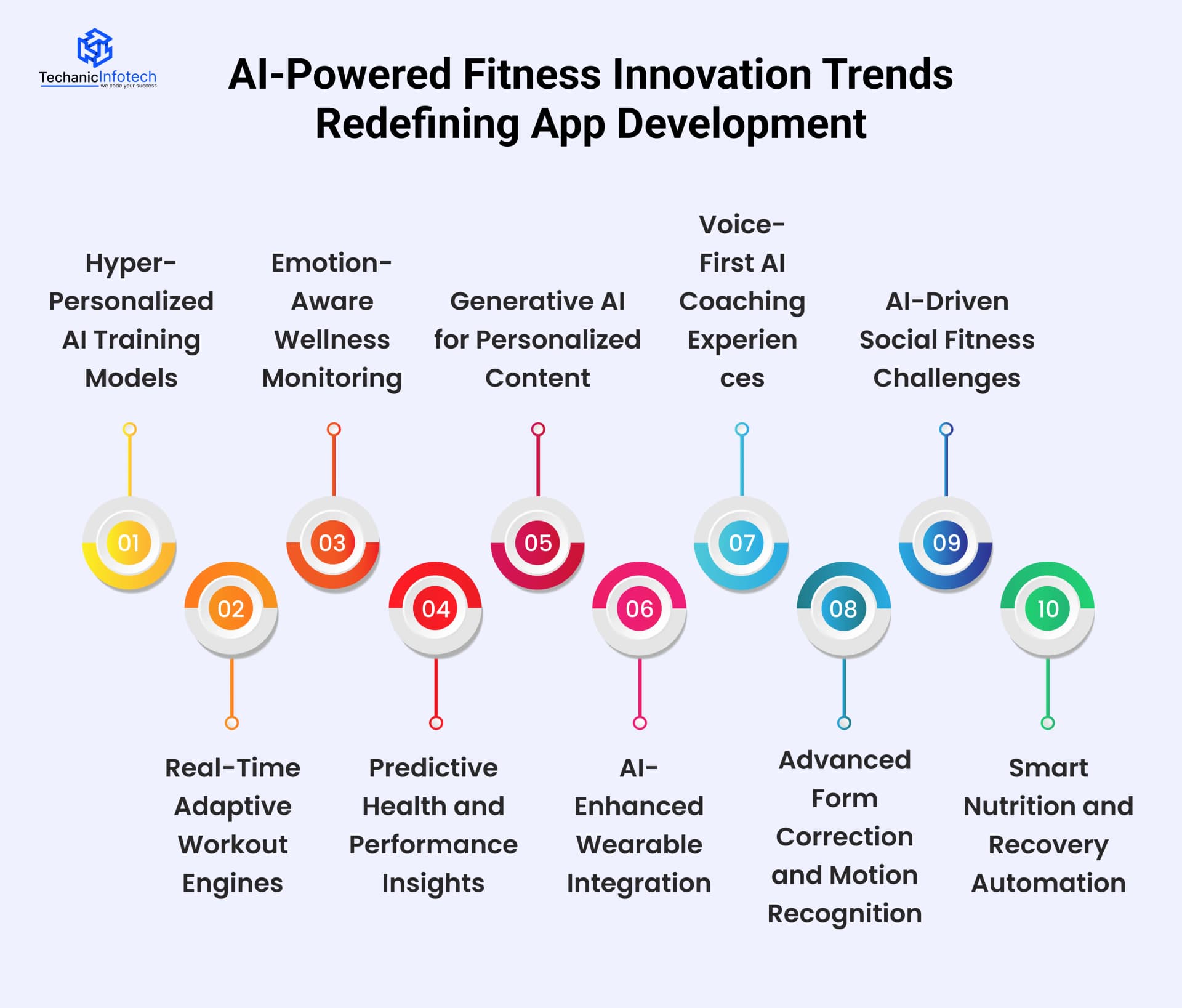
AI builds customized routines using user behavior, goals, biometrics, and training history.
These adaptive plans adjust instantly, delivering more effective workouts that evolve with users as their performance and fitness levels change over time.
Smart algorithms analyze movement, heart rate, and pace to adjust workouts instantly.
These smart fitness app innovations create a personal trainer-like experience, ensuring users stay challenged without risking safety or overtraining.
AI interprets emotional cues from voice, text, and behavior patterns.
This helps apps tailor workout intensity and mental guidance, blending physical training with supportive mobile app features that boost motivation and balance.
AI forecasts plateaus, fatigue, and long-term performance trends.
These insights, powered by AI health and fitness app development, guide users toward safer training decisions, better recovery habits, and more consistent progress.
Generative models create custom workouts, meal plans, and coaching scripts.
This keeps content fresh and user-specific, reducing routine fatigue and increasing engagement through tailored fitness experiences and dynamic training options.
Wearables supply deeper biometric data, while AI interprets it for real-time insights.
This trend also aligns with rising interest in AI chatbot development cost, as AI-driven assistants increasingly support wearable-based coaching and feedback.
Hands-free voice coaching enhances convenience during cardio and strength sessions.
A personalized fitness app with AI offers real-time adjustments, form cues, and motivation, making workouts easier to follow and more effective.
Computer vision checks posture, speed, and movement accuracy.
This approach supports mental health app development by reducing injury risk, improving confidence, and ensuring users can train safely with guided corrective feedback.
AI creates adaptive challenges, competitions, and group goals based on user performance.
This trend pairs well with a mobile app tech stack guide, helping developers build scalable, community-focused fitness features.
AI evaluates nutrition, sleep, and activity levels to recommend targeted recovery routines.
This holistic approach strengthens AI health and fitness app development, ensuring users receive complete guidance across diet, rest, and performance.
The future of AI fitness apps 2026 is shaping a smarter, more connected wellness ecosystem.
With rapid advancements in machine learning and biometric intelligence, fitness platforms will deliver ultra-personalized guidance, predictive insights, and holistic support that adapts continuously to each user’s physical and emotional needs.
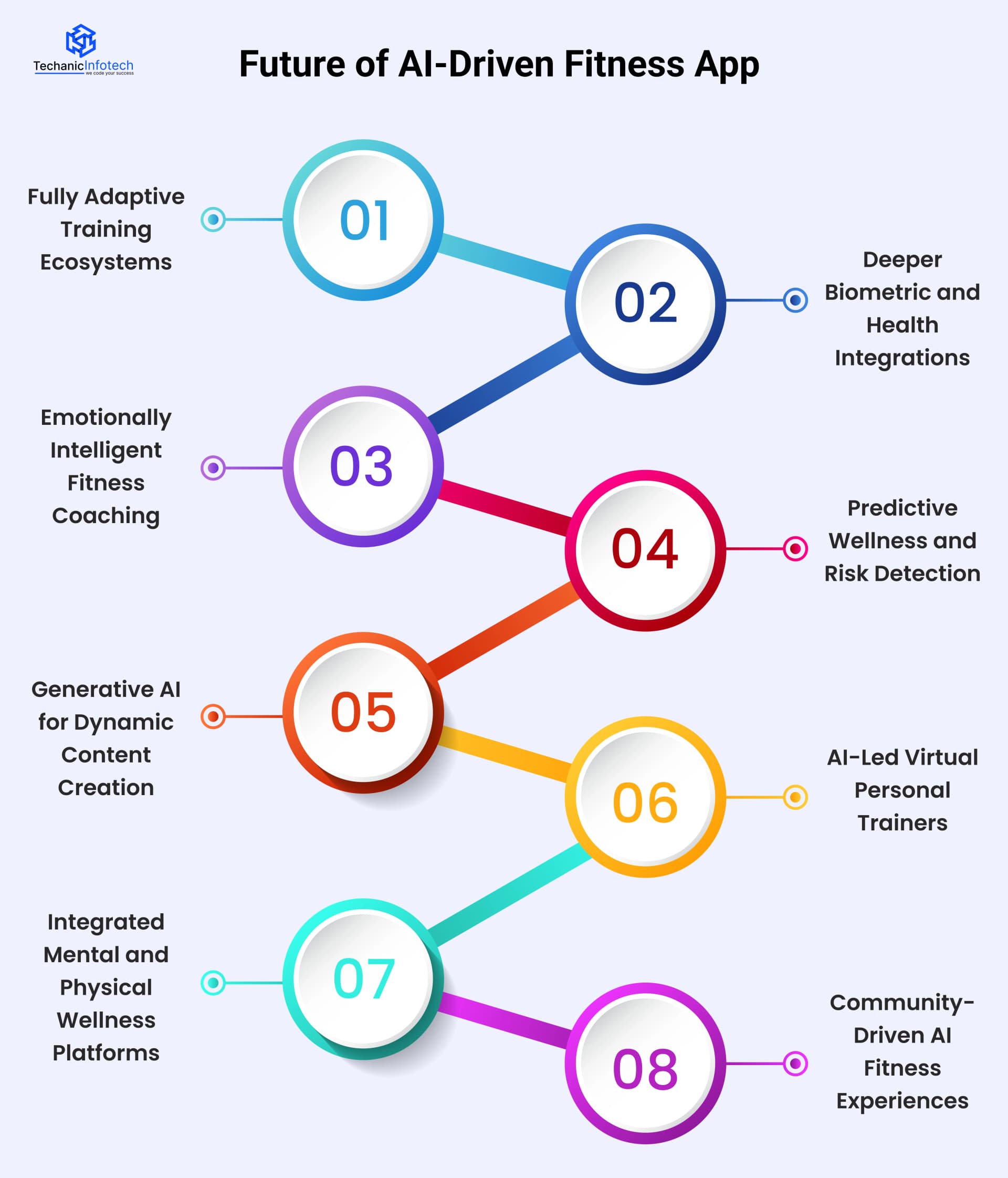
Future fitness apps will create training experiences that evolve automatically with every session.
These systems will fit naturally into the mobile app development process, using real-time data to adjust workouts based on energy levels, progress, and individual capabilities.
Apps will integrate with next-gen wearables, smart clothing, and health sensors to gather rich biometric data.
These advancements will align with major fitness app development trends 2026, enabling highly precise performance insights and smarter workout personalization.
AI will read mood, motivation, and stress signals through voice analysis and behavior patterns.
This emotional awareness reflects rising AI fitness app trends in 2026, helping apps deliver adaptive coaching, supportive prompts, and balanced training based on how users feel.
Predictive AI will flag early signs of fatigue, performance decline, or potential injury.
This proactive approach will improve user safety and consistency, supported by strong minimum viable product development strategies for faster innovation and feature testing.
Generative AI will build personalized workouts, meal plans, and coaching scripts instantly.
Every user will receive fresh, dynamic content that reflects their preferences, progress, and long-term fitness goals, reducing repetitive routines and boosting engagement.
Advanced AI trainers will deliver real-time cues, form corrections, and motivational feedback.
As developing a fitness app becomes more AI-centric, these virtual coaches will replicate human trainer experiences at a much more accessible cost.
Fitness apps will merge workouts, mindfulness, sleep tracking, and emotional wellness into unified mind–body ecosystems.
This holistic model empowers users to maintain overall balance, creating a deeper sense of long-term well-being.
AI will shape personalized group challenges, social features, and fitness communities based on user preferences.
These social-driven upgrades align closely with emerging mobile app development trends, enhancing engagement through dynamic, interactive fitness journeys.
Techanic Infotech has earned a strong reputation for turning complex AI concepts into real, high-performing fitness apps that users love.
As a leading fitness app development company, they specialize in building smart, scalable, and intuitive platforms powered by machine learning, computer vision, and advanced analytics.
Their team understands what modern users want: personalization, real-time tracking, and seamless app experiences, and they bring those expectations to life with clean design and powerful functionality.
What sets Techanic Infotech apart is its ability to combine AI innovation with practical product strategy, helping businesses launch apps that stand out in a competitive market.
From idea to deployment, they deliver reliable solutions that push the future of digital fitness forward.
AI is reshaping the digital fitness world, and its impact will only grow stronger in the coming years.
As users demand smarter, more intuitive wellness experiences, businesses must keep pace with the latest AI-driven fitness app development trends to stay competitive.
From hyper-personalized training and predictive insights to emotion-aware coaching and advanced wearable integration, AI is setting a new standard for what fitness apps can do.
Companies that embrace these innovations will deliver deeper value, stronger engagement, and long-term user loyalty.
The future of fitness is intelligent, adaptive, and data-driven, and those who innovate now will lead the next generation of digital wellness solutions.
AI-driven fitness apps analyze real-time data, user habits, and personal goals to create adaptive workout plans. They adjust intensity, track progress more accurately, and offer personalized guidance that feels closer to a real trainer, improving long-term consistency and results.
Development timelines vary based on features, AI complexity, and platform requirements. On average, a fully functional AI fitness app can take 4–8 months, including planning, design, development, testing, and deployment phases.
Costs depend on app complexity, AI models, integrations, and platform choices. Basic AI-enabled apps may cost moderately, while advanced systems using computer vision, generative AI, or predictive analytics require larger investments for development and data training.
Security depends on strong encryption, secure APIs, and compliance with privacy standards like GDPR or HIPAA. Reputable developers implement strict data protection measures to ensure biometric, activity, and personal information remains safe at all times.


Bharat Sharma is the CTO of Techanic Infotech, bringing deep technical expertise in software architecture, mobile app development, and scalable system design. He leads the engineering team with a strong focus on innovation, performance, and security.