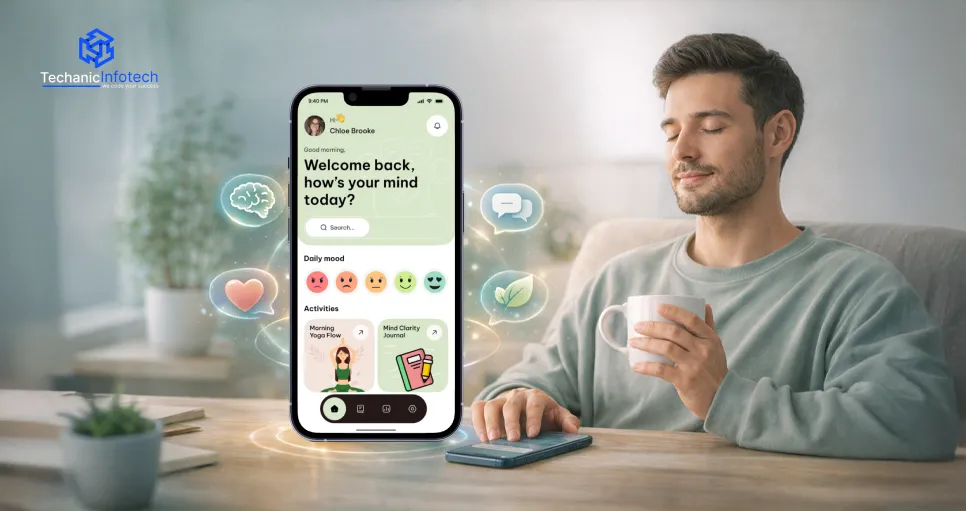
Have you noticed how conversations around mental health have become more open in the last few years?
People are no longer waiting for problems to become serious before seeking help, they’re looking for support early, and they want it to be easy to access.
This growing demand is one of the biggest reasons mental health app development is expanding rapidly in 2026.
Today, users want simple and private ways to manage stress, anxiety, and emotional well-being.
With just a smartphone, they can track moods, connect with professionals, or follow guided wellness routines anytime.
This shift is encouraging businesses to explore self wellness app development and invest in digital mental health solutions.
As technology becomes more personalized and accessible, many organizations are now asking how to create a mental health app that offers real value.
This trend is transforming how support is delivered, making mental health care more consistent, convenient, and user-focused than ever before.

A mental health app is a digital platform designed to help users manage their emotional well-being through tools like mood tracking, guided therapy exercises, journaling, meditation, or professional counseling support.
These apps aim to make mental health care more accessible, especially for people who may not have easy access to traditional therapy.
From a technology perspective, mental health app focuses on building solutions that allow users to track their mental state, receive personalized recommendations, and connect with professionals when needed.
Modern platforms often combine behavioral science, AI-driven insights, and user-friendly design to improve engagement.
For organizations creating a mental health app, the goal is usually to provide continuous, on-demand support rather than one-time consultations.
These solutions can serve different use cases, including:
Self-care and stress management
Therapy and counseling access
Mood and behavior tracking
Workplace wellness programs
Preventive mental health support
Because of rising awareness and digital adoption, businesses across healthcare, HR, insurance, and wellness industries are exploring opportunities to create a mental health app that delivers accessible support at scale.
The rapid growth of digital health has made mental wellness technology one of the fastest-expanding segments.
Here are key data-backed reasons why organizations are investing in mental health app development services:
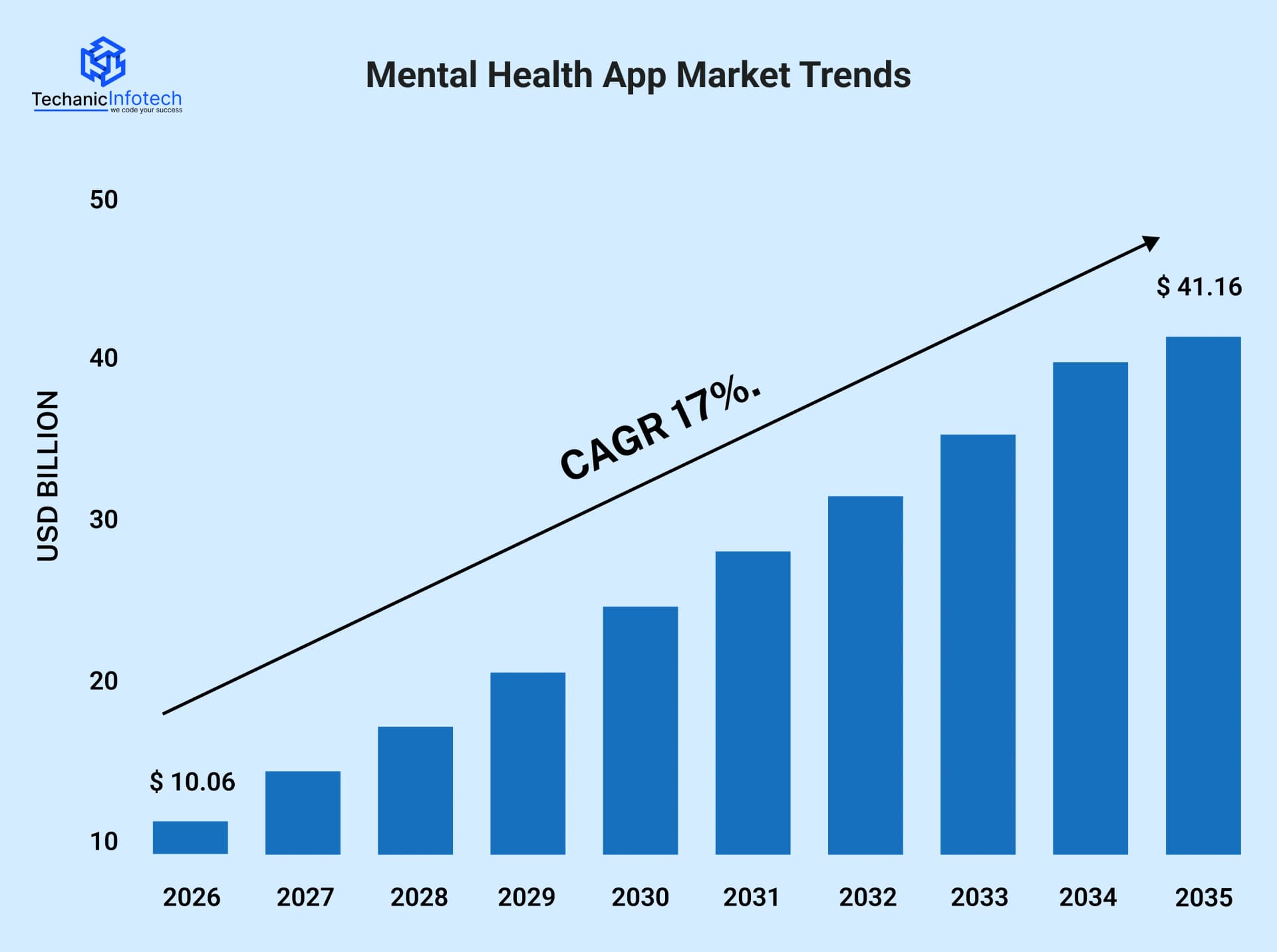
The global mental health apps market was valued at around $10.06 billion in 2026 and is projected to reach $41.16 billion by 2035, growing at a CAGR of over 17%.
Strong Market Growth and Revenue Potential: The global mental health apps market was valued at around $10.06 billion in 2026 and is projected to reach $41.16 billion by 2035, growing at a CAGR of over 17%.
Growing Investment and Innovation in Digital Health: Mental health startups now attract a significant share of digital health funding, showing strong investor interest in scalable wellness technologies.
Expanding Global User Base: Mental health issues affect roughly 1 in 8 people globally, which continues to increase demand for accessible, mobile-based support solutions.
Together, these trends show that mental wellness platforms are no longer optional add-ons, they are becoming a critical part of modern healthcare and employee well-being strategies.
Mental health applications are designed to support users in different ways depending on their needs.
While some focus on relaxation and stress relief, others provide professional therapy access or data-driven insights.
During mental health app development, businesses often choose a category based on their target audience and the type of support they want to offer.
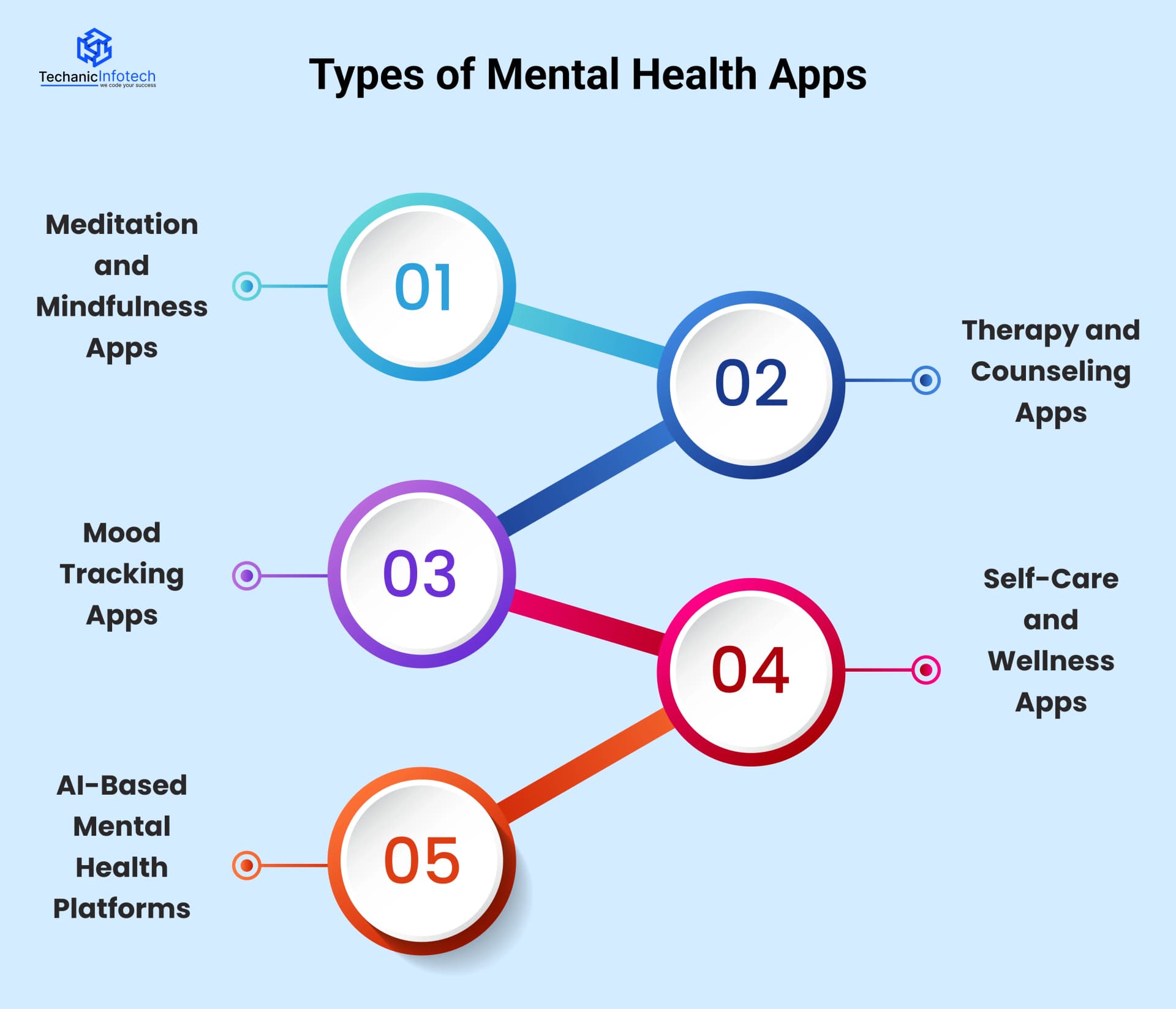
Meditation and mindfulness apps help users manage stress, anxiety, and daily mental fatigue.
These platforms usually include guided meditation sessions, breathing exercises, sleep sounds, and relaxation techniques.
The main goal is to help users develop healthier routines and improve emotional balance.
Many users prefer these apps because they are simple to use and provide quick mental relief during busy schedules.
Therapy and counseling apps connect users with licensed professionals through chat, voice, or video sessions.
These platforms make professional mental health support more accessible for people who cannot visit clinics regularly.
For businesses exploring mental health app, this category often requires secure communication, scheduling tools, and privacy-focused features to ensure a safe environment for users.
Mood tracking apps allow users to log daily emotions, behaviors, and triggers.
Over time, the app analyzes patterns and helps users understand what affects their mental state.
These insights can be shared with therapists or used for self-improvement.
Mood tracking is becoming one of the most valuable mental health app features because it encourages consistent self-awareness and proactive care.
Self-care platforms focus on overall well-being rather than clinical therapy.
They may include habit tracking, journaling, stress management tools, and goal-setting features.
Businesses investing in self wellness app development often target users looking for preventive support instead of treatment.
These apps help users maintain mental balance through daily routines and healthy lifestyle habits.
AI-powered mental health apps use intelligent algorithms to offer personalized recommendations and conversational support.
These platforms may include chatbots that provide coping strategies, mood analysis, or guided activities.
Advanced solutions analyze user behavior to suggest relevant content or interventions.
As technology evolves, AI-based tools are becoming an important part of modern mental health app development services, helping deliver scalable and personalized support experiences.
When businesses plan to develop a mental health app, choosing the right mobile app features is essential for building trust and long-term engagement.
A well-designed app should offer personalized support while ensuring user safety and privacy.
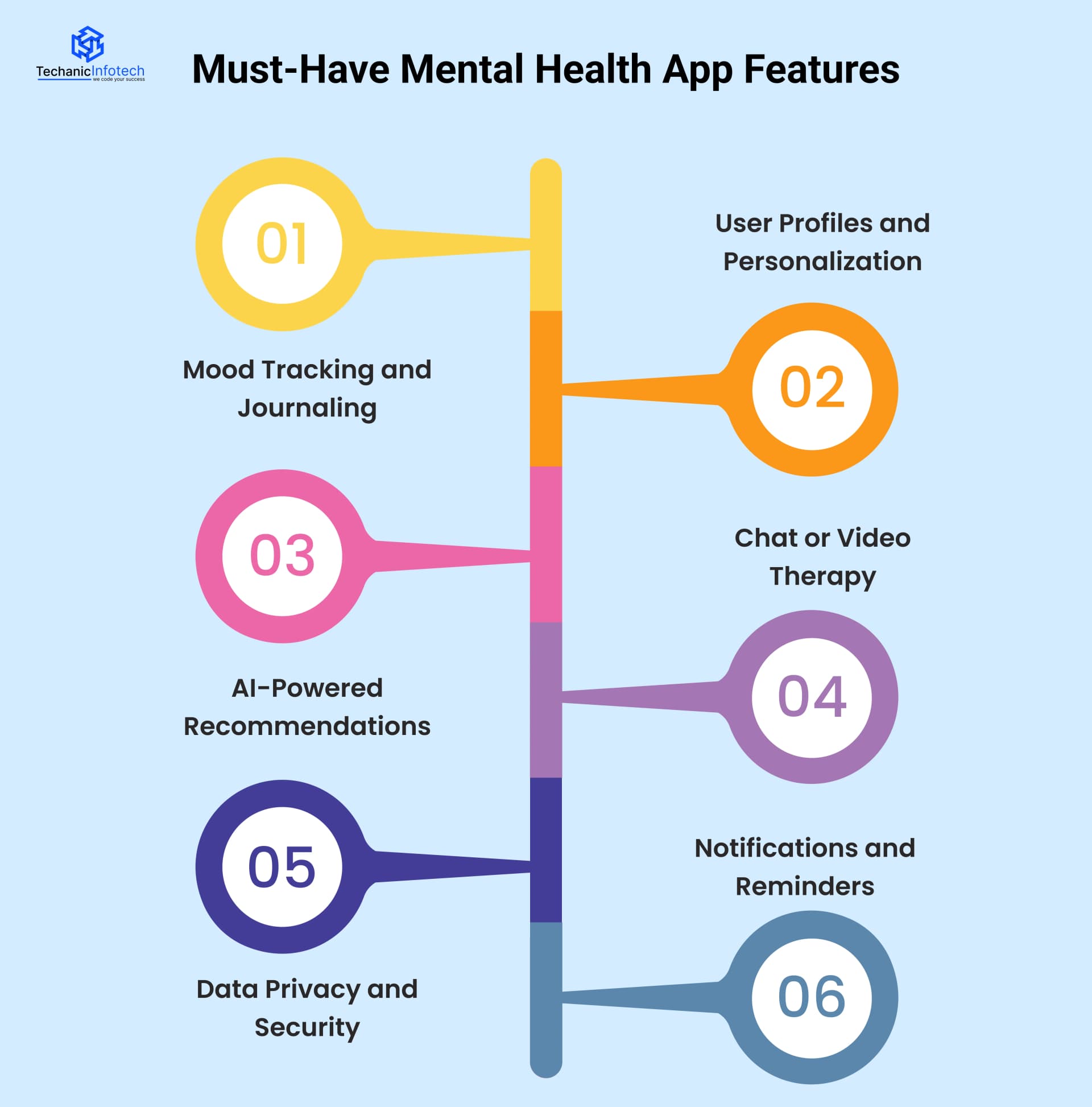
This feature help users set goals, preferences, and wellness priorities.
This allows the app to recommend relevant content, activities, or therapy options tailored to individual needs.
This feature enable users to record daily emotions and thoughts.
Over time, these insights help identify patterns and triggers, supporting better self-awareness and stress management.
It gives users secure access to licensed professionals without needing in-person visits.
This feature improves accessibility and encourages regular support.
It analyze behavior and mood data to suggest guided exercises, meditation sessions, or helpful resources at the right time.
This improves engagement and user retention.
Notifications encourage consistent habits by prompting users to log moods, attend sessions, or practice wellness routines.
Security features are critical because these apps handle sensitive information.
Encryption, secure login methods, and compliance with regulations help protect user data.
Advanced capabilities make the platform more interactive and valuable over time.
Visual insights help users monitor their mental health journey, increasing motivation and consistent app usage.
Seamless connection with fitness devices enables real-time data collection for smarter insights and personalized recommendations.
Activities and wellness plans adjust based on user behavior, ensuring ongoing relevance and long-term mental health support.
Building a successful wellness platform requires careful planning, strong technical execution, and a deep understanding of user needs.
If you’re exploring how to build a mental health app, the process below outlines the key stages involved in developing a secure and user-focused solution.
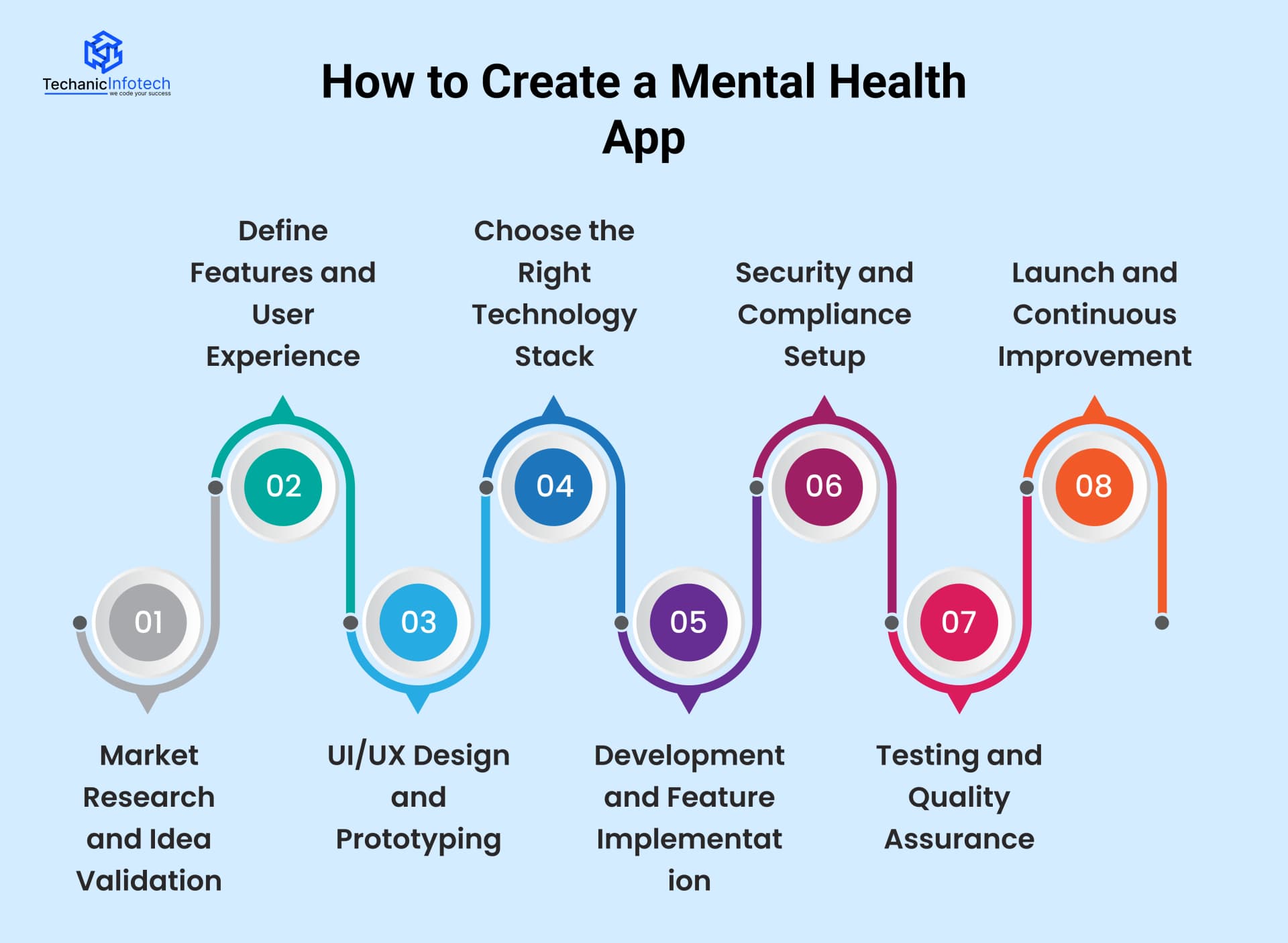
The first step in creating a mental health app is understanding your target audience and identifying the specific problem you want to solve.
Research existing apps to see what features they offer, where they fall short, and what users expect.
During this stage, businesses typically:
Define the app’s purpose (therapy support, mood tracking, mindfulness, etc.)
Identify target users such as individuals, employers, or healthcare providers
Analyze competitors and market demand
Validating the idea early helps reduce development risks and ensures the app solves a real need.
Once the concept is clear, the next step is deciding which mental health app features should be included in the first version.
Start with essential tools like mood tracking, journaling, or therapist communication rather than building everything at once.
At this stage:
Create feature lists based on user needs
Map user journeys and interaction flow
Prioritize features for the MVP (Minimum Viable Product)
Focusing on the right features keeps the project manageable and improves time to market.
UI/UX design plays a critical role in user adoption. Mental health apps must feel calming, easy to navigate, and accessible.
Designers create wireframes and prototypes to visualize how users will interact with the platform.
Key activities include:
Designing user-friendly interfaces
Creating intuitive navigation
Ensuring accessibility for different age groups
Testing prototypes early helps refine the experience before development begins.
Selecting appropriate technologies determines performance, scalability, and security.
Businesses deciding how to develop a mental health app must choose between native or cross-platform development and identify backend infrastructure.
This stage involves:
Selecting programming languages and frameworks
Planning database and cloud storage
Defining integration requirements
A well-planned app technology stack supports long-term growth.
This is where the actual coding begins. Developers build core functionalities, integrate APIs, and ensure that user data is handled securely.
During development:
Backend systems are created
Frontend interfaces are implemented
Communication tools and analytics features are integrated
Working with experienced mental health app developers ensures the platform is stable, scalable, and secure.
Mental health platforms handle highly sensitive data, so security must be built into every layer. Compliance with data protection standards is essential.
Important steps include:
Implementing encryption and secure authentication
Setting up privacy controls
Ensuring compliance with regulations like HIPAA or GDPR
Strong security builds trust and reduces legal risk.
Before launch, the app undergoes extensive testing to identify bugs, performance issues, or usability problems.
Mobile app testing typically includes:
Functional testing
Security testing
Device and performance testing
This step ensures the final product provides a smooth and reliable user experience.
After deployment, the app is released to users through app stores.
However, development does not stop here.
Ongoing updates, new feature additions, and performance monitoring are essential.
Post-launch efforts focus on:
Collecting user feedback
Improving engagement
Expanding features over time
Understanding how to make a mental health app successful also means continuously evolving the platform based on real user needs.
The overall mental health app development cost in 2026 typically ranges between $6,000 to $45,000+, depending on the complexity of the app, number of features, security requirements, and level of customization.
A simple self-care or mood-tracking app falls on the lower end of the budget, while platforms that include AI recommendations, therapy sessions, or advanced analytics require a higher investment.
Choosing the right development approach and prioritizing essential features in the first version helps control mobile app development costs while maintaining quality.
In terms of schedule, the app development timeline usually ranges from 6 weeks to 5 months.
A basic MVP with limited features can be launched quickly, while feature-rich platforms take more time for design, integration, compliance, and testing.
Planning each stage carefully ensures smooth development without delays.
|
Development Stage |
Average Cost Range |
Estimated Timeline |
|
Market Research & Planning |
$500 – $2,000 |
1–2 Weeks |
|
UI/UX Design & Prototyping |
$1,500 – $5,000 |
2–3 Weeks |
|
Core App Development (Frontend & Backend) |
$2,500 – $25,000 |
3–8 Weeks |
|
Feature Integration (Chat, AI, Analytics) |
$1,500 – $10,000 |
1–3 Weeks |
|
Security & Compliance Setup |
$1,000 – $5,000 |
1–2 Weeks |
|
Testing & Quality Assurance |
$800 – $4,000 |
1–2 Weeks |
|
Deployment & Launch |
$200 – $1,000 |
2–5 Days |
|
Post-Launch Maintenance (Initial Phase) |
$1,000 – $8,000 |
Ongoing |
When developing a mental wellness platform, protecting user data is not optional, it is mandatory.
Since these apps handle highly sensitive information such as mood logs, therapy sessions, and personal health details, strict compliance standards must be followed during mental health app development.
Regulations like HIPAA (Health Insurance Portability and Accountability Act) ensure that user health data is stored and shared securely, especially in regions like the United States.
Similarly, GDPR (General Data Protection Regulation) focuses on data privacy, user consent, and secure data handling practices across Europe.
To maintain compliance, apps must implement:
End-to-end data encryption
Secure authentication and access control
Clear privacy policies and consent management
Regular security audits
These measures protect user trust and reduce legal risks. Businesses working with experienced mental health app developers often prioritize compliance from the early stages to ensure the platform is secure and regulation-ready.
Building an effective digital wellness platform requires more than just good design. Successful mental health app focuses on user trust, personalization, and long-term engagement.
Following proven best practices helps ensure the app delivers real value while staying secure and scalable.
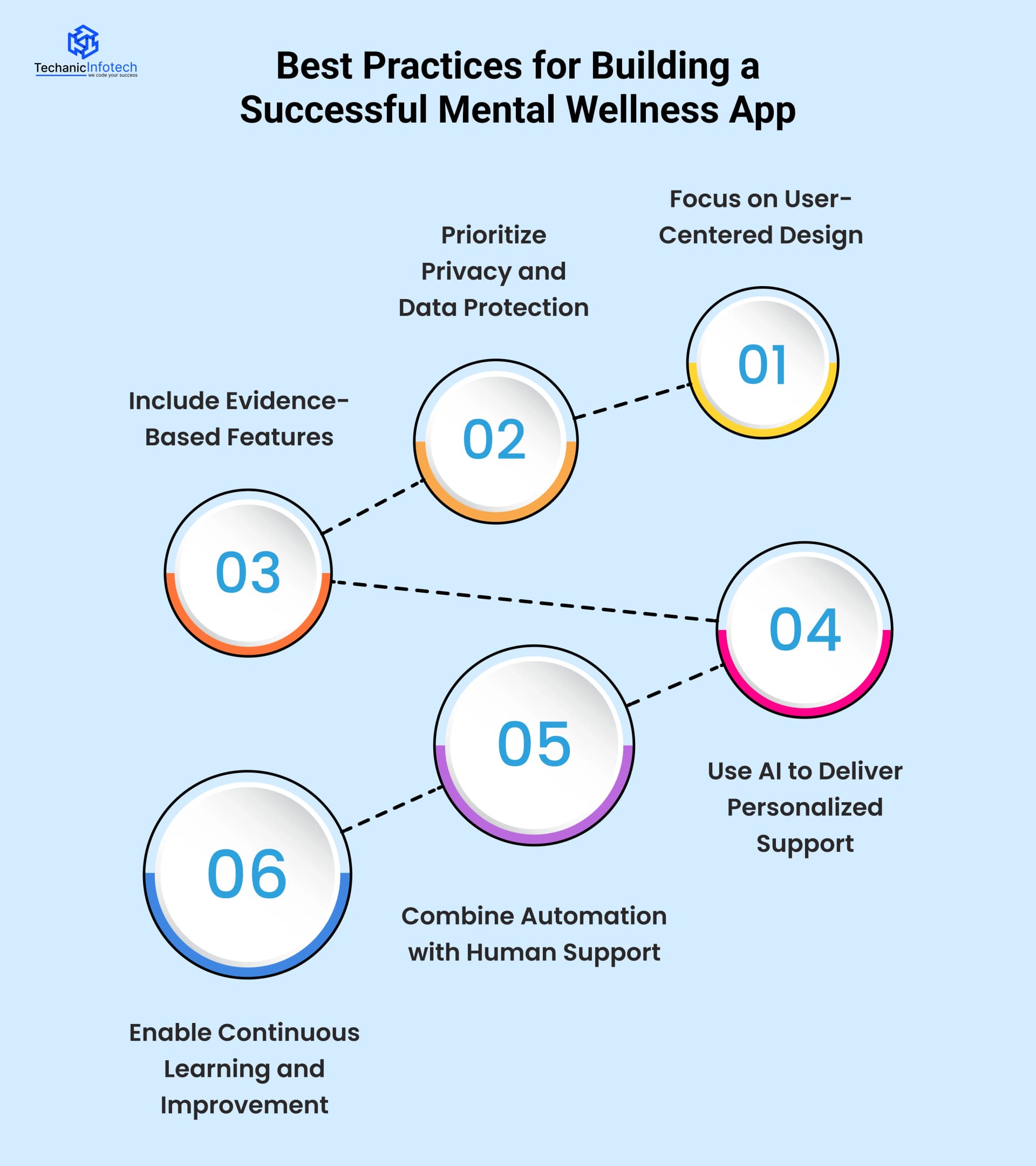
Mental wellness apps must feel safe, simple, and calming. Clear navigation, readable layouts, and accessible features help users engage comfortably.
When developing a mental health app, the experience should reduce stress rather than add complexity.
Since these apps manage sensitive emotional and behavioral data, strong security practices are essential.
Encryption, secure authentication, and transparent consent policies help build confidence and encourage users to share information honestly.
Features such as guided therapy exercises, mood tracking, and journaling should be based on validated psychological methods.
This improves credibility and ensures the platform supports real behavioral improvement.
Artificial intelligence plays a major role in modern platforms.
AI can analyze mood patterns, usage behavior, and engagement trends to provide personalized recommendations like meditation sessions, coping strategies, or wellness routines.
This makes self wellness app development more proactive and user-focused.
While AI-powered chatbots can offer immediate assistance, access to licensed therapists remains essential for deeper care.
A balanced approach improves reliability and user trust.
Successful apps evolve based on user feedback and analytics.
Tracking engagement data helps teams refine features, improve recommendations, and enhance overall performance.
Building a digital wellness platform is rewarding but complex.
During mobile app development, teams often face technical, regulatory, and user-experience challenges that must be addressed early to ensure a reliable and trusted product.
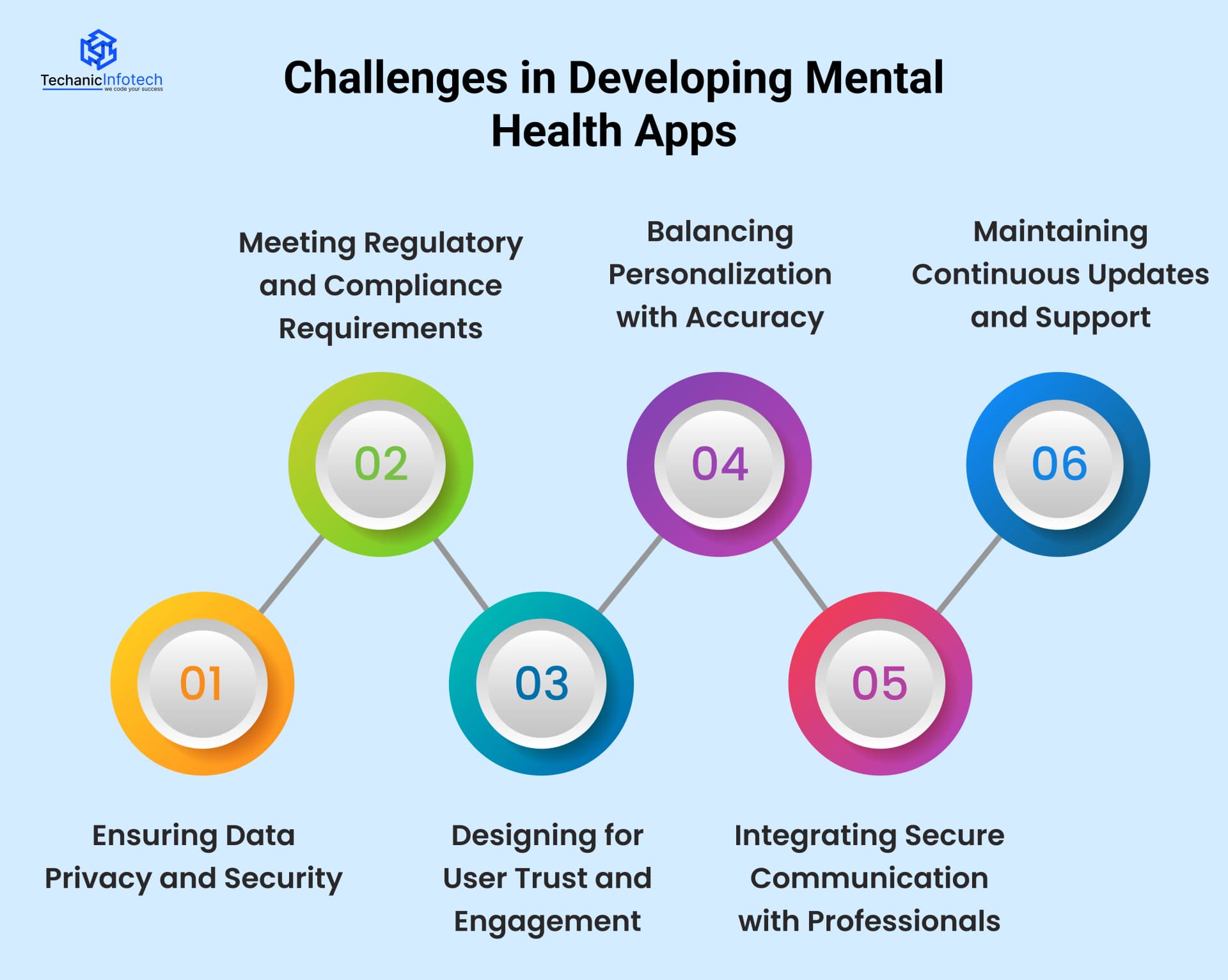
Challenge: Mental health apps handle highly sensitive information such as mood logs, therapy notes, and personal identifiers. Any breach can damage user trust and lead to legal issues.
Solution: Implement end-to-end encryption, secure authentication (MFA/biometrics), role-based access, and regular security audits. Build compliance (HIPAA/GDPR) into the architecture from day one.
Challenge: Different regions have strict healthcare and data protection regulations, which can slow development and increase costs.
Solution: Work with experienced mental health app developers who understand regional standards. Maintain clear consent flows, audit trails, and documentation to pass compliance checks smoothly.
Challenge: Users may hesitate to share personal emotions with an app, especially if the interface feels clinical or complicated.
Solution: Focus on empathetic UI/UX, calm visuals, simple navigation, and transparent privacy messaging.
Add features like journaling and guided support to build comfort and long-term engagement.
Challenge: AI-driven suggestions can be helpful, but inaccurate recommendations may reduce credibility.
Solution: Use validated assessment frameworks, train models on diverse datasets, and include human oversight where needed. Provide clear disclaimers and allow users to adjust preferences.
Challenge: Real-time chat or video therapy requires stable performance, confidentiality, and scheduling management.
Solution: Use encrypted communication protocols, reliable video APIs, and secure session handling. Test across devices to ensure consistent quality.
Challenge: Mental health needs and security threats evolve, requiring ongoing app maintenance.
Solution: Plan a post-launch roadmap with regular updates, performance monitoring, and user feedback loops. Continuous iteration keeps the platform relevant and safe.
Addressing these challenges early helps teams build trustworthy, compliant, and user-centered mental wellness apps that scale successfully
Mental wellness platforms are becoming an essential part of modern healthcare and daily self-care.
A successful solution depends on the right balance of user-focused design, trusted security, meaningful features, and ongoing improvement.
From planning and compliance to launch and continuous updates, each stage plays a role in building a reliable experience that users can depend on.
As demand for accessible support continues to rise, organizations that invest thoughtfully in high-quality digital solutions will be better positioned to deliver consistent value.
By prioritizing privacy, personalization, and long-term scalability, businesses can create mental health apps that genuinely support users while sustaining growth in an evolving digital health landscape.
Mental health app development is the process of designing and building digital platforms that help users manage emotional well-being through features like mood tracking, therapy access, journaling, and guided wellness programs.
Mental health app development is the process of designing and building digital platforms that help users manage emotional well-being through features like mood tracking, therapy access, journaling, and guided wellness programs.
The cost typically ranges between $6,000 and $45,000+, depending on the app’s complexity, features, integrations, and security requirements.
The cost typically ranges between $6,000 and $45,000+, depending on the app’s complexity, features, integrations, and security requirements.
Development timelines usually vary from 6 weeks to 5 months, depending on the scope, design requirements, and testing needs.
Development timelines usually vary from 6 weeks to 5 months, depending on the scope, design requirements, and testing needs.
Essential features include user profiles, mood tracking, journaling, secure chat or video therapy, personalized recommendations, reminders, and strong data privacy controls.
Essential features include user profiles, mood tracking, journaling, secure chat or video therapy, personalized recommendations, reminders, and strong data privacy controls.
Focus on secure data handling, clear privacy policies, evidence-based content, and an easy-to-use interface. Regular updates and reliable performance also help build long-term user confidence.
Focus on secure data handling, clear privacy policies, evidence-based content, and an easy-to-use interface. Regular updates and reliable performance also help build long-term user confidence.
Yes. Apps that store or process sensitive health information often need to comply with regulations such as HIPAA or GDPR to protect user privacy and data security.
Yes. Apps that store or process sensitive health information often need to comply with regulations such as HIPAA or GDPR to protect user privacy and data security.
Experienced developers or specialized development partners can reduce technical risks, ensure compliance, and deliver a more scalable and secure platform compared to building without domain expertise.
Experienced developers or specialized development partners can reduce technical risks, ensure compliance, and deliver a more scalable and secure platform compared to building without domain expertise.


Neha Sharma is a tech expert at heart who loves exploring new technologies and turning complex ideas into easy-to-understand content. With a passion for learning and writing, she enjoys sharing insights on emerging tech, digital products, and innovation that help businesses stay ahead.