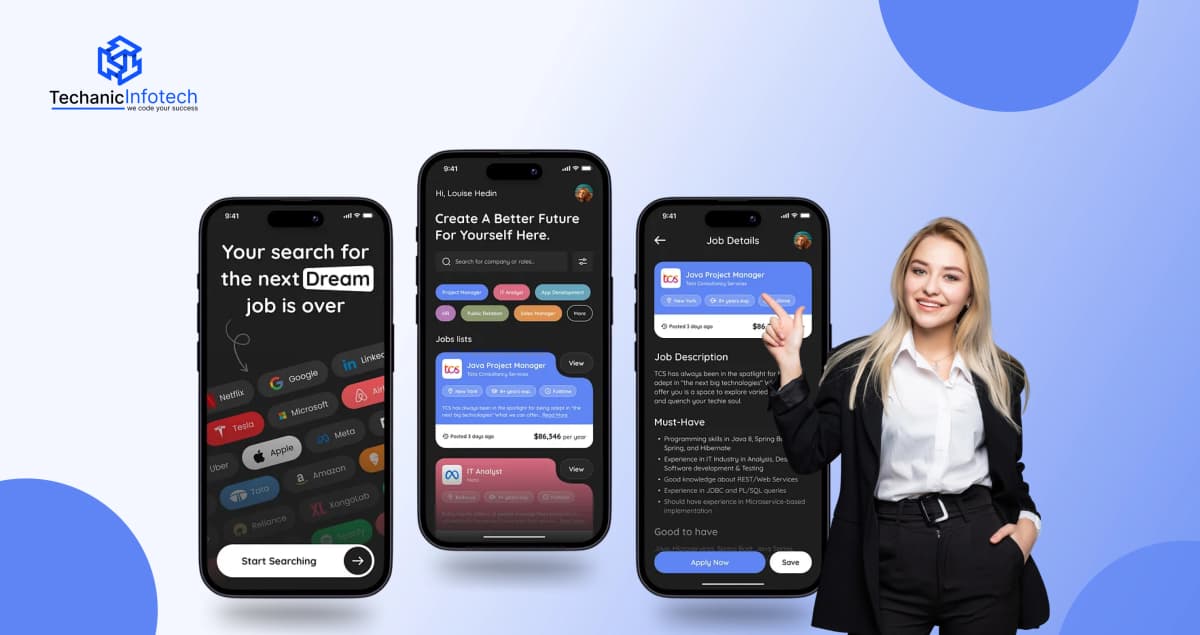
Job Portal App Development
AI-Powered Job Portal Development: Features, Use Cases, & Benefits
January 7, 2026
January 7, 2026
The rapid evolution of technology has transformed the recruitment industry, with AI in job portal app development becoming a pivotal force in shaping the future of job searches and hiring.
By leveraging artificial intelligence in job portal apps, platforms now offer smarter, faster, and more personalized services to both job seekers and employers.
Whether it's AI-powered job portal development, smart job matching, or automating routine tasks like resume screening, AI is streamlining the recruitment process.
For job seekers, AI enables tailored job recommendations, faster application processes, and enhanced interaction with recruiters.
This blog delves deep into AI-based recruitment platforms, their key use cases, features, and the challenges associated with integrating AI into job portals.
AI is revolutionizing job portal apps by improving job matching, streamlining recruitment, and enhancing user experience.
The following are the cases that help both job seekers and employers find the best fits more efficiently.
One of the most transformative use cases of AI in job portal app development is AI-powered job matching.
Traditionally, job portals only allowed users to filter job listings by keywords, experience, and location.
For instance, if a candidate applies for a job in software engineering, the system will consider their proficiency in programming languages, their experience with different technologies, and their soft skills, such as problem-solving abilities.
Similarly, if the job description mentions specific certifications, AI ensures that only candidates with the right qualifications are matched.
In traditional job recruitment processes, hiring managers spend a significant amount of time manually reviewing hundreds of resumes, often overlooking highly qualified candidates due to time constraints or human error. AI-powered job portal development solves this problem with AI-driven resume screening.
AI-based recruitment platforms use natural language processing (NLP) and pattern recognition algorithms to quickly analyze resumes, eliminating bias and significantly reducing the time spent on manual screening.
For example, if a recruiter is hiring for a digital marketing role, the AI will prioritize candidates who have experience with SEO, content marketing, and data analytics, ensuring that only the most relevant candidates are shortlisted.
Artificial intelligence in job portal apps has made job recommendations smarter and more personalized.
Unlike traditional portals, which rely on basic keyword matching, AI best job portal platforms use advanced algorithms to analyze a candidate's preferences, search history, past applications, and even the jobs they spend the most time viewing.
For example, if a job seeker has been browsing jobs related to data science and has applied to a few machine learning positions, the AI system can detect this behavior and proactively recommend similar roles that match their expertise.
This proactive recommendation system saves job seekers time by offering them relevant opportunities that they might have otherwise missed. Additionally, it ensures that they don’t waste time applying for jobs outside their interest area.
AI-powered chatbots are becoming a significant feature of job portals, enhancing user experience by offering real-time assistance to job seekers.
These chatbots can answer frequently asked questions, help users with their job search, or guide them through the application process.
For example, if a user is uncertain about how to upload a resume or whether they qualify for a job, the AI chatbot can offer step-by-step instructions or provide recommendations based on the user’s profile.This feature not only improves candidate experience but also frees up the recruiter’s time by automating scheduling.
One of the major advantages of AI-driven hiring platforms is their ability to conduct advanced talent searches.
AI can filter through thousands of resumes, online profiles, and candidate databases to locate the most qualified individuals based on highly specific criteria.With AI handling the initial search, recruiters can focus on the final stages of candidate engagement, interview preparation, and decision-making.
This process accelerates recruitment and significantly improves the chances of hiring top talent.
Machine learning in job portals enables predictive analytics, which analyzes historical data and market trends to forecast future hiring needs. This helps both job seekers and employers plan more effectively.
For example, if AI detects a growing demand for cloud computing skills in a particular geographic location or industry, it can advise job seekers to upskill in cloud technologies or recommend relevant job postings to employers.By analyzing factors like industry growth, regional trends, and emerging technologies, AI ensures that job seekers are equipped with the right skills, while recruiters can stay ahead of the curve in finding talent with emerging expertise.
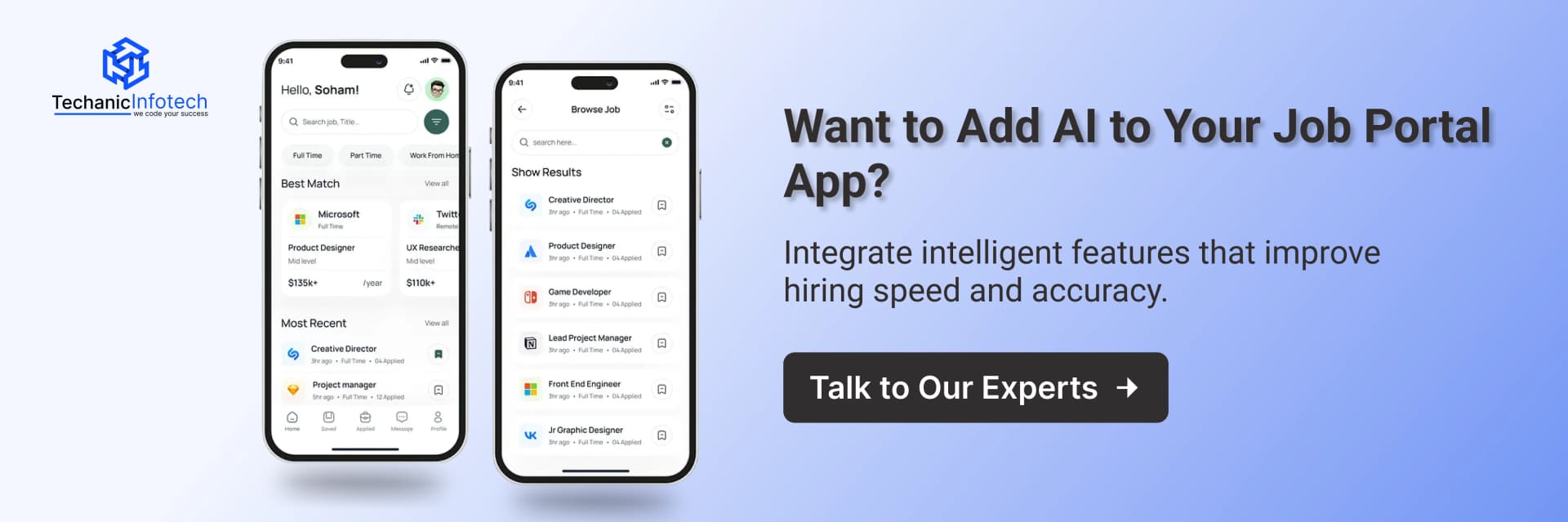
AI powers key features in job portal apps, such as smart job matching, personalized recommendations, and resume parsing.
These job portal app features enhance search capabilities, automate candidate screening, and provide data-driven insights to improve the hiring process.
One of the primary features that AI enhances in job portal apps is smart job search filters.
Traditional job portals offer basic search filters, but AI-driven job portals offer advanced filters that personalize search results based on a user’s behavior and profile.For example, if a job seeker’s previous search history indicates a preference for remote work, the AI will prioritize remote job listings when they perform future searches.
Similarly, users can filter jobs based on salary expectations, preferred industries, and specific certifications, further personalizing the job search.
AI-powered job portal development integrates automated job alert systems that send notifications to users whenever a new job is posted that matches their preferences.
These alerts can be customized to notify users immediately after a job is listed, giving them a competitive advantage by allowing them to apply early.This feature enhances the user experience by ensuring that job seekers are always informed about relevant job openings without the need to constantly check the portal.
Additionally, AI-based notifications are more accurate and tailored to each user’s individual needs, ensuring that they receive only the most relevant alerts.
AI features in job portal apps include the ability to build detailed candidate profiles by gathering data from resumes, interviews, and user interactions on the platform.
These profiles are continually updated as candidates engage with the platform, ensuring they remain accurate and relevant over time.AI tools also assist in evaluating candidates by using predictive analytics to assess the likelihood of success in a particular role based on their past experiences, education, and other factors.
This data-driven approach helps recruiters make more informed decisions and reduces the chances of overlooking highly qualified candidates.
AI-powered resume parsing is a crucial feature for job portals, helping recruiters and employers streamline the hiring process.
AI algorithms automatically extract key data from resumes such as contact information, work experience, skills, and educational background, without requiring manual input.This data is then structured into a format that is easy to analyze, making it quicker for recruiters to assess whether a candidate meets the qualifications for the job.
Smart resume parsing also enables more efficient sorting and filtering of resumes, reducing time spent on manual reviews.
AI-powered job portals provide job trend analytics that offer valuable insights into the job market.
By analyzing past job postings, salary ranges, and required skills, AI helps job seekers stay up-to-date with the most in-demand roles and skills.For example, if AI detects a surge in demand for cybersecurity professionals, it may advise job seekers to consider upskilling in that area or recommend job openings in that field.
This predictive capability helps job seekers plan their careers and ensures they remain competitive in an evolving job market.
With AI automation, interview scheduling becomes far easier. AI algorithms help sync candidates’ availability with recruiters' calendars, reducing the chances of conflicts or scheduling errors.
Once an interview is scheduled, AI can automatically send reminders to both parties, ensuring the interview process runs smoothly.
Integrating AI into job portal apps offers benefits like faster and more accurate job matching, improved candidate selection, and personalized user experiences.
These benefits boost efficiency by automating repetitive tasks, reducing hiring biases, and providing data-driven insights for better decision-making.
The main benefit of AI-powered job portal development is the improved user experience.
Job seekers enjoy personalized job recommendations, quicker application processes, and easier navigation, while recruiters benefit from smarter candidate matching and better candidate engagement.
AI ensures that job seekers spend less time searching and more time applying to roles that suit their qualifications.
With AI-driven hiring platforms, employers can automate time-consuming tasks such as resume screening, interview scheduling, and job matching.
This speeds up the recruitment process and ensures a quicker time-to-hire, reducing the overall cost to build a job portal app with the best companies.
AI enhances the precision of job matching by analyzing various factors, including skills, experience, and personality traits.
The result is that both job seekers and recruiters can be confident that their job matches are highly relevant, reducing the likelihood of mismatches and improving the quality of placements.
By automating the recruitment process, AI reduces the need for manual intervention, cutting down operational costs.
AI-driven hiring platforms also eliminate inefficiencies, saving businesses time and money in the long run.
AI-based recruitment platforms allow businesses to make more informed hiring decisions by providing data-backed insights on candidate profiles, market trends, and hiring patterns.
These insights help recruiters focus on the best-fit candidates, leading to more successful hires.
AI allows job portals to scale efficiently. Whether you're dealing with hundreds or thousands of job seekers, AI can handle vast amounts of data and applications, ensuring that the platform operates seamlessly and efficiently, even during peak times.
AI in job portals faces challenges like data privacy concerns, algorithmic bias, and reliance on high-quality data.
The following are the job portal app challenges where users struggle with understanding the nuances of resumes or job descriptions, potentially overlooking unique candidate traits and experiences.
As AI algorithms process large amounts of personal data, including resumes and job applications, protecting user privacy and ensuring compliance with data protection laws like GDPR is critical.
Job portals must implement strict security measures to safeguard sensitive information.
AI systems can unintentionally inherit biases from historical data or flawed algorithms, leading to discriminatory hiring practices.
To mitigate this, AI algorithms must be continually tested and refined to ensure fairness and reduce bias in recruitment.
AI algorithms require high-quality, comprehensive data to function optimally.
If the data is incomplete or flawed, the AI system's output will be inaccurate, affecting the job matching process and candidate evaluations.
Developing AI-driven job portals involves significant upfront investment, requiring skilled developers and access to advanced technologies.
While AI offers long-term benefits, the initial costs can be a barrier for smaller job portal app development companies or startups.
AI, while incredibly powerful, cannot replicate the nuanced judgment of human recruiters, especially when assessing soft skills, cultural fit, or candidate enthusiasm.
It's essential to strike a balance between AI automation and human decision-making.
AI systems require regular updates, maintenance, and monitoring to ensure they remain effective and up-to-date with changing market conditions and technological advancements.
The future of AI in job portal app development is incredibly promising, with new technologies and innovations continually improving the recruitment process.
As AI-driven hiring platforms become more sophisticated, job portals will evolve into highly personalized, intuitive systems that can predict hiring trends, match candidates with precision, and even assist with soft skill evaluations.
One area poised for significant growth is the use of augmented reality (AR) and virtual reality (VR) within job portals.
Imagine being able to experience virtual office tours or participate in simulated job tasks before applying for a role.
This can provide job seekers with a deeper understanding of potential employers, while giving companies a more interactive way to assess candidates’ skills.
Additionally, machine learning in job portals will continue to enhance the personalization of job recommendations, with AI getting smarter over time.
As job seekers interact with platforms, AI will continuously adapt, learning more about their preferences, strengths, and career aspirations to offer even more accurate job matches.
When it comes to smart job portal app development, Techanic Infotech is a trusted name known as the job portal development company.
They specialize in AI-powered job portal development, ensuring your platform is equipped with the latest AI features for AI-driven hiring platforms.
Whether you're looking to create a cutting-edge job matching algorithm or implement AI-based recruitment platforms, Techanic Infotech provides custom-built solutions that help businesses and job seekers navigate the recruitment process with ease.
With an expert team skilled in machine learning in job portals and AI features in job portal apps, Techanic Infotech offers scalable, user-friendly platforms tailored to your needs.
From development to ongoing support, they ensure that your job portal is always optimized for both users and employers.
The integration of AI in job portal app development is reshaping how recruitment is conducted, offering personalized experiences, faster hiring processes, and improved job matching.
From AI-powered job portal development to AI-driven hiring platforms, the benefits of AI are undeniable.
As AI continues to evolve, job portals will become even smarter, offering more accurate matches, predictive hiring trends, and a more seamless recruitment process.
However, challenges like data privacy and AI bias must be addressed to ensure fairness and transparency.
By embracing AI features in job portal apps, businesses can create platforms that are not only efficient but also forward-thinking, offering a better experience for job seekers and employers alike.
AI-powered job portal development refers to the integration of AI technologies, such as machine learning and natural language processing, to enhance the functionality of job portals, including job matching, resume screening, and candidate engagement.
AI enhances job matching by analyzing various factors, including a candidate’s skills, experience, and preferences, to recommend jobs that are more likely to align with their qualifications and interests.
AI-driven hiring platforms provide benefits like faster resume screening, personalized job recommendations, automated candidate engagement, and predictive analytics for job market trends.
While AI can help mitigate bias by focusing on objective data, it’s crucial to ensure that AI algorithms are properly tested and monitored for bias, as historical data can sometimes influence AI decisions.
Some challenges include data privacy concerns, AI bias, reliance on high-quality data, the initial high cost of AI development, and the need for continuous maintenance and updates.


Abhishek Jangid is the CEO of Techanic Infotech, with extensive experience in mobile app and web development. He specializes in helping businesses turn innovative ideas into scalable digital solutions through strategic planning and modern technology.