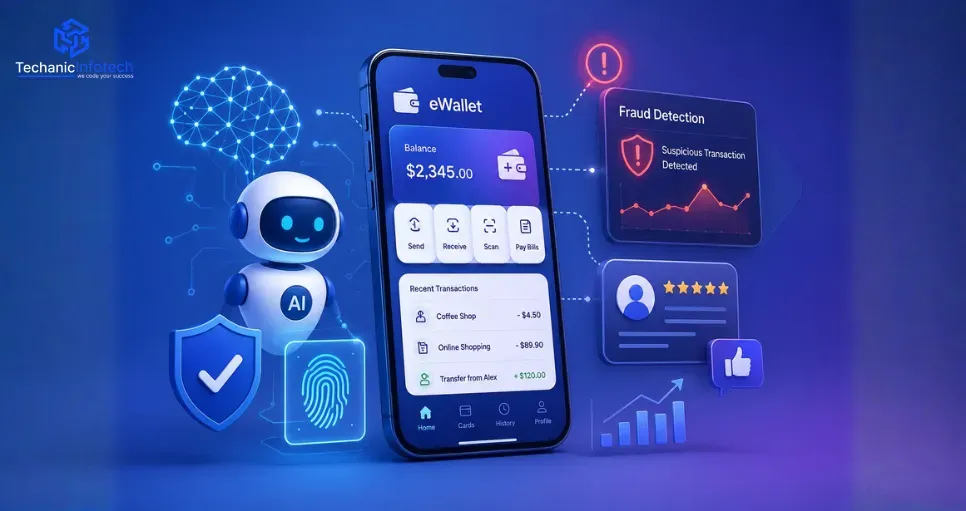
AI is transforming eWallet apps by enhancing security, automating processes, and delivering highly personalised user experiences, making digital payments faster, smarter, and more reliable.
Advanced fraud detection powered by AI helps identify suspicious activities in real time, reducing risks and building stronger trust among users across mobile payment platforms.
Technologies like machine learning, NLP, and predictive analytics are driving innovation, enabling smarter features such as chatbots, financial insights, and seamless transaction experiences.
The future of eWallet apps will focus on voice payments, autonomous financial assistants, and deeper integrations, creating a more connected and intuitive financial ecosystem for users.
Investing in AI-driven eWallet solutions helps businesses stay competitive, improve user engagement, and unlock long-term growth opportunities in an increasingly digital and mobile-first market.
Ever wondered how digital wallets are becoming smarter, safer, and more personalised every day? The rise of AI is reshaping how users interact with mobile payment platforms.
From detecting suspicious activity instantly to tailoring user experience, AI in eWallet apps is driving a new level of efficiency and trust.
These intelligent systems analyse behaviour, automate processes, and enhance security without slowing down transactions.
In this guide, we’ll explore how AI improves fraud detection, elevates user experience, and powers advanced features that make modern eWallet apps more reliable, intuitive, and future-ready for both users and businesses.
Artificial intelligence is rapidly becoming a core part of modern eWallet apps, enhancing security, personalisation, and efficiency. Its growing role is reshaping how users interact with digital payments and financial services worldwide.
AI strengthens eWallet security by detecting suspicious behaviour in real time and reducing fraud risks. It can improve detection accuracy up to 99% and cut fraud losses by 20–30%.
The global eWallet market is expected to grow by $203.40 billion between 2026 and 2030, with a CAGR of 22.1%, driven by AI integration and rising digital transactions.
AI analyses user behaviour to deliver personalised recommendations, spending insights, and smart alerts. This improves user engagement, simplifies financial management, and creates more intuitive, user-friendly eWallet experiences.
AI is redefining security in e-wallet apps by detecting threats faster and preventing fraud in real time. It helps protect transactions while ensuring a safe and seamless payment experience.
AI enables digital wallet systems to monitor transactions instantly and identify suspicious activity. This allows apps to block or flag fraud in real time, ensuring a secure and reliable payment experience.
AI studies user behaviour, including spending patterns and login habits, to detect anomalies. When activity deviates from normal behaviour, the system triggers alerts, helping to prevent unauthorised access and potential fraud.
Artificial intelligence in eWallet apps uses machine learning models that continuously learn from past transactions. This improves detection accuracy over time and helps platforms stay ahead of evolving fraud tactics and threats.
AI enhances authentication by combining biometrics, device recognition, and behavior analysis. This layered approach strengthens security while maintaining a smooth, user-friendly login experience for eWallet users.
With AI for eWallet security and UX, systems assign risk scores to transactions based on multiple factors. High-risk activities trigger alerts or extra verification, reducing fraud while keeping genuine transactions seamless.
AI technologies are powering smarter financial tools, and AI in eWallet apps is leading this shift by enhancing security, automation, and personalisation for faster, safer, and more intuitive digital payment experiences.
Machine learning is the backbone of any AI mobile payment app, analyzing transaction data to detect patterns and predict behavior. It improves fraud detection, personalization, and overall system efficiency over time.
AI in digital wallet apps uses NLP to power chatbots and virtual assistants. These tools understand user queries, provide instant responses, and simplify customer support, improving overall user experience.
Computer vision enhances key eWallet app features like facial recognition and identity verification. It strengthens security through biometric authentication while reducing fraud risks with accurate and fast user identification processes.
AI-powered eWallet apps use predictive analytics to forecast user behavior and spending trends. This helps deliver personalised recommendations, detect potential risks early, and improve financial decision-making for users.
RPA supports AI fraud detection digital wallet systems by automating repetitive tasks like transaction monitoring and verification. This improves efficiency, reduces human errors, and ensures faster processing across the platform.
In eWallet app development, combining AI with blockchain improves transparency and security. It ensures tamper-proof transaction records, reduces fraud risks, and builds stronger user trust in digital payment systems.
Voice recognition allows users to access accounts and perform transactions through voice commands. This adds convenience, enhances accessibility, and creates a more engaging and user-friendly eWallet experience.
An experienced eWallet app development company uses advanced data analytics to understand user behaviour. These insights help improve services, personalise features, and optimise overall app performance for better engagement.
AI continues to evolve rapidly, and AI in eWallet apps is shaping the future with smarter automation, stronger security, and deeper personalisation, redefining how users interact with mobile payments and financial services.
An AI mobile payment app will deliver tailored insights based on user behaviour and spending habits. This helps users manage money better, make informed decisions, and receive real-time financial recommendations.
AI in digital wallet apps will move toward predictive fraud prevention, identifying risks before they occur. These systems will analyse complex patterns to enhance security without disrupting the user experience.
Voice-enabled features will simplify transactions, allowing users to manage payments easily. As innovation grows, optimising e-wallet app development costs while integrating such features will remain a key focus for businesses.
AI-powered eWallet apps will connect seamlessly with banks, apps, and services. This will create a unified ecosystem where users can manage all financial activities from one convenient platform.
Future wallets will include smart assistants built on a strong eWallet app tech stack. These assistants will automate budgeting, bill payments, and savings, improving efficiency and financial management.
With AI for eWallet security and UX, authentication will rely on biometrics and behaviour patterns. This will enhance protection while ensuring a smooth, frictionless experience for users across all transactions.
AI is rapidly reshaping the future of eWallet apps by making them smarter, safer, and more user-focused.
From advanced fraud detection to personalised user experiences, these technologies are helping businesses build trust and improve engagement.
As innovation continues, integrating AI will no longer be optional but essential for staying competitive in the digital payments space.
With the right strategy, scalable infrastructure, and user-centric approach, businesses can create powerful eWallet solutions that meet evolving customer expectations.
Investing in AI-driven features today will not only enhance security and efficiency but also unlock new growth opportunities in an increasingly mobile-first and data-driven financial ecosystem.
AI helps improve security, automate processes, and personalise user experiences. It enables faster transactions, smarter insights, and real-time fraud detection, making eWallet apps more efficient and reliable.
AI analyses transaction patterns and user behaviour to detect suspicious activity instantly. It can block or flag unusual transactions, reducing fraud risks and protecting users from unauthorised access.
AI enhances security, boosts user engagement, provides personalised recommendations, and automates tasks. It also improves decision-making by analysing large volumes of financial and behavioural data.
Technologies like machine learning, natural language processing, predictive analytics, and computer vision are widely used to improve security, customer support, and personalisation in eWallet platforms.
AI delivers personalised insights, smart notifications, and easy navigation. It simplifies financial management by offering recommendations based on user behaviour and spending patterns.
AI will enable predictive fraud prevention, voice-based transactions, and autonomous financial assistants. It will also improve cross-platform integration and make digital wallets more intelligent and user-friendly.
Yes, AI-powered eWallet apps use advanced security measures like encryption, biometric authentication, and behaviour analysis to ensure safe and secure transactions for users.
The cost depends on features, complexity, and technology used. On average, development can range from moderate to high budgets, especially when integrating advanced AI capabilities.
Development time typically ranges from 3 to 9 months, depending on app complexity, AI integrations, and the overall development process.
Investing in AI helps businesses improve security, enhance user experience, increase customer retention, and stay competitive in the fast-growing digital payments market.


Bharat Sharma is the CTO of Techanic Infotech, bringing deep technical expertise in software architecture, mobile app development, and scalable system design. He leads the engineering team with a strong focus on innovation, performance, and security.