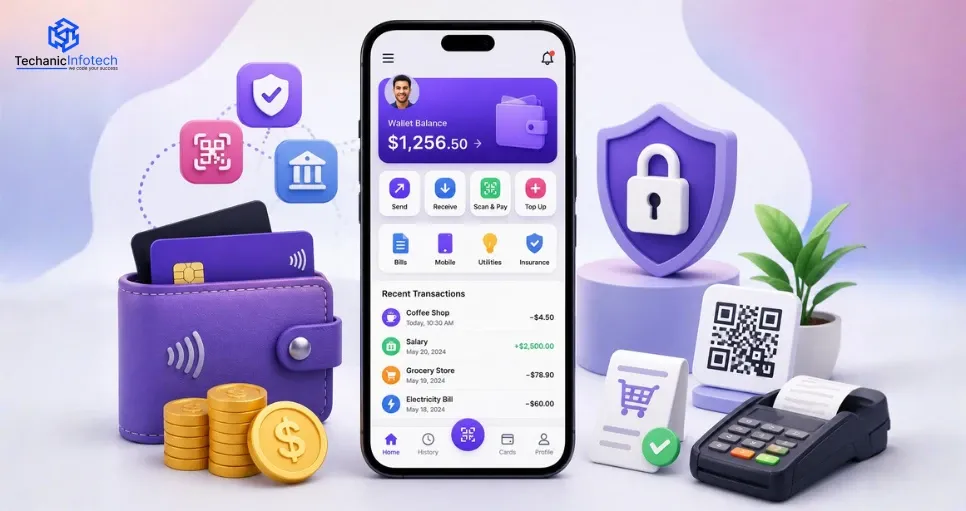
In today’s rapidly evolving digital economy, eWallet applications have become an essential part of modern financial management. From instant money transfers to contactless payments and online shopping, digital wallets are transforming how users handle daily transactions.
According to recent industry reports, the number of digital wallet users is expected to surpass 5.2 billion globally by 2026. This rising adoption has increased the demand for secure, scalable, and user-friendly eWallet applications.
For startups and enterprises planning to enter the fintech market, understanding the Best eWallet App Features is critical for building a successful and competitive platform.
Whether you are planning to launch a new digital wallet or upgrade an existing solution, adding the right features can improve user engagement, retention, and overall app performance.
In this guide, we’ll explore the essential and advanced features every modern eWallet app should include in 2026.
Before exploring the features, it’s important to understand what an eWallet app actually is.
An eWallet, also known as a digital wallet, is a mobile application that allows users to store payment information, transfer money, pay bills, and manage transactions digitally.
These applications are commonly used for:
Online shopping
Peer-to-peer payments
Utility bill payments
QR code transactions
Banking and financial management
Contactless payments
The global eWallet market is projected to exceed $10 trillion in transaction value in the coming years, making it one of the fastest-growing sectors in fintech.
This growing demand has encouraged businesses to invest in advanced fintech app development services and scalable payment ecosystems.
If you’re planning to build a digital wallet application, this is the ideal time to launch a feature-rich and secure solution.
A successful eWallet platform requires more than just payment functionality. Modern users expect security, convenience, personalization, and seamless financial management.
Below are the Best eWallet app features every digital wallet application should include.
An intuitive and visually appealing interface is one of the most important features of a successful eWallet application.
Users should be able to navigate the app effortlessly without confusion or unnecessary complexity.
A clean and user-friendly design significantly improves user engagement and retention.
Simple and minimal dashboard
Easy navigation structure
Clear icons and labels
Personalized home screen
Quick access to payment options
A well-designed interface improves customer satisfaction and encourages long-term app usage.
Security is one of the most critical components of any fintech application.
Users trust eWallet apps with sensitive financial and personal information, making advanced security implementation essential.
Strong authentication systems also improve trust and platform credibility.
Two-factor authentication (2FA)
Face recognition login
Fingerprint authentication
Session timeout protection
Device verification
Strong authentication systems are an important part of modern eWallet app security practices.
Multi-currency support allows users to send, receive, and manage payments across different currencies.
This feature is especially valuable for international users, travelers, freelancers, and global businesses.
Real-time currency conversion
Automatic exchange rate updates
Transparent conversion fees
Multi-currency wallet management
Adding multi-currency functionality improves global accessibility and user convenience.
Seamless banking integration is one of the most important features for digital wallet applications.
Users should be able to connect bank accounts, debit cards, and payment gateways directly within the app.
Proper eWallet API integration ensures smooth and secure transactions.
Bank account linking
Debit/credit card integration
Secure payment gateway integration
Transaction history synchronization
Real-time bank transfers
This feature improves financial management and overall user experience.
Modern users expect to complete payments directly from the application without switching platforms.
In-app payment functionality improves convenience and reduces transaction friction.
Peer-to-peer payments
QR code payments
Merchant payments
Utility bill payments
Subscription payments
This functionality transforms the app into a complete financial management platform.
Loyalty programs help improve user engagement and encourage repeat usage.
Reward systems increase customer retention while adding extra value to the platform.
Cashback rewards
Referral bonuses
Loyalty points system
Merchant discounts
Promotional offers
Loyalty programs are among the best eWallet app features for improving long-term user engagement.
Real-time notifications improve transparency and help users stay informed about account activity.
Push notifications also improve app engagement and security awareness.
Payment confirmation alerts
Failed transaction notifications
Suspicious activity alerts
Spending limit notifications
Promotional notifications
This feature helps build trust while improving user control over financial activity.
Users increasingly prefer the best eWallet apps that help them manage spending and savings effectively.
Analytics and budgeting tools provide valuable financial insights and encourage smarter money management.
Spending analytics
Expense categorization
Monthly budgeting tools
Savings goal tracking
Financial reports and charts
These tools improve user satisfaction and platform value.
Social functionality increases engagement and creates a stronger user community.
Modern eWallet platforms often include collaborative and social payment features.
Bill splitting
Shared group wallets
Social payment sharing
Referral systems
Community interaction options
Adding social elements improves user interaction and retention.
Offline functionality improves app accessibility in areas with limited internet connectivity.
This feature can significantly improve user convenience and market reach.
Offline balance checking
QR code scanning without internet
Offline transaction storage
Auto-sync when connected
Offline support makes the application more accessible for a broader audience.
To stay competitive in the fintech market, businesses should also consider implementing advanced features.
These features may increase eWallet development costs but can significantly improve user experience and platform value.
Biometric authentication in eWallet apps provides advanced security and faster user access.
Users can log in and authorize transactions using fingerprint or facial recognition.
This feature improves both convenience and security.
Artificial intelligence can automatically categorize transactions and analyze spending behavior.
AI-powered analytics help users manage budgets more effectively and make smarter financial decisions.
This is becoming one of the most valuable modern fintech features.
Instant peer-to-peer payment systems allow users to transfer money within seconds.
Fast payment processing improves user convenience and overall app engagement through p2p payment app development
This feature is now considered essential in modern digital wallet applications.
Advanced budgeting systems help users track expenses, monitor savings, and manage financial goals.
Real-time alerts and spending analysis improve financial planning.
Integrating merchant loyalty systems and cashback programs can significantly improve user retention.
Users appreciate rewards that add value to everyday spending.
Cryptocurrency integration is becoming increasingly popular in modern eWallet applications.
Users can buy, sell, and store cryptocurrencies directly within the wallet.
This feature attracts tech-savvy users and expands investment opportunities.
Bill-splitting functionality simplifies group payments among friends, family, and colleagues.
This feature is highly popular in peer-to-peer payment applications.
Behind every successful eWallet application is a well-structured system that ensures smooth operations for users, merchants, and administrators.
Whether you are building a fintech platform from scratch or upgrading an existing solution, organizing features panel-wise helps improve usability, security, and overall performance.
With the right combination of user-focused functionalities and robust admin controls, businesses can create a seamless digital payment experience.
Below is a breakdown of the essential panels and features required in a modern eWallet application:
|
Panel |
Description |
|
Merchant Panel |
A dedicated dashboard for merchants to manage payments, products, transactions, and customer interactions. |
|
Merchant Profile |
Allows merchants to manage business details, account settings, and payment preferences |
|
Transaction History |
Displays a complete record of transactions, refunds, and payment activities. |
|
Product & Service Listings |
Enables merchants to add, update, and manage products or services within the platform. |
|
Payment Settings |
Helps merchants configure payment methods, transaction fees, and settlement options. |
|
Analytics & Reports |
Provides insights into sales performance, customer behavior, and transaction trends. |
|
User Panel |
The primary dashboard where users manage payments, balances, and account activities. |
|
Wallet Balance |
Displays available wallet balance and transaction summaries in real time. |
|
Recent Transactions |
Shows users their latest payment history and transfer activities. |
|
Quick Payment Options |
Enables fast payments to saved contacts, merchants, and utility services. |
|
Offers & Rewards |
Displays cashback offers, loyalty rewards, discounts, and promotional campaigns. |
|
Settings & Security |
Allows users to manage profile settings, passwords, notifications, and security preferences. |
|
Admin Panel |
A centralized management system for monitoring and controlling the entire eWallet platform. |
|
User Management |
Enables admins to manage user accounts, KYC verification, and account approvals. |
|
Merchant Management |
Allows administrators to approve merchants and monitor merchant activities. |
|
Transaction Monitoring |
Provides real-time monitoring of payments, fraud detection, and dispute management. |
|
Analytics & Reporting |
Offers detailed reports related to app performance, revenue, and user engagement. |
|
System Settings |
Helps administrators configure security settings, transaction limits, APIs, and platform policies. |
These panel-wise features improve platform management and overall operational efficiency.
Choosing the right features is essential for building a successful digital wallet application.
Here are some important tips businesses should follow:
Identify your users’ needs, preferences, and pain points before finalizing app features.
Understanding your audience helps prioritize functionalities that deliver maximum value.
Study competing eWallet platforms to identify successful features and market gaps.
Competitor research helps businesses create more innovative and user-focused solutions.
Start with essential features such as secure payments, wallet management, and peer-to-peer transfers.
Advanced functionalities can be added later based on user feedback and business growth.
Strong eWallet app security systems are essential for protecting financial and personal information.
Businesses should prioritize encryption, fraud detection, and secure authentication methods.
5. Plan Future Integrations
Businesses should design apps with future scalability in mind.
Flexible eWallet API integration options help connect the platform with banking systems, payment gateways, loyalty programs, and fintech services.
The fintech industry evolves rapidly, so apps should be flexible enough to support future updates and new technologies.
Scalable architecture helps businesses adapt to changing market trends.
Regular testing and user feedback are essential for improving app performance and user experience.
Continuous optimization helps maintain long-term engagement and app stability.
Modern digital wallet applications are no longer limited to simple transactions. Users now expect security, speed, personalization, analytics, rewards, and seamless payment experiences from a single platform.
Adding the Best eWallet App Features can significantly improve user satisfaction, retention, and overall app performance.
From advanced eWallet app security systems to AI-powered analytics and seamless eWallet API integration, every feature plays an important role in building a competitive fintech solution.
Businesses planning to enter the fintech market should focus on creating secure, scalable, and user-friendly digital wallet applications that adapt to evolving user expectations.
The Best eWallet App Features include secure authentication, peer-to-peer payments, multi-currency support, budgeting tools, AI-powered analytics, loyalty programs, and real-time transaction notifications.
Strong eWallet app security protects users’ financial information and helps prevent fraud, unauthorized access, and data breaches.
eWallet API integration allows digital wallet apps to connect with banks, payment gateways, KYC systems, and third-party financial services for seamless transactions.
Modern eWallet apps commonly use Flutter, React Native, Node.js, Python, cloud infrastructure, AI tools, and secure payment APIs for better performance and scalability.
The cost depends on app complexity, features, platform selection, integrations, and security requirements. A basic app may cost around $15,000, while advanced solutions can exceed $130,000.
Startups should focus on essential features like secure login, instant money transfers, QR payments, bank integration, transaction history, and push notifications.
Multi-currency support allows users to make international transactions easily and improves the app’s accessibility for global users and businesses.
Digital wallet apps generate revenue through transaction fees, premium subscriptions, merchant partnerships, cashback programs, and in-app advertising.
Some common eWallet app development challenges include security compliance, payment gateway integration, scalability, fraud prevention, and regulatory requirements.
Professional fintech app development services help businesses create secure, scalable, and feature-rich digital wallet applications that improve customer experience and business growth.


Abhishek Jangid is the CEO of Techanic Infotech, with extensive experience in mobile app and web development. He specializes in helping businesses turn innovative ideas into scalable digital solutions through strategic planning and modern technology.