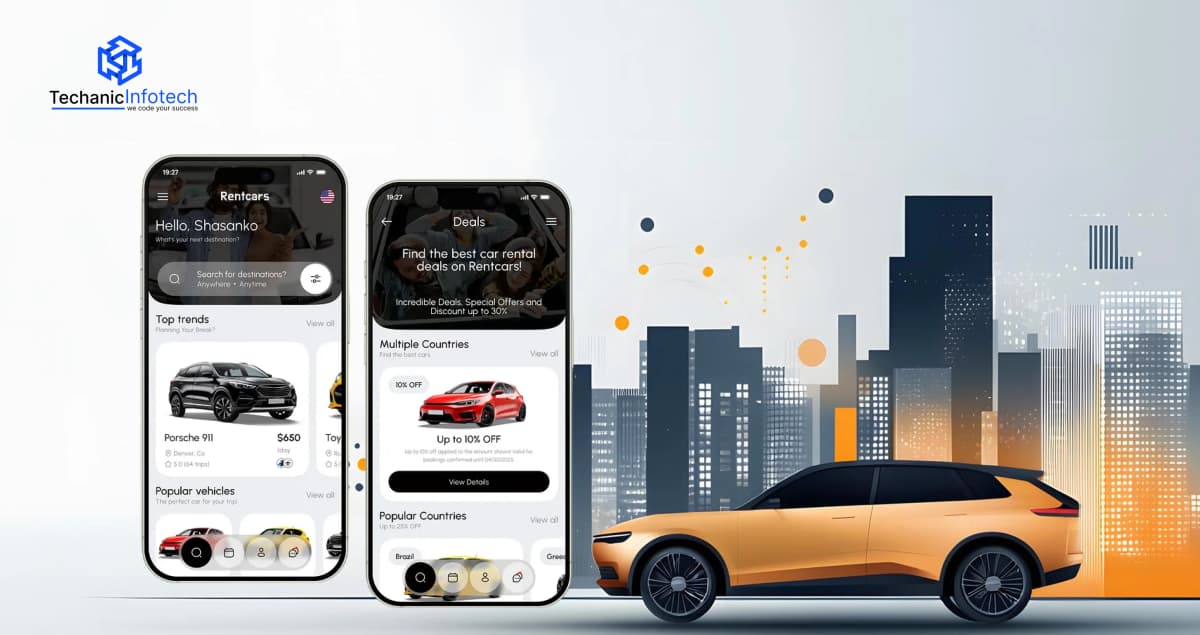
Building a car rental app may seem simple on the surface, but the process involves several moving parts that can slow progress if not handled correctly.
From managing real-time vehicle availability to delivering a smooth booking experience, businesses often face unexpected roadblocks during development.
These car rental app development challenges can impact performance, user trust, and long-term scalability if left unaddressed.
Technical complexity, security concerns, third-party integrations, and cost control are just a few areas where teams struggle. The good news is that these obstacles are manageable with the right planning and proven strategies.
By understanding common pain points early and applying practical solutions, businesses can mitigate risks, accelerate development, and build a reliable car rental app that meets user expectations and supports steady growth in a competitive market.
The car rental app market continues to expand rapidly as travelers and businesses shift toward digital convenience over traditional rental counters.
Rising smartphone usage and on-demand mobility are key growth drivers. Car rental app development in 2026 is becoming more competitive as users expect faster bookings, transparent pricing, and seamless mobile experiences.
These trends are pushing companies to invest in scalable, feature-rich rental platforms.
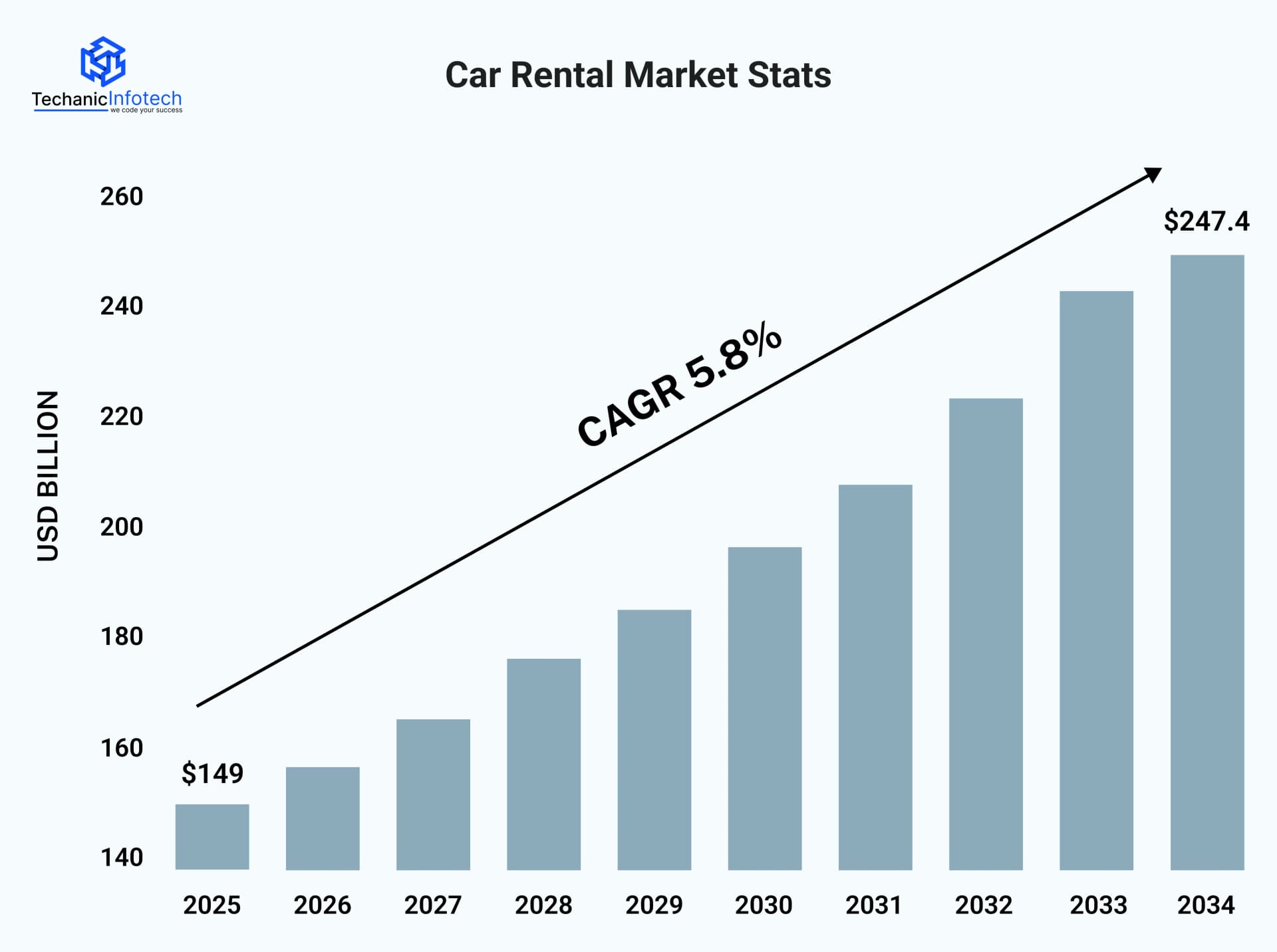
The global car rental market is expected to grow from $149.3 B in 2025 to $247.4 B by 2034.
The global rental used car apps market is forecast to reach $204.5 B by 2034, growing at 8.1% CAGR.
Over 60% of car rentals are booked via mobile applications, reflecting strong digital adoption.
About 85% of customers prefer booking rentals online or through mobile apps rather than at counters.
A strong car rental app helps businesses deliver speed, convenience, and reliability in a competitive market.
With user expectations rising, optimizing car rental app performance is no longer optional. A well-built app improves operations, customer satisfaction, and long-term scalability.
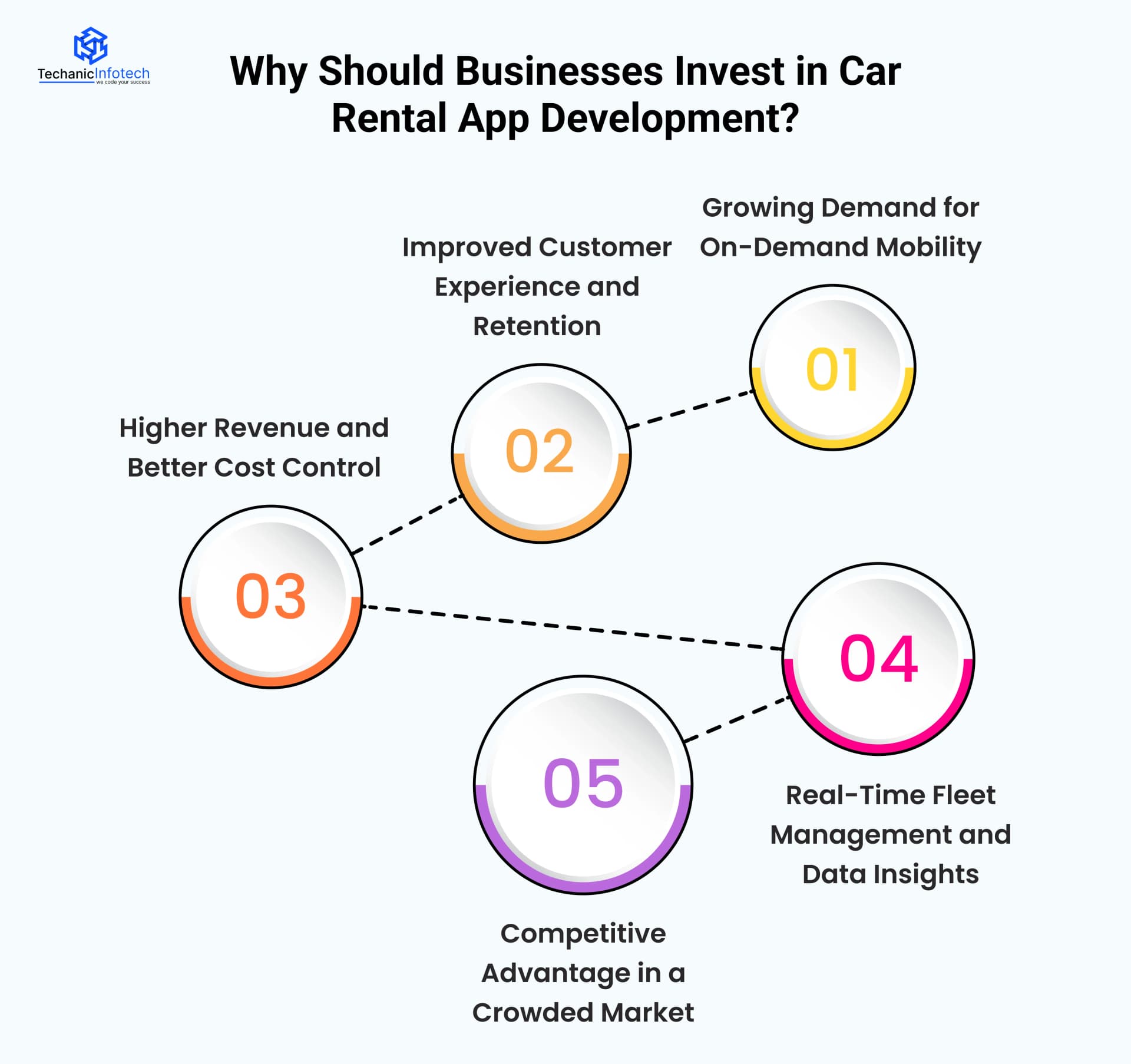
Customer behavior is shifting toward instant, mobile-first services, influenced by evolving mobile app development trends. A car rental app allows users to book vehicles in seconds, check availability, and manage rentals anytime.
This convenience meets modern mobility needs and helps businesses attract users who prefer fast, digital solutions over traditional rental processes.
A user-friendly app streamlines the entire rental journey, from vehicle selection to secure payments. Car rental app development features like intuitive navigation, saved preferences, and real-time updates create a hassle-free experience.
When customers enjoy smooth interactions, they are more likely to return, increasing loyalty and long-term engagement.
Car rental apps automate bookings, billing, and customer communication, reducing manual workload. Businesses can boost revenue through dynamic pricing, add-on services, and targeted offers.
At the same time, automation helps control operational costs, making the app a valuable tool for improving overall profitability.
With a dedicated app, businesses gain real-time visibility into fleet availability, vehicle usage, and maintenance needs.
Analytics and reporting features support smarter decisions, better resource planning, and reduced downtime. This level of control improves efficiency and helps maximize the return on fleet investments.
As competition increases, addressing car rental app development challenges becomes essential for standing out. A reliable, feature-rich app builds trust and brand credibility.
Businesses that invest in quality app development are better positioned to adapt quickly, attract tech-savvy users, and stay ahead of market shifts.
Building a car rental app involves more than basic booking features. It requires managing real-time data, complex integrations, and high user expectations.
When combined with car rental app scalability challenges, these factors make development more demanding, especially for businesses focused on long-term growth and performance.
One of the biggest car rental app feature challenges is showing accurate vehicle availability at all times. The app must instantly reflect bookings, cancellations, and location changes.
Even minor delays can cause double bookings, unhappy users, and lost revenue, making real-time syncing critical.
Managing a fleet involves tracking vehicle status, pricing, maintenance, and locations. These ongoing car rental app development issues increase backend complexity.
Without a structured system, data can become inconsistent, affecting app reliability, operations, and customer trust.
Car rental apps depend on maps, GPS, payment gateways, and verification tools. Choosing the right integrations often requires a clear mobile app tech stack guide.
Poor integration decisions can slow performance, increase errors, and limit future upgrades.
Handling payments and personal data introduces serious car rental app development challenges.
The app must meet compliance standards while maintaining fast checkout flows. Weak security can damage brand reputation and expose businesses to legal risks.
Implementing demand-based pricing is one of the major challenges in car rental app development.
The system must calculate accurate rates in real time without confusing users. Poor pricing logic can lead to abandoned bookings and customer dissatisfaction.
Car rental apps serve customers, admins, and fleet managers. Designing smooth workflows for all users without clutter is difficult.
A confusing interface for any role can slow operations or negatively impact the overall app experience.
As usage grows, apps must handle heavy traffic without crashing. Addressing car rental app security challenges alongside performance optimization is critical.
Without scalable infrastructure, apps may fail during peak demand, harming reliability and user confidence.
Building a successful rental platform involves many moving parts that must work together smoothly.
These car rental app development challenges often arise from technical complexity, user expectations, and operational demands.
Understanding these issues early helps businesses plan better and avoid car rental app development cost mistakes later.
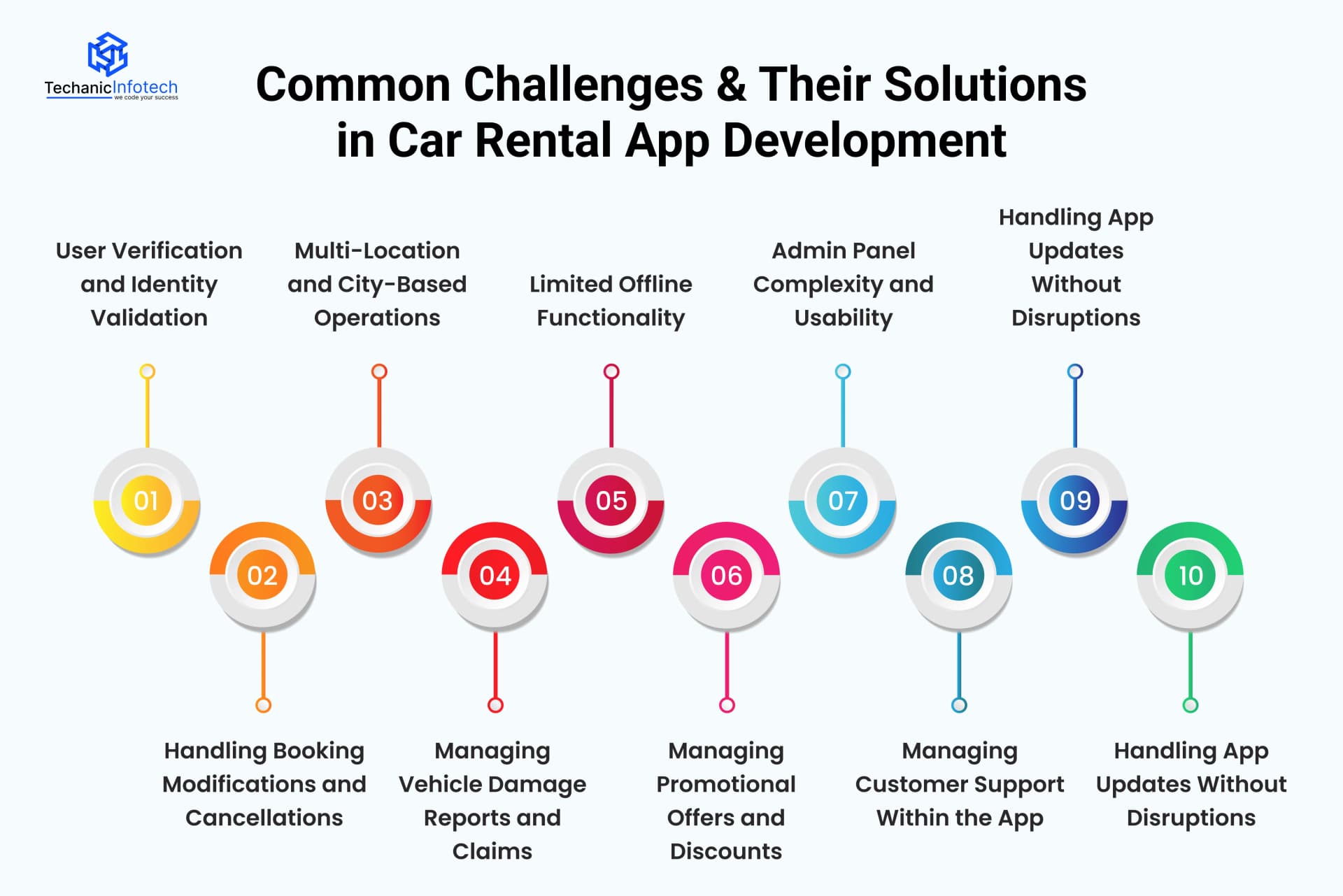
One of the common problems in car rental app development is verifying users without slowing down onboarding. Apps must confirm driver eligibility, age limits, and identity authenticity.
Weak verification can allow fraud, while overly complex steps frustrate genuine users. Striking the right balance between security and speed is essential for trust and compliance.
Enable document uploads with auto-validation
Use AI-based identity verification tools
Flag suspicious profiles for manual checks
Apply region-specific eligibility rules
Encrypt stored user data
Many businesses underestimate booking changes when learning how to develop a car rental app. Users frequently modify or cancel plans, which impacts pricing, availability, and refunds. Without real-time updates, these changes can cause double bookings, revenue loss, and disputes, affecting customer satisfaction.
Solutions
Build flexible modification workflows
Automate refunds and penalties
Sync availability instantly
Show clear cancellation policies
Maintain booking activity logs
Managing rentals across cities introduces car rental app feature challenges like location-based pricing, taxes, and policies. Without proper logic, apps may display incorrect rates or violate regional rules. As expansion grows, handling these variations becomes increasingly complex.
Solutions
Implement city-based pricing logic
Configure location-level admin controls
Automate regional tax calculations
Customize policies per city
Centralize multi-location reporting
Handling vehicle condition tracking is one of the most overlooked areas of car rental app development solutions. Without proper documentation, disputes over damages increase. Manual inspections are inconsistent, leading to delays, customer complaints, and financial losses.
Solutions
Enable photo uploads at pickup and return
Time-stamp inspection records
Store vehicle damage history
Automate claim workflows
Notify teams in real time
Users may lose internet access during trips, parking, or remote travel. Without offline support for essential mobile app features, users cannot access booking details or instructions. This creates frustration and reduces overall app reliability.
Solutions
Cache booking details locally
Allow offline reservation access
Sync data once online
Reduce dependency on live APIs
Optimize for low-connectivity areas
Running promotions introduces challenges in car rental app development, especially when discounts break pricing logic. Incorrect application can confuse users or reduce margins. Managing multiple campaigns during peak seasons adds further complexity.
Solutions
Use rule-based promotion engines
Set usage limits and expiry dates
Display discounts clearly at checkout
Track promotion performance
Test campaigns before launch
Admins handle bookings, vehicles, pricing, and reports daily. A cluttered admin panel slows workflows and increases errors. As features grow, poor usability can reduce productivity and decision-making efficiency.
Solutions
Design role-based dashboards
Simplify navigation and actions
Automate repetitive admin tasks
Add real-time alerts
Use clear data visualizations
Users expect quick help for booking issues or vehicle problems. Relying only on external channels delays responses. Lack of in-app support reduces satisfaction, especially during active rentals.
Solutions
Integrate in-app chat or tickets
Add AI-powered FAQs or bots
Track support history per user
Prioritize urgent issues
Monitor response metrics
Frequent updates are needed for fixes and features. Poor rollout can cause crashes or compatibility issues, especially during active rentals. Updates must be smooth and minimally disruptive.
Solutions
Roll out updates in phases
Maintain backward compatibility
Test across devices and OS versions
Notify users of major changes
Monitor post-update performance
Car rental laws vary widely by location. Designing compliant workflows without hurting usability requires following a clear mobile app design guide. Non-compliance can lead to penalties, service blocks, or legal disputes.
Solutions
Embed region-specific compliance rules
Consult legal experts early
Automate policy updates
Maintain compliance documentation
Review regulations regularly
Choosing Technic Infotech as your car rental app development partner means working with a team that understands both technology and business goals.
As an experienced car rental app development company, Techanic Infotech focuses on building scalable, secure, and user-friendly solutions tailored to market needs.
The team combines strong technical expertise with practical industry insights to handle complex features like fleet management, real-time availability, and secure payments.
From idea validation to post-launch support, Techanic Infotech follows a transparent and collaborative development process.
Their commitment to performance optimization, modern design standards, and long-term scalability helps businesses launch reliable apps that deliver real value.
With a results-driven approach and a deep understanding of mobility platforms, Techanic Infotech supports sustainable growth and competitive advantage.
Successfully building a car rental app requires more than just a good idea; it demands careful planning, the right technology, and a clear understanding of user needs.
From fleet management and pricing logic to security, scalability, and compliance, car rental app development challenges can impact performance and growth if not addressed early.
However, with the right strategies, tools, and development partner, these challenges become manageable opportunities for improvement.
A well-designed app not only streamlines operations but also enhances customer trust and long-term retention.
Businesses that invest in practical solutions, modern architecture, and continuous optimization are better positioned to stay competitive in a fast-evolving mobility market.
By focusing on quality, usability, and scalability, companies can build reliable car rental apps that support sustainable success and future expansion.
The biggest challenges include managing real-time vehicle availability, secure payments, fleet operations, pricing logic, and scalability. Addressing these early helps avoid performance issues, user dissatisfaction, and operational inefficiencies as the app grows.
Development time depends on features, platform, and complexity. A basic MVP may take three to four months, while a feature-rich car rental app with integrations, analytics, and scalability planning can take six months or longer.
Core features include user registration, vehicle listings, booking management, secure payments, real-time availability, admin dashboards, and customer support. Advanced features like GPS tracking, dynamic pricing, and promotions improve user experience and competitiveness.
Costs vary based on app complexity, design, platforms, and integrations. A simple app may require a lower budget, while advanced solutions with custom features, security layers, and scalability planning demand higher investment.
Businesses can reduce risks by starting with an MVP, choosing the right tech stack, focusing on user experience, testing thoroughly, and working with an experienced development partner who understands industry-specific challenges.


Abhishek Jangid is the CEO of Techanic Infotech, with extensive experience in mobile app and web development. He specializes in helping businesses turn innovative ideas into scalable digital solutions through strategic planning and modern technology.