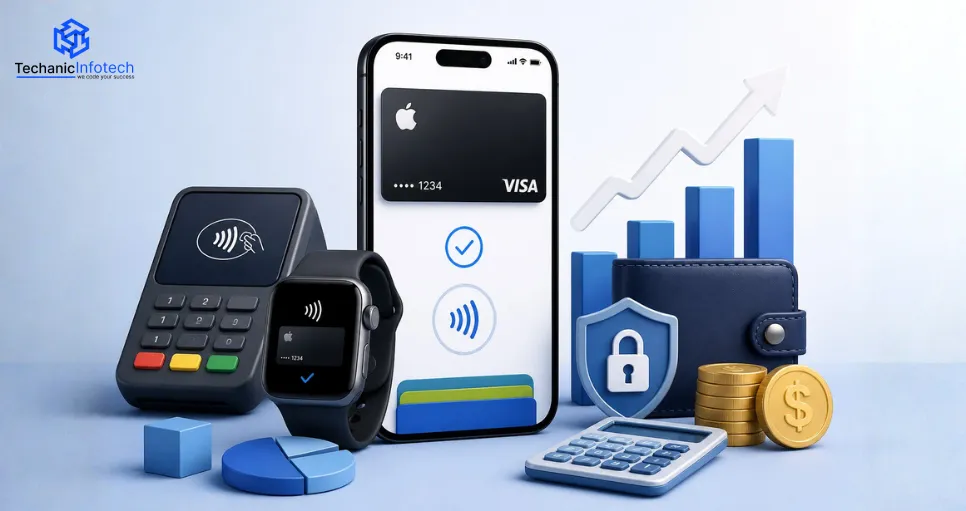
In the world of online payments, Apple Pay has revolutionized the way people transact, providing a fuss-free and secure means of making payments.
However, if you are planning to develop an app like Apple Pay, you may wonder: *How much does it cost to develop an app like Apple Pay?*
Building a solid payment solution is a complex game with many components security, integrations, user experience, and so on.
In this blog post, we're going to deconstruct the cost of an Apple Pay-like app and walk you through the variables that drive its price.
Be it making a mobile payment or adding something new, you can take help from this blog to find an answer to Apple Pay like app development cost.
Apple Pay is a mobile payment and digital wallet service that allows users to make secure payments both in-store and online, and within apps through their Apple devices.
Essentially, it's like having your wallet in your phone, yet it boasts a plus of advanced security features.
Instead of having to swipe a credit card, you simply utilize your Apple device's built-in NFC (Near Field Communication) technology to make contactless payments by tapping on your phone.
Setting up is easy; simply pair your credit or debit card with the Apple Wallet on your iPhone, Apple Watch, iPad, or Mac.
Once you have it set up, you can purchase at participating stores, pay for services online, or even send money to friends and family using Apple Cash.
That's really convenient, fast, and super secure.
Apple Pay employs encryption and multiple types of authentication to ensure that transactions made through it are protected from fraudulent activity.
Investors who are interested in building an eWallet app should realize that building a secure payment system is not so straightforward.
Curious about, “How much does it cost to create an app like Apple Pay?”
Creating such a sophisticated eWallet app involves strategic planning, an appropriate technology stack, and the right team.
On average, the cost to develop an app like Apple Pay can go from $40,000 to $150,000+.
This cost can fluctuate as per various different factors, including platform selection and development team location.
These are some of common factors that we can discuss in detail in the next section
Here is a table of what you expect in the name of eWallet app development cost:
|
Factor |
Estimated Cost Range |
|
Basic App (Single Platform) |
$40,000 - $70,000 |
|
Advanced App (Multiple Features) |
$70,000 - $120,000 |
|
High-End App (With Security & Compliance Features) |
$120,000 - $150,000+ |
When you're considering the cost to create an app like Apple Pay, there's more involved than simply an estimate.
Developing a strong, secure, and loaded digital wallet like Apple Pay isn't a cakewalk.
It takes intelligent planning, best-in-class developers, and state-of-the-art technology.
So, let's get into what influences the cost to build an app like Apple Pay and how that number increases (or decreases).
Do you wish to develop your app for one platform ( Android app development , iOS app development ), or both?
If you're looking for the cost to build an app like Apple Pay for a single platform, the price will be less.
But if you wish to target both Android and iOS users, the Apple Pay-like app development cost goes up since you'll have two different builds (or a cross-platform solution, which comes with its own set of issues).
|
Platform |
Estimated Cost Impact |
|
iOS only |
$40,000 - $70,000 |
|
Android only |
$45,000 - $75,000 |
|
Both iOS and Android |
$80,000 - $150,000+ |
One of the huge eWallet app development challenges is to balance and cost.
The more features you include, the higher the cost to develop an app like Apple Pay will be.
For example, basic payment transactions are easy, but including peer-to-peer transfers, security features such as Face ID, or advanced encryption will take additional development time and resources.
|
Feature Complexity |
Estimated Cost Impact |
|
Basic Features |
$40,000 - $70,000 |
|
Advanced Features |
$70,000 - $120,000 |
|
Custom Features (AI, Analytics, etc.) |
$120,000 - $150,000+ |
eWallet security is no joke.
As mobile payments are all about security, be prepared to invest a bit extra if you intend to ensure your app is impenetrable.
Having it meet international payment standards such as PCI-DSS and GDPR adds a further layer of complexity and expense.
After all, safety first, right?
|
Security/Compliance Level |
Estimated Cost Impact |
|
Basic Security (e.g., encryption) |
$10,000 - $30,000 |
|
High-Level Security (PCI-DSS, GDPR) |
$30,000 - $50,000 |
|
Fraud Prevention/2FA |
$10,000 - $25,000 |
The Apple Pay like app development cost highly depends on location.
The cost to hire a team from an experienced mobile app development company in the U.S. or Western Europe could be anywhere from $100 to $200 per hour. While in Eastern Europe or Asia, it could be around $30 to $70.
That is a big difference while calculating costs for building an app like Apple Pay.
|
Location |
Estimated Cost per Hour |
Total Cost Range |
|
U.S./Western Europe |
$100 - $200 per hour |
$100,000 - $200,000+ |
|
Eastern Europe |
$30 - $70 per hour |
$50,000 - $120,000 |
|
Asia |
$30 - $70 per hour |
$50,000 - $100,000 |
A good-looking, user-friendly eWallet app design plays an important role in how successful your app will be.
A simple design would cost less, while a friendly interface appealing to clients to make payments seem easy will raise the overall costs of creating an app like Apple Pay.
|
Design Complexity |
Estimated Cost Impact |
|
Basic Design |
$5,000 - $15,000 |
|
Custom/Advanced Design |
$15,000 - $30,000 |
|
Interactive UI/UX |
$30,000 - $50,000+ |
For any magic to happen, your app must communicate with processors of payment, banks, and networks of cards. This is why it is one of the growing eWallet app trends.
That means the integration of such systems, especially with high-security policies, will add complexity and costs to your project.
|
Integration Level |
Estimated Cost Impact |
|
Basic Integration |
$10,000 - $20,000 |
|
Advanced Integration |
$20,000 - $50,000 |
|
Real-Time Processing |
$20,000 - $40,000 |
When your mobile application is finally ready for its users, that doesn't mean that the work is over.
Regular maintenance, security patches, and updates are essential for an app to run smoothly.
So, these ongoing costs must be factored into your considerations when you calculate the cost to create an app like Apple Pay.
|
Maintenance Type |
Estimated Cost Impact (Annually) |
|
Basic Maintenance |
$5,000 - $15,000 |
|
Regular Maintenance |
$15,000 - $30,000 |
|
Ongoing Support |
$10,000 - $50,000 |
These figures represent the most significant factors that affect the cost to build an app like Apple Pay.
Depending on what your project requires and how sophisticated your app is, expenses can vary. Always make sure to budget for future maintenance and updates as well.
When you are planning to develop an app like Apple Pay, you have to concentrate on some critical features that make it not only work but also secure, easy to use, and effective.
It is not a small feat to develop a mobile payment solution, but having the correct features will make your app stand out and fulfill user requirements.
Here's a brief overview of the most important eWallet app features you should absolutely have in your Apple Pay-like app to make it a hit.
Remember, the more sophisticated the features, the more it adds to the cost to create an app like Apple Pay, but investing in them can make your app stand out.
|
Feature |
Description |
Cost Impact |
|
User Authentication (Face ID/Touch ID) |
Secure login via biometric methods to ensure safety. |
Adds security complexity, increasing development cost. |
|
Payment Gateway Integration |
Integration with popular payment gateways like Visa, MasterCard. |
Essential for functionality; costs vary based on complexity. |
|
Near Field Communication (NFC) |
Allows users to make contactless payments. |
Adds to cost for hardware and backend integration. |
|
Digital Wallet |
Secure storage for payment cards, loyalty programs, and more. |
Core feature; impacts cost depending on storage and security. |
|
Transaction History |
Lets users view past transactions, making the app more useful. |
Moderate cost for integration and database setup. |
|
Peer-to-Peer Payments |
Allows users to send money to friends or family. |
Increases development complexity, adding to the cost. |
|
Push Notifications |
Alerts for transactions, promotions, and security updates. |
Simple feature; low cost impact, but improves user engagement. |
|
Security Features (Tokenization, Encryption) |
Protects user data and ensures secure transactions. |
High cost due to the implementation of encryption and compliance with standards like PCI-DSS. |
|
Multi-Currency Support |
For global usability, enabling transactions in different currencies. |
Can increase complexity and cost, especially for currency conversion. |
If you want to build an app like Apple Pay, the first thing you need is to follow the right steps.
It is not dependent only on the mere creation of superficial payment solutions. It also includes an understanding of what makes a payment app secure and user-friendly.
Now, let's investigate the necessary steps to develop an app like Apple Pay.
Before you even begin to build an app like Apple Pay, step back and understand your target audience, your competitors, and the problems you will be solving.
Ask yourself: What does your app deliver that Apple Pay doesn't? Which very specific (and narrow) needs of a target group will be executed in your app?
The more you know about the market, the better decisions you will make in defining the features for your app and planning the development roadmap.
When you're ready to embark on the development of an app like Apple Pay, picking the right team is key.
If you choose to go for in-house developers or outsource the job, ensure the team has expertise in app development, payment systems, and security standard practice.
The specialists needed in this development include backend, frontend, implementation in security, and integration with the payment gateway.
The success of any app depends on its usability.
You want your users to feel that making any transfers is intuitive and easy to do. Use your design team to create a neat and simple interface.
Concentrate on easy navigation and smooth transaction processes. A good user experience will wrap your future app in a warm embrace and welcome users back.
Following are the key elements you must pay attention to as you build the app:
Payment Gateway Integration: Select trustworthy payment processors and integrate them into your app. Stripe, PayPal, or direct integration with financial institutions is what you need.
Biometric Authentication: Implement Face ID or Touch ID to support automatic and easy authentication, preventing unauthorized usage.
NFC Support: Create the capability for contactless transactions, enabling customers to tap their phone to make payments at supporting merchants.
Security Measures: Use encryption and tokenization to secure user information. Provide security for all transactions by leveraging industry best practices such as SSL certificates.
Transaction History: Provides the ability to view previous transactions, giving users transparency and keeping them aware of payment history.
This is how you turn your eWallet app idea into a successful solution. But, that’s not it.
Security and functionality are of utmost importance when it comes to payment apps. Thorough testing fills the gap here. Ensure that:
Now that your app has been developed, it's time to launch! But the work does not end here:
Post-launch support is key to the long-term success of your app.
Once your app goes live, you'll have to make sure it's working well, resolve any problems that come up, and keep your users happy. Here's what post-launch support entails:
Post-launch support ensures user satisfaction and keeps the app functioning smoothly, guaranteeing long-term success.
Apple Pay-like apps generate income mostly via transaction fees and collaborations.
The app is free to download and use for the users, yet there are a number of revenue-generating possibilities through payment processing services offered.
Here's how these eWallet apps make income:
Whenever a user makes a payment using the app, there is a small transaction charge.
This is often borne by merchants or companies accepting payments using the platform. It's normally a percentage of the entire transaction amount.
Many top eWallet apps provide premium functionalities to users on a subscription basis.
For instance, they can charge for higher-level transaction reports, added security functions, or linking with other financial software. This can be an annual or monthly charge.
Similar to Apple Pay, the app can charge merchants a fee for accessing the payment platform.
The fee could be less than usual credit card processing fees, but it still gives a consistent source of revenue.
Apple Pay-similar apps can earn money by selling in-app purchases, including extra services or features.
For instance, users can buy virtual gift cards, loyalty points, or financial management tools.
Some apps also provide bundled financial services, i.e., credit cards, loans, or saving schemes.
Partnership with financial institutions will enable them to make money via interest or through a percentage of the profit realized from lending operations.
If the application has a lot of users, it can create revenue by hosting relevant advertisements.
For instance, banner advertising, sponsored promotions, or offer-based advertising focused on the customer's transaction activity can generate incremental revenue.
Looking to create a seamless, secure, and reliable payment app like Apple Pay?
Techanic Infotech is your trusted eWallet app development company experienced in building custom mobile payment solutions.
We specialize in developing apps with robust security features, user-friendly interfaces, and multi-platform support.
Our expert team ensures your app integrates smoothly with payment gateways, offering secure transactions and seamless user experiences.
If you have an idea, better not wait and share with us today.
It takes thoughtful planning, a robust development team, and high investment in features and security to develop an app similar to Apple Pay.
Although the cost to build an app like Apple Pay includes factors like the platform selected, features, security, and development team location, investment in best-quality payment solutions helps ensure your app differentiates itself from other apps in the crowded digital wallet space.
By knowing what influences the cost and by making sure your app is developed with the appropriate features and security, you can develop a successful, easy-to-use mobile payment system.
To proceed, if you are ready to make the move and develop your Apple Pay-like application, contact Techanic Infotech today!
The average cost ranges from $40,000 to $150,000+, depending on features, security requirements, and platform selection.
High costs come from advanced security, payment gateway integrations, compliance (PCI-DSS, GDPR), and real-time transaction processing.
Yes, but starting with an MVP is smarter. Build core features first, then scale based on user feedback and funding.
Typically 6 to 12 months, depending on app complexity, features, and development team size.
Key features include NFC payments, biometric authentication, payment gateway integration, transaction history, and strong encryption.
They use tokenization, encryption, biometric authentication, and comply with standards like PCI-DSS to protect user data.
iOS is often preferred for premium markets, while Android offers wider reach. Many startups begin with one and expand later.
Maintenance, security updates, server costs, and feature upgrades can cost 15–25% of the initial development cost annually.
Yes, but it limits functionality. Alternatives include QR code payments or online transfers, but contactless experience is reduced.
They earn through transaction fees, merchant partnerships, premium features, and sometimes financial services like lending.


Abhishek Jangid is the CEO of Techanic Infotech, with extensive experience in mobile app and web development. He specializes in helping businesses turn innovative ideas into scalable digital solutions through strategic planning and modern technology.