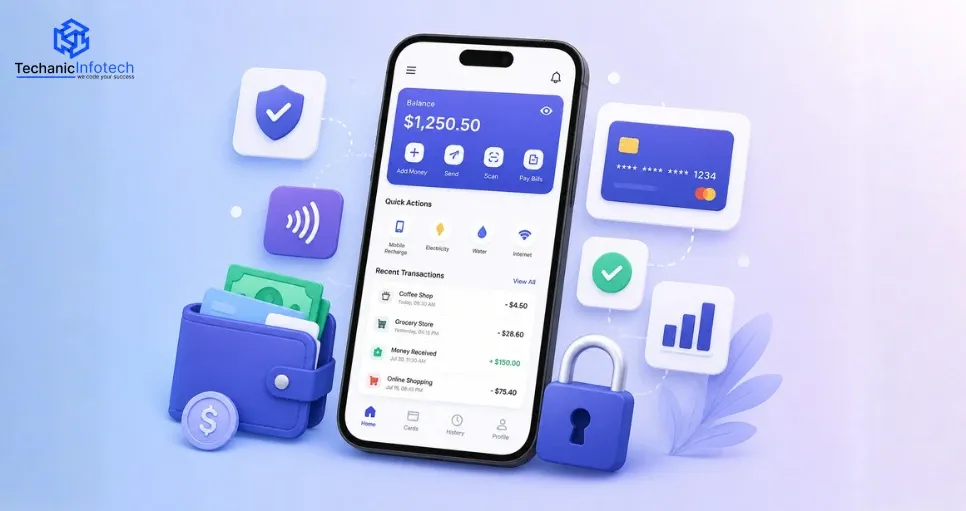
In today’s fast-moving world, eWallet apps have completely changed how we handle our finances.
With just a few taps on your phone, you can now easily make payments, transfer your money, and manage all your money in one place. What goes into eWallet app design that attracts users and makes them enjoy using it? It is surely more than just aesthetics; it’s also about creating an experience users can never forget.
Understanding the eWallet app design is important for any business looking to be successful in the market. So, we have written this blog for you. This is where you will learn all about the design for eWallet app features, trends, and more to meet the needs of current users.
eWallet app design means a meticulous process through which you can create a user-friendly interface and experience for the eWallet app.
This entails a mix of aesthetics, functionality, and user engagement strategy. A good eWallet app would allow its users to send money, pay bills, and even track expenses, all effortlessly.
It is more important to focus on the eWallet mobile application design; after all, the eWallet always has to be accessed to achieve any financial instrument at a quick and smooth pace. Good looks are secondary. More usability, seamless transaction processing, and loading up quickly with perfect navigation through the interface are what users look for.
By focusing on the above aspects, you will create an eWallet app that people use more frequently, enhancing user satisfaction and retention.
Knowing the eWallet app design-related principles will enable you to meet the expectations of users and keep pace with industry advancements. By prioritizing these elements, you create an app that users will rely on regularly, increasing both user satisfaction and retention. Understanding eWallet app design-related principles will empower you to meet user expectations and keep pace with industry advancements.
Before we move any further, let’s understand the components that shape the digital wallet design process.
The creation of an eWallet app strictly requires attention to user experience, security, and function. Besides that, you need to know about those components to make better decisions.
Some of these important design components are summarized below:
Secure user authentication is one of the critical components of the eWallet app design. Financial information is very sensitive, hence demanding security.
Users, therefore, need something with multi-layered security, like using two-factor authentication (2FA) and/or allowing the biometric fingerprint scanner or even facial recognition scans. A security-focused element helps protect users' data by inspiring confidence.
If users feel their money is safe, then they may be able to use this app often. An intuitive user authentication process should reduce friction without compromising the ease with which users can verify their identities. Simplifying the process will significantly improve the overall user experience.
Any eWallet application must include a good navigation system. eWallet features such as transaction history, payment options, and even settings should be found immediately.
The navigation design should be clear and simple with recognizable icons and labels to guide the user through the app. You could have a bottom navigation bar or even add a small menu to navigate to other parts.
One should realize that the easier your app is to navigate, the more likely it is that users will engage with your app regularly. It will help users navigate all the features your eWallet possesses for a brighter user experience.
Users want to track their spending and review past transactions easily. A well-organized transaction history component is essential for achieving this.
Design this section to allow users to see their past activities at a glance, complete with details such as amounts, dates, and transaction types. Incorporating filters and search functionalities can help users find specific transactions quickly, further enhancing usability.
This transparency builds trust and encourages users to keep using the app, as they can easily manage their finances and understand their spending habits.
Different methods of paying ought to be introduced for consumer satisfaction. This includes traditional methods like debit and credit cards to newer methods such as cryptocurrencies or direct bank transfers.
Present the available options clearly in your design, so users can quickly and easily choose the option that suits them. You should also support features like one-click payment buttons and saved payment methods.
The more diverse the payment alternatives you offer to users, the more you are responding to their needs. That flexibility has a significant influence on the decision to use and continue using your eWallet application.
An eWallet app design should be accessible to customer support. This can be in the form of chatbots, FAQs, or direct customer service contact.
The assistance should be available in your application design. You can have a live chat to access instant support. These implementations are well-suited and ensure that the user will be able to find help when needed; thus, there will be an increase in their general experience as well as their confidence in the application.
What catches your user's eye is the overall visual appeal. A unified color scheme, beautiful typography, and nice icons can make an app feel much more reputable and fun to use.
The design must reflect your brand, at the same time, appeal to the tastes of users. Use whitespace after all to create a clean layout that does not overwhelm users.
A nice view design can be a contributing factor to making your users return more frequently. As much as components are important to recognize, it’s time to know about the steps to design a digital wallet.
So, how can we design the eWallet app? A good eWallet app design requires a well-thought-out approach towards providing the best user experience.
From research to launch, every single step counts. Knowing how to design an eWallet app clearly and strategically enables one to optimize the user's needs, differentiate the app, and benefit from the competitive market.
Let's jump into the design steps of the journey:
Thorough research is the first step in designing an eWallet app. Understand your target audience and analyze current market trends. What users found the most useful and most valued within existing best ewallet apps.
Collect data through surveys, interviews, and usability studies. Pay attention to user feedback about experiences with other eWallets.
What do they like?
What makes them frustrated? This analysis will help you guide your design decisions and point out gaps in the market. It can be guaranteed success when you take the time to research that you will have an app well designed in a manner that satisfies client expectations not to mention how it helps fill in a hole in a market. All this theory is a foundation if you continue with this design process.
Now, after gathering all of the research, comes the stage of making the wireframes. Wireframes are just sketches that outline the structuring and layout of your app.
This is basically important in digital wallet app design because it simply gives you an idea as to how users will make their way through the available elements.
Wireframes help the designer decide where to place the buttons, menus, or content. This is as good a time as ever to try out different designs and make changes before deciding on the details of its design. It saves you time in the latter stages and lets you iterate quicker based on feedback. Your wireframes should focus on user experience so navigation is intuitive and logical.
Developing a prototype comes as the subsequent phase after wireframing. It's a prototype miming the user experience; one can test functionalities and receive feedback. This iterative model is essential for refining your mobile app design for eWallet.
Now, you will be able to see how users might interact more dynamically with your app. This stage involves working on your high-fidelity prototype, which reflects your app's designs and functionalities.
This stage is when you must get some form of feedback from users. Using the prototype as your model, let others experience it. You could sit back and watch reactions, thereby being able to fix errors before you finish.
Another important step in eWallet app design is what is termed "User Testing".
This would call for insight into their experience while using the app and figuring out pain points. Pay attention to user testing: Monitor how users navigate the app, where they find intuitive functions, and what presents problems in user testing.
You will receive invaluable feedback to work on your design to fulfill user expectations. You'll want to make the journey of the user as effortless as possible, so priority should be given to areas where users are providing a need for change.
Remember, continuous improvement is the key to a successful eWallet app.
Once the design is finally locked in, it is time to begin moving forward into development. This is a process where coding and integration occur of all the features required to bring the design into a real application.
Your eWallet app tech stack has to be deep enough such that it does not compromise your speed or security in any aspect. This can involve collaboration with your development team in order to ensure that the final product is what you have envisioned.
Pay attention to performance optimization during the development process.
The application should be working extremely fast and responding very quickly since people expect satisfaction in any financial transaction.
Once you have launched an eWallet app, that is not the end of things; keep working on gathering reviews from users to identify some of the areas that may need amendments. This continuous process ensures long-term survival.
Monitor the user's behavior and actions to understand how your application is being used. Develop regular updates and enhancements as per the users' suggestions and market trends. Remember, the importance of mobile app design does not end at launch.
To build loyalty and provide an excellent user experience in the long run, keep up with the changing needs of your users and keep making improvements to your app.
Over the past few years, eWallet apps have changed the way we deal with transactions, making it easy, secure, and efficient.
Looking at these applications will give us valuable insights into effective user interface design, functionality, and user engagement strategies that resonate with consumers in a digital-first world.
PayPal is one of the eWallet pioneers, characterized as being pretty simple and uncomplicated to use. The application stresses security, enabling the user to carry out transactions safely. Its layout is so intuitive that the user can easily see the difference between the modes of paying, transaction history, and settings.
PayPal was designed to put the user in a direct position of trusting it. This user-centric approach has been the key to its growth and helps it maintain a leading position in the digital payment landscape. To create an app like PayPal, work on the same.
Venmo design is unique, especially for the social features. It has different eye-catching features, such as sharing transactions with friends, where the same people can interact as well, and many more.
Such a design, of course, makes paying more convenient and builds up a community among the users. It is a simple user interface that allows sending or requesting money for anyone.
Transaction entry could be enhanced by adding notes and also emojis to add emotions, therefore, creating more personalized experiences. To create an app like Venmo, consider integrating these successful elements into your app development.
It focuses mainly on sociality in use, which has elevated the use to being at a peak: the majority is widely used in the US among the many eWallet apps.
The clean & minimalist design of Cash App makes it focus on the user experience. It also has a simple design through which users can navigate direct deposits, investments, and even Bitcoin trading.
The Cash App resonates very well with huge demographics since it has smooth and easy interfaces, whereby the geeky customers or even first-time customers around the digital payment world end up boarding the train.
Its fast cross-border payment and user-friendliness make it a favorite of youngsters. Peer-to-peer transactions are usually preferred on this app. To make an app like Cash App, a clean design with a good user experience has to be integrated into the application.
Try to attract a diversified user base and also make your digital payment platform more usable overall, focusing on simplicity and easy access to features.
Google Pay triumphs in generating so many features and conveniences into one uniform design. It is user-friendly in design, offering one place to manage different payment cards, loyalty cards, and transaction histories.
This design is very simple and easy to use, with clear sections for payments, offers, and rewards. This holistic approach simplifies the user experience but increases engagement, motivating users to use this app for multiple financial needs.
Among other things, it's slickly designed and blends quite smoothly with other services under Apple.
Modern aesthetics define the application from there, according to the overall philosophy of the brand at Apple. The user experience is streamlined with speed and security in mind. Speedy payments using Face ID or Touch ID are enabled for extra convenience.
This design philosophy has allowed Apple Pay to win significant numbers in a highly competitive market with users who focus on both functionality and aesthetics.
You must have heard of the name Alipay. Alipay is designed differently for the various users across China.
It combines a lot of services, including payments, wealth management, and social features in one app. It makes designs easy to navigate between features very quickly, thus making it possible for users to manage their finances and carry out social transactions.
Alipay has managed to take its position in the digital payments space because it offers a wide range of functionalities and focuses on user experience. It has been adopted by millions. As you get to know them, let’s take a look at some future trends that will be shaping the Future of eWallet app design.
As we all know, the future of eWallet app design will be led by new advancements and the changed expectations of users.
These eWallet trends will be embraced through innovation and meeting diverse user needs in a more digital world.
Hyper-personalization in the context of designing an eWallet application is a game-changer.
It provides a deeper bonding of user experiences with them.
Hyper-personalization further generates greater user engagement, along with loyalty, among your target audience, with feelings of being understood and appreciated.
The more users, the more chances there are for your applications to make them interact with it even more frequently, using personalized notifications and budget recommendations. The outcome? Higher retention rates and possibly more money from enhanced customer satisfaction.
In a competitive marketplace, standing out with customized experiences will be the means to grab and retain users.
Cyber-threats are one of the enormous challenges for the eWallet app. Improved security and privacy measures are, therefore, not debatable in the design of any eWallet app.
In a world where data breaches have become common, an app that keeps the user's security on priority will make its business outstanding from all others.
Biometric authentication and blockchain integration features give your customers the feeling of trust in your app. Besides, you need to make them aware of security through different buttons or tutorials, ensuring the app is used for transactions regularly.
As trust increases, the chances of users telling others about your app also increase. Thus, you expand your customer base.
Seamless integration in your eWallet application design can form a singular financial ecosystem that can, therefore, enhance the user experience by a significant margin. By making sure you have interoperability with other applications and IoT devices, you are catering to today's digital consumer.
This not only makes transactions easier but brings users back to your application more often. This boosts the volume of transactions, and in turn, revenue goes up. As a business, you are better poised as an innovative fintech leader by offering a seamless, fully integrated experience.
Adding AR and VR immersive experiences to your eWallet app design can differentiate your business. These technologies uniquely engage a user in managing their financial lives, making it pleasant to manage one's funds.
Gamified budgeting and interactive visualizations most likely motivate users to engage in deeper interactions with their finances. Increased engagement may most likely result in higher utilization of the app and turn increase customer loyalty.
The more enjoyable it becomes for the users to operate your app, the likelier they are to speak about it. This has the effect of increasing your brand's visibility and, therefore, its market share.
Voice-enabled interfaces in the design of eWallet applications give the business a competitive edge. As more and more people start using hands-free technology, users will find it convenient to make transactions by voice commands.
This will bring in a wider range of customers because some may find traditional interfaces cumbersome. You will have an increased acquisition and retention of users.
With voice technology embracing your eWallet for this rapidly shifting market, it positions your application amongst the modern ones of its league while helping to satisfy the demands of the new digitally wise consumers.
It is well established that issues related to sustainability and accountable design become a bottom-line concern for customers. Implementing sustainable functionality into an eWallet's mobile app design aligns you with your end users' ethics.
In essence, winning over the heart of that "green" consumer simply makes you not lose another that was already with you. Being much more about sustainability, if people consider your commitment, that really stands out in today's highly competitive marketplace to gain greater user engagement.
Thus, it may generate further benefits in terms of being more associated with a sound brand name and will keep helping towards long-term achievements.
Making the most of the use of AI-powered insights in the eWallet app design will act as a super-effective business strategy. To begin with, personalized recommendations concerning financial issues or their resolutions will enhance your customers' experience and engage the users.
AI enables your app to analyze the behavior of a user and allows it to give personalized advice to customers, which helps the latter manage their finances better. This added value can bring higher user satisfaction and retention rates.
By seeing real benefits from using your app, users tend to remain loyal and are more likely to refer friends and family, thus giving you an increased customer base and revenue.
With this growth of the digital payments and financial management area, the eWallet market is growing exponentially. Like any application, a tremendous amount of importance should be given to designing an attractive yet functional interface for an eWallet application to be differentiated in such a congested field.
Techanic Infotech is your eWallet app development company for developing & designing a stunning eWallet app that combines aesthetics with functionality.
Our professional team understands that a design needs to be both intuitive and beautiful. We collaborate with you to create something that becomes an experience aligned with your brand while remaining simple and easy to use.
We are experienced with innovative features and designing e-wallet applications not only to look good but also for engagement and satisfaction.
Let's make your eWallet app more than a tool; let’s make it an experience.
A successful eWallet app design requires an understanding of user needs, trends in the market, and the intricacies involved in mobile app designs. Focus on important aspects such as security, navigation, and visual appearance, and you'll have a trusted and enjoyable application for the users.
Remember that the most vital tips to design an eWallet app include conducting the most thorough research, iteratively based on user feedback, and keeping up-to-date with emerging trends.
With the right approach, you can create a digital wallet that not only satisfies but exceeds user expectations.
Do you want to take your eWallet app design to the next level? Well, let's start creating an engaging and efficient digital wallet that will redefine user experience!
Key features include user authentication and transaction history, multiple modes of payment, user support, and a clean system of navigation for user experience as well as safety.
User experience is critical because its direct reflection would be visible in user satisfaction and retention. Convenience and seamlessness in an interface invite more frequent use and trust within your audience.
The security features are multi-factor authentication, biometric verification, end-to-end encryption, and AI-driven fraud detection. All these ensure that the data of users is safe and create confidence in the minds of the users.
Focus on innovative features, user-friendly design, and exceptional customer support. Carry out deep market research and find out gaps. Then, tailor your app according to the needs of the user.
You should monitor trends such as AI integration, blockchain technologies, compatibility with IoT devices, and features on sustainability to maximally engage users and keep your application relevant.


Abhishek Jangid is the CEO of Techanic Infotech, with extensive experience in mobile app and web development. He specializes in helping businesses turn innovative ideas into scalable digital solutions through strategic planning and modern technology.