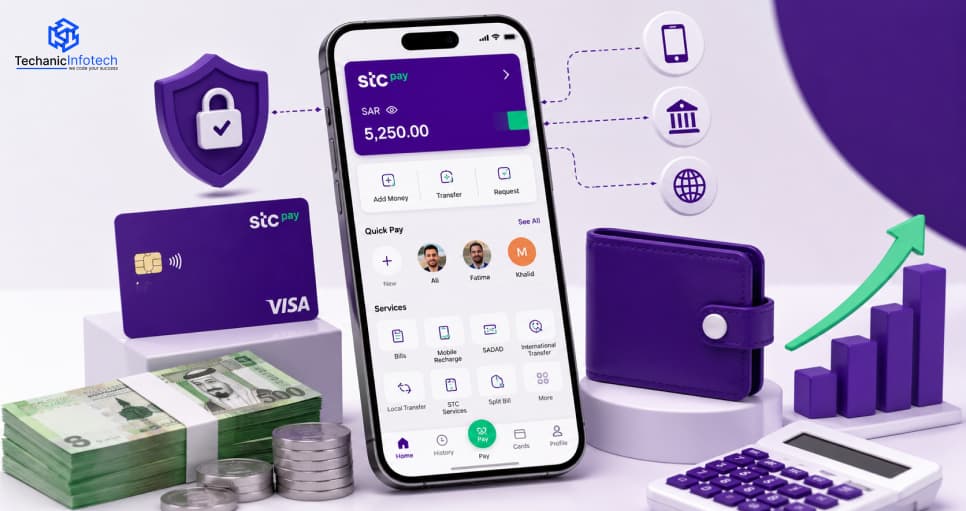
The fintech space shows that digital wallets have moved beyond being a mere trend to become the future of payment solutions. STC Pay stands among the leading digital wallet companies operating in the Middle East.
Whether you're a startup founder or a tech-savvy investor, you've likely wondered, Many people ask, how much does it cost to develop an app like STC Pay?
Well, you're in the right place. This blog will cover all essential details about STC Pay’s success and the true expenses of developing your own digital wallet system.
If you're curious about digital wallet apps or create a digital wallet app like STC Pay, continue reading.
Saudi Telecom Company introduced STC Pay, which stands out as a major digital wallet platform.
STC Pay was developed to enable easy money transfers, payments, and financial management for users within the Kingdom as well as international users.
STC Pay serves the daily financial needs of both individuals and companies by allowing users to pay their bills and move money between accounts while providing shopping facilities and cost-sharing features through a sleek mobile application.
The platform connects to international payment systems, including Western Union, which enables global remittances to happen both quickly and smoothly.
STC Pay provides users easy access to reliable security measures along with biometric verification and timely updates, which deliver convenient operations combined with transparent processes and user control.
To create a digital wallet app or learn about STC Pay, you must obtain detailed knowledge about it.
Let’s be real: The digital payments sector continues to expand rapidly without any signs of deceleration.
STC Pay goes beyond convenience by aligning with consumer expectations for quick, mobile-based, and seamless financial services.
The current period represents the ideal moment to develop a payment app like STC Pay due to specific factors that make it an appealing investment opportunity.
Massive Market Potential: Digital wallet apps have transformed from luxury options into essential tools. The surge in user adoption of mobile-first payment solutions has led to unprecedented demand levels.
If you create an app like STC Pay, it connects with numerous customers who demand efficient and intuitive payment solutions that work quickly.
Emerging markets show significant growth due to their limited banking facilities alongside extensive mobile phone access.
Monetization Made Easy: When you develop an app like STC Pay, it opens up endless revenue streams through transaction fees and bill payment commissions, along with merchant partnerships and premium features for users.
Your platform generates revenue each time users perform transactions, pay bills, or make online purchases.
High User Engagement and Retention: A major advantage of developing an app like STC Pay is its ability to create a "sticky" user experience.
After users transfer money into their wallet and connect it to subscription services or begin daily transactions through the wallet, they will likely remain loyal to it.
The continuous interaction between users and the platform leads to deeper customer relationships and increased lifetime value for each user.
Expand with Strategic Partnerships: If you are planning to make a digital wallet app like STC Pay, you should involve planning for features beyond simple transaction capabilities.
STC Pay has achieved partnerships with major companies such as Western Union, which strengthens their service capabilities and expands their customer base.
Your app can achieve growth by forming partnerships with banks and telecom companies, as well as e-commerce platforms, to build an interconnected system that promotes increased user numbers and transaction volumes.
Success in digital wallet apps requires integrating user convenience with robust security measures, along with speed and flexibility.
To create an app like STC Pay requires these digital wallet app features to distinguish your product in the market.
Your app must let users register through mobile numbers or emails and provide them with a straightforward KYC process to ensure regulatory compliance and smooth onboarding.
Through this approach, companies can establish consumer trust and reduce fraudulent activities. How to develop a digital wallet app like STC Pay requires integration of digital KYC through OCR technology and facial recognition techniques.
Security is non-negotiable in fintech.
Essential security features must include biometric login systems alongside OTP verification and two-factor authentication with proper data encryption.
An app like STC Pay requires robust cybersecurity measures to build user trust while meeting regional financial standards.
Users love speed. The app must support real-time peer-to-peer transfers alongside QR code payments and wallet-to-bank transactions.
To build an app like STC Pay requires integration with payment gateways and popular APIs to ensure smooth transaction processes.
The current evolution of eWallet apps requires faster and more efficient transaction systems, so your application needs to adapt to these new standards.
STC Pay users appreciate the platform because it enables international money transfers through partners such as Western Union.
Your application can achieve similar international money transfer capabilities by adding global remittance APIs to its features.
Make a digital wallet app like STC Pay that operates internationally requires this to be a top priority to function across multiple countries.
A comprehensive wallet app must enable users to handle utility payments and mobile subscription services through a single payment platform.
Create an eWallet app like STC Pay requires incorporating multiple recurring payment functions to maintain user engagement and retention.
The application must enable users to adjust their wallet balances and examine their spending history while allowing them to establish financial limits.
Analyzing weekly or monthly spending helps users gain additional value.
When you develop an eWallet app like STC Pay, implementing these minor yet significant UX details can create substantial benefits.
Enable users to buy products quickly at stores by combining QR code scanning with merchant payment solutions.
The ability to use your app across different platforms provides significant value, which becomes especially important when you build an app like STC Pay.
Make sure users receive updates about their transactions, as well as security alerts and promotional offers. Push notifications serve essential roles in app functionality and user engagement.
Implementing timely alerts will create a dynamic user experience that builds trust while promoting more frequent app interactions.
Now that we have concluded our discussion about app features, we can explore the cost to build an app like STC Pay.
Creating an app like STC Pay involves several cost factors, including features, technology requirements, security systems, and e-wallet app development cost considerations. The minimum cost to develop an STC pay app-like will be $12,000 to $120,000.
Understanding these expenses helps businesses estimate budgets accurately and prepare realistic investments for digital payment application development projects.
A basic MVP payment application generally includes user registration, profile management, payment transfers, and simple dashboard functionality.
This development stage helps businesses validate ideas before implementing advanced features and larger infrastructure requirements.
|
Project Scope |
Estimated Timeline |
Typical Cost |
|
Basic MVP Features |
1–2 Months |
$12,000–$20,000 |
|
Enhanced User Functions |
2–3 Months |
$18,000–$25,000 |
|
Expanded MVP Capabilities |
3–4 Months |
$22,000–$30,000 |
Secure payment applications with the best e-wallet app features require authentication systems, biometric access, encryption methods, and user verification processes.
Security implementation increases development efforts because financial platforms must protect sensitive information and support safer transaction experiences.
|
Project Scope |
Estimated Timeline |
Typical Cost |
|
Basic Security Features |
1–2 Months |
$15,000–$25,000 |
|
Multi-Level Authentication |
2–3 Months |
$22,000–$35,000 |
|
Advanced Security Systems |
3–4 Months |
$30,000–$45,000 |
Payment applications need wallet systems, transaction processing capabilities, and financial integrations for smooth operations.
Adding multiple payment functionalities often increases implementation requirements and development complexity across the platform architecture.
|
Project Scope |
Estimated Timeline |
Typical Cost |
|
Basic Wallet Integration |
2–3 Months |
$20,000–$35,000 |
|
Multi-Payment Features |
3–4 Months |
$30,000–$50,000 |
|
Advanced Payment Ecosystem |
4–5 Months |
$45,000–$65,000 |
Real-time transaction systems support instant payments, notifications, and account updates for users.
These functionalities require stronger backend systems and infrastructure capabilities to maintain speed and performance consistency.
|
Project Scope |
Estimated Timeline |
Typical Cost |
|
Basic Transaction Features |
2–3 Months |
$25,000–$40,000 |
|
Real-Time Processing |
3–5 Months |
$35,000–$55,000 |
|
Advanced Transaction Systems |
4–6 Months |
$50,000–$70,000 |
Following an eWallet app design guide, administrative dashboards help businesses monitor users, transactions, reports, and application activities.
Adding analytics functionality requires additional implementation efforts and backend development resources for stronger monitoring and management capabilities.
|
Project Scope |
Estimated Timeline |
Typical Cost |
|
Basic Dashboard |
2–3 Months |
$20,000–$35,000 |
|
Enhanced Analytics |
3–5 Months |
$35,000–$55,000 |
|
Advanced Reporting Systems |
4–6 Months |
$50,000–$70,000 |
Payment applications frequently require APIs for banking systems, notifications, maps, and verification services.
These integrations increase development complexity while improving functionality and user experience across the application environment.
|
Project Scope |
Estimated Timeline |
Typical Cost |
|
Basic API Integration |
2–3 Months |
$25,000–$40,000 |
|
Multiple Service APIs |
3–5 Months |
$40,000–$60,000 |
|
Advanced Integration Network |
5–6 Months |
$55,000–$75,000 |
Financial applications often require regulatory compliance, security standards, and documentation processes.
Meeting these requirements adds additional development efforts and implementation considerations across project workflows.
|
Project Scope |
Estimated Timeline |
Typical Cost |
|
Basic Compliance Support |
2–4 Months |
$30,000–$45,000 |
|
Industry Compliance Features |
4–5 Months |
$45,000–$70,000 |
|
Advanced Regulatory Systems |
5–7 Months |
$65,000–$90,000 |
A complete STC Pay-style application with eWallet app maintenance requirements includes digital wallets, payment processing, security systems, analytics, notifications, and advanced functionality.
Larger feature requirements and ongoing support needs significantly increase development investments.
|
Project Scope |
Estimated Timeline |
Typical Cost |
|
Mid-Level Application |
6–8 Months |
$70,000–$90,000 |
|
Advanced Payment Platform |
8–10 Months |
$90,000–$110,000 |
|
Enterprise-Level Platform |
10–12 Months |
$100,000–$120,000 |
Are you contemplating joining the rapidly growing digital wallet industry? You’re not alone, and you’re definitely not late.
Financial technology applications such as STC Pay revolutionize money transmission and management, proving fintech has shifted from future potential to the present reality.
But before you rush into development, there's one big question to answer: How much does it cost to create an app like STC Pay? We will analyze all necessary app features systematically, as well as examine every budgetary aspect in detail and provide thorough insights.
Want just basic transfers and a dashboard? Great- it’s lighter on your budget.
But dreaming of remittances, QR payments, loyalty points, and bill pay? Now you’re in full-feature mode.
The cost to create an app like STC Pay increases with every shiny feature you add.
Think of it like ordering coffee or making a huge expense. The latter hits harder… on your wallet, too.
Choose between a simple UI and screens that impress users with their smooth, swipeable design.
A well-designed, intuitive app interface boosts user engagement while increasing the construction costs for applications like STC Pay.
Animations and icons, a growing trend in eWallet apps alongside microinteractions, represent visual elements that result in additional cost to build an app like STC Pay.
The total cost to build a digital wallet app like STC Pay changes depending on the desired level of visual impact.
Targeting just iPhone users? Budget-friendly.
Going for Android too? Double the platform, double the work.
Building native applications for both operating systems elevates the cost to develop an app like STC Pay.
You might choose the hybrid development method, which costs less but potentially decreases performance.
Bottom line: Selecting the right platform affects how much it costs to create an eWallet app like STC Pay.
The initial savings from hiring an individual coder from a gig platform can disappear over time.
A specialized mobile app development company? Pricier, but they know their stuff.
Handling payments and user data requires experienced professionals to ensure compliance.
That’s why the cost to develop an app like STC Pay changes significantly based on the development team responsible for building it.
Expertise = less risk and smoother delivery. Worth it? Usually, yes.
Want to integrate Western Union? Add a currency converter? Hook into local banks?
Each external integration adds complexity and cost.
Every API, SDK, or gateway you plug in pushes up the cost to build an app like STC Pay.
But they also unlock huge user value.
So when asking, how much does it cost to create an app like STC Pay-don’t forget to factor in the plugin price tags.
Security isn’t just a feature- it’s your reputation.
Data encryption, biometric logins, and fraud detection systems are essential in fintech apps.
But the more secure you want it, the more the cost to create an app like STC Pay creeps up.
Still, this is one area where cutting corners can cost you more down the line.
With growing ewallet app development challenges, especially around fraud prevention, this isn’t where you want to save a buck.
How much does it cost to develop an eWallet app like STC Pay? Enough to sleep well at night.
Fintech isn’t the wild west- it’s tightly regulated.
You’ll need to comply with KYC, AML, PCI-DSS, and maybe even GDPR or local banking laws.
Each compliance measure adds to the cost to develop an app like STC Pay-but protects you from lawsuits and penalties. Not following the rules and regulations might lead to your eWallet app's failure.
So, when you wonder how much does it cost to build a digital wallet app like STC Pay, remember: legality isn’t optional, it’s essential.
Building the app is only the first chapter.
Bug fixes, feature updates, and performance optimization are ongoing expenses.
Maintenance and scaling can cost anywhere from 15–25% of the initial dev cost yearly.
So, how much does it cost to develop an eWallet app like STC Pay long-term? More than just the launch-think of it like raising a digital baby.
You’ll need to nurture it to keep it growing, making your eWallet app idea a huge success.
Don’t be afraid, just seeing different factors, here are some ways you can make money.
STC Pay is more than just a convenient payment app it's a well-oiled revenue machine. While it offers users a seamless digital wallet experience, its real brilliance lies behind the scenes, where multiple monetization streams work quietly but effectively. Businesses working with an eWallet app development company often study such successful models to understand how modern payment platforms generate sustainable revenue.
Let’s break down the eWallet app monetization model that powers STC Pay’s growth.
From peer-to-peer transfers to bill payments, every transaction generates micro-fees.
These fees are small enough to avoid user friction, but when processed at volume, they generate substantial revenue.
It’s a low-effort, high-scale model that any fintech startup should study before estimating the cost to build an app like STC Pay.
Cross-border payments open another revenue stream: currency conversion. STC Pay adds a slight markup on exchange rates, a tactic both subtle and effective.
This model not only boosts profit margins but also becomes a smart cost offset strategy during international scalability, especially relevant when mapping out the cost to develop an app like STC Pay for global reach.
Merchants using STC Pay for in-store or online payments pay a small commission on every transaction.
This B2B revenue source is consistent and scalable, and it’s often baked into vendor agreements during onboarding.
For entrepreneurs designing similar apps, aligning this feature with a well-planned eWallet app monetization model ensures sustainability from day one.
Freemium works beautifully in fintech. STC Pay offers basic services for free but unlocks higher transaction limits, priority support, or faster transfers through premium tiers.
This approach captures a wider audience and creates upgrade paths for power users, all without disrupting the core value proposition.
While standard withdrawals may be free, users often pay for faster processing.
These optional, convenience-driven charges create an extra revenue layer.
It's a smart move that boosts profitability without feeling like a forced upsell - exactly the kind of nuanced feature worth considering during development.
Building an eWallet app like STC Pay goes beyond adding features; it’s about creating a seamless, secure, and scalable platform users can trust.
To build a standout app, focus on simplicity, real-time payments, and a user-friendly interface.
Security is paramount, so integrate robust measures like biometric and two-factor authentication.
To appeal to a broader audience, include features like multi-currency support, rewards programs, and detailed payment history.
Using the right tech stack, such as cloud-based systems and AI, ensures your app can scale globally while maintaining smooth functionality.
With the right strategy, your eWallet app can become a game-changer in the fintech space, offering both convenience and trust to users across the globe.
The development cost of an STC Pay-like app generally ranges between $12,000 and $120,000+, depending on app complexity, features, security requirements, integrations, supported platforms, and overall business requirements.
Core features commonly include user registration, KYC verification, wallet management, fund transfers, transaction history, payment gateways, bill payments, notifications, and security systems.
Development timelines typically vary according to complexity, custom functionality, integrations, testing requirements, and security implementation needs. Larger fintech projects generally require longer development cycles.
Security protects user information, financial transactions, and payment data. Strong encryption, authentication systems, and compliance standards help reduce fraud risks and improve customer trust.
Fintech applications often use modern frontend frameworks, backend technologies, cloud infrastructure, APIs, databases, and secure payment gateway integrations depending on project requirements.
Yes. Many startups begin with a Minimum Viable Product (MVP) that includes important features first and later expand functionality based on business goals and user feedback.
Development costs can vary according to app complexity, design requirements, third-party integrations, development team location, platform selection, and security implementation requirements.
Revenue can come from transaction fees, premium subscriptions, partnerships, currency exchange fees, and additional financial services within the application ecosystem.
KYC verification helps confirm user identities, improve security, reduce fraudulent activities, and support regulatory compliance requirements for digital financial platforms.
Post-launch expenses generally include maintenance, server costs, security updates, feature enhancements, technical support, and performance monitoring requirements.


Abhishek Jangid is the CEO of Techanic Infotech, with extensive experience in mobile app and web development. He specializes in helping businesses turn innovative ideas into scalable digital solutions through strategic planning and modern technology.