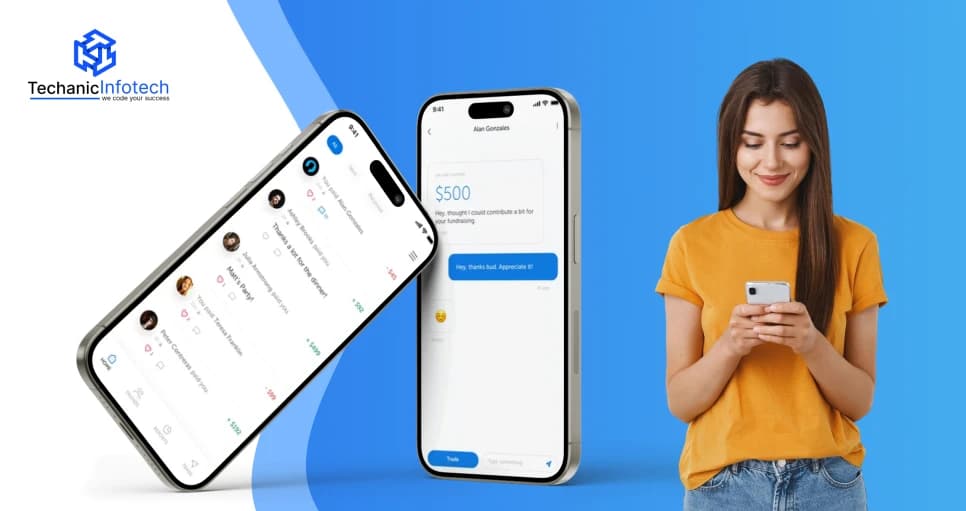
EWallet App Development
Cost to Develop an App Like Venmo: Complete Pricing Guide for 2026
April 9, 2026
April 9, 2026
Key Takeaways
The cost to develop an app like Venmo typically ranges between $10,000 to $80,000+, depending on features, security, and app complexity
A basic e-wallet app with core payment features costs less, while advanced apps with analytics, cards, and integrations increase the budget
Key features like peer-to-peer payments, bank integration, transaction history, and notifications are essential for success
Strong security measures such as encryption, two-factor authentication, and fraud detection are critical and add to development cost
Monetization strategies such as transaction fees, instant transfers, and merchant services drive long-term revenue
If you’re considering developing a payment app, then what’s better as an inspiration than Venmo?
Consequently, many ask, “How much does it cost to create an app like Venmo?”
Well, if we tell a ballpark figure, it can be somewhere between $10,000 to $80,000 based on different factors.
Although this is a common question for entrepreneurs looking to tap into the booming fintech industry.
In today’s fast-paced world, we all want quick & easy solutions for handling money. This is where apps like Venmo come into play.
They do not just provide a way for fast money transfers but also provide a seamless experience that draws users to them again and again.
Now, with that, let’s take a closer look at the cost to develop an app like Venmo and how to earn money from a Venmo-like app.
Venmo is more than an app for paying for purchases, it's an experience. Launched in 2009, it became best friends with millennials and Gen Z.
With its features such as sending money, splitting bills, and even sending entertaining messages, Venmo has been able to build a vibrant community for financial transactions.
Its user-friendly interface with the social features makes it so easy for anyone to use.
Be it settling a dinner bill, compensating a friend for concert tickets, or even sending a last-minute gift, do it all with a few taps on the phone.
Its popularity has inspired many investors to create an eWallet app like Venmo, which they see as a golden opportunity to cater to an ever-growing market that desires speed and convenience.
Hence, if you're pondering entry into this marketplace, you are at the right place where you are supposed to be.
To understand the growing popularity of Venmo, nothing works better than looking at the latest market stats. Let’s dive in:
First and foremost, Venmo continues to have massive brand awareness in the US, with over 97.1 million active users as of 2025.
In terms of usage, Venmo remains one of the most popular peer-to-peer payment apps, especially among younger audiences, with a strong presence in everyday transactions like splitting bills and online payments.
In 2025, Venmo processed over $325 billion in total payment volume, showing consistent growth year over year.
Additionally, Venmo’s monetization is improving, with more users adopting features like Venmo debit cards and business payments, contributing to higher revenue generation.
The shift toward cashless and mobile-first payments continues to rise globally, further boosting the demand for apps like Venmo.
Seeing these numbers, it’s clear why businesses and startups are exploring how much it costs to build an e-wallet app like Venmo.
And that’s exactly what we’ll break down in the next section…
When calculating the cost to create an app like Venmo, it is important to know exactly what this involves.
On average, the Venmo-like app development cost can be somewhere between $10,000 to $80,000. However, several factors would raise the cost to make an app like Venmo.
Here is a rapid table summarizing the eWallet app development cost :
|
Development Stage |
Estimated Cost |
|
UI/UX Design |
$1,000 - $30,000 |
|
Development |
$5,000 - $20,000 |
|
Testing and Launch |
$2,000 - $20,000 |
|
Maintenance (annually) |
10%-15% (Overall Budget) |
You can see, though, how the Venmo clone app development cost might range pretty wildly, depending on what you're aiming for in terms of design and complexity.
Knowing these costs will make the necessary preparations in planning your budget and set up reasonable expectations when venturing into this exciting world of digital payment.
The right investment and vision could create an app like Venmo, a game-changer in the world of digital payments.
Your idea may resonate with users who want that perfect blend of convenience and connection!
When you decide to work on a Venmo-like app, understanding what factors affect the cost to build an app like Venmo is important.
Every factor can have a strong impact on your final budget.
Let's consider all these factors in detail, starting with:
Whether you go for Venmo or P2P app development, your first impression will probably be the design of your application.
After all, that plays a pretty big role in the general user experience.
The basic cost to create an e-wallet app like Venmo can run anywhere from around $1,000 to $8,000 for an advanced interface where the app is interactive and friendly.
Ultimately, if it looks nice, so do you.
People who want an easy-to-navigate and user-friendly experience will use this app.
To understand better, let’s see how design can affect your Venmo clone app development cost:
|
Design Component |
Estimated Cost |
Description |
|
Basic Design |
$1,000-$5,000 |
Simple layout with minimal graphics. Focuses on functionality over aesthetics, suitable for a basic app interface. |
|
Enhanced Design |
$5,000-$10,000 |
More polished interface with improved usability. Incorporates some graphics and custom icons, enhancing user experience without being overly complex. |
|
Cutting-edge Design |
$9,000-$15,000 |
Highly sophisticated layout with custom graphics, animations, and a tailored user experience. Emphasizes aesthetics and brand identity, ideal for attracting users. |
|
Premium Design |
$15,000-$20,000 |
Bespoke design tailored to specific needs, including user research and testing. Involves advanced interactions, animations, and a unique visual identity. |
Moving to another factor, which is:
The complexity of your app directly impacts how much it will cost to create a peer-to-peer payment app like Venmo.
A simple payment app should fall within the $10,000 range.
As compared to that, when the app has intricacies in functionalities, such as integrating bank
APIs can push the cost up to $50,000.
Greater complexity takes more time to develop, test, and deploy, adding more and more to the cost to create an app like Venmo.
In straightforward terms, more complexity means the app has to be great at doing what users want from it.
One of the most common factors that can easily add millions to the cost of the development of a Venmo-like app is "features."
Even a minimal requirement may include something as basic as user authentication or transaction processing, but it will not be costly.
In case moving upwards in eWallet app features such as adding a QR code scanner, biometric authentication, etc. would definitely drive up the cost to develop an app like Venmo.
We suggest considering the critical features for your target user base and not overloading your application with all features at once.
Be it Venmo or Chime-like app development, starting with basic features and then adding advanced options based on user preferences is a perfect solution to keep costs under control.
|
Features Type |
Cost |
Description |
|
Basic Features |
$10,000 - $20,000 |
Core functionalities such as user registration, basic payment processing, and transaction history. Essential for any payment app to function. |
|
Standard Features |
$20,000 - $40,000 |
Includes additional functionalities like user profiles, contact syncing, and notifications. Enhances user experience and engagement. |
|
Advanced Features |
$40,000 - $90,000 |
Incorporates features such as instant transfers, loyalty programs, and advanced security measures like two-factor authentication. Aimed at providing a robust and secure user experience. |
The cost to develop an app like Venmo is majorly determined by the platform that you choose for your application.
A general rule of thumb clearly says iOS app development services and Android app development services often vary in budget since each ecosystem has its set of rules and requirements.
A third option would be cross-platform app development. In this, you would target multiple platforms simultaneously and thereby save money. But this choice must go along with the preferences of your target audience.
The tech stack chosen will affect the Venom-like app development cost and time it takes to develop.
Ensure that the eWallet app tech stack is aligned with the goals and functionality of your app. Also, be sure to take into consideration the long-term implications of your tech choices.
After all, it is going to affect the cost to create an app like Venmo as well as its scalability, security, and ability to adapt to market changes over time.
|
Component |
Basis |
Estimated Cost |
Technology Options |
|
Frontend Development |
User interface and experience |
$2,000 - $20,000 |
React Native, Flutter, Swift (iOS), Kotlin (Android) |
|
Backend Development |
Server-side logic and database |
$2,000 - $30,000 |
Node.js, Django (Python), Ruby on Rails, Spring (Java) |
|
Database |
Data storage |
$500 - $5,000 |
PostgreSQL, MongoDB, MySQL, Firebase |
|
Payment Processing |
Handling transactions |
$500 - $10,000 (plus fees) |
Stripe, PayPal, Braintree, Square |
|
Hosting/Cloud |
Server Hosting |
$500 - $5,000/year |
AWS, Google Cloud, Microsoft Azure, DigitalOcean |
|
Security |
Data protection and encryption |
$1,000 - $6,000 |
SSL/TLS, OAuth 2.0, JWT, Firebase Authentication |
|
Monitoring & Analytics |
Performance tracking |
$200 - $3,000 |
Google Analytics, Mixpanel, Sentry |
|
Compliance |
Regulatory requirements |
$2,000 - $15,000 |
Legal consultations, PCI compliance tools |
|
DevOps |
Continuous integration/deployment |
$1,000 - $5,000 |
Docker, Kubernetes, Jenkins, GitHub Actions |
While considering the Venmo clone app development cost, we can’t forget the development team location is very much a subject of consideration.
A simple rule says that if you hire a developer of an e-wallet app development company from the USA or UK, then the cost will be higher due to the high cost of living as compared to regions like Asia or Eastern Europe.
But, at the end of the day, you have the choice of selecting the right team that can conserve your money without compromising your quality.
Here’s how the hourly rate differs country-wise:
|
Country |
Average Hourly Rate (USD) |
|
USA |
$70-$150 |
|
UK |
$60-$100 |
|
Australia |
$60-$120 |
|
Canada |
$60-$120 |
|
Russia |
$30-$60 |
|
Asia |
$20-$50 |
The experience of your development team is another key factor.
It is often one of the overlooked factors while evaluating the overall cost to develop an app like Venmo.
The lowest bid might be very tempting, but you have to remember that the more experienced teams are usually the most efficient, which saves you time and money in the long run.
Find out how it affects the cost:
|
Experience Level |
Estimated Hourly Rate |
Impact on Development Cost |
Implications for Project |
|
Junior Developer |
$25 - $50 |
Lower initial costs, but the potential for longer timelines due to inexperience. |
May require more oversight and mentoring; risk of bugs or suboptimal code. |
|
Mid-Level Developer |
$50 - $100 |
Moderate cost; generally efficient but may lack deep expertise in specific areas. |
Can handle most tasks independently; good balance of cost and quality. |
|
Senior Developer |
$100 - $200 |
Higher costs can lead to quicker, higher-quality outcomes, reducing overall project duration. |
Expertise in complex problems; better at mentoring juniors and ensuring best practices. |
|
Specialist (e.g., Security, Payments) |
$150 - $300 |
High costs for specialized skills; crucial for security and compliance in financial apps. |
Essential to ensure the app meets regulatory standards and is secure against threats. |
|
Full-Stack Developer |
$70 - $150 |
Versatile, potentially reducing the need for multiple hires; costs can vary widely based on expertise. |
Can streamline development and improve communication between frontend and backend teams. |
These are just some factors you must consider while calculating how much it costs to create an app like Venmo.
But it is just as important to know how one can bring those costs down.
That is precisely what we covered in the next section.
So, as we discussed so many factors that affect the overall cost.
Let us proceed and look at a few smart strategies that may be able to help save some money while still getting to build an amazing app:
You don't have to launch with every feature known in existence. With an MVP, you could focus on the core functionalities.
This way, you're testing the waters with actual users. Gather their feedback and improve based on real needs.
It will save you money upfront, but most importantly, you are sure you are building what people actually want.
The technology stack you choose can impact your budget greatly, depending on the technologies and skills of your team along with the requirements of your app.
Using popular frameworks such as React Native in mobile development can save you time and resources. It supports cross-platform development, so you need to build only one codebase. This option also saves you money on long-term maintenance costs!
Not all features are created equal.
Prioritize the ones that will provide the most value to your users. Core functionalities such as user authentication or payment processing should come first.
Advanced features such as analytics or social sharing can be left behind. This will cost less, addressing a key eWallet app development challenge .
Why reinvent the wheel?
There are numerous existing solutions for payment processing, security, user authentication, and so on.
Reliance on established APIs from companies, i.e., Stripe or PayPal, ensures saving time on development. Generally, these solutions are very reliable and secure. So, you have nothing to worry about.
Integrate with existing tools for cost-saving and expediting your development timeline.
Experienced developers are always quite expensive. However, you get faster development with quality code from the same.
The work efficiency is likely to yield fewer bugs and less rework. It saves money after all.
They will share knowledge about best practices with you to make it an easier process.
Ultimately, they are worth every dollar you spend on them.
Use agile development to be flexible. Adjust based on user feedback along the way. This is how you stay aligned with user needs and avoid expensive changes later.
It also creates frequent updates and improvements, so your app is fresh all the time. You can cut down your overall costs significantly by staying adaptable.
Think ahead!
Be a forward thinker and plan your growth. Spare the pain of pricey overhauls down the line for scalable architecture.
Design, build, and keep something flexible so that you have room to add features within your design rather than require a complete redesign.
Not only, this will save headaches, but also control the cost to create a mobile wallet app like Venmo in the long run.
So, let’s understand “How Long Does It Take to Develop an App like Venmo?”
The same factors that affect the overall cost also affect the development time.
This will depend on the complexity of features, the technology stack, and the size of the development team, so it may vary considerably to develop an app like Venmo.
In general, you may estimate that it will take around 5 to 9 months to develop an app like Venmo completely. You can ensure the development process is going according to your plan by proper planning and focusing on the most important elements.
To comprehend better, the timeline breakdown will help:
|
Development Phase |
Estimated Time |
Details |
|
Planning & Research |
2-3 weeks |
Define goals, target audience, and features. |
|
UI/UX Design |
3-4 weeks |
Create wireframes and design prototypes. |
|
Frontend Development |
6-8 weeks |
Build the user interface for iOS and Android. |
|
Backend Development |
6-8 weeks |
Set up servers, databases, and APIs. |
|
Integration & Testing |
3-4 weeks |
Test for bugs and ensure smooth functionality. |
|
Launch & Deployment |
2-3 weeks |
Prepare for app store submission and marketing. |
|
Post-Launch Support |
Ongoing |
Regular updates and maintenance after launch. |
You can turn your Venmo-like app into a lucrative business by having the right monetization strategy in place.
You would want your app to meet the needs of its users while at the same time generating revenue, much like the best eWallet apps out there.
Let's discuss some of the effective ways to monetize your app without making users unhappy.
One of the most apparent is through transaction fees. Take a small percentage from every transaction, and it adds up fast.
Most users are willing to pay a little for the convenience of quick transfers. Just be transparent about these fees to maintain trust.
Offer premium features for a monthly subscription fee. You could include perks such as advanced analytics, higher transfer limits, or priority customer support.
This provides an option for customers: they can opt out of the free plan and leave it at that, or they can upgrade to add extras.
It's a dead win!
Any app can make much by displaying ads. One gets to collaborate with sponsors the audience will love and adore.
Just ensure these banners are not obtrusive; you don't want a jerky user experience for yourself. Finding that line often means profit without pestering your users.
Reward users to invite friends.
You may give cash bonuses or a discount on the transaction fee for every referral. It encourages growth and makes a community out of your application. This is a free way to grow your user base, but it may be very costly to reward users.
Partner with businesses that complement your application. For example, you may promote financial products or services that offer affiliate commissions.
When users consume these offers, your app gets a percentage of their purchases. This is a good way to create value while earning revenue.
As your user base grows, you will get some valuable data. You can analyze trends and behavior of users to give insights to businesses (of course, respecting privacy laws).
You can sell anonymized data as a significant revenue stream. Just be careful and clear about how you use this data.
Developing an application like Venmo is quite challenging and involves careful planning in the design and development aspects.
What costs the most features, design, and technology stack requires some attention when the decision to optimize the budget takes place while reaching a desired outcome.
Remember, the secret of success is a user-centric app that provides a smooth, secure experience.
Therefore, by focusing on the core functionalities, using an existing solution, and leveraging the best development team you have, you can definitely make a Venmo-like application that will resonate well with your target audience and thus generate great value for it.
The cost to develop an app like Venmo typically ranges between $10,000 to $80,000+, depending on features, security, integrations, and overall app complexity.
On average, it takes 4 to 8 months to develop an e-wallet app like Venmo, depending on features, testing requirements, and the development approach.
Key features include user registration, bank account linking, peer-to-peer payments, transaction history, notifications, security authentication, and real-time payment processing.
Cost depends on app features, UI/UX design, backend complexity, security measures, third-party integrations, platform choice, and the development team’s location.
Popular technologies include Flutter or React Native for frontend, Node.js for backend, and secure APIs for payment processing and bank integrations.
Yes, with the rise of digital payments and cashless transactions, e-wallet apps offer strong revenue potential through transaction fees, subscriptions, and partnerships.
They generate revenue through transaction fees, instant transfer charges, merchant payments, debit cards, and premium financial services
Yes, starting with an MVP helps reduce initial costs. You can launch with basic payment features and scale gradually by adding advanced functionalities.
Security is critical. Features like encryption, two-factor authentication, fraud detection, and secure APIs are essential to protect user data and transactions.
If budget allows, build for both platforms. Otherwise, start with cross-platform development to reduce cost and reach a wider audience quickly.
Ongoing costs include server hosting, maintenance, security updates, third-party API fees, compliance, and marketing expenses.
A professional mobile app development company ensures secure architecture, scalability, compliance, and faster delivery, helping you build a reliable and successful payment app.


Abhishek Jangid is the CEO of Techanic Infotech, with extensive experience in mobile app and web development. He specializes in helping businesses turn innovative ideas into scalable digital solutions through strategic planning and modern technology.