Hiring the right Flutter developer in 2026 can feel overwhelming, especially with rates shifting across different regions, skill levels, and project needs.
If you’re planning a new app or scaling an existing one, understanding the cost to hire Flutter app developers helps you set a realistic budget and avoid surprises later.
In 2026, pricing is influenced by experience, project complexity, and the type of working arrangement you choose: freelance, contract, or full-time.
Flutter continues to grow as one of the most efficient cross-platform frameworks, which means demand for skilled developers is rising, too.
This guide breaks down what you can expect to pay, how rates differ, and how to choose the right developer for your project without overspending.
Flutter developer rates continue to shift in 2026 as demand grows and project expectations rise.
Understanding the hire Flutter app developers helps businesses plan smarter and choose talent that matches their needs.
Rates now reflect skill level, project complexity, and the increasing value of cross-platform development expertise.
Average hourly rates now range roughly $25–$150+, depending on experience and project complexity.
Mid-level Flutter app developers often charge $30–$80/hour across major markets.
Senior or specialist developers can command $70–$120+/hour.
Regions with large talent pools show competitive pricing, e.g., Asia at $20–$100/hour.
Agencies and full-service teams generally have higher rates than individual freelancers.
Several factors shape the overall cost of hiring a Flutter developer.
From skill level to mobile app features, these elements help you budget smartly and choose talent that fits your development needs.
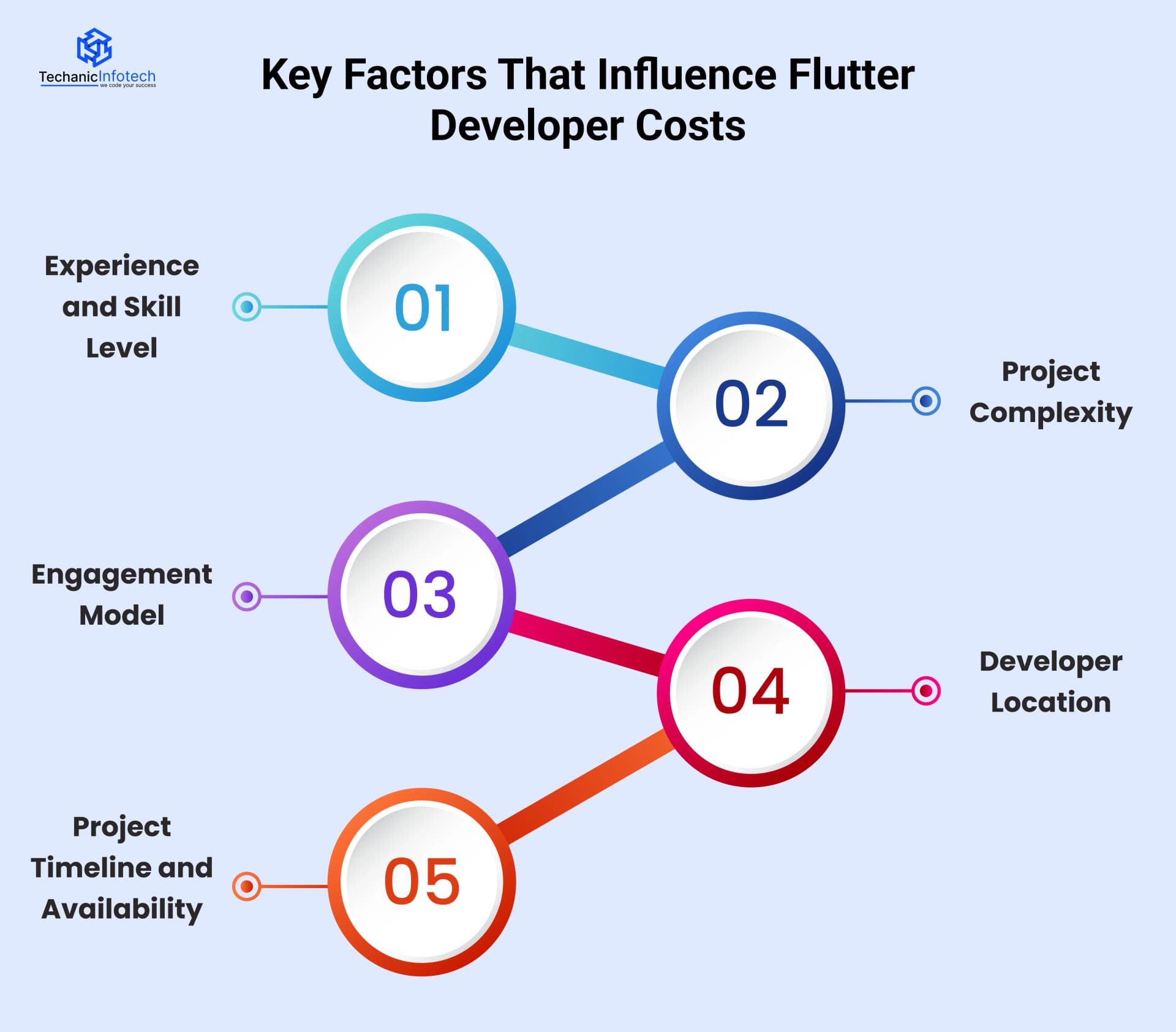
A developer’s expertise strongly impacts Flutter app developer pricing.
Junior developers charge less but may need extra guidance, while mid-level and senior developers deliver faster, cleaner work.
Their experience boosts efficiency, reduces errors, and increases your project’s long-term value.
The more complex your app, the higher the development cost.
Advanced mobile app features like real-time updates, animations, or custom backend integrations require greater technical skills and more hours, ultimately increasing the total investment needed for your Flutter project.
Your hiring approach affects the overall cost to hire Flutter app developers.
Freelancers can be cost-efficient for short-term tasks, while full-time developers or agencies provide stability and full-cycle support but usually come with higher long-term pricing commitments.
Rates vary widely across regions due to wage standards and market demand.
Developers in higher-income countries typically charge more, while equally skilled talent in other locations may offer more budget-friendly options without compromising quality or expertise.
Short deadlines drive up costs because developers must prioritize your project.
When you need rapid delivery, expect higher rates or additional team members. A flexible timeline usually helps maintain a more manageable overall budget.
Understanding the Flutter developer hourly rate helps you budget accurately and compare options.
With a clear Flutter development cost breakdown, you can see how experience, project needs, and hiring models impact pricing, making it easier to plan your development budget wisely.
|
Factor |
Hourly Rate Range |
Monthly Rate Range |
Notes |
|
Junior Developer |
$20–$40/hr |
$3,000–$6,000 |
Best for simple tasks and basic features. |
|
Mid-Level Developer |
$40–$70/hr |
$6,000–$10,000 |
Strong balance of skill, speed, and cost. |
|
Senior Developer |
$70–$120/hr |
$10,000–$18,000 |
Ideal for complex apps, architecture, and scaling projects. |
|
Specialized Flutter Expert |
$100–$150+/hr |
$15,000–$22,000+ |
High-end skills in performance, animations, and integrations. |
|
Freelance Developer |
$25–$90/hr |
$4,000–$12,000 |
Flexible option with wide pricing variance. |
|
Full-Time In-House Developer |
Salary-based |
$5,000–$12,000 |
Stable but higher long-term commitment. |
|
Flutter Development Agency |
$60–$150+/hr |
$12,000–$25,000+ |
Includes designers, QA, PMs, and development support. |
|
Regional Pricing Differences |
$20–$120/hr |
$3,000–$18,000 |
Rates shift based on local cost of living and talent demand. |
|
Project Complexity |
$40–$150+/hr |
$6,000–$22,000+ |
Advanced features, real-time modules, and custom UI increase cost. |
|
Long-Term Contracts |
Negotiable |
$5,000–$15,000 |
Monthly retainers often reduce hourly costs. |
Understanding the dedicated Flutter app developers' cost helps you plan your project budget with confidence.
Rates vary based on experience, workload, and project complexity, making it important to evaluate your options carefully before hiring.
Hiring costs vary depending on your approach. Understanding this helps with your overall Flutter development cost breakdown.
Freelancers start quickly, while full-time developers require onboarding and formal hiring steps that shape your initial mobile app development cost.
Freelancers require almost no onboarding or HR involvement. Their fast setup makes them ideal for teams wanting a low upfront investment and immediate project momentum.
Full-time hiring includes training, recruitment, and administrative steps. These additional processes increase costs but support longer-term stability and smoother internal integration.
Rate structures differ greatly between freelancers and full-time developers. Freelancers typically charge more per hour, while full-time roles provide predictable salaries.
This impacts your overall Flutter developer monthly cost and long-term financial planning.
Freelancers often charge higher hourly rates due to short-term availability and specialized skills. You pay for flexibility and targeted expertise rather than long-term commitment.
Full-time developers receive consistent monthly salaries, offering predictable budget planning. Their hourly equivalent is generally lower, making them cost-effective for ongoing development.
Your financial commitment depends on how long you retain a developer. Freelancers offer flexibility, while full-time employees require continuous compensation.
This difference affects the overall Flutter developer cost in 2026 and long-term resource planning.
Freelancers let you scale up or down as needed. You only pay for active work, making them ideal for shifting workloads or temporary phases.
Full-time developers require ongoing salaries, benefits, and raises. They are best for sustained development needs and long-term product evolution.
Every project evolves differently. Freelancers provide agility for shifting scopes, while full-time developers operate within structured workflows aligned with your mobile app development process, ensuring controlled and steady progress.
Freelancers thrive in flexible environments and adjust quickly to feature changes, new requirements, or evolving deadlines.
Full-time developers follow structured plans and internal workflows. They handle change steadily but may not pivot as quickly as freelancers during rapid shifts.
Capacity varies based on the working model. Freelancers juggle multiple clients, while full-time developers dedicate their entire schedule to your product, which influences overall Flutter app development cost.
Freelancers often manage multiple workloads, which can limit availability. They fit best in projects with controlled workloads or defined task-based responsibilities.
Full-time developers focus solely on your app. Their consistent availability results in steady progress and reliable long-term development outputs.
Maintaining quality depends on your team's structure. Freelancers operate independently, while full-time developers follow internal standards, supporting your mobile app maintenance strategy and ensuring consistent quality control.
Freelancers may require additional supervision unless highly experienced. Their independence can lead to varying quality levels depending on the developer.
Full-time developers follow your internal guidelines and quality processes. This makes collaboration smoother and ensures more consistent results.
Expertise affects speed and performance. Freelancers often specialize in niche tasks, while full-time developers provide continuous, broad support.
These differences influence your overall Flutter developer hiring cost and delivery outcomes.
Freelancers excel in delivering fast, high-quality results in specialized areas like integrations, UI, or performance optimization.
Full-time developers support long-term product growth, maintenance, and feature expansion with consistent dedication and teamwork.
Communication styles differ across models. Freelancers may span multiple time zones, while full-time developers align with your daily workflow, improving team collaboration.
Freelancers may respond more slowly due to flexible schedules or time differences. They are great for independent tasks but not constant collaboration.
Full-time developers align with internal meetings, communication channels, and collaborative processes, leading to faster responses and smoother workflows.
Your hiring model shapes software, hardware, and tool costs. Freelancers often bring their own equipment, while full-time developers rely on company-provided resources.
Freelancers typically use their own devices and software. This reduces your operational costs and simplifies project setup.
Full-time developers require company-provided tools, equipment, and licenses. These costs add up but support consistency, security, and standardized workflows.
Your ability to scale depends on your hiring model. Freelancers help with short bursts of growth, while full-time developers strengthen long-term expansion tied to your mobile app development timeline.
Freelancers help scale quickly during busy phases or when specific expertise is needed temporarily.
Full-time developers support long-term team building and deep product knowledge, helping your app evolve predictably over time.
Experience and skill level greatly influence Flutter developer fees and shape overall Flutter developer pricing models, helping businesses budget accurately.
Understanding these variations allows companies to make informed decisions and choose the right expertise for their project needs.
Beginner Flutter App developers charge lower fees because they are still building foundational skills and practical experience.
Their rates reflect limited expertise, slower development speed, and higher dependency on guidance, making them suitable for small tasks but not complex, high-risk projects.
Mid-level Flutter app developers offer balanced pricing due to stronger technical skills, hands-on project experience, and better problem-solving abilities.
Their involvement supports efficient development and aligns well with modern goals such as eco friendly app development, making them ideal for medium-complexity projects.
Senior Flutter app developers command higher fees because they bring deep expertise, architectural knowledge, and proven experience across diverse projects.
Their ability to optimize performance, eliminate risks, and lead development teams justifies premium pricing for mission-critical or large-scale mobile application initiatives.
Specialized Flutter experts, such as those skilled in advanced animations, integrations, or enterprise-grade systems, charge premium fees.
Their niche capabilities accelerate development and enhance product quality, making them valuable when projects demand complex features or require overcoming unique technical challenges efficiently.
Full-stack Flutter app developers charge higher fees due to their ability to manage both frontend and backend tasks.
Their broad expertise supports rapid minimum viable product development, reduces role fragmentation, and enables cohesive development for applications requiring complete system architecture handling.
Flutter development agencies typically have the highest fees because they provide structured teams, project managers, quality assurance experts, and predictable delivery processes.
Their pricing reflects comprehensive services, higher accountability, and the ability to handle large, complex, or long-term development projects.
Choosing the right Flutter app development company is crucial for building future-ready mobile applications, and Techanic Infotech stands out as a trusted partner for 2026 and beyond.
With rapid advancements in Flutter, businesse need a team that not only understands the framework but also anticipates evolving trends, performance requirements, and user expectations.
Techanic Infotech brings deep technical expertise, a proven delivery approach, and a strong focus on innovation to help brands create scalable, secure, and visually appealing apps.
Their commitment to quality, transparent communication, and cost-efficient solutions ensures every project meets strategic goals.
Whether you're launching a new product or modernizing an existing one, partnering with Techanic Infotech ensures long-term success in a competitive digital landscape.
Understanding the cost to hire Flutter app developers is essential for planning a successful app project in 2026.
By evaluating experience levels, project complexity, engagement models, and long-term goals, businesses can make smarter budgeting decisions and avoid unexpected expenses.
Flutter continues to evolve rapidly, offering faster development, cross-platform efficiency, and high-performing apps, making it a top choice for startups and enterprises alike.
Whether you choose freelance talent or a dedicated development team, aligning your budget with your product vision is key.
Partnering with the right experts ensures quality, scalability, and timely delivery. With the insights from this guide, you’re now better equipped to estimate costs and confidently move forward with your Flutter app development journey.
Flutter developer costs depend on experience, project complexity, timeline, location, and required skill sets. Specialized expertise or advanced app features typically increase overall pricing.
Yes. Flutter app developers are cost-effective because they build Android and iOS apps from one codebase. This reduces development time, maintenance efforts, and long-term project expenses.
Most Flutter apps take 2–6 months, depending on features, integrations, UI complexity, and testing needs. Larger projects or custom solutions may require more development time.
Freelancers are budget-friendly for short projects, while full-time developers provide consistency and long-term support. The best choice depends on your workload, timeline, and future app plans.
Yes. Flutter’s performance, scalability, security options, and flexible UI make it suitable for enterprise apps. It supports complex architecture, backend integration, and high-traffic environments.


Bharat Sharma is the CTO of Techanic Infotech, bringing deep technical expertise in software architecture, mobile app development, and scalable system design. He leads the engineering team with a strong focus on innovation, performance, and security.