Ecommerce App Development
E-commerce App Development Timeline: How Much Time Does It Really Take?
February 3, 2026
February 3, 2026
Building an e-commerce app is a strategic investment, and one of the most common questions businesses ask is how long the development process takes.
The answer depends on multiple variables such as app complexity, platform selection, features, integrations, and team expertise.
A basic e-commerce app may take a few months, while an enterprise-level solution can take up to a year or more.
From planning and design to development, testing, and deployment, each phase contributes to the overall timeline.
Understanding the development duration helps businesses plan budgets, set realistic expectations, and launch faster.
In this guide, we’ll break down the timelines, influencing factors, and ways to speed up development efficiently.
E-commerce app development time depends on several critical factors, including app complexity, feature set, platform choice, design requirements, and integration needs.
Understanding these elements helps businesses plan timelines, budgets, and resources more effectively.
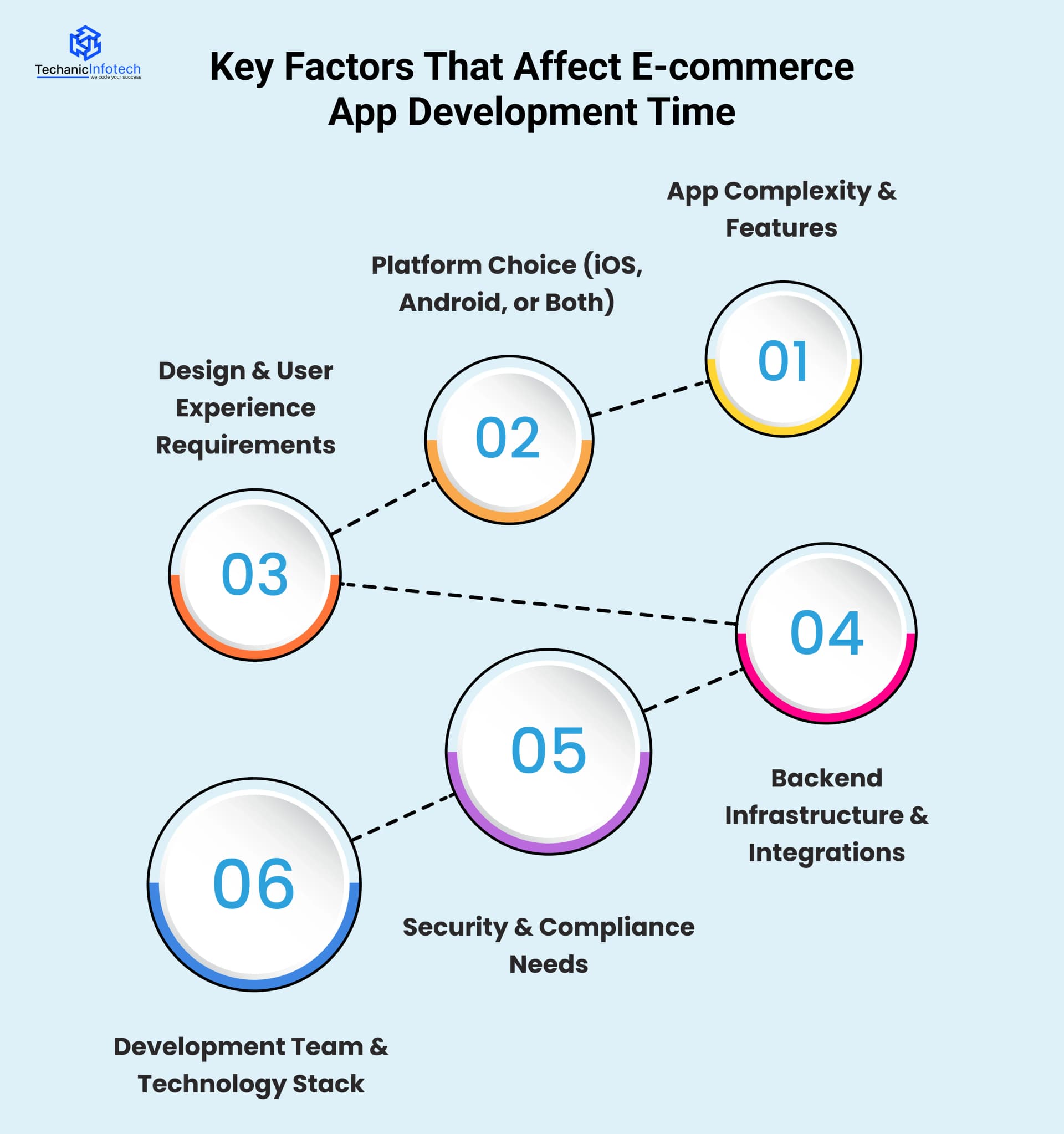
The number and complexity of features significantly impact development time.
Basic features like product listings take less time, while advanced features such as AI recommendations, real-time tracking, and multi-vendor support require more planning, coding, and testing, extending the overall mobile app development timeline.
Developing for a single platform is faster than building for both iOS and Android. Each platform has unique guidelines and testing requirements.
Cross-platform frameworks can reduce time, but native development typically takes longer due to separate codebases.
Custom UI/UX designs take longer than template-based designs.
Highly interactive layouts, animations, and personalized user journeys require multiple design iterations, usability testing, and refinements, which can extend the design and development phases significantly.
A robust backend is essential for inventory management, order processing, and scalability.
Integrating payment gateways, CRM systems, ERP tools, and analytics platforms adds complexity and increases development time due to configuration and testing requirements.
E-commerce apps must comply with security standards like PCI-DSS, GDPR, and data encryption protocols.
Implementing secure authentication, payment protection, and compliance checks adds additional development and testing time but is critical for user trust.
An experienced development team using modern frameworks works faster and more efficiently.
Outdated technology stacks or limited expertise can slow development, while agile teams with proven tools can accelerate timelines without sacrificing quality.
An e-commerce app development timeline outlines each project phase, from planning and design to development, testing, and launch.
Breaking down the mobile app development process helps stakeholders understand task dependencies, manage expectations, and ensure timely, high-quality delivery.
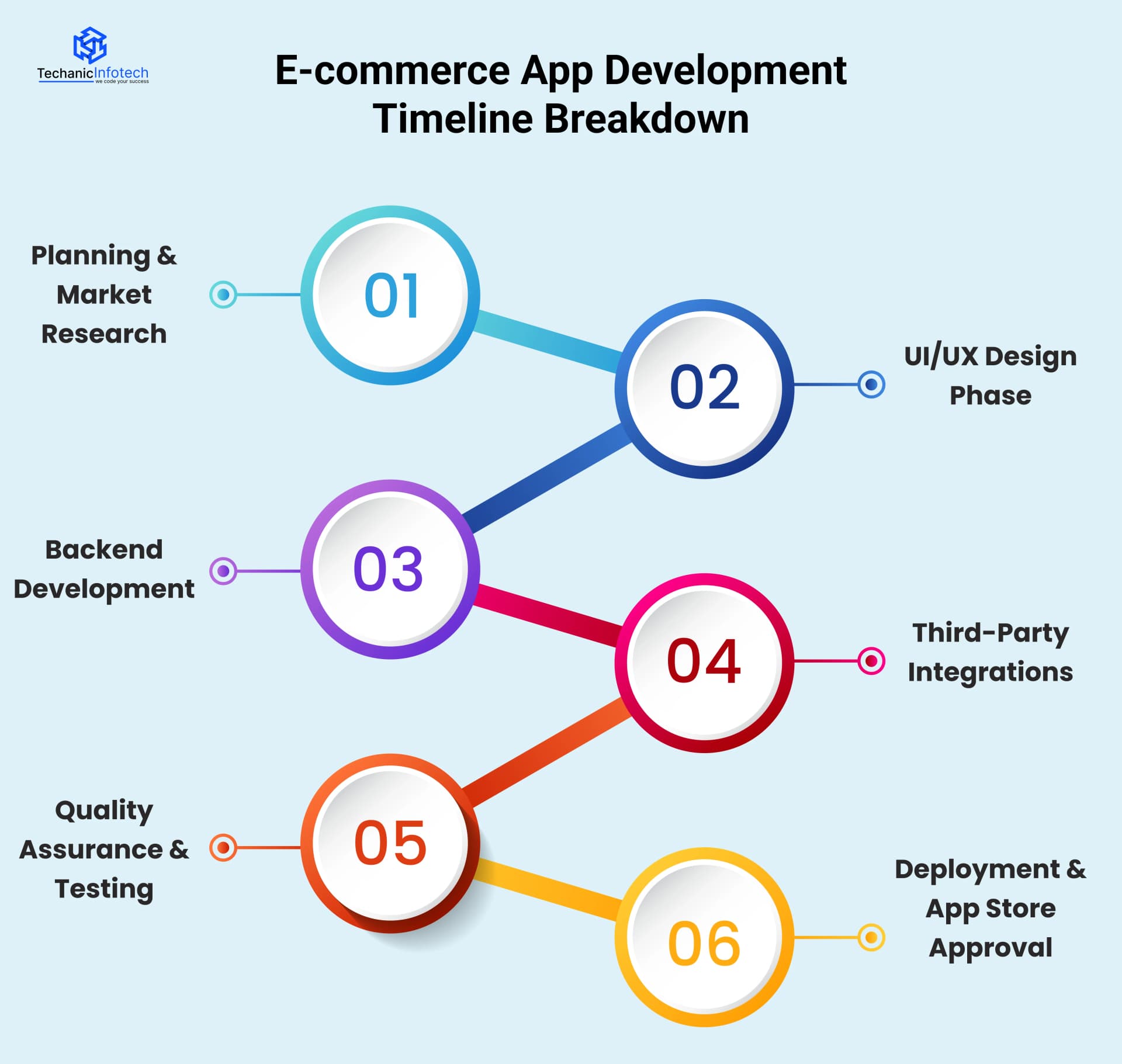
This stage covers competitor analysis, audience profiling, feature validation, and technical feasibility.
Clear planning aligns the product with business goals, reduces risk, avoids costly rework later, and creates a realistic roadmap that guides design, development, budgeting, and stakeholder expectations management.
Designers develop wireframes, interactive prototypes, and visual systems that define the user experience.
User journeys, usability testing, and feedback loops refine navigation and accessibility.
Additional revisions or complex branding can extend timelines but significantly improve long-term engagement and retention rates.
Frontend development transforms mobile app design into responsive, interactive screens using appropriate frameworks.
Developers handle animations, state management, performance optimization, and cross-device compatibility.
Timelines vary depending on feature richness, platform targets, and the need for accessibility compliance or advanced user interactions support.
Backend development builds the application’s core infrastructure, including databases, APIs, authentication, and admin tools.
It enables secure user management, transactions, and business logic.
Complexity increases with scalability requirements, real-time features, integrations, data security standards, and performance optimization needs for growth.
Third-party integrations connect the app with external services like payments, shipping, analytics, and messaging.
Developers configure, customize, and test these services for reliability.
Delays may occur due to API limitations, documentation gaps, security reviews, or compatibility issues across providers globally.
Quality assurance ensures the application works reliably under real-world conditions.
Testers evaluate functionality, performance, security, and usability across devices. Identified defects are fixed iteratively, improving stability.
Comprehensive testing minimizes launch risks, protects brand reputation, and reduces mobile app development cost and post-release support efforts.
Deployment involves preparing production builds, configuring servers, and submitting the app to stores. Teams handle compliance, metadata, and review feedback.
Approval times vary by platform and region, especially on iOS, and may require revisions before public release and full availability.
The time required to build an e-commerce app varies by type, from basic storefronts to advanced marketplace or enterprise solutions.
Each app category differs in ecommerce app features, integrations, and complexity, directly influencing the overall development timeline.
An MVP e-commerce app is built to launch fast with only mission-critical features such as product listings, cart, checkout, and basic payments.
It helps startups validate market demand, test user behavior, attract early adopters, and refine the product roadmap while keeping development cost, risk, and time-to-market low.
A mid-level e-commerce app expands beyond basics by adding advanced search and filters, user profiles, wishlists, order tracking, multiple payment gateways, and basic analytics.
It supports higher traffic, improves personalization, and enhances customer engagement, making it ideal for businesses transitioning from startup to growth stage.
Enterprise-level e-commerce apps are highly scalable, feature-rich platforms designed for complex operations.
They include AI-powered recommendations, multi-vendor systems, ERP and CRM integrations, advanced analytics, automation, and robust security.
These solutions require detailed planning, custom architecture, rigorous testing, and long-term infrastructure investment.
Native and cross-platform development differ in approach and efficiency.
This comparison examines how each impacts development time, focusing on coding, testing, and mobile app maintenance speed across platforms.
The following is the comparison table of the native and cross-platform development:
|
Factor |
Native App Development |
Cross-Platform App Development |
|
Development Approach |
Built separately for each platform |
Built once for multiple platforms |
|
Codebase |
Separate codebases for iOS and Android |
Single shared codebase |
|
Development Duration |
Longer development time |
Shorter development time |
|
Price (Cost) |
Higher development and maintenance cost |
Lower development cost |
|
Time to Market |
Slower launch |
Faster launch across platforms |
Native app development involves building applications specifically for a single platform using its dedicated languages and tools, offering high performance, better user experience, and full access to device features.
Native apps are built using languages designed for one platform, like Swift for iOS or Kotlin for Android, which increases development time due to specialized coding requirements.
Developers must create and manage different codebases for Android and iOS, meaning the same features are built twice, which significantly increases overall development time.
Native apps provide the best performance and smooth UI because they follow platform guidelines, but achieving this level of optimization takes more design and development time.
Each platform requires separate testing, debugging, and bug fixes, increasing the total time spent before deployment and during future updates.
Because development, testing, and deployment are done separately for each platform, native apps usually take longer to reach users compared to cross-platform apps.
Cross-platform app development enables developers to build a single application that runs on multiple platforms using one codebase, reducing development time and cost while maintaining consistent functionality.
Cross-platform development allows developers to write one codebase that runs on multiple platforms, which significantly reduces development time and avoids repetitive coding work.
Reusable components and shared logic enable quicker implementation of features, allowing developers to build and launch apps much faster than native development.
Since most of the code is shared, testing efforts are reduced, saving time during quality assurance and making bug fixing faster and more efficient.
Although faster, cross-platform apps may face limitations in accessing advanced device features, which can sometimes require extra time for custom native integrations.
Cross-platform apps are ideal for startups and MVPs because they can be developed, tested, and launched quickly across platforms, saving both time and cost.
E-commerce apps include a range of common features such as user authentication, product catalogs, payment gateways, and order management.
Each feature requires different development efforts, and estimating their timelines helps in accurate project planning and prioritization.
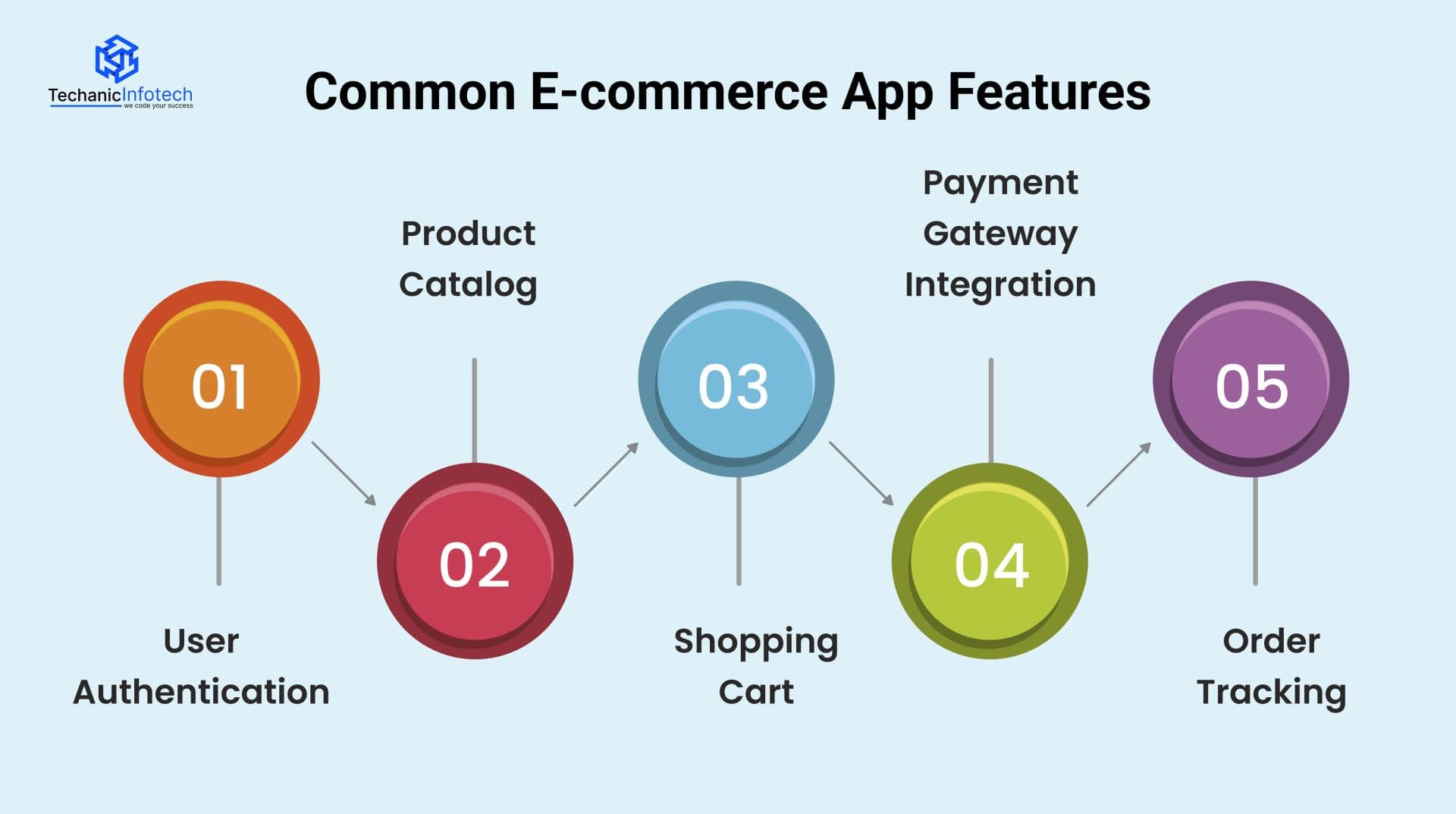
Login, signup, and password recovery usually take 1–2 weeks.
Time depends on security requirements, third-party integrations, and whether social logins or biometric authentication are included.
Developing a product listing with categories, filters, and search typically takes 2–3 weeks.
Complexity increases with large inventories, dynamic pricing, and real-time updates.
A shopping cart feature usually requires 1–2 weeks. It includes product selection, quantity management, price calculation, and session handling across devices.
Payment integration takes around 1–3 weeks, depending on the number of gateways, security compliance, and support for multiple currencies or regions.
Order tracking features take 1–2 weeks. This includes order status updates, notifications, and backend synchronization with logistics or delivery partners.
Speeding up e-commerce app development requires strategic planning, the right technology stack, and efficient workflows.
Leveraging pre-built solutions, agile methodologies, and experienced teams can significantly reduce development time without compromising quality.
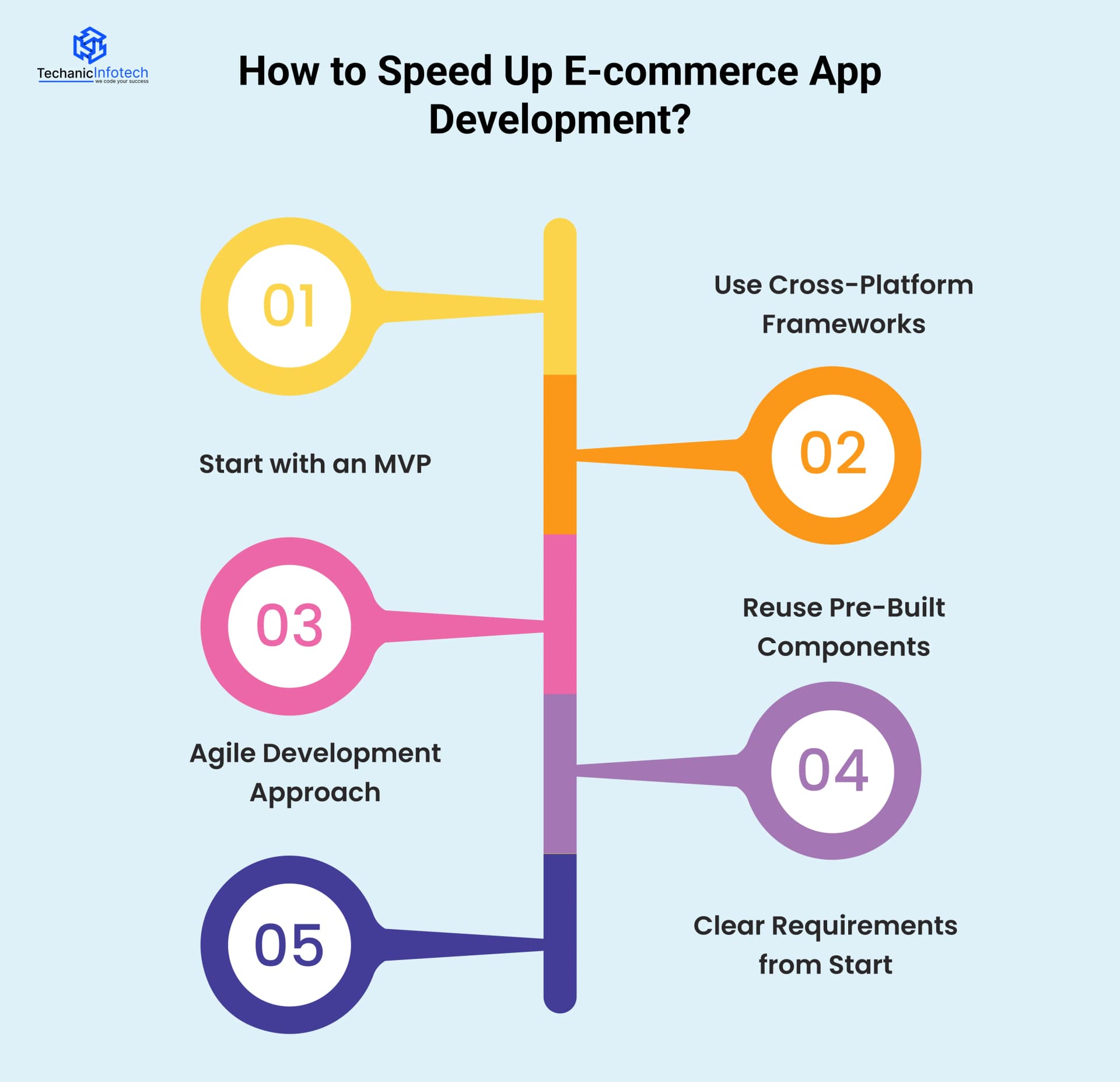
Frameworks like Flutter or React Native reduce development time by allowing a single codebase for multiple platforms, speeding up both development and deployment.
Building a minimum viable product helps launch faster. Focus on essential features first and add advanced functionalities based on user feedback later.
Using ready-made UI components, APIs, and SDKs saves time and reduces the need to build everything from scratch.
Agile methodology enables faster iterations, continuous feedback, and early issue detection, helping teams deliver features quickly and efficiently.
Well-defined requirements prevent rework. Clear documentation and wireframes help developers work faster and avoid unnecessary delays.
Hidden factors like unclear requirements, scope changes, third-party integration issues, and poor testing can silently slow development.
Identifying and addressing these early helps avoid delays and keeps the project on schedule.
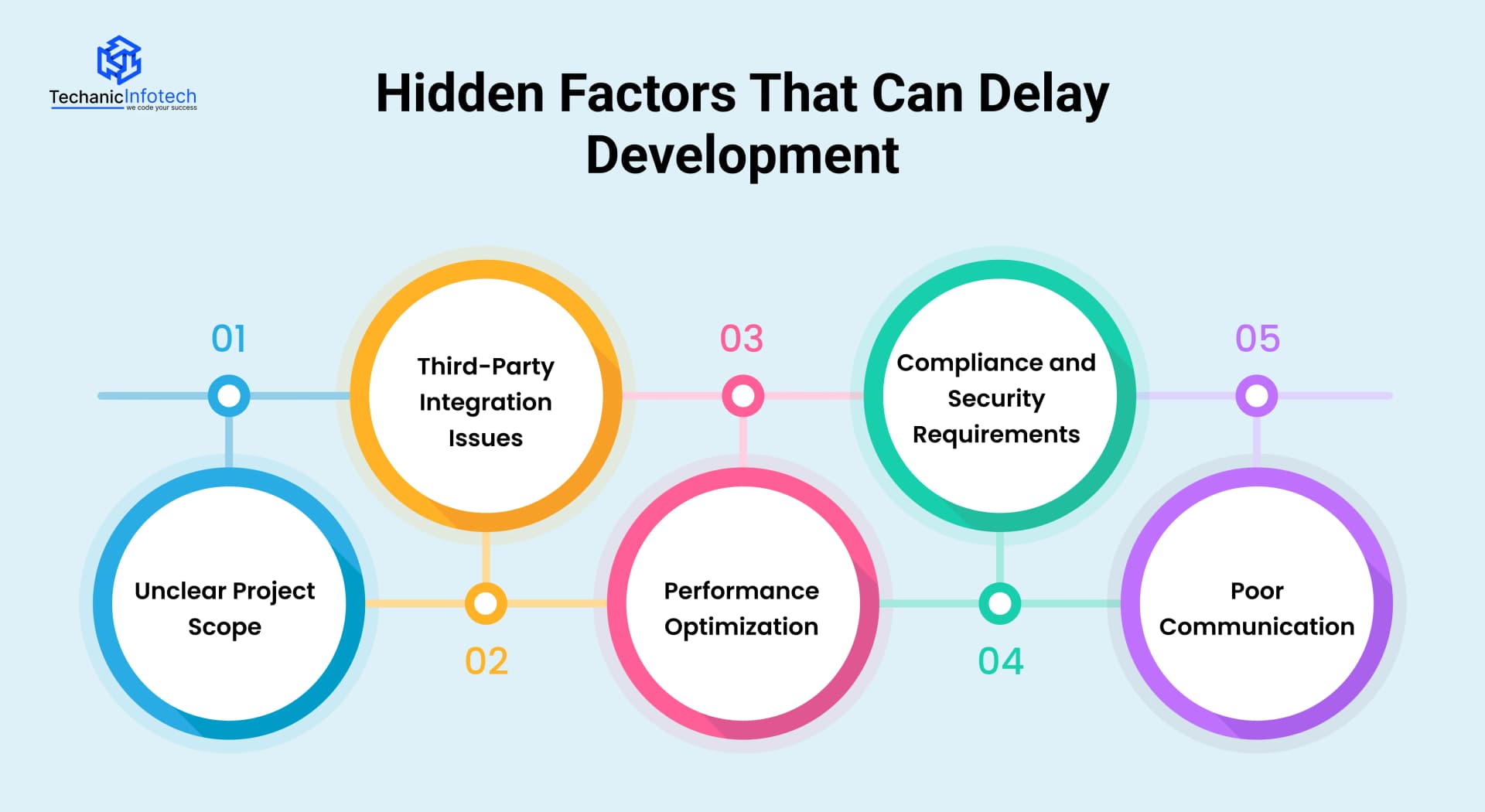
Frequent changes in requirements can slow development. Lack of clarity leads to rework, extended timelines, and increased development costs.
APIs, payment gateways, or logistics services may have limitations or bugs, causing unexpected delays during integration and testing.
Ensuring app speed, scalability, and stability often takes extra time, especially when handling large user traffic or complex backend processes.
Meeting data protection, payment security, and regional regulations can add extra development and testing time.
Delayed feedback or miscommunication between stakeholders and developers can significantly slow down progress and decision-making.
Techanic Infotech is an ecommerce app development company known for building scalable, secure, and high-performing e-commerce apps tailored to business needs.
Their experienced team excels in native and cross-platform development, ensuring faster delivery without compromising quality.
They follow an agile approach, enabling transparency, flexibility, and timely updates throughout the project lifecycle.
Techanic Infotech focuses on user-centric design, seamless integrations, and robust backend architecture to support business growth.
With expertise in the latest technologies, payment gateways, and security standards, they deliver reliable solutions.
Their strong post-launch support and maintenance ensure long-term success, making them a trusted partner for eCommerce app development.
Choosing the right development approach and partner plays a crucial role in eCommerce app success.
Native development offers performance advantages, while cross-platform development saves time and cost.
Understanding feature complexity, hidden delays, and optimization strategies helps set realistic timelines.
Speeding up development requires clear planning, the right technology stack, and an experienced team.
Partnering with a reliable company like Techanic Infotech ensures efficient execution, scalability, and quality.
A well-built eCommerce app not only improves user experience but also drives conversions and long-term business growth in a competitive digital market.
Cross-platform development is generally faster because it uses a single codebase for multiple platforms, reducing development and testing time.
An eCommerce app typically takes 3–6 months, depending on features, design complexity, integrations, and development approach
Yes, modern frameworks support scalability and performance, making cross-platform development suitable for large eCommerce applications.
Complex features, third-party integrations, frequent requirement changes, and performance optimization can increase development time.
A professional company ensures quality, security, faster delivery, and long-term support, reducing risks and development challenges.


Abhishek Jangid is the CEO of Techanic Infotech, with extensive experience in mobile app and web development. He specializes in helping businesses turn innovative ideas into scalable digital solutions through strategic planning and modern technology.