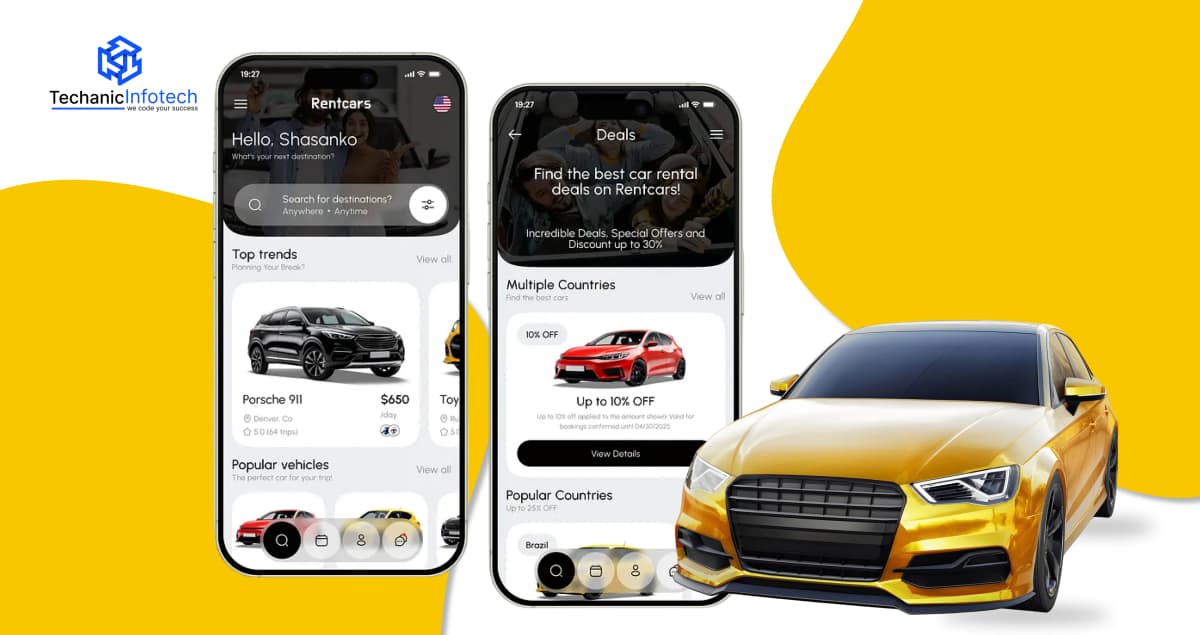
Ekar is a UAE-based car-sharing and mobility platform offering pay-per-minute, daily, and subscription-based vehicle rentals.
Instead of owning a car, users locate nearby vehicles via the app, unlock them digitally, and pay only for usage time.
The business model focuses on asset-light fleet optimization, strategic parking zones, and IoT-enabled vehicle access.
By leveraging telematics, GPS tracking, and digital KYC verification, Ekar minimizes operational overhead while maximizing utilization rates.
This guide is helpful in developing the Ekar clone app successfully by following the complete steps, market analysis, reasons to invest in this clone app, key features, technology stack, steps, costs, and monetisation strategies.
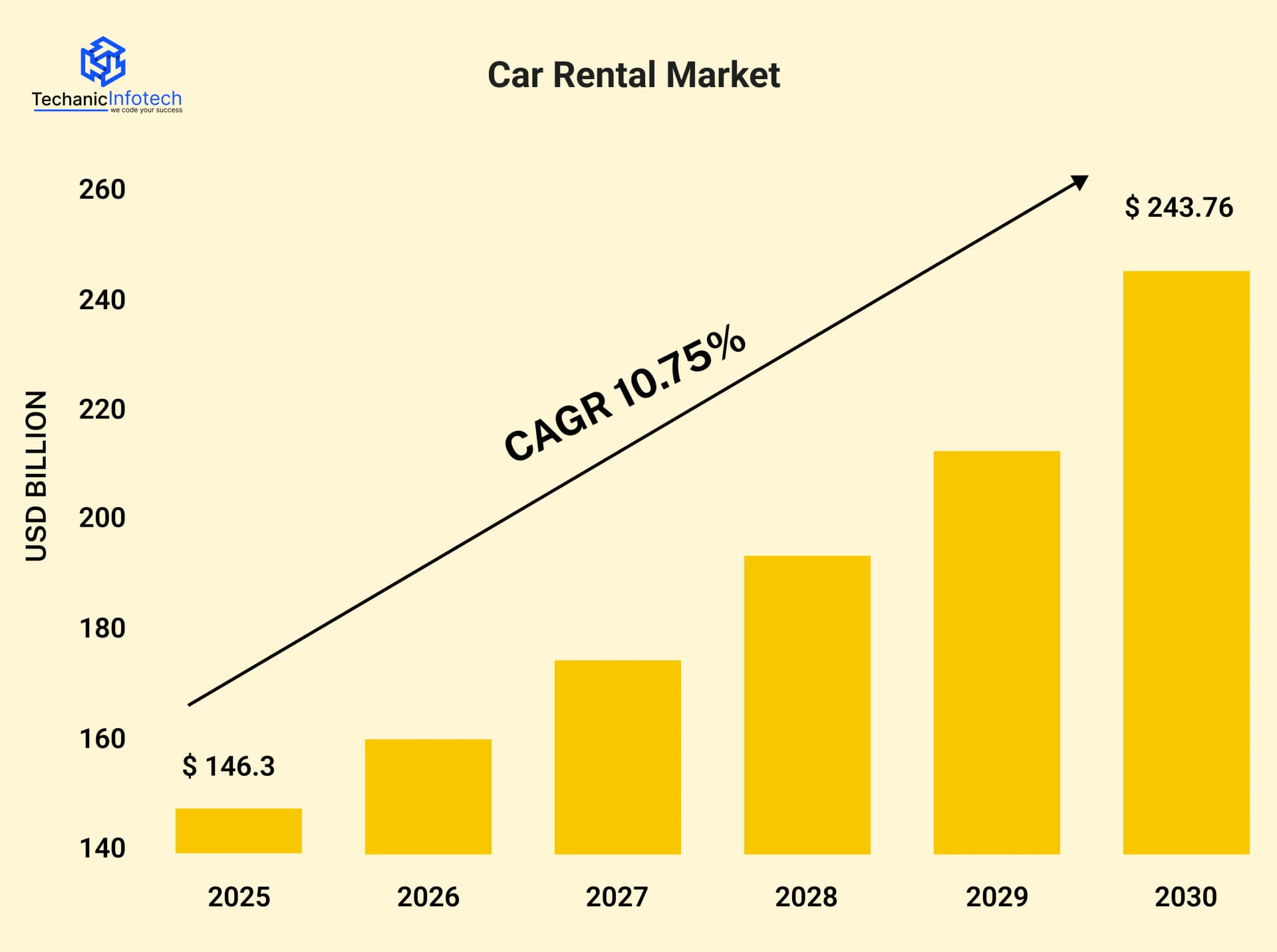
The global car rental market is projected to grow from $146.3 billion in 2025 to $243.76 billion by 2030, at a CAGR of 10.75%.
Ekar’s revenue has increased tenfold, driven by strategic technology partnerships and operational efficiency.
By 2027, around 70% of car rentals are expected to be booked online or via mobile apps, reflecting a strong shift to on-demand digital platforms.
A growing share of car rental revenues is moving to online platforms, highlighting the importance of digital solutions in the industry.
The U.S. car rental market was valued at $35.2 billion in 2024 and is expected to grow at a 5% CAGR from 2025 to 2034.
With the rapid evolution of the global mobility landscape, investing in an Ekar clone app positions your business at the forefront of the shared economy revolution.
The following are the reasons that explain why one should invest in Ekar Clone applications.
Urban consumers increasingly prefer short-term vehicle access over ownership.
Rising fuel costs, insurance expenses, and parking limitations push users toward flexible car-sharing solutions, creating strong recurring demand for digital rental platforms.
Subscription plans, pay-per-minute billing, and corporate leasing generate predictable income streams.
Add-ons like insurance coverage and premium vehicles further diversify revenue opportunities and increase customer lifetime value.
An Ekar clone app can scale city-by-city without heavy infrastructure investments. Cloud hosting, IoT integrations, and fleet partnerships allow operational expansion with controlled capital expenditure.
Mobility startups attract venture capital due to sustainability alignment and smart-city integration.
Investors see long-term profitability in technology-driven transportation ecosystems.
Automation through GPS tracking, digital KYC, and telematics reduces manual processes. This lowers operational costs and improves fleet utilization rates.
Partnerships with hotels, airports, and enterprises unlock bulk rental agreements, increasing consistent bookings and brand visibility.
An Ekar clone app combines convenience, technology, and seamless mobility, offering users a modern car-sharing experience.
The following are the key top car rental app features, designed to enhance usability, security, and operational efficiency for both customers and fleet managers.
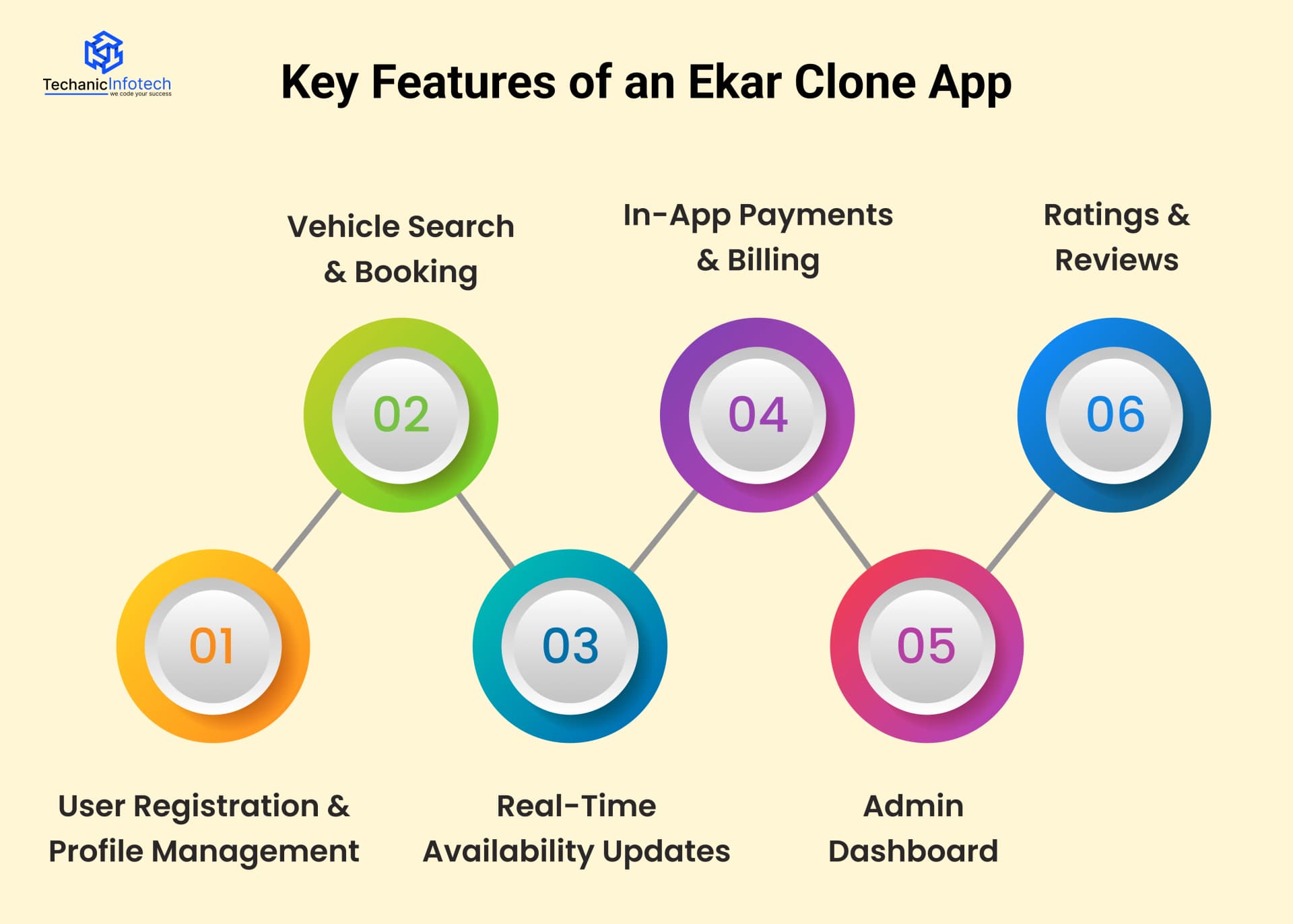
A secure and intuitive onboarding process featuring document uploads, driver verification, and comprehensive profile management ensures regulatory compliance and builds user trust.
A streamlined sign-up experience minimizes friction, enhances personalization, and significantly improves user retention.
Advanced GPS-enabled vehicle discovery allows users to locate nearby vehicles in real time, compare pricing, and reserve instantly.
Smart filters for vehicle type, availability, and pricing tiers enhance usability and create a seamless booking experience.
Dynamic, real-time vehicle availability tracking eliminates double bookings and enhances operational reliability.
Instant push notifications confirm reservations, cancellations, and booking modifications, ensuring a smooth and transparent user journey.
Secure, integrated digital payment gateways support credit/debit cards, digital wallets, and subscription-based models.
Automated billing, instant invoices, and transaction history tracking enhance transparency, simplify accounting, and strengthen customer trust.
A centralized administrative dashboard provides comprehensive fleet management, booking analytics, revenue tracking, and performance insights.
Advanced reporting tools empower operators to optimize utilization, improve operational efficiency, and drive data-driven decision-making.
A robust feedback and rating system promotes service quality, accountability, and user trust.
Transparent reviews encourage responsible vehicle usage while helping operators continuously improve service standards.
The right combination of mobile app tech stack, including frontend, backend, database, cloud services, and IoT integrations, ensures high performance, security, and a seamless user experience across platforms.
Frontend technologies define how users interact with the application.
Frameworks such as React Native or Flutter enable cross-platform development, allowing a single codebase to run seamlessly on both iOS and Android devices.
The backend acts as the core engine of the application.
Technologies like Node.js or Django power scalable APIs that handle user authentication, booking management, payments, and data processing securely and efficiently.
The database securely stores and manages all critical information, including user profiles, vehicle data, booking records, transaction history, and analytics.
Both support real-time updates, data encryption, backup mechanisms, and high availability to maintain system integrity.
Cloud platforms such as AWS or Google Cloud provide the infrastructure required to host the application reliably.
These services offer scalable computing power, secure data storage, automated backups, and global content delivery networks (CDNs).
Third-party services enhance functionality and speed up development by integrating specialized tools into the platform.
Payment gateways enable secure transactions and multi-currency support. SMS and email APIs facilitate booking confirmations and notifications.
IoT (Internet of Things) integration connects physical vehicles to the digital platform.
Smart lock systems allow users to unlock and start vehicles through the mobile app without physical keys.
Creating a successful Ekar clone app involves a structured, step-by-step development process.
Each step from market research and UI/UX design to mobile app development, testing, deployment, and post-launch maintenance ensures a reliable, user-friendly, and scalable car-sharing platform.
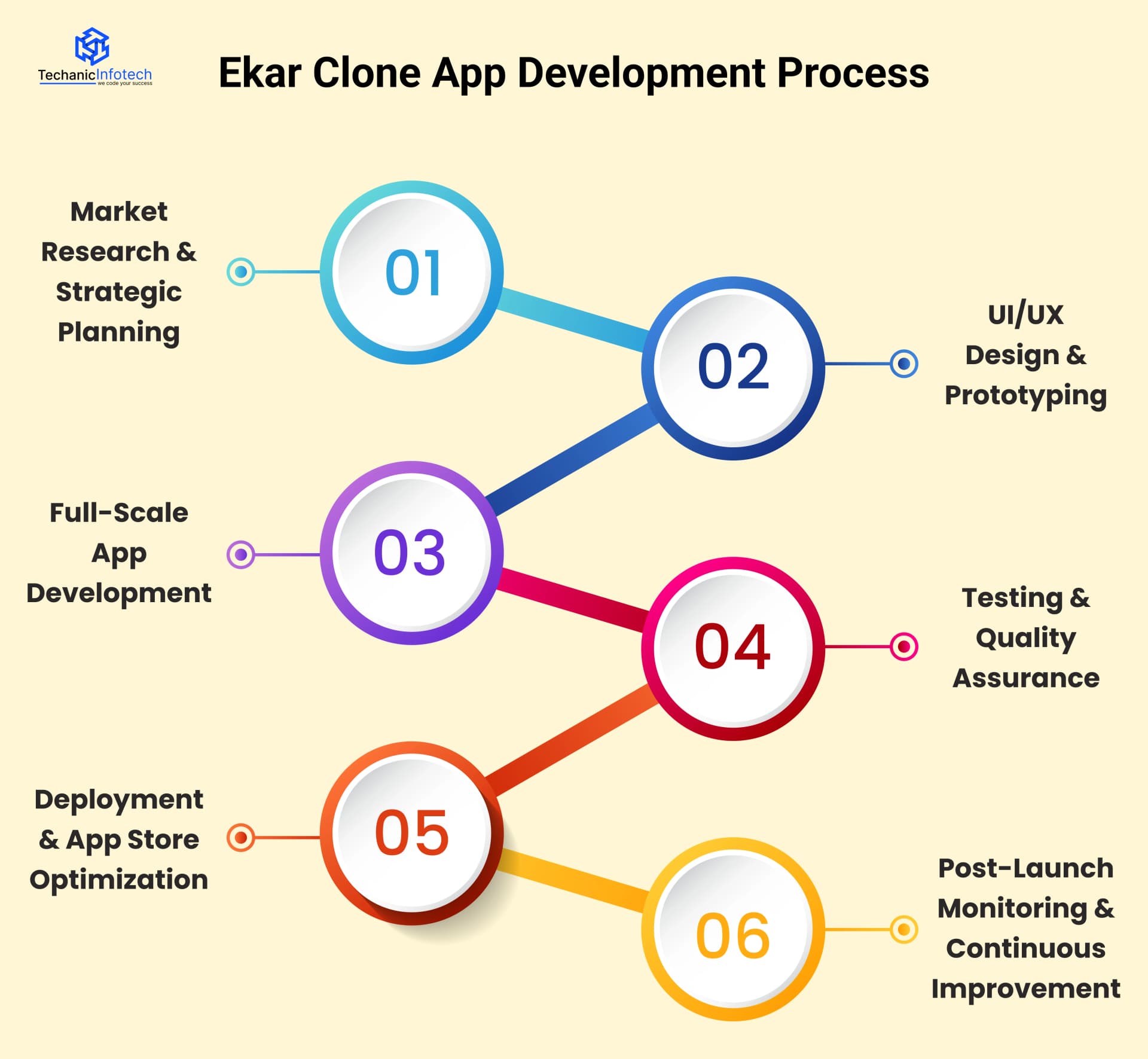
This step involves analyzing competitors, identifying market gaps, defining the target audience, and understanding regional regulatory requirements.
It also includes outlining clear monetization strategies such as subscription models, pay-per-use pricing, or premium feature tiers.
User experience is a critical stage that focuses on creating detailed wireframes, interactive prototypes, and user journey maps that prioritize simplicity and efficiency.
The goal is to minimize booking steps, ensure intuitive navigation, and deliver a visually engaging interface that builds trust and encourages repeat usage.
During development, frontend and backend systems are built simultaneously to ensure seamless integration.
Scalable APIs are developed alongside mobile interfaces, while essential services such as GPS tracking, secure payment gateways, digital KYC systems, and IoT integrations are incorporated.
This includes functional testing to validate features, security testing to safeguard user data, and performance testing to evaluate scalability under high traffic conditions.
Compliance checks are also conducted to ensure adherence to data protection regulations and industry standards, minimizing operational risks before launch.
This stage includes preparing optimized metadata such as keyword-rich descriptions, compelling visuals, and preview videos to improve discoverability and downloads.
Proper configuration of analytics, monitoring tools, and crash reporting systems ensures a smooth launch and early issue detection.
After launch, continuous monitoring of user behavior, engagement metrics, and system performance is essential. Analytics insights help identify feature gaps and optimization opportunities.
Regular bug fixes, security patches, performance upgrades, and feature enhancements keep the app competitive, scalable, and aligned with evolving customer expectations.
The cost to build a car rental app like Ekar varies based on features, complexity, and scalability requirements.
The following table shows the pricing of developing the Ekar clone app, that mentioned a per version, maintenance support, and growth investment.
|
Version |
Key Features Included |
Estimated Cost |
|
Basic Version |
• User registration • Vehicle listing • Booking management • In-app payments |
$10,000 – $20,000 |
|
Standard Version |
• Advanced security • Compliance tools • Operational dashboard • Regional scaling support |
$20,000 – $40,000 |
|
Advanced Version |
• Automation tools • User personalization • Fleet optimization • Advanced analytics |
$40,000 – $70,000 |
|
Enterprise Version |
• High scalability • Global expansion support • Robust compliance • Custom integrations |
$70,000 – $90,000 |
|
Ongoing Maintenance & Support |
• Updates & bug fixes • Security patches • Performance optimization • Cloud management |
15–20% annually |
|
Marketing & Growth Investment |
• ASO • Paid ads • Influencer marketing • Customer acquisition |
Varies ( as per demand ) |
A foundational version of the app typically costs between $10,000 and $20,000, making it ideal for startups entering local or niche markets.
This package generally includes essential features such as user registration, vehicle listing, real-time availability, booking management, secure in-app payments, and a basic admin dashboard for fleet oversight.
With an estimated development cost ranging from $20,000 to $40,000, the standard version expands on core functionality by incorporating advanced operational tools.
These features improve security, compliance, and operational visibility, making it suitable for growing businesses aiming to scale regionally.
An advanced app version generally requires an investment between $40,000 and $70,000.
Designed for competitive and high-demand markets, this version enhances automation, user personalization, and fleet efficiency.
For large-scale operations, mobile app development costs typically range from $70,000 to $90,000, depending on customization requirements.
It is built for established businesses seeking high scalability, robust compliance frameworks, and seamless global expansion.
Post-launch maintenance usually accounts for approximately 15–20% of the total development cost annually.
This includes regular updates, performance optimization, bug fixes, security patches, cloud hosting management, and compatibility upgrades with new operating system versions.
Beyond development, businesses should allocate a dedicated marketing budget for brand building, App Store Optimization (ASO), paid advertising campaigns, influencer partnerships, and customer acquisition strategies.
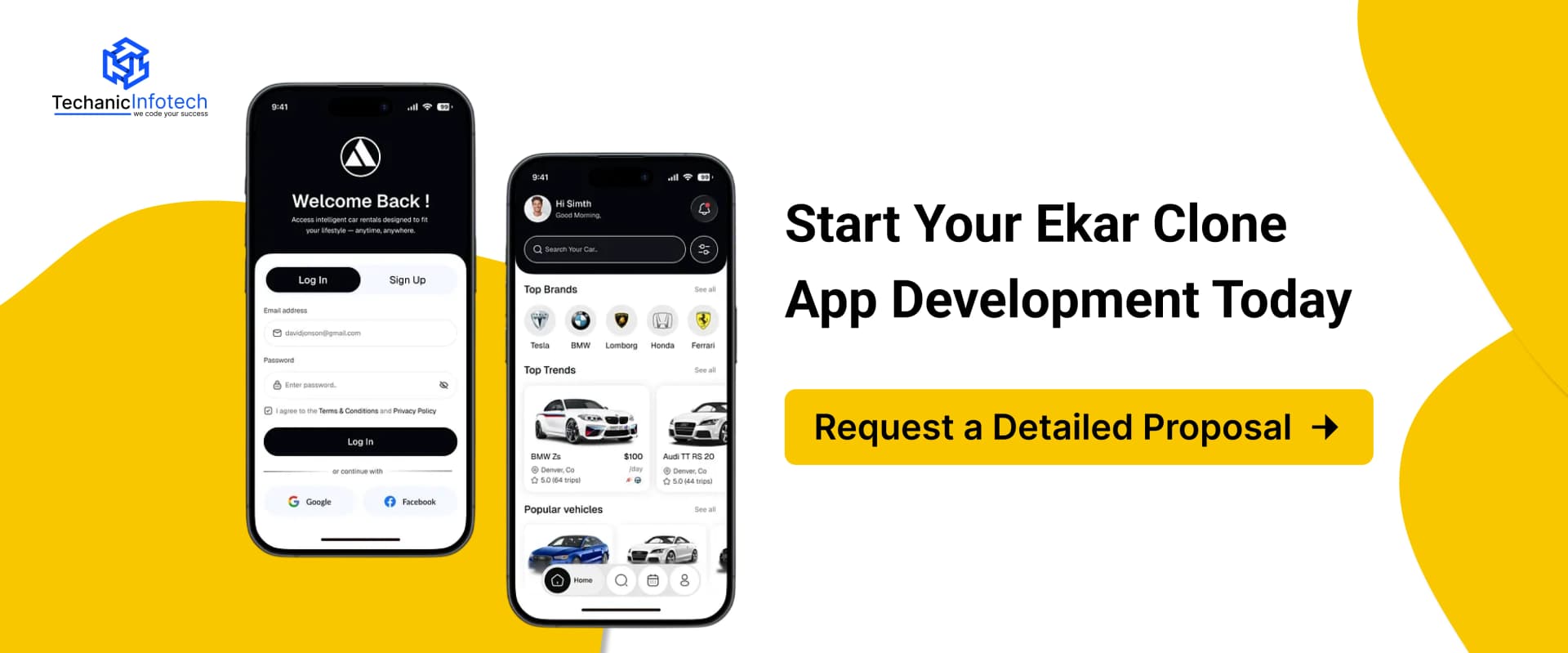
Technanic Infotech is the best car rental app development company that delivers secure, scalable, and feature-rich Ekar clone app development tailored to your market.
With expertise in mobility platforms, IoT integrations, and AI-based analytics, the team ensures enterprise-grade performance and compliance.
From UI/UX design to cloud deployment, Technanic follows agile methodologies and rigorous QA processes.
Their developers integrate GPS tracking, digital KYC, smart lock systems, and payment gateways for seamless functionality.
Whether targeting startups or enterprises, Technanic Infotech provides customized mobility solutions aligned with smart-city initiatives and sustainable transportation trends.
With urban populations rising and consumers prioritizing convenience over ownership, digital car-sharing platforms offer scalable and profitable business models.
By integrating AI recommendations, IoT-based vehicle access, secure payments, and real-time tracking, entrepreneurs can build competitive, future-ready solutions.
Success depends on strategic market research, strong technology infrastructure, compliance with regulations, and consistent post-launch optimization.
With expert development support and effective marketing, your car rental app can generate recurring revenue, enhance user experience, and establish long-term brand authority in the mobility ecosystem.
Development typically takes 3–6 months, depending on feature complexity, integrations, and testing requirements.
Yes, IoT enables contactless access and real-time tracking, significantly improving user convenience and operational efficiency.
Yes, scalable cloud infrastructure allows multi-city deployment with centralized admin management.
SSL encryption, secure APIs, GDPR compliance, and multi-factor authentication are essential for protecting user data.
With effective fleet utilization, subscription models, and corporate partnerships, car-sharing platforms can achieve strong recurring revenue and ROI.


Abhishek Jangid is the CEO of Techanic Infotech, with extensive experience in mobile app and web development. He specializes in helping businesses turn innovative ideas into scalable digital solutions through strategic planning and modern technology.