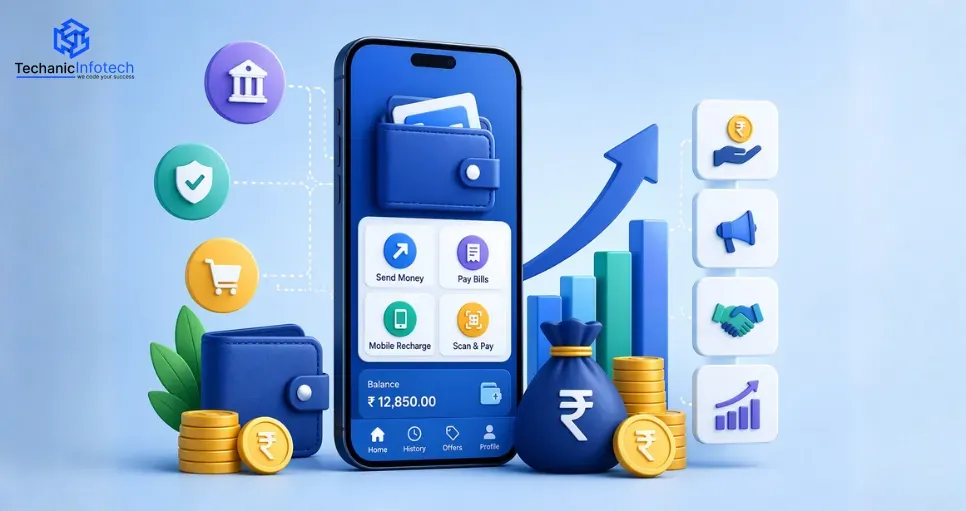
eWallet apps have fundamentally changed how one manages and spends money.
From sending money to friends to buying everyday goods and services and even investing in stocks, mobile wallets have indeed become indispensable parts of the larger financial ecosystem.
With PayPal, Venmo, and Cash App as examples, one can conclude that eWallets have become necessary tools for managing financial transactions rather than being just merely convenient things.
This is what made many investors curious “How eWallet apps make money?”
This blog will let you know about the top eWallet app monetization strategies, helping you to generate more stable revenues, improve the user experience, and sustain long-term business growth.
If you're building an eWallet app or have one and want to scale it up, understanding these strategies will equip you with the kind of insight you need to succeed in the competitive mobile wallet marketplace.
Without any delay, let’s get started:
Monetizing eWallet apps involves an array of options for the companies to delve into.
Transaction fees, affiliate marketing, data monetization & whatnot.
The range of options spans from each of these to an abundance of others that will help an app to become an asset.
Let's see some top monetization models for eWallet apps:
One of the well-known monetization models for apps like eWallets is charging transaction fees.
For each money transaction done via the app, a small percentage of the amount is charged as a fee.
As an example, PayPal charges its fees for business transactions, whereas personal transactions are usually free and rely on the type of payment used.
Transaction fees are cheap to scale, especially when your eWallet app does cross-border payments or currency exchange, where it usually attracts extra charges.
It is a good model to use in applications that encounter a large number of transactions.
In-app advertising is a tried and tested way to generate passive revenue.
You can make money from advertisers with every ad view or click by showing ads to your users.
eWallet apps can integrate any type of ad, such as:
Such monetization models are ideally suited for apps that have a large number of users.
Make sure to not interfere with the user experience. Other than that, it’s a great model to leverage a large user base especially when ads are shown intermittently or rewarded.
The third most popular eWallet app monetization strategy is paying a subscription fee for premium functions or premium services.
While the core functionalities like sending money will remain free of charge, more advanced eWallet app features in your app may be charged for, such as:
This model thus suits those who see value in premium functionalities and are ready to pay recurring fees for added convenience or exclusive features.
Another way to make money is to tie up with merchants and dealers.
By incorporating your eWallet app with such businesses you will earn a commission whenever a user makes a purchase using your app.
This is a win-win for both since the users will have a streamlined checkout experience while at the same time, you would earn your share of the percentage on any sale.
For instance, Google Pay and Apple Pay have implemented in-app payments with different merchants, so users can pay for groceries or make e-commerce purchases from the same application.
Other collaborations may involve incentives, discounts, and loyalty rewards, which drive users to make more purchases.
So, yes when considering revenue, make sure to integrate this eWallet app monetization strategy.
Although we do not suggest this, it has been quite a topic of discussion in the industry.
User data from eWallet apps such as transaction history, spending habits, and preferences are very precious.
This data could be summed up and anonymized to provide invaluable insights for businesses operating campaigns for targeted marketing.
Data monetization can also be in the form of selling insights into customer behavior or direct advertising to users.
However, in doing so, certain privacy laws like GDPR need to be adhered to.
Providing users with data transparency and control enables trust while still allowing you to tap into data to generate revenue.
If you have a large number of users for your eWallet application, monetize that by selling financial products directly to your users within the app.
Wouldn’t that be great!
For instance, you can offer to lend users funds (personal loans, payday loans, or microloans) based on their historical spending behavior.
This particular monetization model for the eWallet app adds a source of value to the users through the offer of a wide-ranging financial services ecosystem.
It may also potentially help diversify your revenue streams and enhance user engagement.
Talking about eWallet app monetization strategies, how can we leave this one behind?
So, Affiliate marketing can be done through the eWallet app by promoting third-party products or services.
This model best works with users who have trust in your platform and are likely to respond to recommendations.
For instance, if your application enables users to understand their spending, you can then sell credit cards, loans, and even subscription-based services, like budgeting tools.
Partnering with companies that benefit from your app's goals enhances the user experience while driving passive income.
Cross-border payment is becoming a new norm.
If your eWallet application supports cross-border payments or multi-currency transactions, you can make money through foreign exchange and currency conversion fees.
This is an especially efficient model for applications that enable users to send or receive money cross-border.
A foreign currency conversion fee may apply when a user transfers from a wallet where they do not have that currency, and it is usually a percentage of the amount being moved.
For instance, Revolut charges foreign exchange fees each time the user sends payments abroad.
This is an excellent digital wallet monetization model without impairing the user experience, especially in the case of cross-border payment where users need such frequent services.
But, to leverage, you need to consult an experienced mobile app development company.
Peer-to-peer, or P2P lending, is becoming a popular service within the eWallet ecosystem.
A P2P lending platform could then be integrated into the application, allowing users to lend money to other users in exchange for interest payments.
Through being an intermediary for borrowers and lenders, the system earns repetitive interest or charges fees on each transaction, thus earning revenue.
You can also charge management or transaction fees if your application facilitates investment for its users who buy or sell stocks, bonds, or even cryptocurrencies straight through that platform.
Transaction insurance is one relatively newer monetization model.
You can allow users to buy insurance over transactions, especially big amounts or international transfers.
This type of insurance protects users in cases of fraud, failed transactions, or issues on the receiving side, therefore providing a secure and hassle-free payment experience.
For example, if users send money abroad and are worried that the transfer might get delayed or lost, they can buy insurance coverage for a minimal cost.
This mobile wallet monetization model provides users peace of mind while offering a source of extra revenue for the app.
We hope that, at this point, you have gained some valuable insights regarding how to monetize a model efficiently in an eWallet application.
Let's dig deeper into how some of the most popular eWallet apps work towards their monetization strategies.
You can’t be a market leader without having a successful monetization model. After all, it’s no longer probable for long-term sustainability.
So, let's delve into some of the most popular eWallet apps , and how they have structured their monetization models.
This will give you an idea of how an eWallet app makes money, and what monetization models might work best for your app.
PayPal is the OG here.
It is one of the most popular eWallet applications in the world, allowing people to make easy online transactions and business payments.
Today, with millions of users around the world, it is among the most trusted and accepted digital wallet solutions.
Transaction Fee: PayPal earns a fee on sending and receiving payments, especially international transactions or business use.
Conversion fee for currencies: PayPal earns through conversion fees whenever a user pays in other currencies.
Merchant services: This payment solution helps businesses and incurs a small processing fee for each.
If you are developing an app like PayPal, then peer-to-peer payments and international transactions will be quite key to that aim.
You can take the lead of PayPal and provide merchant solutions while also making your revenue mainly from transaction fees.
Have you heard of Venmo? We believe so, yes!
Venmo, a subsidiary of PayPal, is extremely popular, particularly among younger consumers, when it comes to peer-to-peer money transfers.
The social aspect of Venmo with the capability for users to share payments and comments adds a social component to digital payments.
Instant Transfer Fees: They charge a fee from their users to transfer the funds immediately into their bank accounts.
Merchant Fees: Venmo lets clients make purchases at merchant businesses and makes a fee on each transaction.
In-App Advertising: It generates revenue by running ads inside the app as businesses would be interested in reaching out to its user base.
If you were looking to build something like Venmo, think about adding social features and instant transfer options as the integrations should drive engagement.
Using a combination of transaction fees, immediate transfer services, and advertising will make your app a sure money maker.
You know when something from Apple, it ought to be Perfect!
Apple Pay is one of the leading mobile wallet and payment systems. The app is used through iPhones, Apple Watches, and iPads.
Integrated into the Apple ecosystem, users can very easily and securely make online payments as well as in-store purchases.
Transaction Fees: Revenue is generated by Apple Pay when merchants pay a fee every time for a transaction carried out by using the app.
Apple Partnerships with Banks: Apple charges a fee to banks whenever customers add their credit cards to Apple Pay.
If you are building an app that's going to look like Apple Pay, you can look into partnering with the bank to make smooth transactions. Your monetization model for the eWallet app can be based on transaction fees and strategic partnerships.
Google Pay has a reputation of being the best.
With Google Pay, it becomes easier to store credit and debit cards securely and make payments directly from the smartphone. It's used heavily across Android devices and seamlessly integrates with Google services for the user's ease.
Transaction Fees: Google Pay charges merchants every time they receive a payment in the application.
Business Partnerships: Google Pay provides businesses with offers that are related to promotional tools and loyalty programs, thereby generating revenue through these services.
In-app advertising: Google Pay has made a revenue stream from running advertisements within the app.
If you're considering building an eWallet of your own, learning about Google Pay's relative balance between transaction fees and in-app advertising might be a wise decision.
Cash App by Square has mushroomed into popularity in a short amount of time.
With money transfer services along with buying and selling Bitcoin and even stock investment, it has established a presence in the market.
Cash App offers Flexibility with Many Features to Keep One Hooked.
Transaction Fees: There are fees associated with instant transfers and Bitcoin transactions with Cash App.
Cash Card Fees: It takes a small percentage of every transaction from users whenever they use their Cash App card to pay for something.
Stock and Bitcoin Trades: Cash App derives revenue from stock and Bitcoin trade fees, which apply in certain types of transactions.
If you want to create an app like Cash App, consider adding the user's ability to buy and sell cryptocurrencies, invest in stocks, offering instant transfers with related fees. You can look forward to different revenue streams from such features.
As we laid the foundation of top apps and their monetization model, we are going to talk about how you can choose the right model.
Selecting a proper monetization model for your eWallet application may require much thought and consideration.
Here are some of the key tips that may guide your decision-making process:
The first step of monetizing an app is to know the target audience.
Are your users tech-savvy millennials who can be targeted through in-app ads and gamified features?
Or, are they professional businessmen and women who value quick, secure payments? And would prefer subscription models for such premium features.
Your target audience will inform your choices of monetization.
Monetization is very much a zero-sum game where good monetization balances great revenue generation with great user experience.
Avoid overly aggressive monetization methods, such as having too many ads, charging extravagant fees, or being too obnoxious with upsells, which frustrate users and encourage churn.
Your monetization model also needs to scale with your expansion. Pick one that scales easily as your app scales.
Such as transaction fees or subscriptions scale easily while others like cross-selling products require more investment in infrastructure.
Compliance and security can be huge eWallet app development challenges when monetizing an eWallet app.
Make sure your app adheres to the stipulations of data privacy laws like GDPR or CCPA to prevent potential security breaches or legal complications.
All in all, security features like encryption and multi-factor authentication models should be there to secure transactions for users' finances.
Your monetization model needs to align with the core functionality of your app.
If it has an investment or loan service, a subscription model or cross-selling of financial products may be a better fit.
The more aligned your revenue model is to the value that your app primarily offers, the easier and less obtrusive it becomes for users.
Finally, consider the features while making decisions and determine the cost of making an eWallet app.
While generating quick revenue is important, the bottom line is that the app must eventually have the potential for long-term revenue generation.
For instance, in-app advertisements are able to produce revenue faster but may fade over time if the users don't continue to engage with the application.
Subscriptions, however, can generate regular streams of revenue and even more stable ones too.
Aside from this, using multiple monetization models (such as adding transaction fees to premium subscriptions) will help diversify income and make your eWallet app more resilient to market shifts.
Taking long-term sustainability into consideration will mean developing a much stronger revenue model that is responsive to the behavior of the users and changing market conditions.
Building a successful eWallet app would include a solid development plan and the right monetization strategy.
Techanic Infotech is a top eWallet app development company helping to create a mobile wallet that is secure, easy to use & monetized.
Our team of experts can take you through the entire process, from ideation to launch.
We make sure that our designs and features are in tune with the requirements of your target audience so that we are offering them a holistic monetization model in an eWallet app.
We will help you in aligning your eWallet app to meet user expectations while ensuring that your app develops into something that brings long-term profitability.
With mobile payment undergoing all these transformations, the window for making money by monetizing an eWallet app has never been better.
In-app transaction fees, advertising, subscription models, and strategic partnerships are among the factors that can help create a sustainable revenue model.
With the right strategy in place, you can be sure that your eWallet app will not only become a convenient tool for its users but also a profitable business venture for stakeholders and investors.
Let's work together to craft an app that will change the way money is managed while making sure your business thrives in a very competitive mobile payments market.
PayPal primarily makes revenue through transaction fees, currency conversion charges, and merchant services. Revenue is also generated through its vast network of business relationships as well as through premium services.
Yes, you would be able to combine different monetization strategies, including transaction fees, in-app advertisements, and premium services, into a diversified income model for the eWallet application.
In-app advertising enables businesses to reach a targeted audience through ads shown in the app. eWallet apps generate revenue by charging businesses for running these ads to their user base.
The cost of developing an eWallet app varies with the features, the platform of operation (iOS or Android), and the complexity of the app. It will be better to seek an estimation from a mobile app development company based on your requirements.
The most used monetization models are transaction fees, merchant fees, in-app advertising, and premium features. These models help the eWallet apps earn money by offering value-added services to customers.


Abhishek Jangid is the CEO of Techanic Infotech, with extensive experience in mobile app and web development. He specializes in helping businesses turn innovative ideas into scalable digital solutions through strategic planning and modern technology.