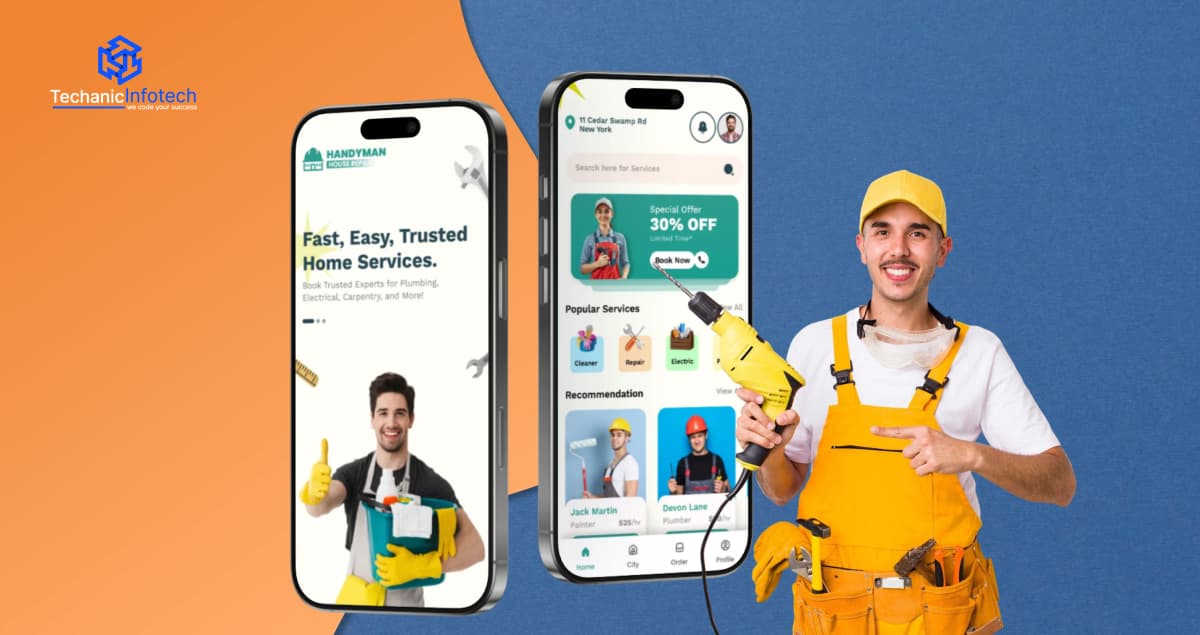
Ever wondered how much it actually costs to build a handyman app like the ones people use to book plumbers, electricians, or repair experts in minutes? If you’re planning to enter the on-demand home services market, this is usually the first and most important question.
The handyman app development cost ranges between $5,000 and $80,000 but it totally depends on several things, such as the type of features you want, the app’s complexity, and how fast you want it built. From understanding the cost to exploring handyman app features, pricing factors, and the overall handyman app development timeline, every decision affects your budget.
In this guide, we’ll break down the handyman service app development cost in a simple way and walk you through the complete development process, so you can plan your app idea with clarity and confidence.
The market for on-demand handyman and home service apps is growing rapidly as users increasingly prefer booking services through mobile platforms. This strong demand is driving growth in both traditional home services and digital marketplaces.
Here are key stats that show the current size and potential of the industry:
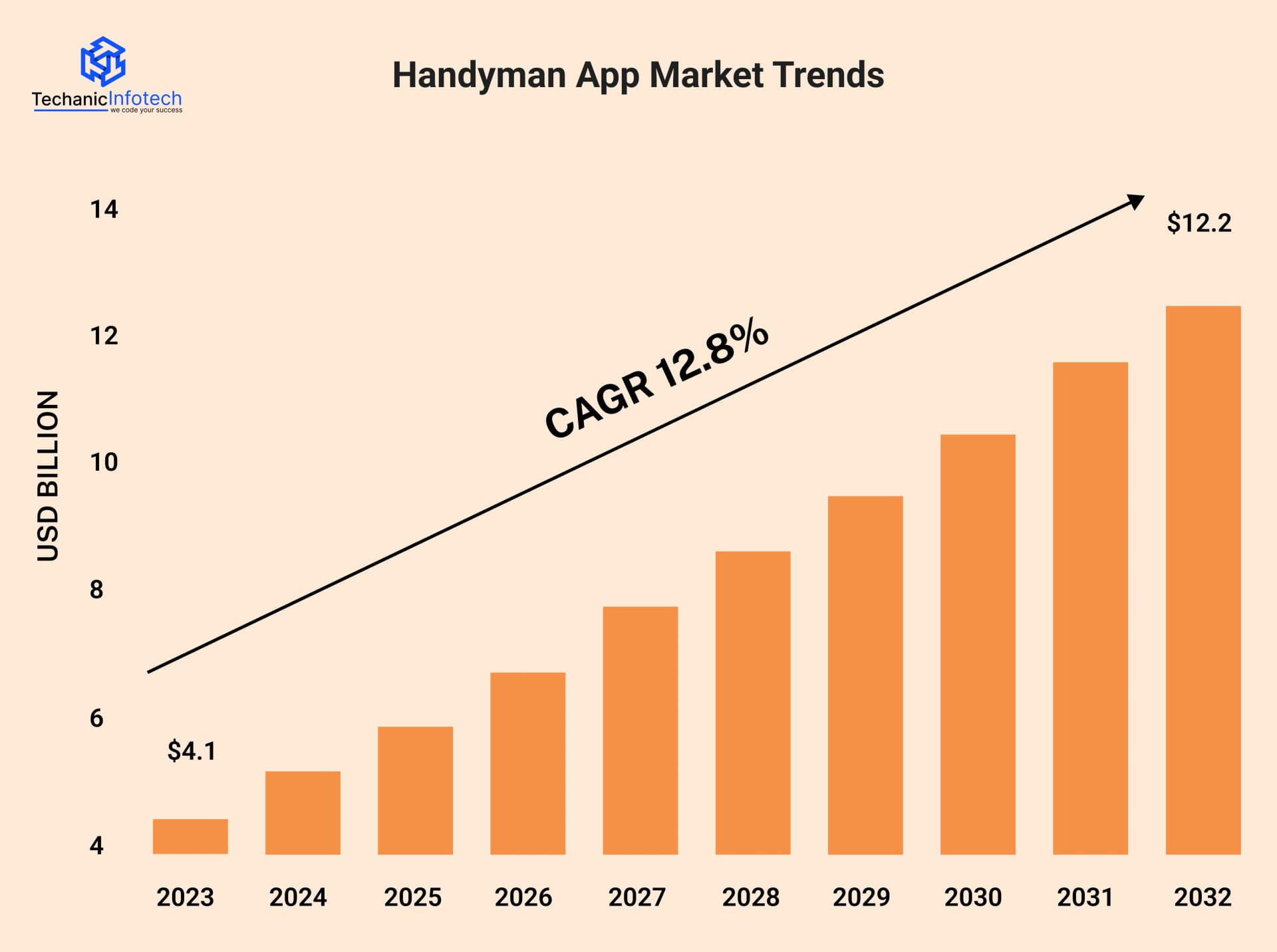
The global on-demand handyman app market was valued at around $4.1 billion in 2023 and is projected to reach about $12.2 billion by 2032, growing at a strong pace as convenience drives adoption.
The handyman service market is expected to grow significantly, with forecasts suggesting it could reach over $479.8 million by 2026 as demand for repair and maintenance rises.
The broader online on-demand home services market is expected to reach over $19.65 billion by 2033, showing strong digital adoption.
Another projection estimates the global handyman services market at $530.5 million in 2025, growing to around $2.34 billion by 2035.
In the broader home services space, on-demand home services are predicted to grow steadily, with one estimate showing the market reaching over $19 billion by 2033.
Some reports also suggest the global on-demand home services sector could be worth hundreds of billions by 2031, driven by digital adoption and changing consumer preferences.
These figures highlight how rapidly the home services ecosystem, including handyman marketplace app development, is expanding, creating opportunities for new on-demand platforms.
A successful handyman app is built around convenience, trust, and ease of use. Whether you’re planning a basic app or full handyman marketplace app development, the mobile app features you choose directly impact user experience and overall cost.
Below are the most important handyman app features explained in simple terms.
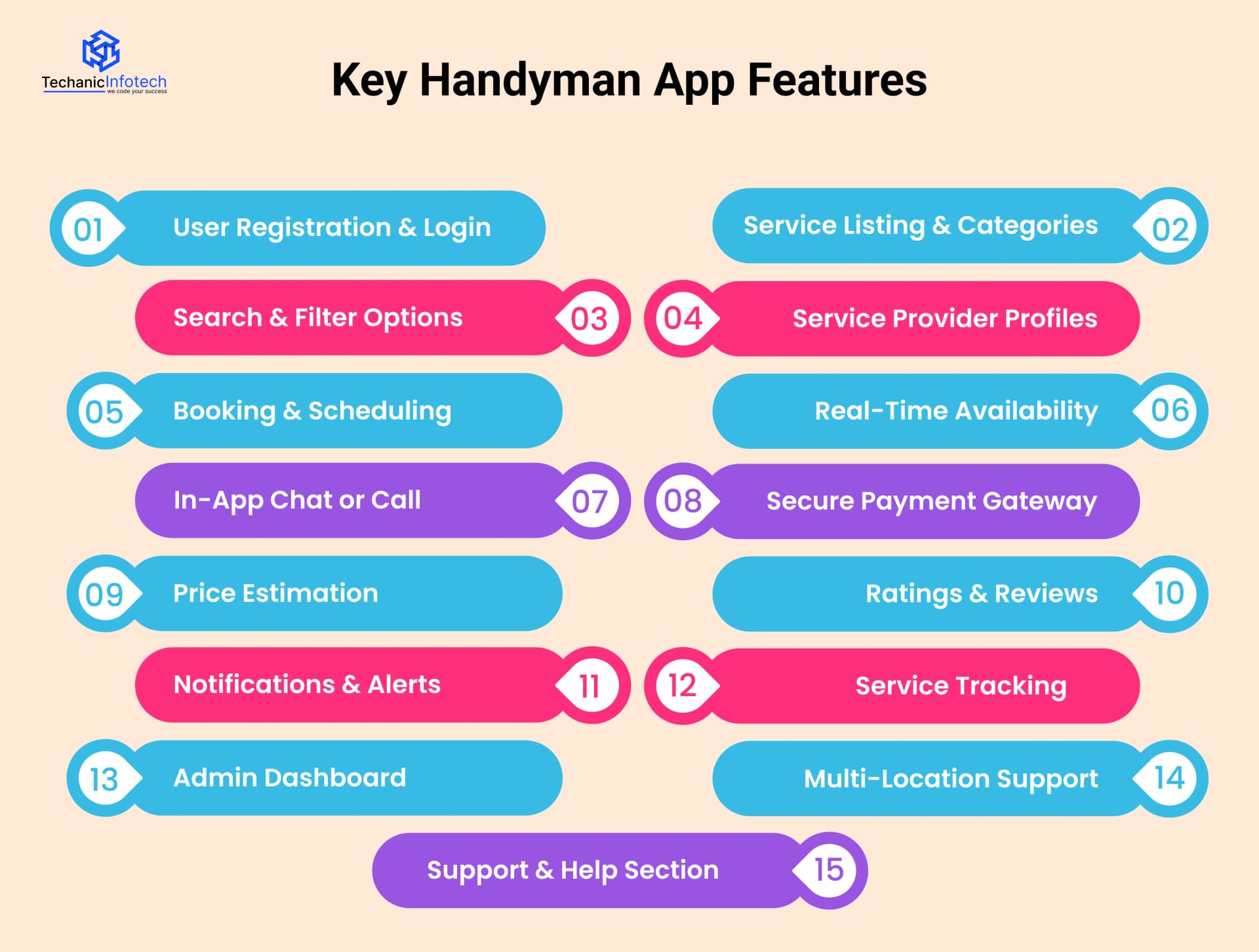
User Registration & Login: Allows customers and service providers to sign up using email, phone number, or social accounts for quick access.
Service Listing & Categories: Displays services like plumbing, electrical work, cleaning, carpentry, and repairs in clear categories so users can find what they need easily.
Search & Filter Options: Helps users search for services based on location, price, ratings, or availability, improving booking speed.
Service Provider Profiles: Shows handyman details such as experience, skills, ratings, reviews, and completed jobs to build trust.
Booking & Scheduling: Enables users to book services instantly or schedule them for a later date and time.
Real-Time Availability: Displays whether a handyman is available or busy, reducing booking conflicts.
In-App Chat or Call: Allows customers and service providers to communicate directly for job details or clarifications.
Secure Payment Gateway: Supports multiple payment options like cards, UPI, wallets, or cash to ensure smooth transactions.
Price Estimation: Gives users a rough cost estimate before booking, improving transparency in handyman app pricing.
Ratings & Reviews: Lets users rate services and leave feedback, helping maintain quality across the platform.
Notifications & Alerts: Sends updates for booking confirmation, service status, payments, and reminders.
Service Tracking: Allows users to track handyman arrival and job progress in real time.
Admin Dashboard: Enables app owners to manage users, services, payments, and disputes from one place.
Multi-Location Support: Useful for scaling the app to different cities or regions.
Support & Help Section: Provides assistance through FAQs, chat, or customer support tickets.
Choosing the right mix of features helps control the pricing while delivering a smooth and reliable experience for both customers and service providers.
The cost to build a handyman app depends on the type of app you want to launch and the features you include.
On average, the handyman app development cost ranges between $5,000 and $80,000. This wide range exists because some apps are simple booking platforms, while others are full handyman marketplace solutions.
A basic handyman app with essential features like user registration, service listings, booking, and payments usually costs around $5,000 to $15,000. These apps are suitable for startups or small service providers who want to enter the market quickly.
A mid-level app with advanced features such as real-time tracking, in-app chat, price estimation, and ratings can cost between $20,000 and $40,000. At this level, the mobile app development cost increases due to better design and functionality.
For large businesses, the cost can go up to $50,000 to $80,000. These apps include complex features, admin panels, and multi-city support. Understanding these factors helps plan the right handyman app development pricing and budget effectively.
|
Development Stage |
Role in App Development |
Average Cost (USD) |
|
Requirement Analysis & Planning |
Defines app goals, features, user flow, and technical scope |
$500 – $2,000 |
|
UI/UX Design |
Designs user-friendly screens and overall app experience |
$1,000 – $6,000 |
|
Frontend Development |
Builds the app interface for users and service providers |
$2,000 – $15,000 |
|
Backend Development |
Develops servers, databases, APIs, and business logic |
$3,000 – $20,000 |
|
Payment Gateway Integration |
Adds secure online payment and transaction handling |
$800 – $4,000 |
|
Third-Party API Integration |
Integrates maps, notifications, analytics, and tools |
$1,000 – $6,000 |
|
Admin Panel Development |
Manages users, services, pricing, and reports |
$1,500 – $8,000 |
|
Testing & Quality Assurance |
Tests app performance, bugs, and security |
$800 – $4,000 |
|
Deployment & Launch |
Publishes app on App Store and server setup |
$500 – $2,000 |
|
Maintenance & Support (Annual) |
Updates, bug fixes, and performance improvements |
$1,500 – $6,000 |
The cost of developing a handyman app is not fixed. It depends on several practical decisions you make during planning, such as the type of app, platforms, features, and technology choices. Understanding these factors helps you estimate the budget more accurately and avoid unexpected expenses.
This factor defines the overall structure of your app. A single service app is built around one business offering and usually follows a simple booking flow. A handyman marketplace app, however, functions like a platform business, where multiple service providers and customers interact.
Marketplace apps require extra logic for provider onboarding, service approval, commission handling, dispute management, and performance tracking. Because of this added operational layer, they require more development time, testing, and backend planning, directly increasing the cost to create a handyman app.
|
App Type |
Best Suited For |
Average Cost |
|
Single Service App |
Individual businesses or local providers |
$5,000 – $20,000 |
|
Handyman Marketplace App |
Startups and multi-service platforms |
$25,000 – $80,000 |
Total App Type Cost: $5,000 – $80,000
Platform choice affects cost because each operating system has its own design guidelines, development standards, and testing requirements. Developing for a single platform helps reduce initial investment and speeds up launch.
Supporting both Android and iOS means maintaining consistent performance across devices, handling OS-specific updates, and conducting extended testing. While cross-platform frameworks can optimize effort, multi-platform apps still increase the cost to build a handyman app due to broader coverage.
|
Platform Selection |
Launch Strategy |
Average Cost |
|
Single Platform (iOS & Android) |
Faster launch, lower initial cost |
$5,000 – $30,000 |
|
Android + iOS |
Wider reach, higher investment |
$15,000 – $50,000 |
Total Platform Development Cost: $5,000 – $50,000
Features determine how powerful and competitive your handyman app will be. A minimal feature set helps validate the idea, while advanced features support scale and automation.
Each new feature increases backend logic, UI screens, and testing complexity. Real-time tracking, admin controls, and analytics require deeper system architecture, which raises the mobile app development cost. Choosing features in phases is often the smartest way to manage budget.
|
Feature Level |
Included Features |
Average Cost |
|
Basic Features |
Login, service listing, booking, payments |
$5,000 – $15,000 |
|
Mid-Level Features |
Chat, notifications, ratings, scheduling |
$15,000 – $35,000 |
|
Advanced Features |
Real-time tracking, admin panel, analytics |
$35,000 – $80,000 |
Total App Features & Functionality Cost: $5,000 – $80,000
UI/UX design directly impacts how easy and trustworthy your handyman app feels to users. A simple design with standard screens keeps development fast and affordable. However, if your app needs custom layouts, smooth animations, user-friendly booking flows, or branding-focused visuals, the design effort increases.
Complex UI/UX also requires more user testing and revisions to ensure smooth navigation for both customers and service providers. This added design and testing time raises the overall handyman app development cost, but it can significantly improve user engagement and retention.
|
UI/UX Element |
Description |
Average Cost |
|
User Flow Design |
Planning smooth booking and navigation flow |
$800 – $2,500 |
|
Wireframes |
Basic screen structure and layout planning |
$500 – $1,500 |
|
Visual Design |
Colors, typography, branding, and icons |
$1,500 – $4,000 |
|
Interactive Prototypes |
Clickable designs for user testing |
$1,000 – $3,000 |
|
Animations & Micro-Interactions |
Transitions, loading effects, feedback actions |
$1,500 – $5,000 |
|
Responsive Design |
Optimizing UI for different screen sizes |
$800 – $2,500 |
Total UI/UX Design Cost: $4,000 – $18,000
Third-party integrations help your handyman app function smoothly without building everything from scratch. Common integrations include payment gateways, maps, push notifications, analytics tools, and customer support systems.
While basic integrations are straightforward, complex or custom integrations require extra development and testing. Paid APIs may also include licensing or usage fees. These integrations increase the cost to develop a handyman app, but they save long-term effort and improve reliability.
|
Integration Type |
Description |
Average Cost |
|
Payment Gateway |
Online payments (cards, UPI, wallets) |
$800 – $3,000 |
|
Maps & Location Services |
GPS tracking and service location |
$700 – $2,500 |
|
Push Notifications |
Alerts for booking, updates, reminders |
$500 – $1,500 |
|
SMS & Email Services |
OTPs, confirmations, notifications |
$500 – $1,200 |
|
Analytics Tools |
User behavior and performance tracking |
$800 – $2,500 |
|
Customer Support Tools |
In-app chat or helpdesk systems |
$1,000 – $3,500 |
Total Integration Cost: $4,000 – $15,000
The location and experience level of your development team strongly influence pricing. Teams in regions like North America or Western Europe generally charge higher rates due to labor costs, while teams in countries like India offer more affordable pricing.
Expertise also matters. An experienced team may cost more upfront but reduces errors, rework, and delays. This often results in better quality and controlled home service app development cost over time.
|
Country |
Hourly Rate (USD) |
Average Project Cost |
|
United States |
$100 – $150/hour |
$40,000 – $80,000 |
|
United Kingdom |
$80 – $130/hour |
$35,000 – $70,000 |
|
Germany |
$70 – $120/hour |
$30,000 – $65,000 |
|
Australia |
$60 – $110/hour |
$30,000 – $60,000 |
|
India |
$20 – $50/hour |
$8,000 – $30,000 |
The technology stack defines how your handyman app is built, how fast it performs, and how easily it can scale in the future.
It includes frontend technologies for the mobile app, backend frameworks for handling business logic, databases for storing data, and cloud services for hosting. A modern and well-chosen mobile app tech stack ensures smooth booking, secure payments, and real-time updates.
While advanced technologies may slightly increase the cost to build a handyman app, they help reduce long-term issues like poor performance or frequent crashes. Choosing the right stack also makes future upgrades easier and more cost-effective.
|
Technology Layer |
Tools / Technologies |
Purpose in the App |
Average Cost |
|
Mobile App Frontend |
Flutter / React Native / Swift / Kotlin |
Builds user and service provider mobile apps |
$4,000 – $18,000 |
|
Web Frontend (Admin Panel) |
React.js / Angular / Vue.js |
Admin dashboard and management panel |
$2,000 – $8,000 |
|
Backend Framework |
Node.js / Laravel / Django / Spring Boot |
Handles business logic, APIs, workflows |
$5,000 – $22,000 |
|
Database |
MySQL / PostgreSQL / MongoDB |
Stores users, bookings, payments, reviews |
$1,500 – $5,000 |
|
Cloud Infrastructure |
AWS / Google Cloud / Azure |
Hosting, scalability, data storage |
$2,000 – $8,000 |
|
Authentication & Security |
OAuth, JWT, Firebase Auth |
User login, role-based access, security |
$1,000 – $4,000 |
|
Payment Gateway |
Stripe / Razorpay / PayPal |
Secure in-app payments |
$800 – $3,500 |
|
Maps & Location Services |
Google Maps / Mapbox |
Location-based service discovery |
$800 – $2,500 |
|
Notifications |
Firebase Cloud Messaging / Twilio |
Push notifications and SMS alerts |
$700 – $2,000 |
|
Analytics & Monitoring |
Google Analytics / Mixpanel |
Track user behavior and app performance |
$800 – $3,000 |
|
CI/CD & DevOps |
Docker / GitHub Actions |
Automated deployment and updates |
$1,000 – $4,000 |
Technology Stack Cost Range: $8,000 – $35,000
Building a handyman app is not a one-time cost. After launch, regular maintenance and support is required to keep the app stable, secure, and compatible with new device updates. Maintenance includes fixing bugs, improving performance, updating features, and applying security patches.
Without proper maintenance, apps may face downtime, user complaints, or security risks. Ongoing updates help improve user experience and keep the app competitive. These recurring efforts are an important part of the overall handyman service app development cost and should be planned in advance.
|
Maintenance Area |
What It Covers |
Average Annual Cost |
|
Bug Fixes |
Resolving post-launch issues |
$800 – $3,000 |
|
Performance Optimization |
Speed, stability, and load improvements |
$1,000 – $3,500 |
|
OS & Device Updates |
Compatibility with new Android/iOS versions |
$1,000 – $4,000 |
|
Feature Enhancements |
Minor feature improvements |
$1,500 – $5,000 |
|
Monitoring & Support |
App uptime and issue monitoring |
$800 – $2,500 |
Annual Maintenance Cost: $4,000 – $15,000
Scalability determines how well your handyman app can grow as your business expands. This includes supporting more users, adding new services, launching in multiple cities, and integrating advanced features over time.
Apps built with scalability in mind can handle higher traffic without slowing down. Planning future enhancements early may slightly increase initial development effort, but it helps avoid costly rework later. Scalability ensures your investment remains valuable as demand and competition increase.
|
Scalability Element |
Purpose |
Average Cost |
|
Multi-City Expansion |
Supporting multiple service locations |
$2,000 – $8,000 |
|
Increased User Load |
Handling higher traffic and bookings |
$2,000 – $7,000 |
|
Advanced Admin Controls |
Automation and reporting tools |
$1,500 – $5,000 |
|
New Feature Modules |
Adding new services or workflows |
$3,000 – $12,000 |
|
Infrastructure Scaling |
Server upgrades and load balancing |
$1,500 – $6,000 |
Scalability & Enhancement Cost: $5,000 – $25,000
The handyman app development timeline depends on the app’s complexity, feature set, and platforms you choose.
While every project is different, most handyman apps follow a structured mobile app development process that ensures quality, stability, and scalability. On average, building a handyman app can take anywhere from 8 weeks to 6 months.
Below is a detailed breakdown of each stage.
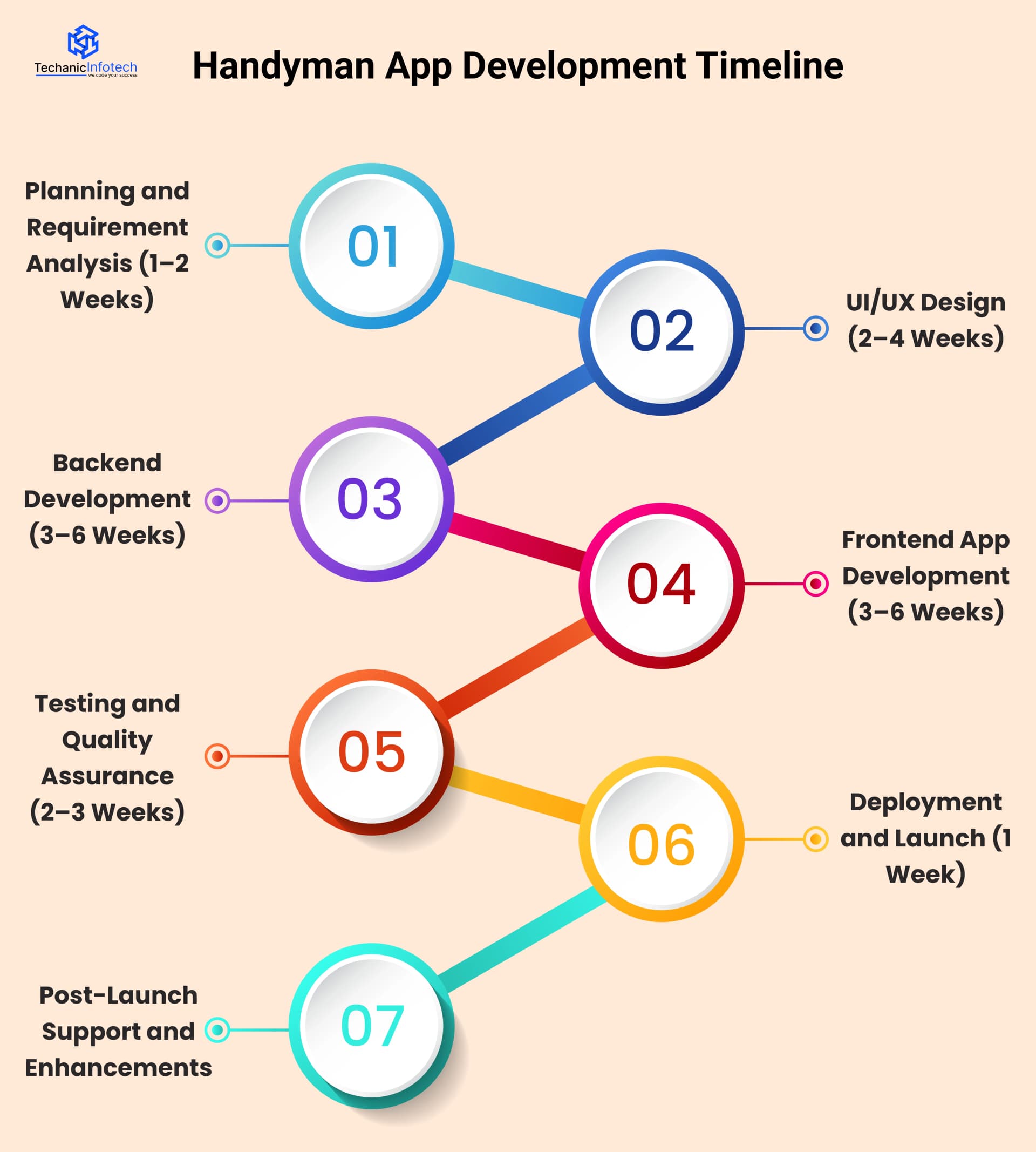
This is the foundation stage of the handyman app development process. The team defines business goals, target users, core features, and technical requirements. Wireframes and user flows are also planned here. Proper planning at this stage helps avoid rework later and keeps the development timeline on track.
Once requirements are clear, designers create user-friendly interfaces for customers, service providers, and admins. This includes layouts, navigation flow, and interactive prototypes. A well-designed UI improves usability and reduces confusion, which is especially important for on-demand service apps.
Backend development focuses on building the server-side logic that powers bookings, payments, user management, and notifications. APIs, databases, and security layers are developed during this phase. For marketplace apps, this stage takes longer due to provider management and admin controls.
Frontend development brings the design to life on Android and iOS platforms. Developers integrate features such as service listings, booking, chat, and real-time updates. If the app supports multiple platforms, this stage may run parallel to backend development.
Testing ensures the app works smoothly across devices and scenarios. Functional testing, performance testing, and security checks are done to fix bugs and improve stability before launch.
The app is prepared for release on Play Store, servers are configured, and final checks are completed. Post-launch monitoring begins to track performance and user feedback.
After launch, ongoing updates, feature enhancements, and maintenance help the app stay competitive and scalable as the business grows.
This structured timeline helps businesses plan resources, budget, and launch goals more effectively.
Building a handyman app does not have to be expensive or time-consuming if it is planned the right way. Many projects go over budget simply because of poor planning or unnecessary features.
Below are practical and easy-to-follow tips that help reduce both the cost and mobile app development time.
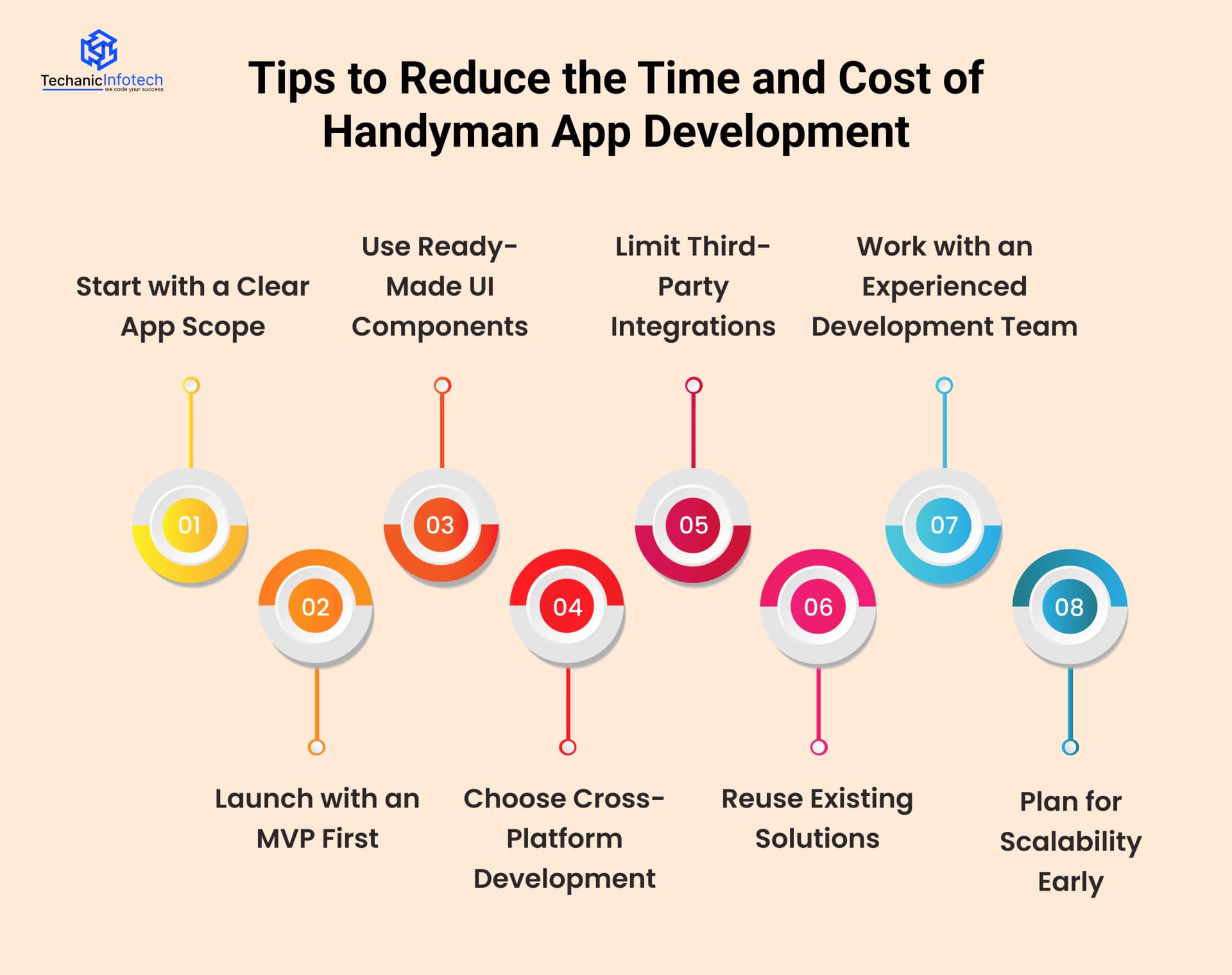
Before development begins, clearly define what your app should do. List only the essential features required for launch. A well-defined scope avoids frequent changes during development, which often increase both cost and timeline.
Instead of building a full-scale app at once, start with a Minimum Viable Product (MVP). An MVP includes only core features such as booking, payments, and service listings. This helps you launch faster, validate your idea, and reduce the initial cost to build a handyman app.
Custom designs take more time and effort. Using pre-built UI components and templates can speed up development while keeping the app clean and professional. You can always improve the design later once the app gains traction.
Building separate apps for Android and iOS increases cost. Using cross-platform frameworks allows developers to write one codebase for both platforms, saving development time and reducing the overall handyman service app development cost.
Integrations like payments and maps are necessary, but too many tools increase complexity. Choose only essential third-party services at the beginning. Additional tools can be integrated later as your app grows.
Avoid reinventing the wheel. Use proven libraries, APIs, and backend modules that are already tested. This shortens development time and lowers the risk of errors.
An experienced team may cost slightly more upfront but helps avoid mistakes, delays, and rework. Skilled developers deliver faster and build scalable solutions that save money in the long run.
Building a scalable foundation early prevents costly changes later. Even basic planning for future growth helps save time and development effort down the line.
By following these tips, businesses can build a reliable handyman app faster while keeping costs under control.
Our handyman app development company helps businesses turn handyman app ideas into reliable, scalable, and cost-efficient digital products. Instead of overbuilding, the team focuses on what truly matters, clean design, essential features, and a strong technical foundation.
From MVP development to full-scale handyman marketplace apps, every solution is planned to reduce time, control cost, and support future growth.
With hands-on experience in on-demand app development, Techanic Infotech follows a transparent process, uses modern technologies, and keeps communication simple at every stage. If you want to launch a handyman app faster without unnecessary complexity, Techanic Infotech helps you build it the right way from day one.
Building a handyman app is a smart move in today’s on-demand service market, but success depends on careful planning and the right development approach. From choosing the app type and features to managing time and budget, every decision affects the final outcome.
Understanding the handyman app development cost, timeline, and key influencing factors helps businesses avoid delays and unnecessary expenses.
By focusing on essential features, using the right technology, and working with an experienced development partner, you can launch a reliable and scalable handyman app. With proper strategy, your app can grow smoothly and meet long-term business goals.
The handyman app development cost usually ranges between $5,000 and $80,000, depending on the app type, features, platforms, and development approach.
The average handyman app development timeline is 8 weeks to 6 months. Simple apps take less time, while marketplace apps with advanced features take longer.
Key factors include app type, number of platforms, features, UI/UX design complexity, third-party integrations, technology stack, and development team location.
Starting with one platform helps reduce initial cost and development time. You can expand to both Android and iOS later as the business grows.
Yes. Launching an MVP, limiting features at the start, using cross-platform development, and choosing the right development partner can significantly reduce cost.
A handyman app usually offers one service, while a handyman marketplace app connects multiple service providers and customers on one platform.
Yes. Regular maintenance is essential for bug fixes, performance updates, security patches, and feature improvements.
Yes. With growing demand for on-demand home services, handyman apps offer strong business potential when built with the right strategy.


Bharat Sharma is the CTO of Techanic Infotech, bringing deep technical expertise in software architecture, mobile app development, and scalable system design. He leads the engineering team with a strong focus on innovation, performance, and security.