Home Service App Development
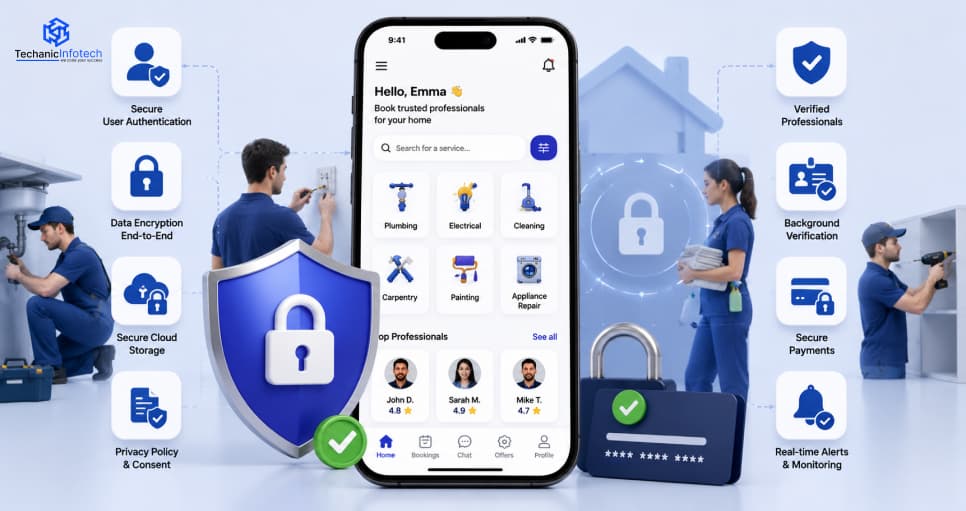
Home Service App Security: Best Practices to Protect User Data and Payments
June 9, 2026
June 9, 2026
The home services industry has undergone a significant digital transformation in recent years. From booking plumbers and electricians to hiring cleaners and handymen, customers now rely on mobile applications to access services quickly and conveniently.
However, as home service apps continue to handle increasing amounts of personal information, payment data, and real-time location details, security has become a critical concern for both businesses and users. A single security vulnerability can expose sensitive customer information, damage brand reputation, and lead to significant financial losses.
That's why security should never be treated as an afterthought during home service app development. Implementing robust security measures helps protect customer data, prevent fraudulent activities, ensure regulatory compliance, and build long-term trust among users and service providers.
In this guide, we'll explore the most common security challenges in home service apps, proven strategies to protect user data, compliance requirements, best practices for service providers, and emerging security trends shaping the future of the industry.
On these apps, users share names, phone numbers, addresses, and payment details. If these details are not protected, hackers can steal this information. This can be the biggest threat to the security of your home service app.
Apps often store card details or use wallets for seamless payment. Weak payment security can open doors for scams and fraud. Protecting transactions is a key part of home service app security.
Sometimes fake service providers or customers try to enter the platform. This can lead to unsafe visits to homes or fake bookings. Without proper security checks and verification, trust in the app drops quickly.
If the app allows weak passwords or single-step login, it becomes easy to break in. Strong login is one of the most important components of home service app security. Such a login approach is also a doorway to your app network, and hence any unauthorized access should be eliminated.
Outdated code and poor app testing leave gaps. Further, hackers can leverage these gaps to take control of the app. Hence, not investing in app maintenance and upgrades is one of the key challenges that service apps can face. Keeping systems updated is the only way to stop this.
Not all risks come from outside. Staff or providers can sometimes misuse data or make unintended errors in data processing due to a lack of awareness. Hence, it is recommended to invest in staff training and implement strict rules to reduce these risks.
Being aware of the risks and associated challenges is only halfway. But along with that, you need to work on strategies that can help secure your home service apps.
However, while framing such strategies, keep in mind the user experience, and ensure that the security doesn't impact their experience at large.
So, let’s consider some proven ways to secure your home service app.
The most effective way is to add multifactor login, like password plus OTP. Also, you can allow fingerprint or face ID for faster and safer access. Such multistep logins lower the chance of fake logins. This can increase your overall cost to develop a home service app , but it’s important.
It is recommended to encrypt all data from user details to payments. Such ensures that even if hackers get the data, the data will stay encrypted. This can be one of the most basic home service app security strategies to consider.
Use trusted payment gateways like Stripe or PayPal. Also, design your app in a manner that it never stores card details directly in the app. Always show payment confirmation screens, allow users to enter OTPs, and provide confirmations, so users can feel safe.
Outdated apps are easy targets for hackers. Push regular updates to fix small bugs and gaps in security patches. Such helps keep the security of your home service app strong and even improves with time.
Not everyone needs full control. Hence, limited access can be planned for user segments such as service providers, admins, and staff. Such allows keeping sensitive data safe, without disrupting the entire workflow.
Service apps can use monitoring tools to track unusual activity. If someone tries to log in too many times, it can automatically send an alert. Such quick action can keep both the user and the platform alert and stop bigger security concerns.
Home service apps rely on APIs to connect maps, allow payments, and more. But before integrating any API to your platform, make sure it is protected with tokens and encryption. The security threat or gap from APIs can also impact your users’ experience.
User education is also an effective way if you are concerned about how to secure your home service app. Guide users on setting strong passwords and reporting scams. Clear in-app navigation can reduce many common risks.
Keep regular backups of app data. Such backups are effectively helpful in case of any data breach or event of app crash. Through such backups, the app can recover fast without losing user trust.
When you combine these strategies, the role of security in home service app design becomes clear. The security of your app is about leveraging technology to build trust and consider responsibility.
Good security isn't just about technology. It is also about respecting laws that defend user data.
If you aim to secure your home service app both ethically and legally, you must be familiar with the regulatory compliance and legal considerations.
Some must-follow considerations for home service apps are:
There are laws such as GDPR in the EU and CCPA in the US that countries follow. These laws instruct businesses on how to store and share user data in different scenarios. Violating them will result in hefty fines, along with the loss of users’ faith in the app.
Accepting payments is one of the most common features of a home service app. Hence, if you accept payments through your app, you'll need to adhere to PCI DSS standards. They ensure card transactions are secure also minimize the potential for fraud.
While operating globally, it is important to be aware of the local norms and regulations. Some regions will have additional requirements for online services or online platforms. Be sure to check with a law expert to remain updated as per the region.
Your app should display an evident privacy policy. Inform users what data you are gathering, for what reasons you are gathering it, and how it will be used. This makes your app transparent and trustworthy.
Always request permission from users before viewing sensitive information such as location or contacts. Explicit permission is not merely a legal requirement but also a mark of respect for users.
The impact of security in a home service app can be worse if not audited timely manner. It is recommended to conduct timely security and legal checks. This guarantees your app remains compliant with evolving laws.
By taking these legal steps, you minimize risks and show users that you honor their privacy.
Security is not only about the app. Service providers who use the platform also play a big role in keeping it safe. When providers follow the right steps, it protects both the business and the customers.
Ask providers to create strong passwords and enable two-factor authentication for their accounts. Such makes it challenging for attackers to break in.
Always check the identity of every provider. Ask for valid documents and run background checks. Verified profiles make customers feel safe when booking.
Keep all chats and calls inside the app. This reduces scams and gives you a record in case of disputes.
Embrace a system that allows providers to accept payments only through the app or through secured routes. This lowers fraud risks and ensures that customers have proof of payment.
Teach providers about security practices. Share tips on spotting fake requests or phishing messages. A little awareness goes a long way.
Have clear rules for provider behavior. If someone breaks these rules, you can act fast and keep the platform safe.
Remind providers to keep their phones and apps updated. Outdated devices often have security gaps.
These practices, if adopted thoroughly by the service provider, can protect both sides of the app. Customers feel safe booking services, and providers build trust with their clients.
Trust is the reason people return to an app again and again. Accordingly, the home service app's security plays a direct role in building that trust. When customers feel safe, they book more often and even recommend the app to others.
Share your security policies with the customers. Let them know their data is encrypted, and their payments are protected. Transparency makes users confident about using the app, and hence improves retention.
Show verified badges on service provider profiles. A simple tick mark or label helps customers know the provider is genuine. Small details like this reduce hesitation during booking.
Add visible signs that payments are safe. Such signs can be payment confirmation messages and verified and legal receipts. Customers should never feel unsure about their money.
Provide fast support channels in case of problems. A visible help button or 24*7 chat makes people feel backed up. Hence, they will be able to make bookings more conveniently through the app.
When adding a new home service app feature , keep the app updated with safety functions. When users see regular improvements, they know the app is cared for and monitored. Such updates can be regarding any specific feature upgrade or security patch updates.
Never share customer details without consent. Make privacy policies clear and easy to understand. Customers trust platforms that respect their personal information.
When security is visible and reliable, it turns into a trust builder. Customers stop worrying about risks and focus only on getting quality services. Trust created through security also helps the business scale with time.
Technology keeps evolving, and accordingly, the Impact of security in home service apps shifts. With time, home service apps will need stronger systems in the future to stay safe and reliable.
Here are a few trends to watch to ensure the security of your home service app:
Security is one of the top challenges in home service apps , which is why Logins will move beyond passwords. Face scans and fingerprints will turn out to be a must-have and a secure approach, making it hard for intruders to break in.
Apps will start using artificial intelligence to spot unusual behavior. This can help reduce the risk of fraud before it happens.
Secure payment methods like blockchain will reduce the risks of tampering and bring more trust to online transactions done on these home services apps.
Customers and providers may get instant alerts when something suspicious happens. Quick action can prevent bigger issues.
Users will expect more control over their personal data. Options to manage permissions will become a standard feature.
Communication between customers and providers will be encrypted. This will keep chats, addresses, and instructions safe from leaks.
Future apps will likely include automated security checks that run in the background and fix weaknesses fast.
The future of home service app security will focus on making users feel safe at every step. The stronger the security, the higher the trust. Businesses that adapt to these trends will keep their customers close and ahead of competitors.
In today's online world, one security breach can lead to irreparable damage to your brand and user trust in a second.
This is why having a secure and safe home service app is important. Techanic Infotech, a home service app development company , is committed to offering the best home service app available, free from cyber harm.
We incorporate sophisticated encryption, secure authentication, and secure API integration to ensure user data protection.
By protecting payment data and discovering possible vulnerabilities, our team designs apps with security in mind, while also ensuring ease of use.
With Techanic Infotech, you can have a reliable, secure, and user-trusted home service app that ensures your customers and business are protected.
Home service app security is not something you can leave for later. It protects users, builds trust, and keeps your business safe. A secure app gives customers confidence to book services without worry. From data protection to strong login systems, every layer matters.
The role of security in home service apps will only grow as users share more personal details. Following the right strategies today helps avoid costly risks tomorrow. Whether it is encryption, safe payments, or regular checks, every step counts.
If you want your app to succeed, focus on security as much as features. Secure your home service app, and you will see lasting trust, stronger growth, and happy users who return again and again.
Security protects user data, payments, privacy, and builds long-term customer trust.
Data breaches, payment fraud, fake profiles, weak authentication, and cyberattacks.
Implement multi-factor authentication, strong passwords, biometric logins, and access controls.
Encryption protects sensitive user information from hackers and unauthorized access attempts.
Home service apps should comply with GDPR, CCPA, PCI DSS, and local regulations.
Strong security reassures users, encourages bookings, increases retention, and boosts loyalty.


Bharat Sharma is the CTO of Techanic Infotech, bringing deep technical expertise in software architecture, mobile app development, and scalable system design. He leads the engineering team with a strong focus on innovation, performance, and security.