Agriculture App Development
How to Build an Agriculture App That Farmers Actually Use?
January 23, 2026
January 23, 2026
The agriculture industry is rapidly embracing digital transformation, helping farmers and agribusinesses make smarter, data-driven decisions.
From crop monitoring and weather forecasting to supply chain management and online marketplace, mobile apps are reshaping how modern farming operates. If you’re planning to build an agriculture app, understanding the right approach is essential for long-term success.
As agri-tech experts often point out, digital farming tools are no longer optional; they are becoming essential for sustainable and profitable agriculture.
A well-designed agriculture app can improve productivity, reduce operational costs, and connect farmers with real-time insights they can trust.
However, building such a solution requires more than just an idea-it demands clear goals, the right technology stack, and a deep understanding of user needs.
This complete step-by-step guide takes you through everything required to plan, design, develop, and launch a scalable agriculture app that delivers real value in today’s competitive agri-tech landscape.
Understanding the concept of an agriculture app starts with recognizing how technology supports modern farming needs.
An agriculture app is a digital solution designed to help farmers, agribusiness owners, and suppliers manage daily operations more efficiently.
These apps can offer features like crop monitoring, weather alerts, soil analysis, market price updates, and farm management tools all in one place.
For startups and enterprises looking to build an agriculture app, the focus should be on solving real-world challenges faced in the field. A successful agriculture app simplifies decision-making, saves time, and improves overall productivity.
By combining user-friendly design with data-driven insights, agriculture apps bridge the gap between traditional farming practices and smart, technology-enabled agriculture, making farming more sustainable, profitable, and accessible for users across the agricultural ecosystem.
Agriculture apps are becoming indispensable as farmers and agribusinesses look for smarter, faster ways to manage their operations.
These digital tools improve decision-making, boost efficiency, and connect users with real-time insights like weather updates, market prices, and crop health data.
As global farming shifts toward precision agriculture and data-driven practices, demand to create an agriculture app is rising sharply across developed and emerging markets.
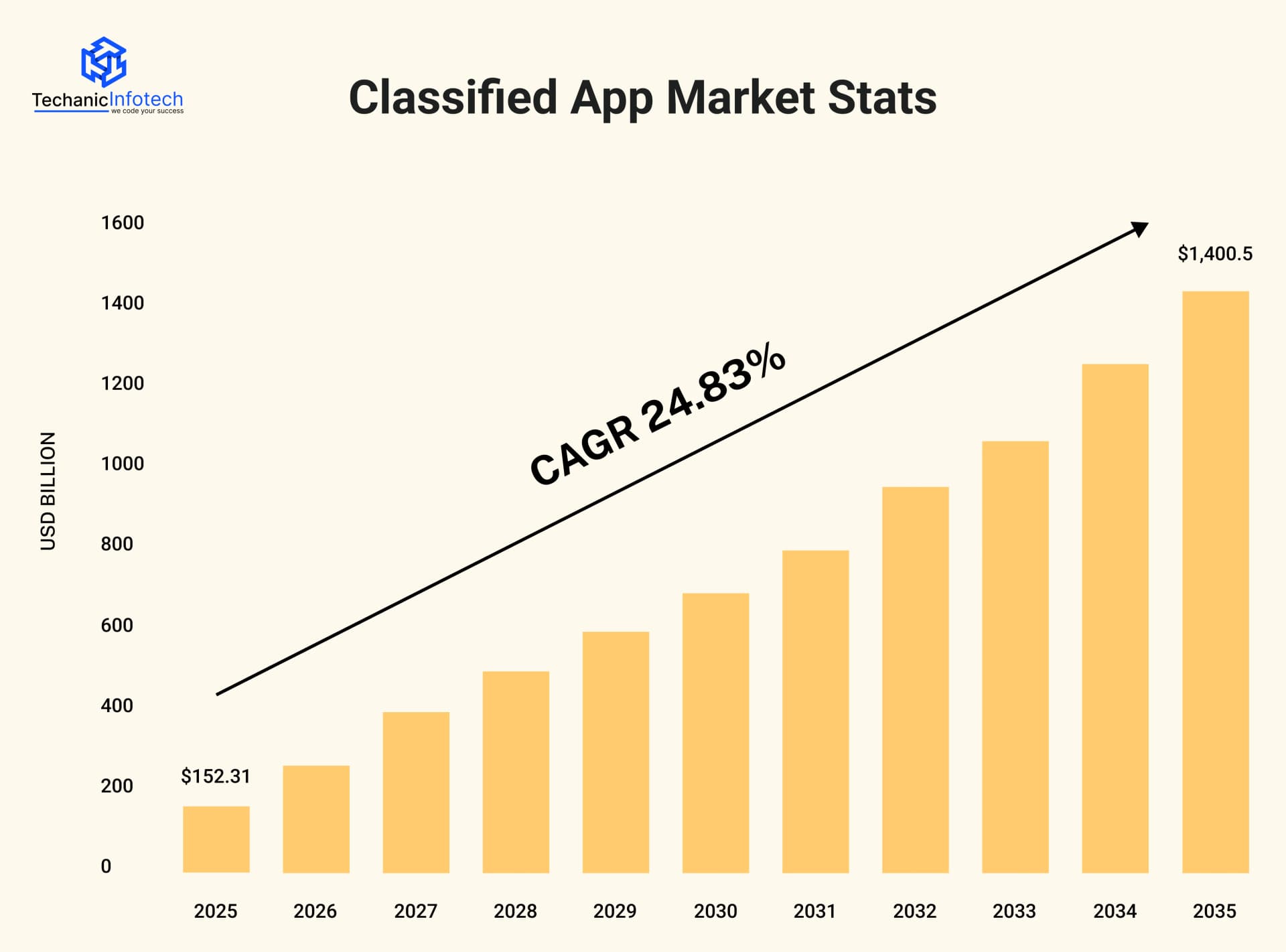
The global digital agriculture market is projected to reach about $25.24 billion in 2025, up from previous years.
Digital agriculture’s overall market size is expected to hit roughly $16.11 billion in 2025.
The agriculture apps segment alone is estimated at around $5.2 billion in 2025.
Mobile agricultural apps are driving growth globally with rapid smartphone adoption in rural regions.
IoT and AI integration continue to expand app utility, fueling digital adoption on farms.
Understanding the types of agriculture apps available today helps startups and agribusinesses choose the right solution based on real farming needs.
These apps are designed to solve specific challenges across the agricultural value chain, from crop planning to product sales.
Below are five popular types of agriculture apps shaping modern farming.
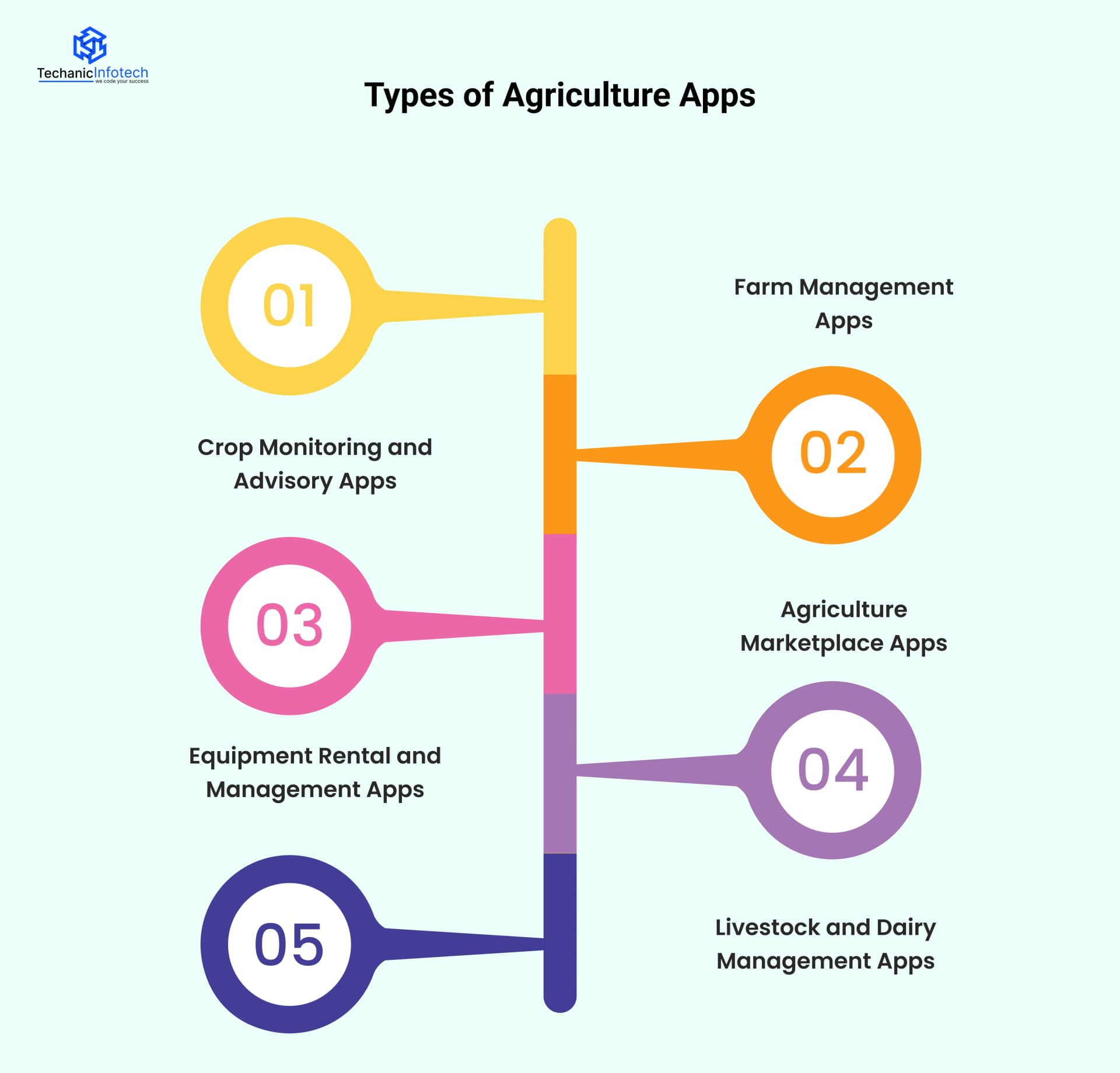
Farm management apps help farmers organize daily activities such as crop planning, irrigation schedules, labor tracking, and expense management.
By centralizing data in one platform, these apps improve productivity and reduce operational errors. They are ideal for farmers looking to digitize traditional farm workflows.
These apps use weather data, satellite imagery, and analytics to monitor crop health and soil conditions. Farmers receive timely alerts, pest control advice, and fertilizer recommendations, enabling smarter decisions and better yields throughout the growing season.
Agriculture marketplace apps connect farmers directly with buyers, suppliers, and distributors. If you plan to create a mobile app in this category, the focus should be on secure transactions, transparent pricing, and easy product listings.
These apps reduce dependency on middlemen and improve farmer profitability.
These apps allow farmers to rent or share agricultural equipment such as tractors and harvesters. They help reduce ownership costs while improving access to modern machinery, especially for small and mid-sized farms.
Livestock apps track animal health, feeding schedules, breeding cycles, and milk production. A well-designed solution in this category can become a top agriculture app by offering real-time insights and easy data management for livestock owners.
The features of the agriculture app play a critical role in determining how useful, scalable, and farmer-friendly the solution will be.
A well-built agriculture app focuses on solving real problems while delivering accurate insights and easy navigation. Below are five must-have features every successful agriculture app should include.
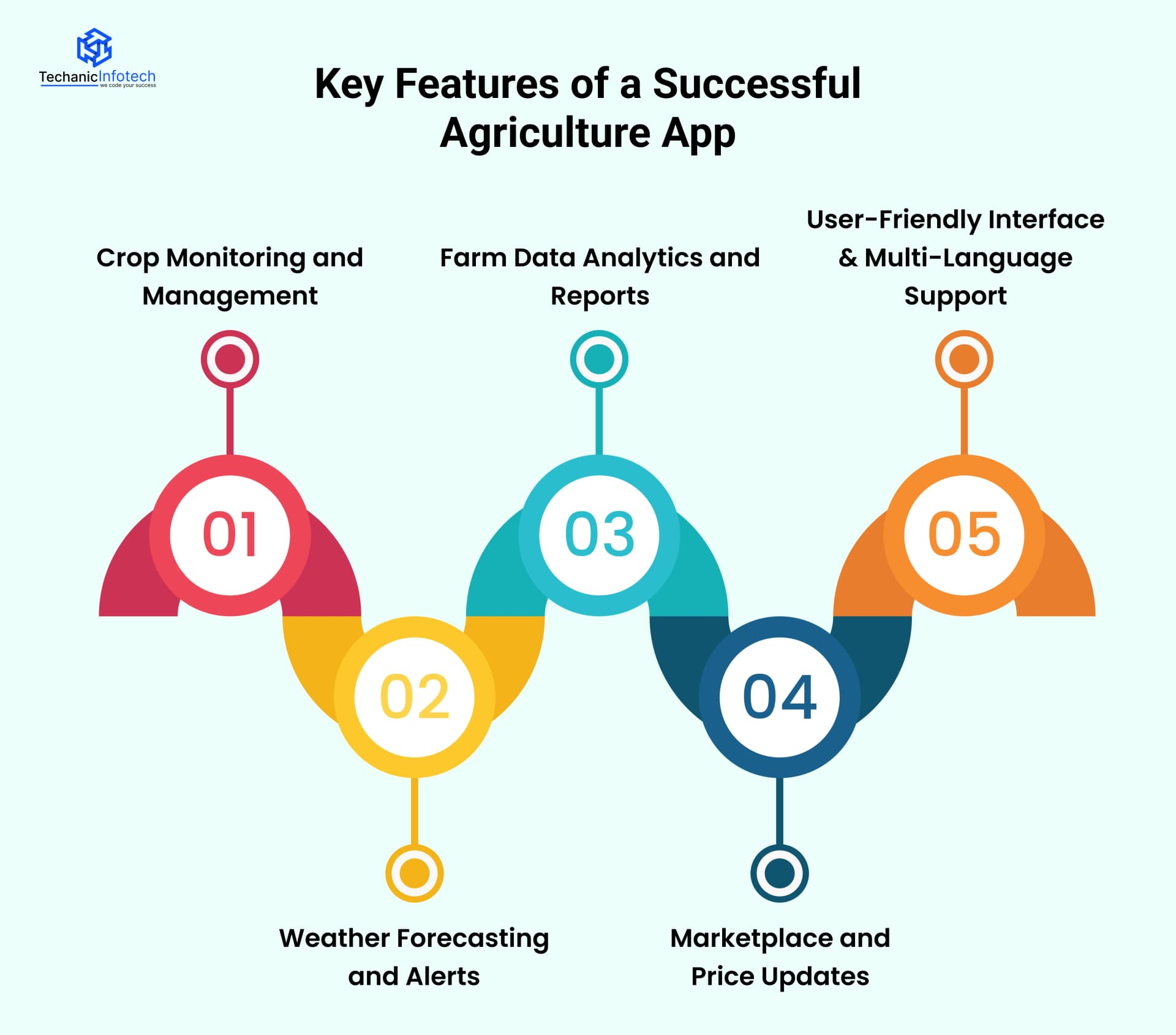
This feature allows farmers to track crop health, growth stages, and field conditions in real time. Using satellite data, sensors, or manual inputs, users can identify pest issues, nutrient deficiencies, and irrigation needs early. It helps reduce losses and improve yield quality.
Accurate, location-based weather updates are essential for planning irrigation, harvesting, and spraying activities. Timely alerts for rainfall, frost, or extreme heat help farmers make quick decisions and protect crops from unexpected damage.
Advanced analytics turn raw data into actionable insights. During agriculture app development, integrating dashboards and reports enables farmers to analyze productivity, input costs, and seasonal performance. This data-driven approach supports smarter planning and long-term profitability.
An in-app marketplace connects farmers directly with buyers, suppliers, and service providers. Real-time market price updates ensure fair pricing and reduce dependency on middlemen, improving income transparency and trust.
For agritech mobile apps, simplicity is key. A clean interface, intuitive navigation, offline access, and regional language support ensure higher adoption among farmers with varying technical skills. This feature improves usability and keeps users engaged over time.
Understanding the process of developing an agriculture app is essential if you want to create a solution that genuinely supports farmers, agribusinesses, and agri-tech stakeholders.
Agriculture apps are more than digital tools; they solve real problems like crop monitoring, yield prediction, market access, and farm management.
Below is a clear, step-by-step process that helps turn an idea into a scalable, user-friendly agriculture app.
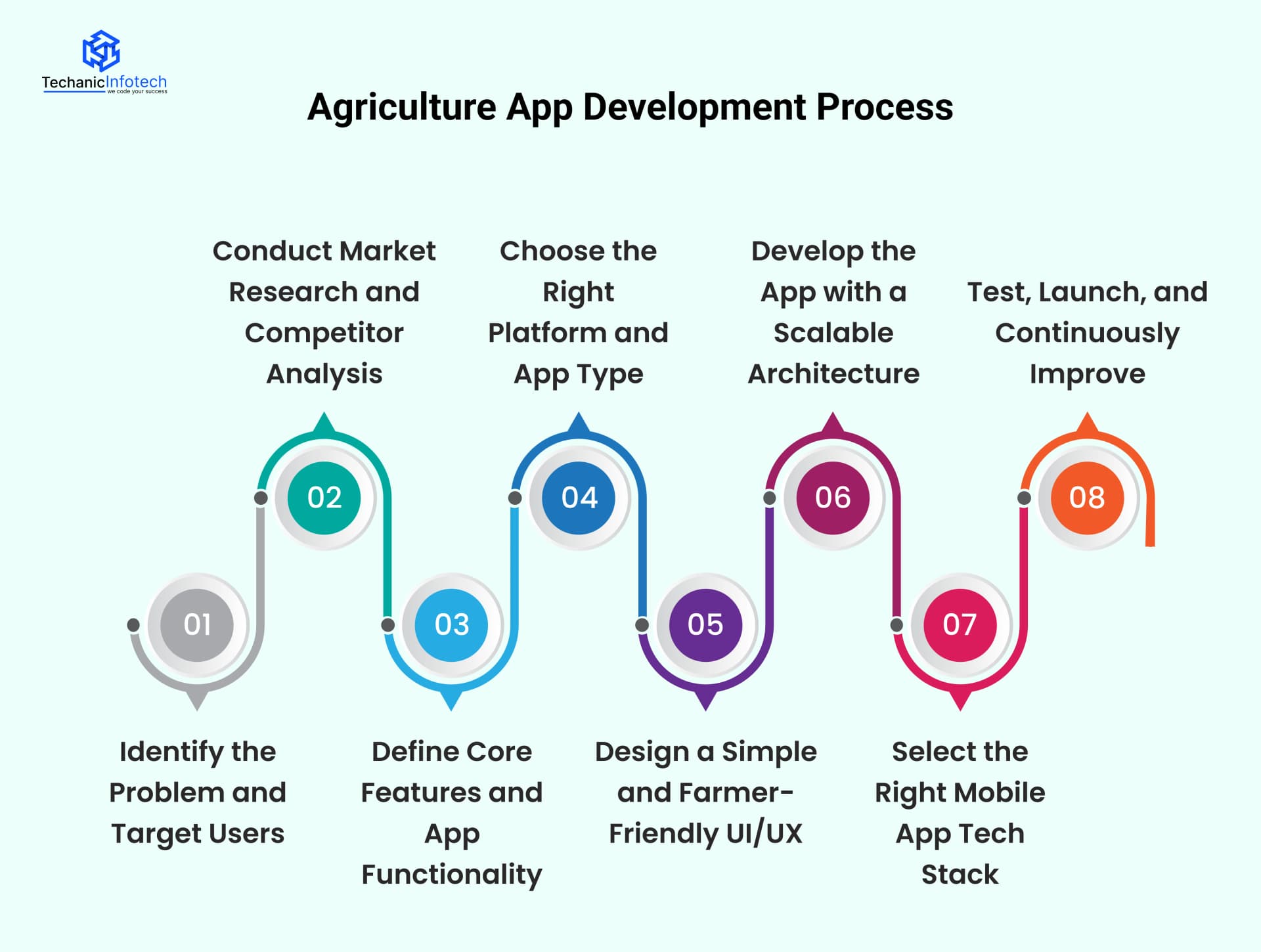
Every successful agriculture app starts with a clearly defined problem.
Are you solving issues related to crop health, irrigation planning, weather forecasting, or supply chain inefficiencies? At this stage, identify who your primary users are: small farmers, large farm owners, cooperatives, agribusinesses, or input suppliers.
Understanding their daily challenges helps you shape app features that deliver real value. Clear user personas also guide design decisions and feature prioritization later in the development process.
Market research validates your idea before development begins. Analyze existing agriculture apps to understand what they do well and where they fall short.
Look at user reviews, pricing models, feature sets, and engagement levels. This research helps you find gaps in the market and define a unique value proposition.
Strong competitor analysis ensures your app doesn’t repeat existing mistakes and positions your solution effectively in a competitive agri-tech landscape.
This step focuses on deciding what your app will actually do.
Core features may include weather alerts, crop advisory tools, soil health insights, market price updates, or farm record management.
Keep mobile app features practical and avoid unnecessary complexity. If your goal is to make an agriculture app that farmers actually use, prioritize simplicity, offline accessibility, and easy navigation.
Feature clarity at this stage prevents scope creep and keeps development costs under control.
Decide whether your agriculture app will be Android-based, iOS-based, or cross-platform. In many farming regions, Android dominates due to affordability and device availability.
You should also decide between native, hybrid, or progressive web apps based on performance needs and budget.
The right platform choice ensures better adoption, smoother performance, and long-term scalability as your user base grows.
Mobile app design plays a crucial role in adoption, and following a mobile app design guide is essential for success.
When you build an agriculture app, the interface should be intuitive, visually clear, and usable even by non-tech-savvy users.
Use readable fonts, simple icons, minimal text, and logical navigation. Multilingual support and voice-based assistance can further improve usability.
A strong UX design reduces learning curves and increases daily engagement, especially for users working in outdoor or low-connectivity environments.
Once design and features are finalized, development begins. Developers build the frontend, backend, APIs, and databases while ensuring scalability and performance.
Cloud-based infrastructure helps handle large data volumes such as satellite imagery, weather updates, and real-time analytics.
Security measures like data encryption and role-based access should also be implemented to protect sensitive farm and user data.
Choosing the right mobile app tech stack directly impacts performance and maintenance.
Common frontend options include Flutter or React Native for cross-platform apps, while backend technologies may include Node.js, Python, or Java. Databases like PostgreSQL or MongoDB work well for structured and unstructured data.
Integrations with AI, IoT devices, GPS, and third-party APIs enhance app capabilities and support advanced agriculture use cases.
Before launch, rigorous testing ensures the app performs well across devices, networks, and real-world conditions. Test for usability, security, performance, and compatibility to deliver a smooth user experience.
Once everything is validated, launch the app on the App Store and other relevant platforms to make it accessible to your target users.
Once live, gather user feedback and monitor analytics to improve features and fix issues based on real usage patterns.
To successfully develop an agriculture app, continuous updates, feature enhancements, and technical support are essential for long-term success and user retention.
Following this structured process helps you develop an agriculture app that is practical, scalable, and aligned with real farming needs.
The cost to develop an agriculture app usually ranges from $10,000 to $90,000+, based on the app’s feature set, platform selection, and level of technical complexity.
Whether you’re building a simple farm management tool or an advanced solution with AI, IoT, and on-demand services, understanding the cost structure upfront helps you plan development efficiently and avoid unexpected expenses.
The scope of features directly impacts development time and cost. Simple apps focus on information delivery, while advanced apps support analytics and automation.
|
App Complexity Level |
Key Features Included |
Estimated Cost |
|
Basic |
Weather updates, crop tips, farm logs |
$10,000 - $25,000 |
|
Medium |
User dashboards, APIs, notifications |
$25,000 - $55,000 |
|
Advanced |
AI insights, crop monitoring, analytics |
$55,000 - $90,000+ |
Your choice of platform determines development effort and maintenance needs.
|
Platform Type |
Description |
Cost Impact |
|
Android or iOS Only |
Single-platform development |
Lower |
|
Cross-Platform |
Flutter / React Native |
Medium |
|
Native (Both) |
Separate iOS and Android apps |
Higher |
The tech stack plays a major role in overall mobile app development cost, especially when real-time data is involved.
|
Technology Element |
Usage Area |
Cost Range |
|
Cloud & APIs |
Data storage, third-party integrations |
$5,000 - $12,000 |
|
AI & Analytics |
Crop prediction, smart recommendations |
$10,000 - $20,000 |
|
IoT Integration |
Sensors, soil, and weather devices |
$15,000 - $30,000 |
To create an on-demand agriculture app, additional backend logic and real-time processing are required.
|
On-Demand Feature |
Use Case |
Added Cost |
|
Equipment Rental |
Booking & availability tracking |
$8,000+ |
|
Expert Consultation |
Live chat or video support |
$7,000+ |
|
Location Tracking |
GPS-based service delivery |
$5,000+ |
Strong usability is essential when planning how to create an agriculture app that farmers actually adopt.
|
Design & QA Phase |
Scope |
Cost Range |
|
UI/UX Design |
Wireframes, user flows, visual design |
$5,000 - $10,000 |
|
App Testing |
Functional, security, and performance tests |
$5,000 - $8,000 |
|
Maintenance |
Updates and bug fixes (annual) |
$8,000+ |
To build an agriculture app like Agritech, businesses must overcome several real-world and technical challenges that are unique to the farming ecosystem.
Agriculture users often operate in diverse environments with varying levels of digital access, which makes app development more complex than standard mobile solutions.
Below are five major challenges developers face, along with practical solutions.
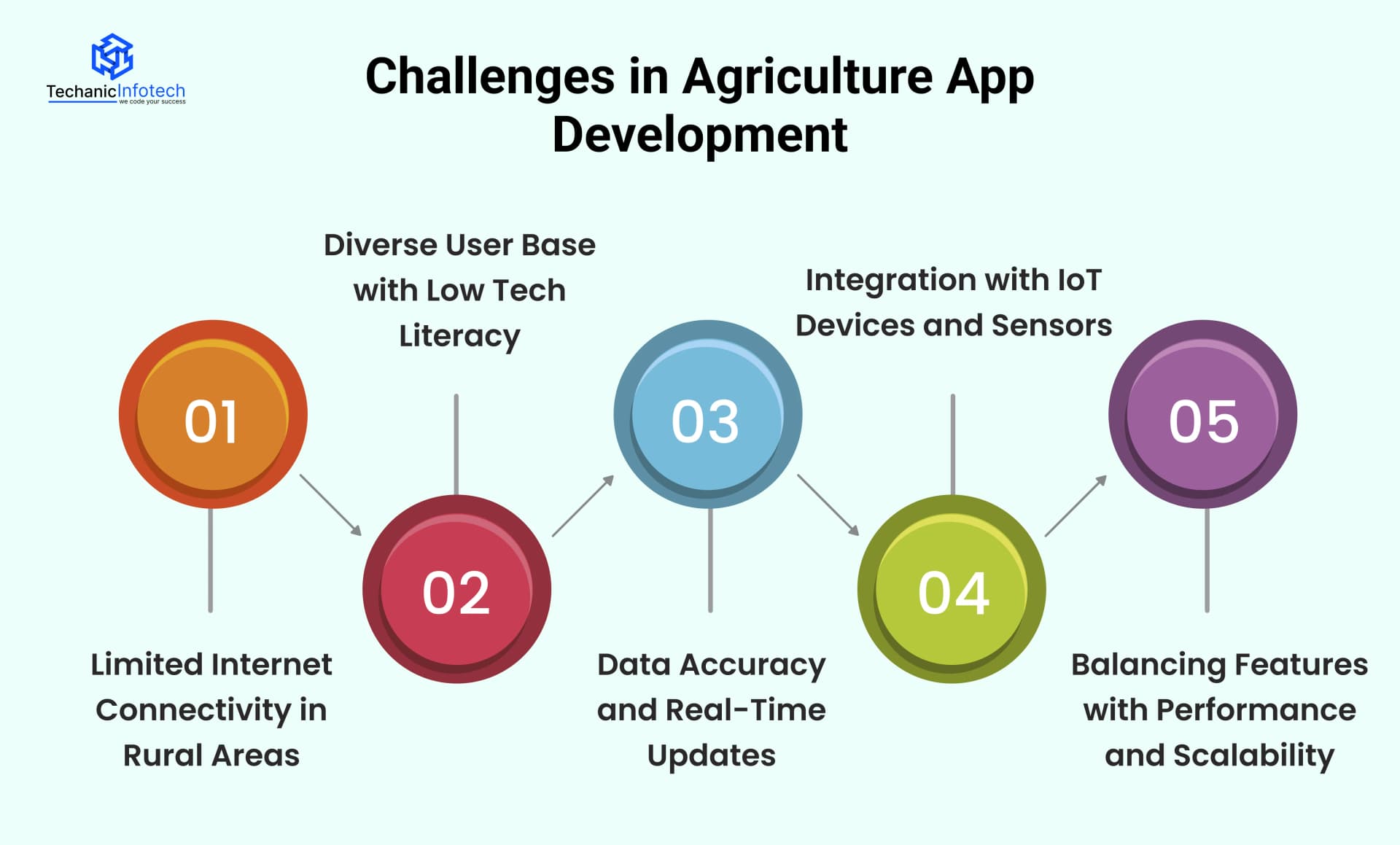
Many farmers work in regions with unstable or low internet access, affecting app performance and usability.
Solution: Enable offline functionality with local data storage and automatic sync when connectivity is restored.
Farmers have different levels of smartphone experience, making complex apps difficult to adopt.
Solution: Build a simple, intuitive interface with multilingual support and visual guidance.
Agriculture apps rely heavily on weather, soil, and market data, which must be accurate and timely to deliver value when you make an agriculture app.
Solution: Integrate reliable third-party APIs and real-time data validation mechanisms.
Connecting drones, sensors, and smart equipment can be technically challenging and costly.
Solution: Use scalable APIs and modular architecture to support seamless IoT integrations.
Adding too many features can slow down the app and impact user experience, especially without a clear design guide for agriculture app development.
Solution: Prioritize core features first and follow a scalable, performance-focused design approach.
A well-planned monetization strategy ensures long-term success while keeping the user experience farmer-friendly.
Along with a strong mobile app design guide, choosing the right revenue model helps agriculture apps balance profitability and usability.
Below are the most effective monetization models used in the agri-tech ecosystem today.
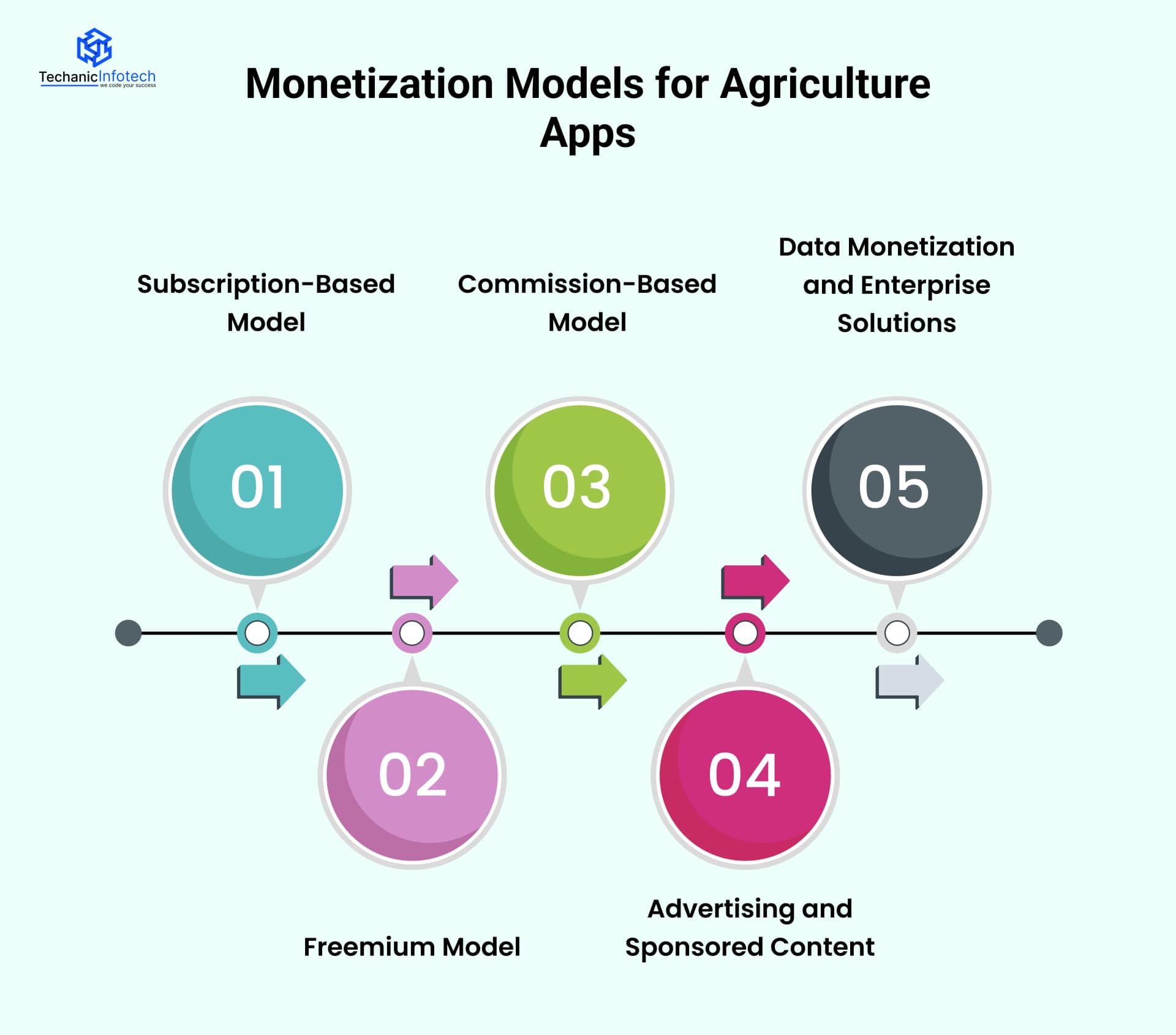
This model allows users to pay monthly or annually for premium features such as AI-based crop recommendations, advanced weather insights, and detailed farm analytics.
Tiered pricing works well for small, mid-sized, and large farms, as explained in any reliable agriculture app development guide, making the app accessible to different user segments.
The freemium approach offers basic features for free while charging for advanced tools like predictive analytics or personalized advisory services. It’s an effective way to attract users, build trust, and monetize gradually after you launch the app on the Play Store and scale adoption.
Marketplace-focused agriculture apps earn revenue by charging a commission on transactions. This includes selling seeds, fertilizers, equipment rentals, or connecting farmers with buyers. The more value the app delivers, the higher the transaction volume.
Relevant ads from seed companies, equipment manufacturers, or agri-input brands can generate consistent income. Sponsored listings work best when they align with user needs and don’t disrupt the app experience.
Aggregated, anonymized insights can be sold to agribusinesses, insurers, or research institutions. Custom dashboards and enterprise tools designed for large-scale operations further boost revenue, especially for agritech mobile apps targeting professional users.
Techanic Infotech is a trusted agriculture app development company with proven expertise in building scalable and user-friendly agriculture apps.
Our team understands the real challenges faced by farmers, agribusinesses, and agri-tech startups, allowing us to create solutions that deliver practical value.
From crop monitoring and weather integrations to AI-driven insights and marketplace features, we develop apps tailored to your business goals.
We follow a transparent development process, focus on intuitive design, and ensure high performance across devices.
With strong technical skills, industry knowledge, and post-launch support, Techanic Infotech helps you build secure, future-ready agriculture apps that support growth, innovation, and long-term success in the evolving agri-tech landscape.
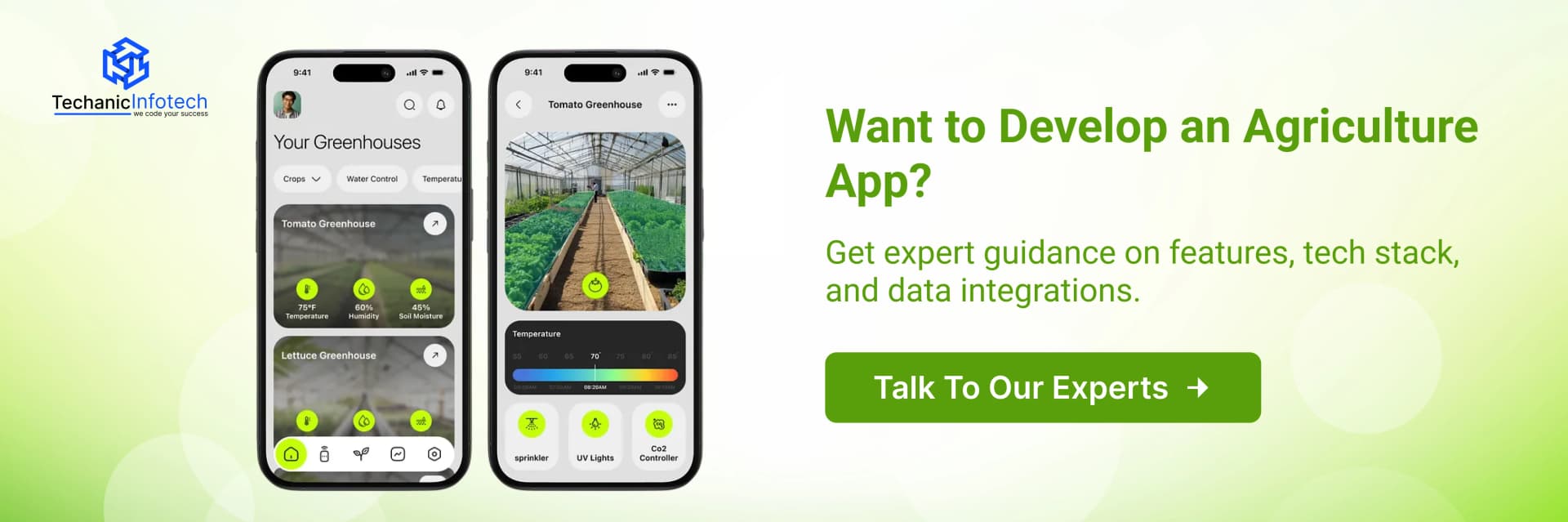
Agriculture apps are transforming the way farmers and agribusinesses operate by improving efficiency, productivity, and decision-making.
From choosing the right features and technology stack to addressing development challenges and monetization strategies, every step plays a crucial role in long-term success.
A well-planned agriculture app not only solves real-world farming problems but also supports sustainable and data-driven practices.
If you’re planning to build an agriculture app, partnering with an experienced development team ensures a scalable, secure, and user-friendly solution.
With the right strategy and execution, your agriculture app can create meaningful impact, drive adoption, and stand out in today’s rapidly growing agri-tech ecosystem.
An agriculture app is a mobile or web-based solution designed to help farmers manage crops, monitor weather, track soil health, access market prices, and improve overall farm productivity using digital tools.
Building an agriculture app usually takes 3 to 6 months, depending on app complexity, number of features, platform selection, integrations, and testing requirements for performance, security, and usability.
Key features include weather forecasting, crop and soil monitoring, farm management tools, real-time alerts, marketplace access, analytics dashboards, and user-friendly interfaces with multilingual and offline support options.
The cost to develop an agriculture app depends on design complexity, features, technology stack, and team size, typically ranging from a basic MVP to a fully customized, feature-rich solution. The estimated cost to develop is between $30,000- $150,000.
Yes, agriculture apps can be tailored for small farmers by offering simple navigation, affordable plans, local language support, offline access, and essential features that improve daily farm operations and decision-making.


Shailendra is a dedicated professional known for his strong client-focused approach and clear understanding of business needs. He brings a thoughtful understanding of client needs and focuses on building long-term relationships through clear communication and quality-driven work. With a blend of strategic thinking, content expertise, and a hands-on approach, Shailendra plays a key role in shaping content that aligns with both business goals and user expectations.