EWallet App Development
How to Create an App Like Wero: Features, Cost, Tech Stack & Development Guide
June 9, 2026
June 9, 2026
Key takeaways
Build a secure digital wallet app with seamless payments and excellent user experience.
Wero-like apps require strong compliance, encryption, authentication, and fraud prevention mechanisms.
Essential features include KYC verification, QR payments, wallet management, and notifications.
Development costs typically range between $8,000 and $60,000 based on project complexity.
Monetization strategies include subscriptions, transaction fees, affiliate partnerships, and premium services.
Have you ever wished for a simpler way to split bills with friends or send money instantly without dealing with complicated banking details? Apps like Wero are transforming digital payments by making money transfers, online purchases, and wallet management faster and more convenient.
Wero allows users to send money, pay for everyday purchases, and manage digital funds securely through a seamless mobile experience. As digital payments continue to grow across Europe and beyond, businesses are increasingly looking to build similar solutions for their target markets.
If you're planning to develop a digital wallet app like Wero, this guide covers everything you need to know. From understanding how Wero works and identifying essential features to selecting the right technology stack, ensuring security compliance, and estimating development costs, you'll gain a complete roadmap for launching a successful wallet application.
Whether you're a startup entering the fintech space or an established enterprise expanding your digital offerings, building a modern wallet app presents a significant opportunity. Partnering with an experienced eWallet app development company can help you accelerate development and launch a secure, scalable product that meets evolving user expectations.
This section examines the comprehensive requirements for creating a wallet app that remains functional through future technological advancements.
The next-generation digital wallet Wero transforms European payment, saving, and money-sharing methods.
Wero enables users to quickly transfer money to friends and family via text message speed while also allowing bill sharing and online shopping with instant donation capabilities.
Major European banks support this platform, which combines trust and security with a seamless user experience in a sleek format.
Wero stands as the ideal model for anyone aiming to build a digital wallet with seamless speed and robust security alongside user-friendly convenience.
Businesses can build an app like the Wero app that maintains core functions, including instant transfers and contactless payments while allowing for personalized features.
Are you considering building an app like Wero for your market space? This fintech frontier offers a thrilling opportunity that combines innovative solutions with user convenience to place the financial future directly in your pocket.
Understanding how the Wero-like app works will help you make better development decisions:
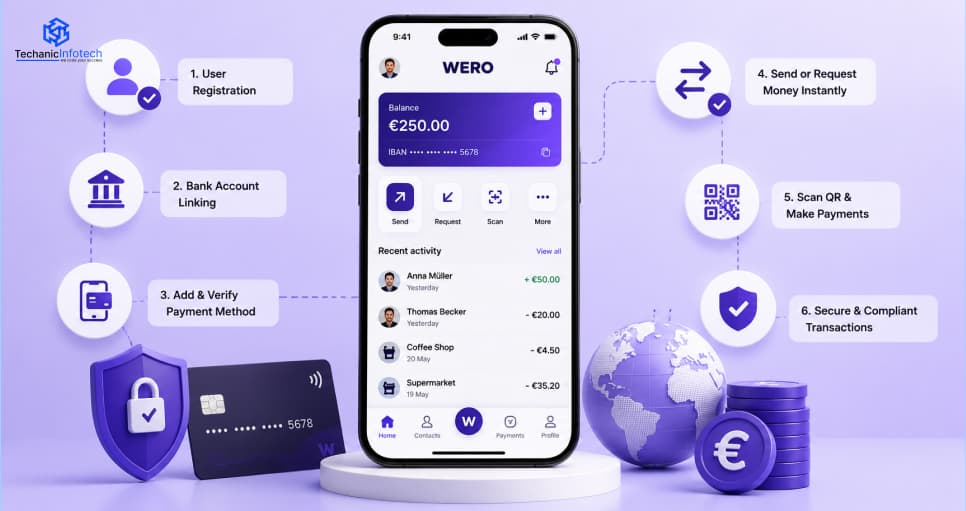
To register on Wero, users provide their phone number or email address and complete an identity verification process, which typically requires bank-level KYC (Know Your Customer) procedures.
Wero establishes a direct connection with users’ existing bank accounts or debit cards to support smooth financial operations.
The service allows users to instantly transfer money through phone numbers, email addresses, or QR codes without needing to memorize complex account information.
Users have the ability to deposit funds into their Wero wallet or use the application to process transactions that connect directly to their bank account.
Each transaction benefits from protection through multi-factor authentication, along with encryption and PSD2-compliant security measures.
With features like bill splitting and payment reminders through to charity donations, Wero transforms digital payments into smart social experiences.
To begin developing your own app like Wero, you should start by gaining a thorough understanding of its key features.
Developing an app like Wero requires combining financial tools with sleek UI design and adherence to regulatory standards.
Your app should include these 10 crucial digital wallet features to ensure success.
Users should be able to register rapidly through their mobile device or email address, followed by a robust identity verification procedure.
The KYC process helps financial applications remain compliant with regulations while establishing user trust, which stands as a critical component for the success of digital wallet apps like Wero.
Users should be able to connect their bank accounts or payment cards to enable hassle-free fund transfers and efficient wallet management.
The banking integration delivers real-world convenience, which proves critical to maintaining efficient financial functionality in an ecosystem similar to Wero.
Enable users to transfer money instantly by sending funds through phone numbers, email addresses, or QR codes.
The feature delivers modern fintech app expectations while being an important key to creating an app like Wero.
You can simplify group payments through automatic functionality that splits bills.
The app enables users to choose friends and split payments before sending payment requests with just a few taps for activities like dining out and trip planning.
Users must have the ability to add funds to their wallet or withdraw money directly to their bank account without difficulty.
The availability of numerous payment options delivers flexibility and easy transactions during real-time purchases.
Provide detailed transaction records with downloadable receipts.
The ability to monitor expenses, retrieve previous transactions, and maintain order brings essential transparency and control to Wero clone app development.
Instant alerts notify users about payments received, incoming funds, special offers, and app activities.
Notifications provide better transparency alongside improved user engagement and retention metrics.
The app allows users to make swift QR code-based contactless payments for in-store purchases and peer-to-peer exchanges.
The latest feature enables the development of a practical and future-ready app that mimics Wero for customers who prioritize digital solutions.
Establish a reward program that delivers cashback options along with coupons and loyalty points as incentives for consistent transactions.
The reward system drives repeat usage while introducing a gamified element to your digital wallet experience.
Use biometric login methods along with OTP verification and data encryption protocols.
Building an app similar to Wero requires strong security measures as they are essential for maintaining user trust and regulatory compliance.
Planning to develop a modern payment application similar to Wero? Great choice.
To develop an app like Wero, you need a combination of strategic planning, user-focused design, regulatory compliance, and flawless execution.
Let's break down the Wero-like app development process into manageable steps that can help you launch a successful digital wallet application.
Every successful fintech application starts with extensive market research.
Study your competitors, understand local and international digital payment regulations, and identify your target audience's expectations before starting development.
Analyze existing wallet applications, user pain points, transaction behaviors, and emerging fintech trends.
This research phase helps you avoid costly mistakes, identify market opportunities, and create a product that addresses real user needs.
When you build an app like Wero, a strong foundation of market research significantly improves your chances of success.
Think beyond simply replicating Wero.
Features like instant peer-to-peer payments, wallet balance management, QR code payments, and transaction tracking are considered baseline requirements.
To stand out, identify a unique value proposition.
For example, you might offer:
AI-powered budgeting assistance
Hyperlocal merchant rewards
Voice-enabled payments
Cryptocurrency support
Cross-border transfers
Advanced financial insights
A clear differentiation strategy helps your product compete effectively in the growing fintech market.
Technology choices directly impact performance, scalability, and security.
Popular frontend technologies include:
Flutter
React Native
Swift (iOS)
Kotlin (Android)
For backend development, businesses commonly choose:
Node.js
.NET Core
Java
Python
Database options may include:
PostgreSQL
MongoDB
MySQL
Cloud infrastructure providers such as AWS, Microsoft Azure, and Google Cloud help ensure scalability and reliability.
Selecting the right technology stack is essential for long-term growth and operational efficiency.
User experience plays a critical role in the success of any digital wallet.
A complicated interface can quickly drive users away.
Focus on:
Clean navigation
Fast onboarding
Easy payment flows
Clear transaction history
Minimal user friction
Strong UI/UX design builds trust and encourages long-term engagement.
When users can send money, pay bills, or manage their wallet effortlessly, retention rates typically improve.
Remember, simplicity is one of the most valuable assets in fintech app design.
Digital wallet applications manage highly sensitive financial information.
Security should never be treated as an optional feature.
Implement:
End-to-end encryption
Multi-factor authentication
Biometric login
KYC verification
Fraud detection systems
Secure APIs
Depending on your target market, compliance requirements may include:
GDPR
PCI DSS
PSD2
AML regulations
Strong security practices protect users while helping your business maintain credibility and legal compliance.
Once development and testing are complete, it's time to launch your application.
Before deployment:
Conduct final quality assurance checks
Test payment workflows
Verify security measures
Monitor infrastructure readiness
After launch:
Monitor performance metrics
Track crash reports
Analyze user feedback
Resolve issues quickly
A successful launch requires both technical readiness and a strategic marketing plan.
App development doesn't end after launch.
The fintech industry evolves rapidly, and user expectations continue to change.
Ongoing maintenance should include:
Security updates
Feature enhancements
Bug fixes
Performance optimization
Compliance updates
Regular improvements help maintain user satisfaction and keep your application competitive in the digital wallet marketplace.
Building a digital wallet app involves more than adding payment functionality.
Even well-funded projects can fail if critical mistakes are overlooked.
Here are some of the most common pitfalls to avoid.
Many businesses rush directly into development without fully understanding their target audience.
Questions you should answer include:
What payment problems are users facing?
Which features do they value most?
What frustrations do they experience with current wallet apps?
Without proper research, you risk building features that users neither need nor want.
Conduct surveys, interviews, and competitor analysis before writing a single line of code.
Fintech applications should be simple and intuitive.
A cluttered interface filled with unnecessary options creates confusion and frustration.
Users should be able to:
Check balances instantly
Send money easily
Review transactions quickly
Access support without difficulty
Minimalist design often leads to better engagement and user satisfaction.
Security failures can destroy user trust overnight.
If your app handles financial transactions, compliance and security must remain top priorities.
Essential measures include:
KYC verification
Two-factor authentication
Data encryption
Secure payment processing
Regulatory compliance
A single security incident can result in legal issues, financial losses, and reputational damage.
An application that performs well with 100 users may struggle with 100,000 users.
Without scalability planning, rapid growth can cause:
Slow performance
Downtime
Failed transactions
Poor user experience
Consider:
Cloud infrastructure
Load balancing
Database optimization
Auto-scaling systems
Building for scalability from the beginning helps support future growth.
Even small bugs can severely impact user trust.
Test every critical function, including:
Registration
KYC verification
Wallet top-ups
Payments
Withdrawals
Notifications
Refund processing
Use both manual and automated testing approaches across multiple devices and operating systems.
Comprehensive quality assurance helps deliver a smooth user experience.
Not all users have consistent internet connectivity.
Providing limited offline functionality can improve usability.
Examples include:
Viewing wallet balances
Accessing transaction history
Scanning QR codes for later synchronization
Offline capabilities can significantly improve the user experience in regions with unstable network coverage.
Many businesses assume development ends after launch.
In reality, post-launch support is essential.
Users expect:
Fast bug resolution
Regular updates
New features
Reliable customer support
Ignoring post-launch maintenance often results in declining user satisfaction and increased churn.
A dedicated support strategy helps ensure long-term success.
The cost to develop an app like Wero typically ranges from $8,000 to $60,000, depending on the app's complexity, feature set, security requirements, platform selection, and third-party integrations.
A Wero-like app should include user registration, KYC verification, bank account integration, instant peer-to-peer payments, QR code payments, transaction history, wallet management, push notifications, cashback rewards, and advanced security features.
The development timeline generally ranges from 3 to 8 months, depending on the project's complexity, number of features, compliance requirements, and development team size.
Popular technologies for Wero-like app development include Flutter, React Native, Node.js, .NET Core, PostgreSQL, MongoDB, AWS, and Azure. The final tech stack depends on business requirements and scalability goals.
Digital wallet apps generate revenue through transaction fees, subscription plans, partner commissions, in-app advertising, premium financial services, and value-added features such as virtual cards and budgeting tools.
Security is crucial because digital wallet apps handle sensitive financial data and transactions. Features such as encryption, biometric authentication, KYC verification, fraud detection, and PCI DSS compliance help protect user information and build trust.


Abhishek Jangid is the CEO of Techanic Infotech, with extensive experience in mobile app and web development. He specializes in helping businesses turn innovative ideas into scalable digital solutions through strategic planning and modern technology.