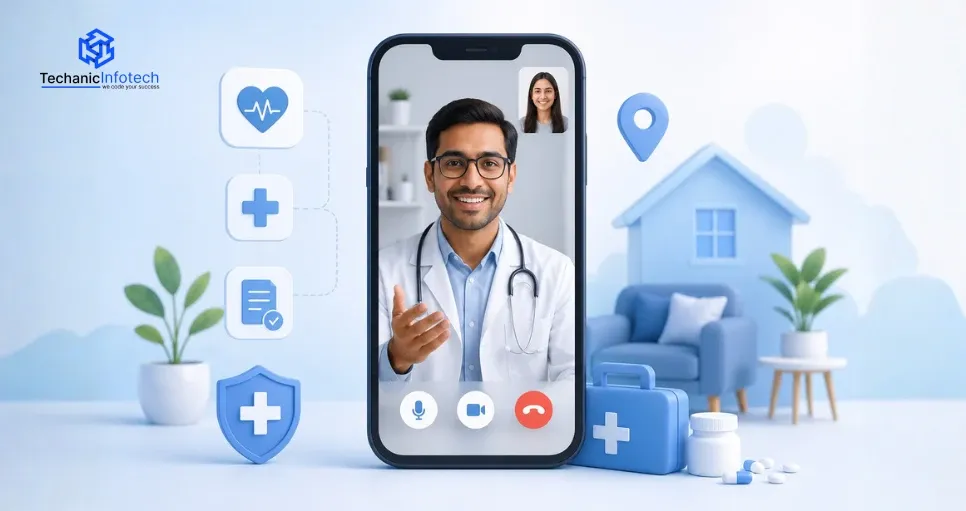
Doctor On Demand App Development
How to Create a Doctor-On-Demand App? Complete Guide for 2026
May 13, 2026
May 13, 2026
Are you planning to create a doctor-on-demand app in 2026? You are at the right place.
As digital healthcare services continue to grow, more users are looking for fast, secure, and convenient medical consultations from their smartphones. A doctor-on-demand app allows patients to connect with doctors through video calls, chat, appointment booking, and online prescriptions without visiting a clinic physically.
Modern healthcare apps now focus on better user experience, secure payment integration, real-time scheduling, and data privacy to improve both patient and doctor convenience.
With the rapid growth of telemedicine, doctor-on-demand app development has become a great opportunity for startups, healthcare providers, and businesses looking to invest in the digital healthcare industry.
In this guide, we will explore the development process, key features, estimated costs, and important factors required to build a successful doctor-on-demand app in 2026.
With the growing demand for telemedicine and virtual healthcare services, doctor-on-demand apps are becoming one of the fastest-growing healthcare solutions in 2026.
A professional doctor-on-demand app development company helps businesses build scalable healthcare platforms that allow patients to connect with doctors quickly and securely through modern digital solutions.
Here are some important reasons to invest in doctor-on-demand app development:
A doctor-on-demand app allows users to consult doctors anytime and from anywhere using their smartphones. Patients can book appointments, attend video consultations, and receive online prescriptions without waiting in long hospital queues.
Doctor-on-demand apps help healthcare providers connect with patients beyond geographical boundaries. People living in remote or underserved areas can easily access quality healthcare services online.
Virtual healthcare platforms reduce operational expenses compared to traditional healthcare systems. Online consultations help businesses save costs while improving efficiency and patient management.
Modern healthcare apps can offer general consultations, specialist appointments, mental health support, follow-up care, and digital prescriptions all in one platform, improving user experience significantly.
The telemedicine industry is expanding rapidly as users prefer fast and accessible healthcare solutions. Investing in Doctor-On-Demand app development helps businesses stay competitive and future-ready in the digital healthcare market.
Doctor-on-demand applications are transforming the healthcare industry by making medical services more accessible, scalable, and convenient for both patients and healthcare providers.
A successful doctor-on-demand app should provide a smooth and secure experience for both patients and healthcare providers. Modern healthcare users expect fast appointment booking, real-time consultations, secure medical records, and simple navigation within the application.
To build a reliable and user-friendly healthcare platform, here are some important features your Doctor-On-Demand app should include.
The patient panel is one of the most important sections of a healthcare application because it directly affects user experience and engagement.
A simple and intuitive interface helps patients access medical services quickly and comfortably, which is also essential in mental health app development for improving user accessibility and patient support.
Patients should be able to create accounts easily using email, phone numbers, or social login options. The profile section can store personal details, medical history, allergies, and healthcare preferences for better consultation experiences.
Users should be able to search doctors based on specialization, availability, ratings, consultation fees, and language preferences. A quick appointment booking system improves convenience and saves users valuable time.
Secure video calling and chat features allow patients to connect with doctors remotely from anywhere. This feature is essential for virtual healthcare services and improves accessibility for users.
The app should allow users to schedule appointments in advance and receive automated notifications for upcoming consultations, reducing missed appointments.
Doctors can provide digital prescriptions directly through the app, allowing patients to access medications, treatment details, and dosage instructions anytime.
Patients should have access to previous consultations, prescriptions, reports, and medical records in one secure location for better healthcare management.
Integrated payment gateways allow users to pay consultation fees securely using cards, wallets, or other digital payment methods within the app.
Allowing patients to rate doctors and share reviews helps build transparency, improve service quality, and increase trust within the platform.
Push notifications help users stay updated about appointments, prescriptions, health reminders, offers, and important healthcare updates.
Supporting multiple languages and user-friendly accessibility features helps healthcare businesses reach a wider audience and improve patient experience.
The right combination of features can help businesses create a scalable, secure, and user-focused Doctor-On-Demand app that meets the growing demand for digital healthcare services.
The doctor panel is designed to help healthcare professionals manage consultations, appointments, patient records, and earnings efficiently within the Doctor-On-Demand app.
A well-structured doctor dashboard improves workflow management and helps doctors provide better virtual healthcare services, which also plays an important role in determining the cost to develop a doctor-on-demand app.
Here are some essential doctor panel features that should be included in a modern healthcare application:
Doctors should be able to create detailed professional profiles, including specialization, qualifications, experience, consultation fees, and availability timings. This helps patients choose the right healthcare professional easily.
The doctor panel should allow healthcare professionals to accept, reject, reschedule, or manage appointments efficiently. Automated scheduling helps avoid conflicts and improves consultation management.
Integrated video consultation features allow doctors to connect with patients remotely through secure and high-quality virtual sessions. Smooth communication is essential for providing effective online healthcare services.
Doctors should have secure access to patient medical history, prescriptions, reports, allergies, and previous consultations. This helps healthcare professionals provide more accurate diagnoses and personalized treatment plans.
After consultations, doctors can generate and share digital prescriptions directly through the app. This simplifies the treatment process and improves convenience for patients.
Doctors should be able to track completed consultations, pending payments, earnings reports, and transaction history through a dedicated dashboard for better financial management.
The review and rating system allows patients to share feedback based on their consultation experience. This helps maintain service quality and builds trust within the healthcare platform.
Real-time notifications help doctors stay updated about upcoming appointments, cancellations, patient messages, and consultation reminders for smooth workflow management.
A powerful doctor panel not only improves operational efficiency but also helps healthcare professionals deliver secure, accessible, and high-quality virtual healthcare experiences to patients.
The admin panel is one of the most important parts of a doctor-on-demand application because it helps businesses manage the entire healthcare platform smoothly.
A powerful admin dashboard allows administrators to monitor users, consultations, payments, reports, and platform activities efficiently, which is why choosing the right mobile app development company is important for building a scalable healthcare platform.
Here are some important admin panel features every modern healthcare app should include:
Administrators should be able to manage both patient and doctor accounts from a centralized dashboard. The system should support account verification, profile approval, suspension of fraudulent users, and overall user activity monitoring.
The admin panel should provide complete visibility into scheduled appointments, completed consultations, cancellations, and ongoing sessions. This helps businesses maintain platform performance and resolve issues quickly.
Admins should be able to monitor transactions, doctor commissions, patient payments, refunds, and revenue reports. A transparent financial management system helps businesses track overall platform earnings efficiently.
The admin dashboard should allow businesses to manage blogs, healthcare articles, banners, announcements, promotional offers, and health tips directly from the platform to keep users engaged and informed.
An integrated support management system helps administrators handle user complaints, technical issues, consultation disputes, and feedback efficiently for better user satisfaction.
Advanced analytics help businesses track app performance, consultation statistics, active users, revenue growth, and doctor engagement. These insights support better business decisions and platform optimization.
Admins should be able to send push notifications, reminders, promotional updates, and emergency announcements to users directly through the app dashboard.
The admin panel should include secure access management, data protection settings, role-based permissions, and healthcare compliance support to maintain platform security and patient privacy.
A well-designed admin panel helps healthcare businesses manage operations efficiently while improving platform performance, security, and overall user experience.
Developing a successful Doctor-On-Demand application requires proper planning, modern technology, strong security, and a user-focused approach. From market research to deployment, every stage plays an important role in building a scalable and reliable healthcare platform.
Here is a step-by-step process to understand how doctor-on-demand app development works.
Before starting development, businesses should analyze the telemedicine market, target audience, and user expectations. Researching popular healthcare applications helps identify market trends, patient behavior, and service gaps.
Studying competitor platforms also helps businesses understand which doctor-on-demand app features users prefer the most, such as video consultations, appointment scheduling, AI chat support, and digital prescriptions.
The next step is to finalize the features and functionalities of the healthcare application. Choosing the right mobile app features is important for creating a smooth user experience, including patient registration, doctor profiles, appointment booking, video consultations, payment integration, notifications, medical records, and admin dashboards.
Businesses should also define platform goals, monetization strategies, security requirements, and scalability plans before moving into the development phase.
Selecting the right technologies is important for building a secure and high-performing healthcare application. A strong mobile app tech stack helps businesses create scalable and reliable platforms using technologies like Flutter or React Native for cross-platform development, while backend frameworks such as Node.js and Python support secure server architecture and smooth app performance.
Strong encryption, cloud infrastructure, and healthcare compliance integration are also essential for protecting sensitive patient information.
A clean and user-friendly interface improves overall patient and doctor experience. Following a proper mobile app design guide helps developers create effective wireframes, app flow structures, and interactive prototypes to visualize the platform before actual development begins.
In this stage, developers build the frontend, backend, databases, APIs, payment gateways, video consultation systems, and notification services required for the healthcare platform.
The development process also includes security implementation, performance optimization, feature testing, and planning for long-term mobile app maintenance to ensure smooth platform performance after launch.
Before launching the app, thorough testing is performed to ensure smooth functionality, fast performance, secure transactions, and a bug-free user experience across different devices and operating systems.
Once testing is completed, the application is deployed on Android and iOS platforms. Continuous maintenance, feature updates, security monitoring, and technical support are important for long-term success.
The overall custom healthcare app development cost depends on app complexity, technology stack, integrations, security requirements, and the number of features included in the platform.
|
Category |
Modern Technology Stack |
Purpose |
|
Frontend Development |
Flutter, React Native, SwiftUI, Kotlin |
Used for building high-performance Android and iOS healthcare apps. |
|
Backend Development |
Node.js, Python, Django, Express.js |
Manages app logic, APIs, authentication, and server operations. |
|
Database |
PostgreSQL, MongoDB, Firebase |
Stores patient records, appointments, prescriptions, and app data securely. |
|
Cloud Services |
AWS, Google Cloud, Microsoft Azure |
Provides secure hosting, scalability, and cloud storage solutions. |
|
Video Consultation |
WebRTC, Twilio, Agora |
Enables secure real-time video and audio consultations. |
|
Payment Integration |
Stripe, PayPal, Razorpay |
Supports secure online payments and subscription handling. |
|
Authentication & Security |
Firebase Auth, OAuth 2.0, JWT |
Ensures secure login, user verification, and data protection. |
|
Push Notifications |
Firebase Cloud Messaging, OneSignal |
Sends appointment reminders, alerts, and healthcare updates. |
|
Analytics & Monitoring |
Firebase Analytics, Mixpanel |
Tracks app performance, user engagement, and platform insights. |
Studying successful healthcare applications can help businesses understand modern telemedicine trends, user expectations, and advanced healthcare features. Popular Doctor-On-Demand apps have transformed the healthcare industry by providing secure virtual consultations, online prescriptions, appointment scheduling, and AI-powered healthcare support.
Here are some well-known healthcare platforms that can inspire your Doctor-On-Demand app development strategy.
Teladoc is one of the most recognized telemedicine platforms globally. The app provides video consultations, virtual healthcare services, mental health support, and specialist consultations through a user-friendly interface.
The platform is known for offering accessible healthcare services while maintaining a smooth patient experience.
Amwell connects patients with doctors, therapists, and healthcare specialists through virtual consultations. The platform supports appointment booking, online prescriptions, and remote patient care services.
Its strong healthcare provider network makes it one of the leading telemedicine solutions in the market.
MDLive offers virtual consultations for general healthcare, mental health, dermatology, and urgent care services. The platform focuses heavily on user-friendly healthcare experiences and fast online consultations.
Babylon Health became popular for integrating AI-powered healthcare assistance with telemedicine services. Users can access symptom checking, AI health assessments, virtual doctor consultations, and personalized healthcare recommendations within the platform.
Push Doctor is widely known for providing quick video consultations and digital prescription services. The platform focuses on accessibility and faster healthcare support for patients needing immediate medical attention.
Heal introduced a unique healthcare model by offering doctor home visits alongside virtual consultations. The platform focuses on personalized healthcare experiences and patient convenience.
Lemonaid Health is popular for providing affordable virtual healthcare services, online consultations, and prescription support for multiple medical conditions. Its simple pricing structure and accessible healthcare approach helped it gain strong user adoption.
These successful platforms show how telemedicine applications are evolving with AI integration, virtual care systems, real-time consultations, and scalable healthcare technologies. Businesses planning to build similar healthcare platforms should focus on user experience, platform security, accessibility, and advanced healthcare features.
Understanding the cost to develop an app like Zocdoc depends on factors such as app complexity, AI integrations, healthcare compliance requirements, video consultation systems, and overall platform scalability.
The cost of developing a doctor-on-demand app depends on several factors, such as app complexity, feature requirements, UI/UX design, technology stack, third-party integrations, and platform scalability.
A basic healthcare application with core features like user registration, appointment booking, chat support, and doctor profiles usually costs between $8,000 to $20,000+. Mid-level telemedicine applications with video consultations, payment integration, notifications, and prescription management may range from $20,000 to $45,000+.
Advanced doctor-on-demand apps with AI-powered features, cloud infrastructure, wearable integrations, multilingual support, analytics dashboards, and enterprise-level security can cost between $45,000 To $70,000+, depending on customization and business requirements.
|
App Type |
Estimated Development Cost |
|
Basic Doctor-On-Demand App |
$8,000 – $20,000+ |
|
Mid-Level Telemedicine App |
$20,000 – $45,000+ |
|
Advanced Healthcare Platform |
$45,000 – $70,000+ |
The final development cost also depends on factors like Android/iOS platform selection, healthcare compliance requirements, maintenance services, API integrations, and post-launch updates. Investing in a scalable and secure healthcare solution helps businesses deliver better patient experiences while supporting long-term growth in the telemedicine industry.
A strong monetization model is important for making a doctor-on-demand app profitable and sustainable in the long run. Modern telemedicine platforms generate revenue through multiple income streams while continuing to provide convenient healthcare services for users.
Here are some of the most effective ways Doctor-on-demand apps make money:
Many healthcare apps offer monthly or yearly subscription plans that provide users with premium benefits such as unlimited consultations, priority appointments, faster support, and access to specialist doctors.
One of the most common revenue models is charging users per consultation. The consultation fee may vary depending on doctor's specialization, appointment type, consultation duration, or emergency services.
Healthcare platforms can earn commissions from doctors for every successful consultation booked through the app. This model helps create a steady revenue stream while growing the healthcare provider network.
Doctors and healthcare clinics can pay for featured listings to improve visibility within the platform. Featured profiles often appear at the top of search results, helping doctors attract more patients.
Doctor-on-demand apps can generate additional revenue through healthcare-related advertisements, wellness promotions, pharmacy partnerships, and sponsored medical services.
Many businesses partner with telemedicine platforms to provide virtual healthcare services for employees. Offering corporate healthcare plans can help generate long-term recurring revenue.
Integrating medicine delivery and online pharmacy services allows businesses to earn commissions on prescription orders and healthcare product sales.
Partnering with insurance companies and healthcare providers can create additional revenue opportunities through referral programs and integrated healthcare services.
Using multiple monetization strategies helps Doctor-On-Demand apps increase profitability while improving healthcare accessibility, user engagement, and long-term business growth.
Developing a successful telemedicine platform requires more than just adding healthcare features. Businesses must focus on security, performance, scalability, compliance, and smooth user experience to create a reliable healthcare ecosystem.
Understanding Doctor On Demand App Development Challenges helps businesses prepare better strategies while building scalable and secure healthcare applications.
Healthcare applications handle highly sensitive patient information, including medical records, prescriptions, and consultation history.
Implementing strong encryption, secure authentication, and data protection systems is essential for maintaining user trust and healthcare compliance.
Video consultation is one of the most important parts of any telemedicine application. The platform should provide stable, high-quality, and low-latency communication for smooth doctor-patient interaction across different devices and internet conditions.
As the user base grows, the healthcare platform must handle large numbers of appointments, consultations, and real-time activities without performance issues. Poor scalability can affect app speed, reliability, and user experience.
Doctor-On-Demand applications must comply with healthcare regulations such as HIPAA, GDPR, and regional medical policies. Meeting compliance requirements is important for protecting patient data and avoiding legal risks.
Integrating secure and flexible payment systems can be challenging. The application should support multiple payment methods, transaction security, refunds, and transparent billing processes for both patients and healthcare providers.
A modern healthcare app should intelligently connect patients with the right doctors based on specialization, availability, language, ratings, and consultation type to improve healthcare efficiency.
Both doctors and patients expect a simple, smooth, and reliable interface. The platform should offer easy appointment management, fast navigation, secure communication, and transparent consultation workflows.
Healthcare technology evolves rapidly, which means regular app maintenance, security updates, performance optimization, and feature enhancements are necessary for long-term success.
By understanding these challenges early, businesses can build a more reliable, scalable, and user-friendly Doctor-On-Demand platform that delivers better healthcare experiences for both patients and medical professionals.
The demand for Doctor-On-Demand applications continues to grow as more users prefer fast, secure, and convenient digital healthcare solutions. Modern telemedicine platforms are transforming the healthcare industry by making medical consultations more accessible for patients while improving operational efficiency for healthcare providers.
A successful Doctor-On-Demand app should focus on user-friendly design, secure video consultations, appointment management, digital prescriptions, payment integration, and strong data security. Businesses that invest in scalable healthcare technologies can create reliable platforms that improve patient engagement and healthcare accessibility.
Whether you are a healthcare startup, hospital, clinic, or entrepreneur, investing in telemedicine app development can open new growth opportunities in the rapidly expanding digital healthcare market. With the right strategy, technology stack, and feature set, businesses can build future-ready healthcare platforms that deliver seamless experiences for both patients and medical professionals.
A Doctor-On-Demand app is a telemedicine application that allows patients to connect with doctors through video calls, chat, voice consultations, appointment booking, and digital prescriptions using mobile devices.
The development timeline depends on app complexity and features. A basic healthcare app may take 2–4 months, while advanced telemedicine platforms can require 6 months or more.
Important features include user registration, doctor profiles, appointment booking, video consultations, secure payments, prescriptions, notifications, medical records, and admin dashboards.
The development cost can range from $8,000 to $70,000+ depending on app features, UI/UX design, integrations, security requirements, and platform complexity.
Popular technologies include Flutter, React Native, Node.js, Python, Firebase, AWS, WebRTC, and secure payment gateways like Stripe or Razorpay.
Yes, modern healthcare apps use advanced encryption, secure authentication systems, and healthcare compliance standards such as HIPAA and GDPR to protect patient data.
Yes, video consultation is one of the core features of telemedicine applications, allowing doctors and patients to communicate remotely in real time.
These apps generate revenue through subscription plans, consultation fees, commissions from doctors, premium listings, advertisements, and healthcare partnerships.
Telemedicine is growing because users prefer faster, more convenient, and accessible healthcare services that can be accessed from home through smartphones and digital platforms.
Doctor-On-Demand apps help healthcare businesses improve patient accessibility, increase operational efficiency, expand digital healthcare services, and create long-term business growth opportunities.


Neha Sharma is a tech expert at heart who loves exploring new technologies and turning complex ideas into easy-to-understand content. With a passion for learning and writing, she enjoys sharing insights on emerging tech, digital products, and innovation that help businesses stay ahead.