Key Takeaways
Apps like Urban Company are driving the home services industry towards rapid digital transformation.
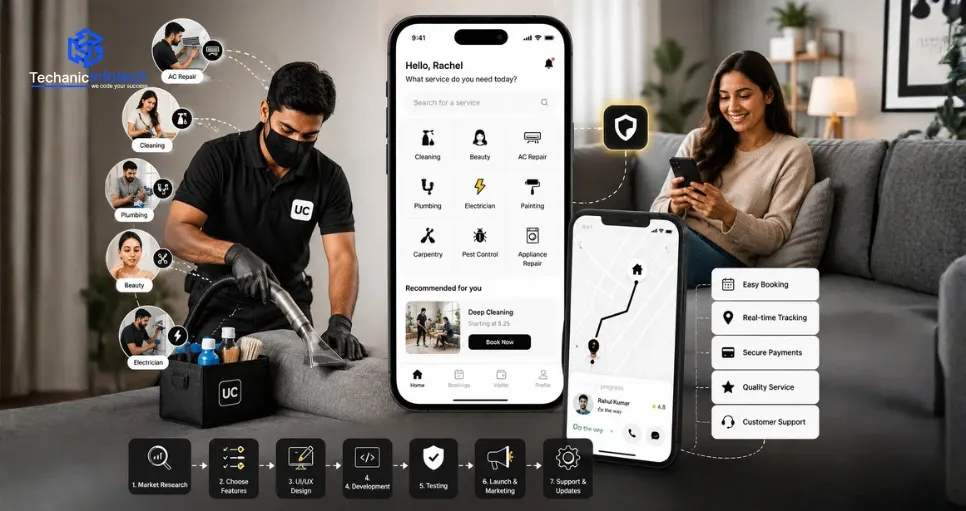
A successful home service app needs essential features like real-time booking, GPS tracking, secure payments, and ratings & reviews.
Building an app like Urban Company usually requires customer, provider, and admin panels working together smoothly.
The development cost can range from $10,000 to $100,000+ depending on features, platform, and scalability needs.
Starting with an MVP and scaling gradually is the smartest way to validate the idea and reduce risk.
A few years back, people still called local technicians through random WhatsApp numbers or that one “known guy” in the neighbourhood. Now? One tap, and a professional is standing outside the door. That shift happened fast, faster than most businesses expected.
According to market insights from Technavio, the global home services market has already breached the $460 billion mark, with the online marketplace segment accelerating at a massive CAGR of over 13%. Apps like Urban Company are sitting right at the center of this change.
If you’re planning to develop an app like Urban Company, this isn’t just another startup trend anymore. It’s a real business opportunity hiding inside everyday problems people face constantly, leaking taps, AC repairs, salon bookings, deep cleaning, small needs, huge demand.
But here’s the thing most founders realize late: users don’t stay for features alone. They stay because the experience feels easy, reliable, almost stress-free. And building that kind of platform takes more than a cloned script and a booking button.
Urban Company (ex UrbanClap) is a mobile platform that brings customers and reliable professionals together to provide home services such as beauty, cleaning, repair, and wellness.
It makes expert service booking easier and more convenient for people, all from a smartphone app.
If you're going to develop a home service app similar to Urban Company, it's important to grasp its central value: linking service providers and users efficiently, accurately, and securely.
The company’s user-friendly interface and strong vetting process have made it a go-to option in the service tech industry.
Let’s dive into the core features that you’ll need if you want to build an app like Urban Company. These mobile app features aren’t just technical add-ons they directly shape user experience, trust, and retention.
Users should be able to sign up quickly using email, phone number, or social accounts. Simple OTP or biometric login adds an extra layer of security and makes the app feel more trustworthy from the start.
After logging in, users can access preferences, history, and update information in a custom dashboard.
Experts must have an easy onboarding experience where they can register, upload ID proofs, certification, and set up their service offerings.
Admin approval is for credibility, and profile management keeps them updated. This feature is indispensable to have a dependable, quality-driven network of service providers on the platform.
An efficient service booking process is critical to user satisfaction. Allow users to verify professional availability, choose time slots, and confirm appointments in real-time.
Double bookings are prevented by real-time syncing, and automated reminders keep both customers and service providers informed from booking to delivery.
With GPS integration, users are able to find nearby services automatically. This increases user convenience and helps match them with nearby experts more quickly.
The app is also integrated to propose location-based deals and services, providing a hyper-personalized and location-aware experience without user input.
Communication must be real-time and secure. In-app chat and VoIP calling enable customers to reach service providers without revealing personal contact information.
Automated messages and pre-chat templates can streamline discussions on pricing, timing, and service expectations, providing a seamless user experience for both parties.
Provide users multiple payment options such as debit/credit cards, wallets, UPI, and net banking.
One of the common home service app development challenges is ensuring secure and seamless payment integration. To overcome this, include reliable payment gateways that offer encryption and fraud protection.
Automate payment receipts, refunds, and invoicing to deliver a smooth, trustworthy monetary experience for all users.
After each service is completed, users can be prompted to leave ratings and feedback.
This establishes platform credibility and enables new users to make informed decisions.
Service providers can be improved upon through reviews, and top-rated professionals can be promoted through app algorithms for maximum visibility.
To enhance retention, add promotional elements such as discount codes, referral rewards, and loyalty points.
Users can use these at checkout, and repeat customers should receive points or badges.
Reward gamification inspires repeat booking and makes the app more interactive and competitive in the home service market.
Honestly, most users never see the admin pane, but that’s where the real business runs. From handling bookings and tracking professionals live to solving customer complaints, everything flows through it. A solid dashboard helps manage payouts, pricing, support, and daily chaos without losing control as the app grows.
Want to build an app like Urban Company? It's not all about coding—it's about creating a user-first platform that makes home services hassle-free.
Honestly, successful mobile app development in the home services space now depends more on user convenience than flashy design alone.
From researching the market to selecting the perfect tech, every step is critical. Here's how to build a home service app like Urban Company that's working, scalable, and well-loved by both users and service providers.
Start by researching competitors and mapping service gaps. Learn what Urban Company is doing well and where it needs to improve.
This helps establish your niche and provides something different.
Good research guarantees that your strategy is evidence-based, particularly when you are going to develop an app like Urban Company, which can stand out in a very competitive on-demand home services space.
To develop an app like Urban Company, you must identify the core services you will be providing—be it cleaning, repairs, or beauty. Classify them for simple access.
Design user and provider flows, booking logic, and necessary features like real-time scheduling, payments, and feedback. This feature planning in an organized way guarantees an app that caters to actual customer demands.
Selecting the appropriate technologies is critical when you create an app such as Urban Company.
Utilize Flutter or React Native for cross-platform apps, Node.js for server-side logic, and AWS or Azure for cloud hosting.
Select tech that supports real-time updating, scalability, and security, particularly if your app will process sensitive customer information and transactions.
Your app needs to work for both service professionals and customers. Create two distinct panels with intuitive interfaces and functionalities based on their purposes.
Consumers should be able to browse and book seamlessly, while professionals can control jobs and scheduling.
When you create a home service app like Urban Company, equal experiences for both are paramount to success.
Allow users to find local services using GPS integration. Utilize Google Maps or Mapbox for precise geo-detection.
Include secure payment gateways such as Razorpay, Stripe, or PayPal to enable payments through UPI, cards, and wallets.
This is necessary to develop a home service app like Urban Company that seems seamless and trustworthy.
Good design establishes trust.
When building an app like Urban Company, prioritize clean layouts, easy-to-use navigation, and streamlined booking flows.
Utilize design systems that enable fast loading and unambiguous CTAs. Avoid cluttering the interface—let images lead users organically through the app.
A seamless UI/UX makes users stick around and come back.
Now, start full-scale development. Employ agile methodology and develop your app in iterations.
Test for functionality, security, and speed manually and automatically after each sprint.
QA is crucial when you develop a home service app like Urban Company—users won't accept bugs in something they depend on to get their critical services.
Begin with a soft launch or MVP release.
Track performance, get user feedback, and ship quickly. Users will highlight problems you haven't noticed.
Implement feedback to enhance your app rapidly. When you create an app like Urban Company, flexibility after release is what guarantees long-term growth and stickiness.
You've developed the app—now scale it. Leverage SEO, social media, paid media, and local alliances to create traffic.
Incorporate analytics platforms such as Firebase to monitor user actions and feature performance.
Making optimizations driven by actual data is paramount if you're to effectively develop a home services app like Urban Company that scales.
The on-demand service market looks exciting from the outside. But once you start planning the product, the real picture shows up pretty quickly. Building a platform like Urban Company isn’t just about one mobile app, you usually need a customer app, a provider app, and a strong admin panel running quietly in the background.
The cost to develop a Mobile app like Urban Company usually depends on platform choice, backend complexity, real-time feature requirements, and whether you’re building for Android, iOS, or both. On average, the cost to develop a home service app like Urban Company can range anywhere between $10,000 to $120,000+.
To make budgeting easier, here’s a practical breakdown of development cost, timeline, and feature scope based on different app levels for 2026.
|
App Type |
Estimated Cost (USD) |
Development Timeline |
What’s Included |
|
Basic MVP App |
$10,000 – $35,000 |
3 – 5 Months |
Basic booking system, service listings, OTP login, and single payment gateway integration. |
|
Mid-Level Marketplace App |
$35,000 – $65,000 |
5 – 8 Months |
iOS + Android support, live tracking, in-app chat, ratings & reviews, and advanced admin dashboard. |
|
Advanced Enterprise Solution |
$65,000 – $120,000+ |
9 – 14 Months |
Custom UI/UX, AI-based reminders, dynamic pricing, automated payouts, VoIP calling, and enterprise-level scalability. |
|
Factor |
Description |
Impact on Cost |
|
App Platform (iOS, Android, Both) |
Developing for multiple platforms increases scope and complexity. |
Higher for cross-platform apps |
|
Features & Functionality |
Basic vs. advanced features (chat, tracking, reviews, etc.). |
More features = higher cost |
|
UI/UX Design |
Intuitive, branded designs demand skilled designers. |
Premium designs cost more |
|
Backend Infrastructure |
Scalable cloud services, APIs, and databases are required. |
Influences maintenance cost |
|
Tech Stack |
Native (Swift, Kotlin) vs. hybrid (Flutter, React Native) technologies. |
Native usually costs more |
|
Development Region |
Rates vary widely—India vs. USA vs. Europe. |
Offshore teams may be cost-effective |
|
Team Composition |
In-house vs. outsourcing vs. freelance. |
Varies depending on structure |
|
Third-party Integrations |
Payment gateways, analytics, CRM tools, etc. |
Adds to the overall development cost |
|
Maintenance & Updates |
Ongoing fixes, upgrades, and support post-launch. |
Increases long-term cost |
To develop an app like Urban Company, businesses must go beyond just coding a booking platform.
It's about delivering a seamless, secure, and scalable experience to both users and service professionals.
If you are about to develop a home service app such as Urban Company, implementing these best practices can really enhance your success rate as well as keep you away from expensive pitfalls.
User-centric design assists in designing a home service app that is user-friendly and simple to use.
Prioritize clean layouts, quick loading, and fewer steps to book.
To build an app like Urban Company that users enjoy using, user experience (UX) must be your number one design concern from day one.
Creating a high-functioning app begins with scalable infrastructure. Select cloud solutions that enable your platform to scale smoothly as users grow.
If you want to develop a home service app like Urban Company, a scalable backend architecture provides long-term reliability and quick response time, even at high usage.
Adding real-time functionalities such as service tracking, chat, and push notifications is critical to build an app like Urban Company.
These features update users and promote transparency. An app for home services without live features seems old-fashioned and untrustworthy, particularly when customers hope for live updates.
Trust from users cannot be compromised while creating an app like Urban Company. Implement safe authentication, data encryption, and adhere to privacy norms such as GDPR.
A safe home service app instills trust, particularly when users are inputting personal addresses and financial details.
To create a home service app similar to Urban Company, include customer reviews and expert ratings.
It instills transparency and faith, the two most significant drivers of user retention. Allow users to rate services, give feedback, and make informed decisions based on previous customers' experiences.
Enable users to pay via UPI, digital wallets, cards, or even cash.
If you’re planning to create a home service app like Urban Company, offering flexible payment gateways enhances user satisfaction.
It shows professionalism and caters to a broader range of user preferences.
Before going live, test every feature across multiple devices and platforms.
To make a home service app such as Urban Company run smoothly, resolve bugs, test performance under load, and confirm user flows.
Uncared-for apps result in uninstalls, negative reviews, and loss of trust.
App development is not over at launch. To
Developing an app such as Urban Company that remains competitive requires rolling out regular updates, addressing reported bugs, and adding new features.
This not only keeps the users but also makes your platform desirable and up-to-date.
A lot of founders focus only on features and design in the beginning. But honestly, your mobile app tech stack quietly affects everything behind the scenes — from app speed to long-term maintenance costs.
If you plan to build a home service app like Urban Company for Android, iOS, or both, choosing the right technologies early can save both time and budget later. Here is the highly scalable tech architecture we recommend for 2026:
|
App Layer |
Recommended Technology |
Why It Matters |
|
Frontend (Mobile App) |
Flutter / React Native |
Helps build apps for Android and iOS using a single codebase, which reduces development time and keeps costs more manageable. |
|
Backend & APIs |
Node.js / FastAPI (Python) |
Handles real-time bookings, notifications, and user requests smoothly without slowing down the platform. |
|
Database |
MongoDB / PostgreSQL |
MongoDB works well for flexible user data, while PostgreSQL manages bookings, transactions, and structured records securely. |
|
Cloud & Infrastructure |
AWS / Google Cloud |
Keeps the app stable during heavy traffic and allows easy scaling as more users join the platform. |
|
Third-Party Integrations |
Google Maps, Stripe, Razorpay, Firebase |
Used for live location tracking, secure payments, OTP verification, analytics, and push notifications. |
Partnering with an experienced home services app development company can simplify everything from feature planning to scalable deployment.
Businesses investing in professional mobile app development services and the home services industry often scale faster because the technical foundation is planned correctly from the start.
But more than features and design, it is also important to know the cost of developing an app similar to Urban Company in order to make wise business decisions.
From choosing the best tech stack to a smooth user experience, each step matters.
By collaborating with the proper development team and adhering to industry best practices, you can launch a high-performing, scalable, and customer-loved app.
Ready to turn your service concept into a successful digital product? Now's the ideal time to take the leap.
Start with market research and decide which services you want to offer first. After that, build the customer app, service provider app, and admin panel together, because honestly, all three need to work smoothly side by side for the business to survive.
The cost usually starts around $10,000 for a basic MVP and can cross $100,000 for a fully scalable platform with advanced features. It really depends on app complexity, custom UI, integrations, and whether you’re building for Android, iOS, or both.
Yes, quite a few actually. Apps like Thumbtack, TaskRabbit, Housejoy, and Handy work on a similar model where users book local professionals for home services, repairs, cleaning, and beauty sessions.
A basic version may take 3–5 months. Advanced platforms with custom features often stretch close to a year or more.
Managing real-time bookings, provider reliability, secure payments, and scaling the backend, these issues usually hit founders early.
GPS helps users find nearby professionals faster. It cuts waiting time and makes the whole booking experience feel effortless, almost instant.
Flutter, Node.js, AWS, and MongoDB work really well together. They help apps stay fast, stable, and easier to scale later.


Abhishek Jangid is the CEO of Techanic Infotech, with extensive experience in mobile app and web development. He specializes in helping businesses turn innovative ideas into scalable digital solutions through strategic planning and modern technology.