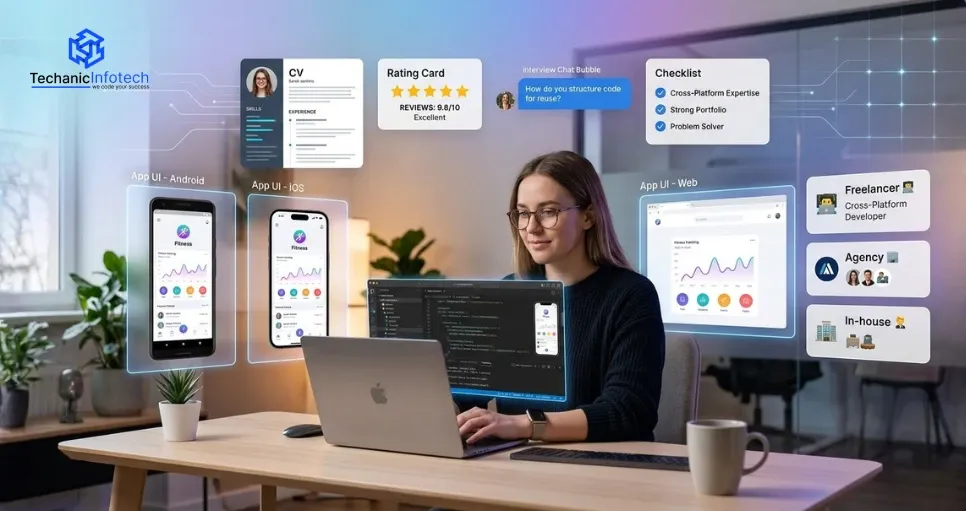
Key Takeaways
Hiring cross-platform developers helps businesses build apps for both iOS and Android using a single codebase, reducing development time, costs, and ensuring consistent user experience.
Choosing the right developer requires evaluating technical expertise in frameworks like Flutter or React Native, along with strong programming, UI/UX understanding, and API integration skills.
Cross-platform development is ideal for startups and businesses needing faster launches, limited budgets, wider audience reach.
Following a structured hiring process defining requirements, evaluating portfolios, conducting technical tests, and starting with small projects ensures selecting reliable and skilled developers for long-term success.
Development costs vary based on app complexity, ranging from basic apps to enterprise-level solutions, with additional expenses for maintenance, updates, and advanced feature enhancements over time.
In today’s fast-paced digital world, businesses want mobile applications that work seamlessly across multiple platforms such as iOS and Android.
Instead of building separate apps for each operating system, cross-platform development allows companies to create a single application that runs efficiently on multiple platforms.
Hiring the right cross-platform developer can help businesses save time, reduce development costs, and ensure a consistent user experience.
From evaluating technical expertise to assessing communication skills, companies must follow a structured approach.
This guide explains how to hire a cross-platform developer, the key skills to look for, costs involved, benefits, and common hiring mistakes to avoid.
Before hiring a cross-platform developer, it’s important to evaluate technical expertise, problem-solving ability, and framework knowledge to ensure they can build efficient multi-platform applications.
A skilled developer should have strong experience with frameworks like Flutter, React Native, or Xamarin.
These tools enable developers to create applications that run smoothly on multiple platforms using a single codebase.
Cross-platform developers must be proficient in programming languages such as JavaScript, Dart, or C#.
Strong coding skills help ensure efficient minimum viable product development, fewer bugs, and better performance across different devices and operating systems.
Developers should understand user interface and user experience principles.
This ensures that applications look visually appealing and function consistently across both Android and iOS platforms while maintaining platform-specific usability standards.
Modern applications rely on third-party services and APIs.
A capable cross-platform developer should know how to integrate APIs efficiently to enable mobile app features like payments, authentication, cloud storage, and real-time updates.
Debugging and testing are essential for delivering stable applications.
Developers should be familiar with testing frameworks and debugging tools to identify performance issues, fix bugs, and ensure smooth functionality.
Experience with version control systems like Git is essential.
It helps developers collaborate effectively, track code changes, and maintain a well-organized development workflow in team environments.
Businesses often face situations where a Flutter app development company becomes the most efficient option.
Understanding when to hire such developers helps maximize development speed, cost, efficiency, and product reach.
Cross-platform development allows developers to write one codebase for multiple platforms.
This significantly reduces development time and enables businesses to launch their applications faster in competitive markets.
Developing separate apps for Android and iOS can be expensive.
Hiring a software development team helps reduce costs by eliminating the need for separate development teams and duplicated coding efforts.
If your goal is to reach both Android and iOS users simultaneously, cross-platform development is an ideal solution.
It ensures your app is accessible to a broader user base from the beginning.
Cross-platform development works best when app features and functionality remain largely the same across platforms.
This approach ensures consistent performance while simplifying development and maintenance.
Maintaining a single codebase is much easier than managing separate native apps.
Updates, bug fixes, and feature improvements can be implemented quickly across all platforms.
Startups often build a Minimum Viable Product (MVP) first.
Hiring a cross-platform developer helps quickly test the product idea across multiple platforms without heavy investment.
Hiring a cross-platform developer offers several advantages, including faster development cycles, reduced mobile app development cost, and consistent app experiences across multiple platforms without maintaining separate codebases.
Developing a single codebase significantly reduces development expenses.
Businesses can avoid hiring separate iOS and Android developers, making cross-platform development a cost-effective approach.
Since developers write one codebase for multiple platforms, development time is shortened.
Businesses can launch their apps faster and respond quickly to changing market demands.
Cross-platform apps allow businesses to target both Android and iOS users simultaneously.
This increases the app’s visibility and helps reach a larger audience.
With a shared codebase, developers can implement updates, bug fixes, and improvements more efficiently.
Changes made once automatically apply to multiple platforms.
Cross-platform frameworks help maintain similar design and functionality across devices.
This ensures users enjoy a consistent and seamless experience regardless of the platform they use.
Following a clear step-by-step approach ensures you select skilled professionals who can successfully deliver high-quality cross-platform applications.
Start by clearly outlining your app idea, features, target platforms, and budget.
Having well-defined requirements helps attract the right developers and ensures smoother communication throughout the mobile app development process.
Decide which framework best suits your project needs, such as Flutter or React Native.
The framework choice will influence the type of developer you should hire.
Look for developers on professional platforms, development agencies, or freelance marketplaces.
Review portfolios, previous projects, and client feedback to evaluate their experience.
Conduct technical interviews or coding assessments to verify the developer’s expertise in cross-platform frameworks, programming languages, and development tools.
Review the developer’s past projects to understand their work quality.
Speaking with previous clients can provide insights into their reliability and communication skills.
Before committing to a full project, assign a small test task.
This helps evaluate the developer’s problem-solving ability, coding quality, and adherence to deadlines.
Once satisfied, finalize the contract, mobile app development timeline, milestones, and communication channels to ensure smooth collaboration throughout the development process.
The cost of hiring a cross-platform developer depends on several factors, especially the complexity of the application. Apps are generally categorized into basic, medium, and complex levels.
Basic cross-platform apps include simple features such as user login, basic UI screens, and limited functionality.
These apps are suitable for startups or MVPs and usually cost around $10,000 – $25,000, depending on design requirements and development time.
Medium-complexity apps include features like API integrations, payment gateways, real-time notifications, and advanced UI elements.
These applications require more development time and testing, typically costing between $25,000 – $60,000 based on functionality and customization.
Advanced apps include complex features such as real-time data processing, AI integration, custom animations, large databases, and high security.
These enterprise-level applications require experienced developers and can cost $60,000 – $90,000+, depending on complexity and scale.
After the app is launched, regular maintenance is required to fix bugs, improve performance, and ensure compatibility with new operating system updates.
Ongoing maintenance and support typically cost $2,000 – $10,000 per year, depending on app complexity and update frequency.
As user needs evolve, businesses often add new features, integrations, or UI improvements.
These updates require additional development work and can cost around $5,000 – $20,000+, depending on the number of features and the complexity of implementation.
Many businesses make critical mistakes during the hiring process. Avoiding these common errors can help ensure you hire skilled developers capable of delivering high-quality applications.
Failing to review a developer’s portfolio can lead to hiring someone without relevant experience. Always evaluate past projects to understand their technical capabilities.
Choosing the cheapest developer may result in poor-quality work. It is important to balance cost with experience, technical skills, and reliability.
Skipping technical assessments can be risky. Testing coding skills and framework knowledge helps ensure the developer can handle real project challenges.
Lack of clear communication channels can cause misunderstandings and delays. Establish communication methods, meeting schedules, and reporting structures early.
Starting a project without clearly defined requirements can lead to scope changes and increased costs. Always document project goals and deliverables.
Hiring the right cross-platform developer can significantly impact the success of your mobile application.
Cross-platform development offers several advantages, including faster development time, reduced costs, and easier maintenance.
However, it is important to follow a structured hiring process, carefully evaluate candidates, and avoid common mistakes such as ignoring portfolios or focusing only on cost.
Whether you are launching a startup app, building an MVP, or expanding your digital presence, hiring the right cross-platform developer ensures efficient development and better long-term results for your business.
Choose based on your project needs. Flutter is great for high-performance UI, while React Native is ideal if you prefer JavaScript and faster integration with web apps.
Freelancers are cost-effective for small projects, while agencies are better for complex apps requiring a full cross-platform development team for bus
Look for at least 2–5 years of experience with real-world projects, especially those similar to your app’s requirements.
You can assign a small paid test project or conduct a technical interview focusing on coding, API integration, and debugging ski
They commonly use frameworks like Flutter or React Native, along with tools like Git, Firebase, Android Studio, and Visual Studio Code.
Very important. Clear communication ensures better collaboration, fewer misunderstandings, and smoother project execution.
Yes, for small projects. However, larger apps usually require a team including designers, testers, and backend developers.
Dedicated developers work remotely on your project (often from an agency), while in-house developers are full-time employees working within your organization.
Timelines depend on app complexity simple apps may take 2–3 months, while complex apps can take 6+ months including testing and deployment.
The contract should include project scope, deadlines, payment terms, milestones, intellectual property rights, and maintenance support details.


Bharat Sharma is the CTO of Techanic Infotech, bringing deep technical expertise in software architecture, mobile app development, and scalable system design. He leads the engineering team with a strong focus on innovation, performance, and security.