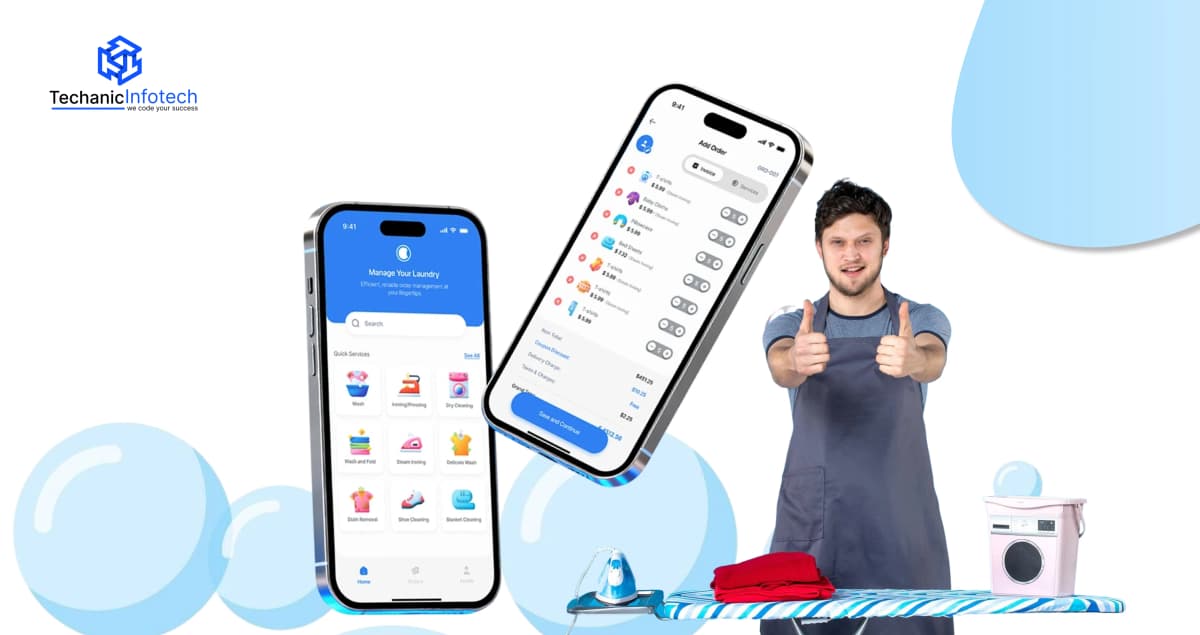
The on-demand economy continues to reshape consumer behavior in 2026, and laundry service apps are emerging as a profitable digital solution for startups and established businesses alike.
With increasing urbanization, busy lifestyles, and demand for doorstep services, investing in a laundry app offers strong revenue potential.
However, understanding the true cost of laundry app development is essential before starting your project.
Development expenses vary depending on features, design complexity, technology stack, platform choice, and development location.
Whether you are building a basic MVP or a full-scale enterprise solution, costs can range significantly.
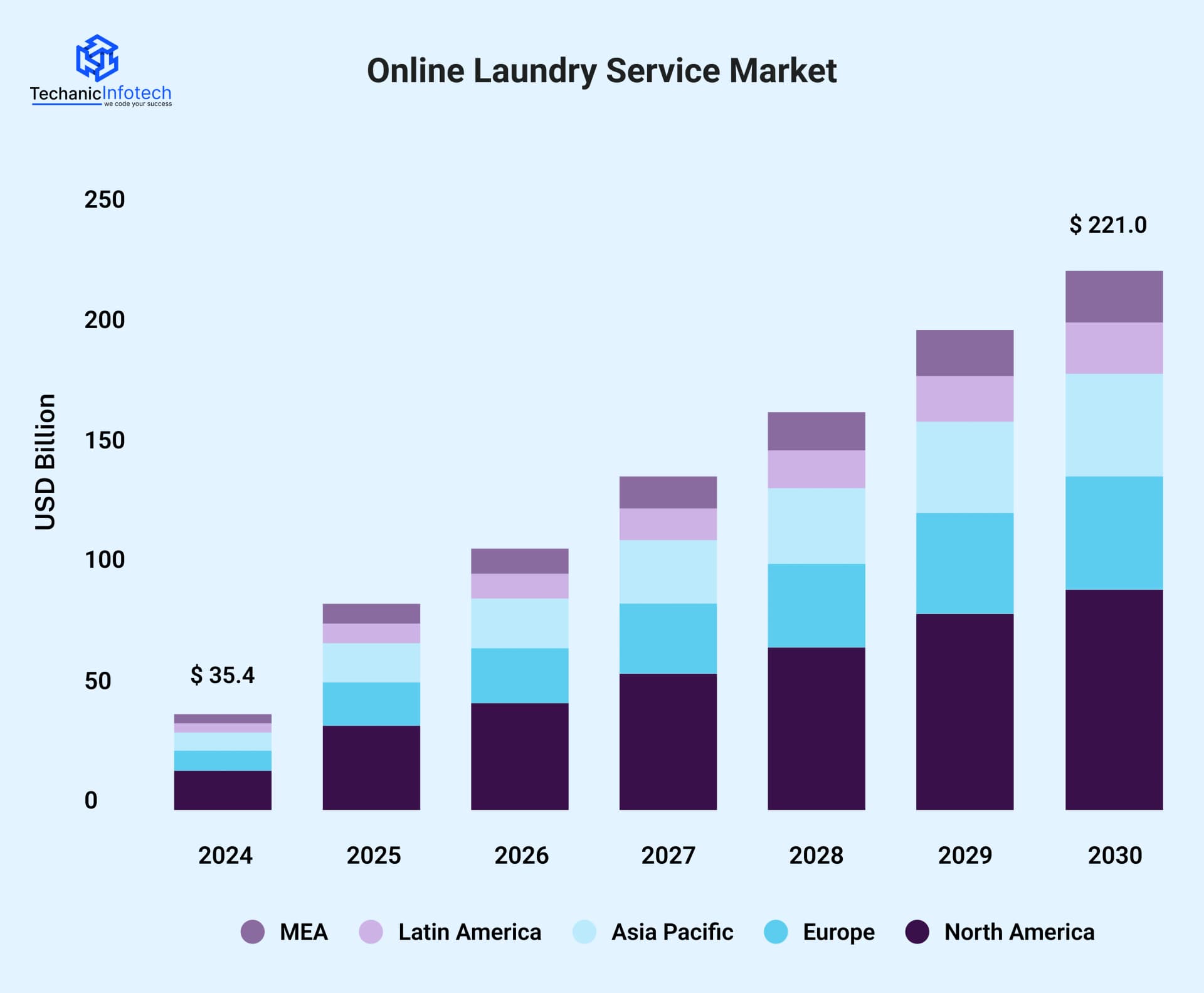
The global online laundry service market was valued at USD 28,479.2 million in 2023 and is forecasted to surge to USD 221,046.2 million by 2030, expanding at a remarkable CAGR of 35.7% during 2024–2030.
In 2023, North America emerged as the largest revenue-generating regional market, driven by high digital adoption, busy urban lifestyles, and strong penetration of online service platforms.
Within the region, Canada is anticipated to witness the highest compound annual growth rate (CAGR) throughout the forecast period (2024–2030), reflecting accelerating market adoption and expanding service infrastructure.
By service type, the Laundry Care segment accounted for USD 13,513.3 million in revenue in 2023.
The cost of developing a laundry app depends on multiple factors, including app complexity, platform choice, features, design, backend infrastructure, integrations, maintenance, and scalability requirements.
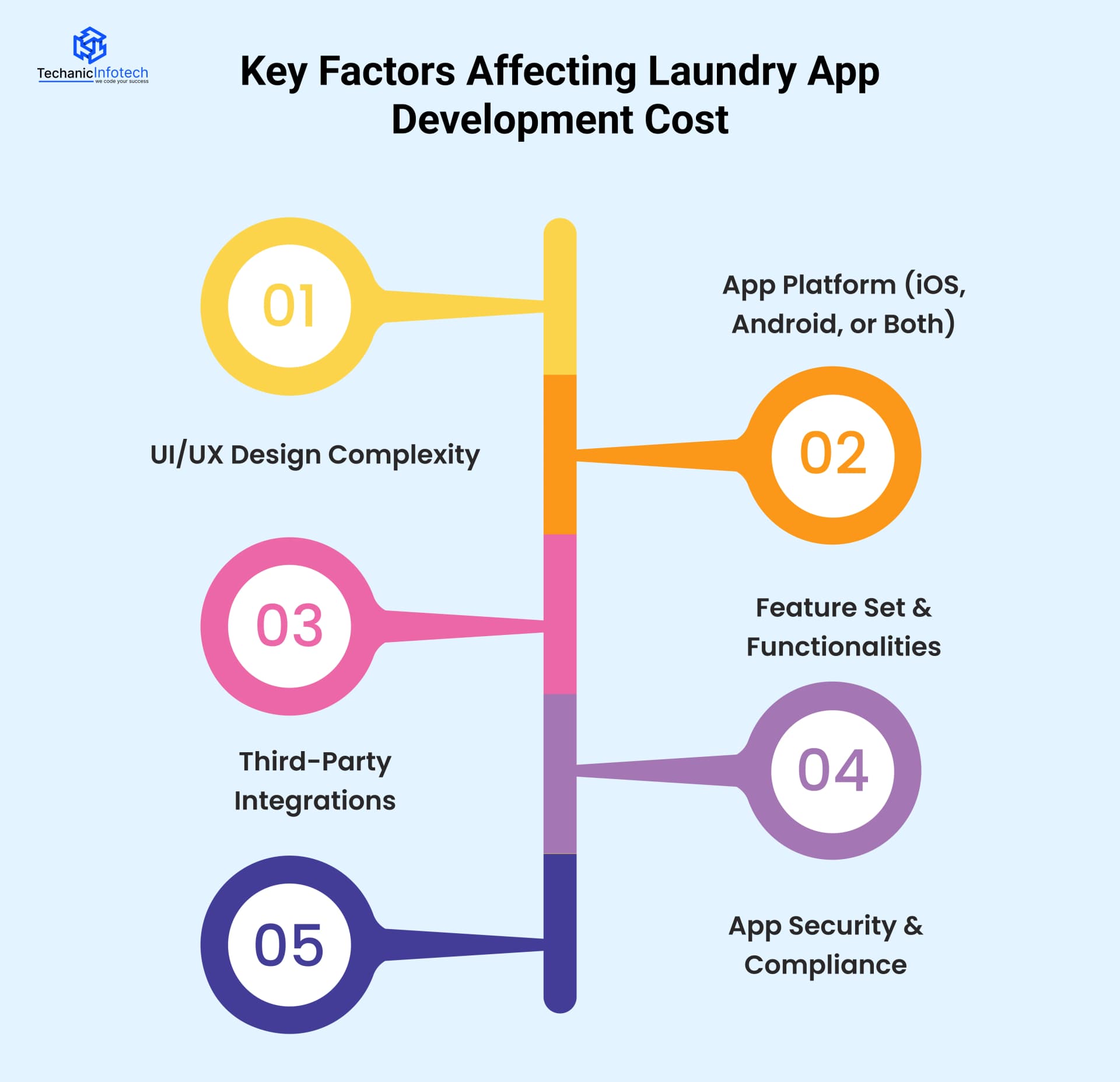
Developing for a single platform (iOS or Android) reduces the cost to build a mobile app, while building for both increases budget requirements.
Native development requires separate coding, whereas cross-platform frameworks lower expenses.
A simple, template-based design is more affordable than a custom, interactive UI/UX with animations and branding elements.
Advanced user flows, accessibility compliance, and responsive design increase design hours.
Basic apps include registration, booking, and payments. Advanced apps add tracking, AI recommendations, subscription plans, loyalty programs, and analytics dashboards.
More features require extended time to create a mobile app, backend logic, API integrations, and testing, directly increasing project cost.
Payment gateways, SMS APIs, GPS tracking, CRM systems, and analytics tools require integration and configuration.
Some services charge licensing or transaction fees. Complex integrations increase development effort and maintenance needs, impacting both upfront and recurring expenses.
Implementing encryption, secure authentication, GDPR compliance, and PCI-DSS payment security adds development complexity.
Security testing, data protection measures, and legal compliance are essential in 2026, increasing cost but preventing potential data breaches and financial penalties.
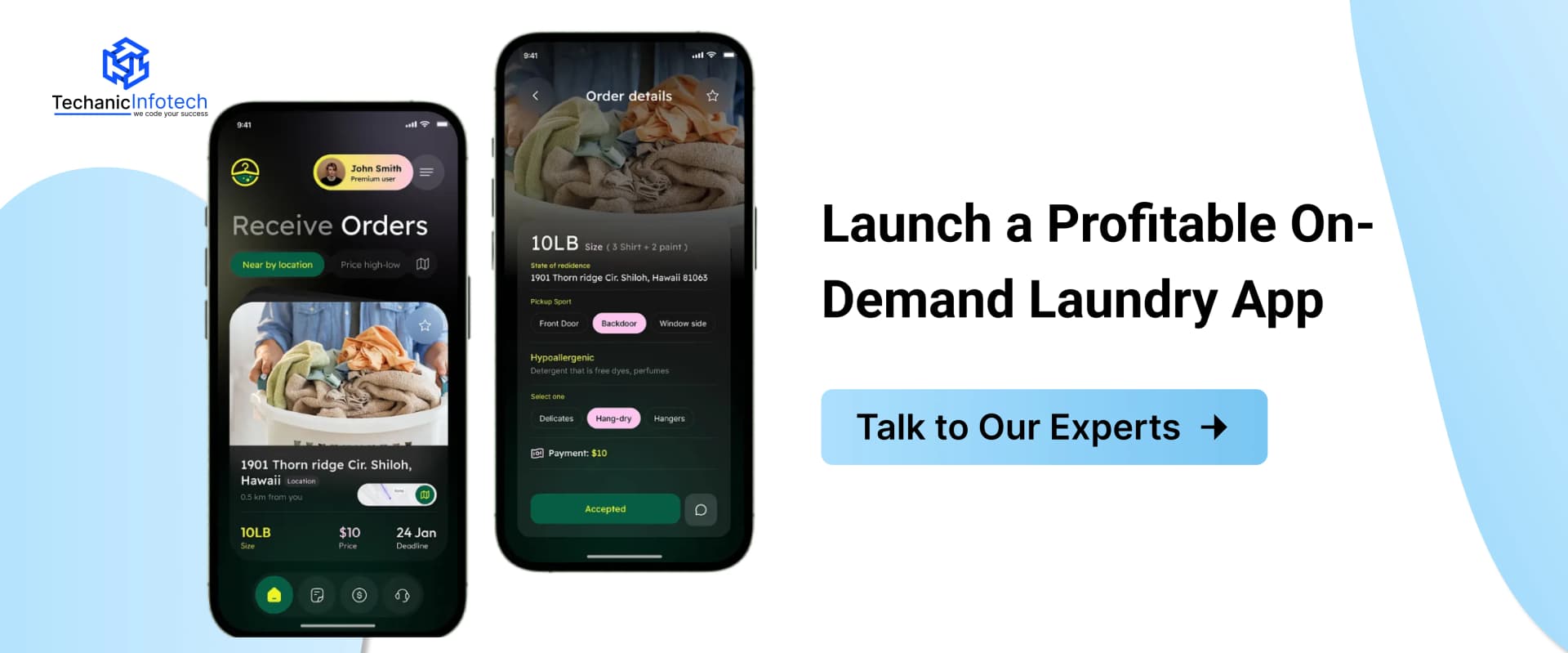
Developing a laundry app involves varied costs, influenced by app type, features in the mobile app, design, backend infrastructure, platform choice, and ongoing maintenance, shaping total investment for startups and enterprises.
A basic laundry app MVP with essential features like user registration, service selection, order booking, secure payments, and simple admin management typically costs between $10,000 and $25,000.
It’s ideal for startups validating market demand with minimal customization and streamlined functionality.
|
Feature |
Short Description |
Price Allocation |
|
User Registration & Login |
Secure sign-up/login via email or phone authentication |
$2,500 – $6,000 |
|
Service Selection |
Users choose laundry type, quantity, and pickup time |
$1,500 – $3,000 |
|
Order Booking & Scheduling |
Simple order placement with pickup/drop scheduling |
$3,000 – $5,000 |
|
Payment Integration |
Secure online payments (cards, wallets, UPI) |
$3,500 – $7,000 |
A mid-level laundry app with advanced features such as real-time order tracking, push notifications, subscription plans, ratings, and a comprehensive admin dashboard generally costs between $25,000 and $50,000.
It suits growing businesses seeking scalability, automation, and enhanced user engagement.
|
Feature |
Short Description |
Price Allocation |
|
Real-Time Order Tracking |
Live driver & order progress tracking |
$6,500 – $13,000 |
|
Push Notifications |
Automated updates & marketing alerts |
$4,000 – $8,500 |
|
Subscription Plans |
Recurring weekly/monthly laundry packages |
Recurring weekly/monthly laundry packages |
|
Ratings & Admin Dashboard |
Feedback system + advanced admin controls |
$7,000 – $13,500 |
An enterprise-grade laundry app featuring AI-based recommendations, route optimization, multi-location management, advanced analytics, automation tools, and third-party integrations.
This usually costs between $50,000 and $90,000, depending on complexity, customization, security standards, and cross-platform requirements for creating a mobile app.
|
Feature |
Short Description |
Price Allocation |
|
AI-Based Recommendations |
Smart service suggestions & demand prediction |
$14,000 – $22,000 |
|
Route Optimization |
Intelligent driver routing & fuel efficiency |
$11,000 – $18,000 |
|
Multi-Location Management |
Control multiple branches in one system |
$10,000 – $20,000 |
|
Advanced Analytics & Integrations |
Automation, CRM, ERP & third-party APIs |
$15,000 – $30,000 |
Backend development, including scalable architecture, API integrations, database design, cloud hosting setup, admin controls, and real-time order processing, usually costs between $10,000 and $30,000.
Pricing varies based on security requirements, user load capacity, and system performance expectations.
|
Feature |
Short Description |
Price Allocation |
|
Scalable Cloud Architecture |
AWS/Azure/GCP server setup |
$3,500 – $9,000 |
|
API & Third-Party Integrations |
Payment, SMS, and maps integration |
$2,000 – $6,500 |
|
Database Design & Security |
Secure data storage & encryption |
$2,500 – $7,500 |
|
Real-Time Processing System |
Order updates & admin management |
$2,000 – $7,000 |
Professional UI/UX design covering user research, wireframing, interactive prototypes, visual branding, responsive layouts, and user journey optimization generally costs between $5,000 and $15,000.
Expenses depend on customization level, animation complexity, platform compatibility, and overall design sophistication.
|
Feature |
Short Description |
Price Allocation |
|
User Research & Wireframes |
UX strategy & app flow planning |
$1,200 – $3,800 |
|
Interactive Prototypes |
Clickable high-fidelity prototypes |
$1,000 – $3,200 |
|
Visual Branding & UI System |
Color schemes, icons & typography |
$1,500 – $4,500 |
|
Responsive & Adaptive Layouts |
iOS & Android optimization |
$1,300 – $3,500 |
Ongoing maintenance, including performance monitoring, security updates, feature enhancements, bug fixes, server management, and technical support.
Usually, this costs 15–20% of total development expenses annually, averaging between $5,000 and $15,000, depending on app complexity and usage volume.
|
Feature |
Short Description |
Price Allocation |
|
Performance Marketing |
Speed and uptime management |
$800 – $3,000 |
|
Security & Compliance Updates |
Patch upgrades & data protection |
$1,200 – $3,500 |
|
Bug Fixes & Feature Enhancements |
Continuous improvement & fixes |
$1,500 – $4,000 |
|
Hosting & Technical Support |
Server management & tech support |
$1,500 – $4,500 |
Beyond development, laundry apps incur hidden costs like app maintenance, cloud hosting, payment processing fees, marketing, app store commissions, and unexpected updates, which can significantly impact the total budget and ROI.
Expenses include bug fixes, performance improvements, feature enhancements, OS compatibility updates, security patches, server monitoring, and technical support to ensure smooth functionality and long-term reliability.
Cloud hosting services such as AWS or Google Cloud can cost between $10,000 and $20,000 annually, depending on traffic, storage, bandwidth, and scaling requirements.
Payment gateways typically charge 2–3% per transaction, plus fixed processing fees. For high-volume platforms, annual payment processing costs can exceed $10,000.
Costs include digital advertising, influencer partnerships, app store optimization, content creation, branding, public relations, and promotional campaigns to attract early users and drive downloads.
Depending on revenue scale, businesses may spend $10,000 or more annually in platform fees and marketplace transaction commissions.
The following tables show the hidden cost of developing the laundry applications.
|
Category |
Cost Components |
Estimated Annual Cost |
|
App Maintenance & Updates |
Bug fixes, performance optimization, feature upgrades, OS updates, security patches, server monitoring, and technical support |
$10,000 – $25,000+ |
|
Cloud Hosting (AWS / Google Cloud) |
Server infrastructure, database hosting, storage, bandwidth, CDN, scaling, DevOps management |
$10,000 – $20,000 |
|
Payment Gateway Charges |
2–3% transaction fees, fixed processing fees, international payments, refunds, and chargebacks |
$10,000 – $22,000+ (Depends on transaction volume) |
|
Marketing & Launch Expenses |
Digital ads, influencer marketing, ASO, branding, PR, promotional campaigns |
$10,000 – $30,000 |
|
App Store Fees |
Developer program fees, 15–30% commission on IAPs/subscriptions, marketplace fees |
$10,000 – $28,000+ (Depends on revenue scale) |
Reducing laundry app development costs involves strategic planning, prioritizing essential features, choosing the right technology, leveraging MVPs, optimizing design, and outsourcing or using pre-built solutions without compromising quality.
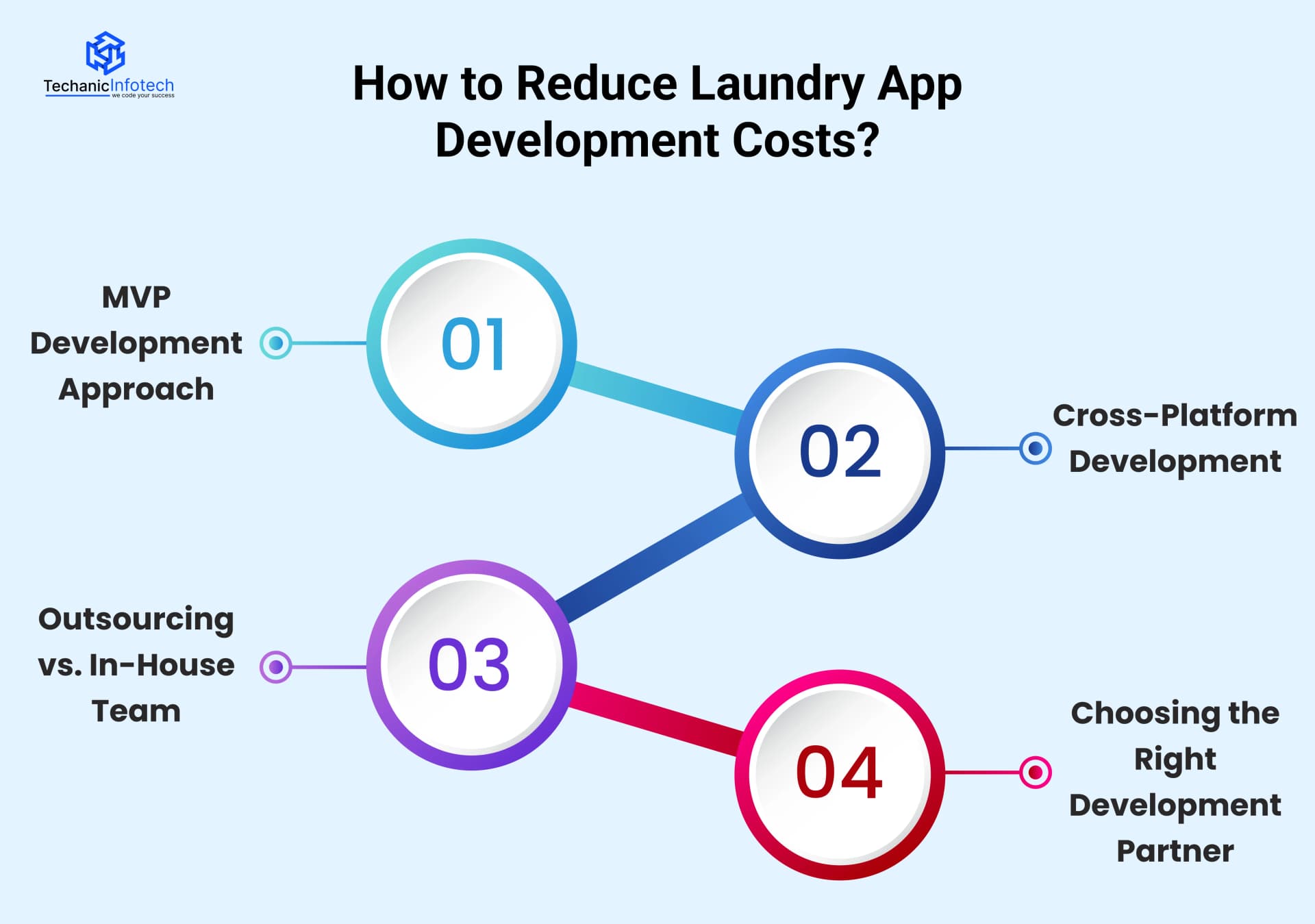
This strategy reduces upfront development costs, accelerates time-to-market, gathers real user feedback, and minimizes financial risk before committing to building a minimal viable product expansion.
This approach significantly lowers development time, reduces costs, simplifies maintenance, and ensures consistent performance across multiple devices.
Compared to maintaining a mobile app and an in-house team, outsourcing provides access to specialized expertise, faster project execution, flexible scaling options, and lower long-term overhead costs.
Selecting the right development partner ensures project efficiency and cost control. Evaluate their portfolio, technical expertise, transparent pricing structure, and communication process.
Selecting the right guide for the mobile app tech stack is crucial for building a robust, scalable, and secure laundry app, covering frontend, backend, databases, cloud services, payment integration, and real-time tracking solutions.
Flutter, React Native, Swift, and Kotlin enable the development of responsive, visually engaging, and scalable mobile applications, ensuring seamless cross-platform compatibility.
Node.js, Laravel, Django, and Express.js power secure, scalable, and high-performance server-side development, enabling efficient API integration.
MySQL, PostgreSQL, and MongoDB provide reliable, scalable, and structured data storage solutions, supporting efficient data retrieval and secure transactions.
AWS, Google Cloud, and Microsoft Azure deliver scalable cloud infrastructure, secure hosting environments, automated backups, load balancing, and real-time monitoring.
Techanic Infotech is the best laundry app development company, specializing in developing scalable, secure, and feature-rich on-demand applications tailored to business goals.
Our expert team follows a structured development methodology that includes in-depth market research, intuitive UI/UX design, agile development practices, and rigorous quality assurance testing.
We prioritize performance optimization, cloud scalability, and robust security compliance to ensure long-term operational success.
From MVP development to enterprise-grade laundry solutions, we provide transparent pricing, milestone-based delivery, and post-launch maintenance support.
Laundry app development in 2026 presents strong business opportunities driven by digital transformation and consumer demand for convenience.
However, cost estimation requires careful evaluation of features, technology stack, platform selection, and long-term scalability.
Development costs typically range from $10,000 for basic MVPs to $90,000+ for enterprise-level solutions.
Businesses should focus on launching with essential features, validating market demand, and gradually scaling operations.
Factoring in hidden costs such as maintenance, hosting, and marketing ensures realistic budgeting and sustainable growth.
Laundry app development costs range between $10,000 and $90,000, depending on features, design complexity, and development location.
Laundry app development costs range between $10,000 and $90,000, depending on features, design complexity, and development location.
Typically, development takes 3 to 6 months, depending on app complexity and feature requirements.
Typically, development takes 3 to 6 months, depending on app complexity and feature requirements.
Building an MVP using cross-platform frameworks helps reduce initial investment and development time.
Building an MVP using cross-platform frameworks helps reduce initial investment and development time.
Yes, maintenance, hosting, updates, and marketing may cost $10,000+ annually.
Yes, maintenance, hosting, updates, and marketing may cost $10,000+ annually.
Yes, scalable backend architecture and cloud hosting allow seamless expansion as your user base grows.
Yes, scalable backend architecture and cloud hosting allow seamless expansion as your user base grows.


Bharat Sharma is the CTO of Techanic Infotech, bringing deep technical expertise in software architecture, mobile app development, and scalable system design. He leads the engineering team with a strong focus on innovation, performance, and security.