Mobile App Development
Low Code vs Custom App Development: Which is Best for Your Business?
March 14, 2026
March 14, 2026
Businesses today are under constant pressure to launch digital products faster than ever before.
Whether it’s a customer-facing mobile app, an internal automation tool, or a new SaaS platform, companies need development approaches that are both efficient and scalable. This growing demand has sparked a major discussion in the tech world: low code vs custom app development.
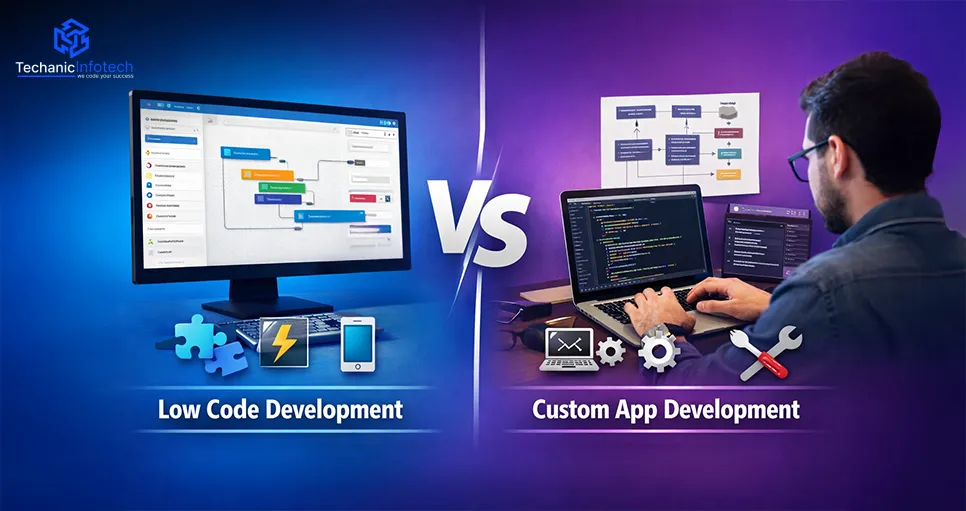
Low code platforms promise faster development with minimal coding, while custom development offers complete flexibility and control. Naturally, many organizations are now evaluating low code vs traditional app development models to determine which approach best fits their long-term goals.
Industry leaders have been highlighting the rise of low code development for years.
Satya Nadella, CEO of Microsoft, once said, "Every company is a software company. You have to start thinking and operating like a digital company.”
Low code tools are one way businesses are responding to that challenge by enabling faster application creation without relying entirely on traditional coding.
The growth of the low code market reflects this shift. According to industry research, the global low code development platform market is expected to surpass $60 billion by 2027, driven by increasing demand for faster software delivery and digital transformation initiatives.
Still, speed isn’t the only factor businesses must consider. Questions around scalability, flexibility, long-term maintenance, and security often arise when comparing low code vs custom software development approaches.
Some companies benefit from rapid development through low code platforms, while others require a more tailored custom mobile app development strategy to support complex features and future expansion.
In this guide, we’ll explore the key differences, benefits, and limitations of both approaches so you can decide which development path is best for your business.
Low code app development is a modern approach to building software applications using visual interfaces, drag-and-drop tools, and pre-built components instead of writing large amounts of code manually.
Low code platforms allow developers and even non-technical users to create applications faster by simplifying the development process. Instead of building every feature from scratch, developers can use ready-made modules for tasks such as database connections, user interfaces, and workflows.
This approach has become popular among organizations looking to accelerate digital transformation and reduce app development time. Businesses often use low code platforms to build internal tools, workflow automation systems, customer portals, or simple mobile applications.
One of the biggest benefits of low code development is speed. Applications that might take months to build using traditional coding methods can sometimes be created in weeks. Low code platforms also reduce the dependency on large development teams, making them attractive for companies with limited technical resources.
However, while low code solutions are ideal for simple or moderately complex applications, they may have limitations when businesses need highly customized functionality or advanced integrations.
Custom app development refers to the process of building software applications entirely from scratch based on the specific needs of a business.
Unlike low code platforms, this approach involves writing code manually using programming languages, frameworks, and development tools. The result is a fully tailored application designed to match a company’s exact requirements.
A custom mobile app development strategy allows businesses to create unique features, integrate complex systems, and design highly personalized user experiences. This approach is commonly used by companies that require scalable, high-performance applications such as enterprise platforms, fintech systems, or large e-commerce apps.
One of the biggest custom app development advantages is flexibility. Developers can control every aspect of the application, including performance optimization, security measures, and future scalability.
Although custom development usually takes longer and requires higher upfront investment compared to low code platforms, it often provides better long-term value for businesses that need powerful and fully customized digital solutions.
When businesses evaluate low code vs custom app development, they often compare several factors such as development speed, cost, scalability, flexibility, and long-term maintenance.
While both approaches aim to build functional applications, they differ significantly in how the development process works and what level of control businesses have over the final product.
The table below highlights the major differences between low code vs custom software development approaches.
|
Factor |
Low Code App Development |
Custom App Development |
|
Development Approach |
Uses visual builders, drag-and-drop interfaces, and pre-built components to create applications quickly. |
Applications are built from scratch using programming languages and frameworks. |
|
Development Speed |
Much faster development since many components are already available. |
Slower development because every feature must be coded manually. |
|
Cost |
Lower upfront development cost due to reduced coding effort. |
Higher initial cost because of full-scale development and larger development teams. |
|
Customization |
Limited customization since developers rely on predefined platform features. |
Complete customization with full control over features, architecture, and functionality. |
|
Scalability |
May face limitations when scaling large or complex applications. |
Highly scalable and suitable for enterprise-level applications. |
|
Flexibility |
Restricted by the capabilities of the low code platform being used. |
Extremely flexible because developers can design and modify any part of the application. |
|
Performance Optimization |
Performance depends on the platform's capabilities and infrastructure. |
Developers can fully optimize performance according to business needs. |
|
Security |
Security features depend on the platform provider. |
Security can be customized and strengthened based on application requirements. |
|
Maintenance |
Easier to maintain since updates and infrastructure are often managed by the platform provider. |
Requires dedicated maintenance and technical support from the development team. |
|
Best Use Cases |
Internal tools, workflow automation, MVPs, and simple business applications. |
Enterprise systems, fintech platforms, large e-commerce apps, and complex software solutions. |
|
Skill Requirement |
Can be used by developers and sometimes non-technical users. |
Requires experienced software developers and engineering teams. |
|
Long-Term Control |
Businesses rely on the platform provider for updates and infrastructure. |
Full ownership and control over the application and its future development. |
Low code development has become increasingly popular as businesses look for faster ways to build digital products.
By using visual tools and pre-built components, companies can create applications without writing extensive code. However, while the benefits of low code development are attractive, there are also limitations businesses should consider.
Faster Development Time
One of the biggest advantages of low code platforms is speed. Developers can build applications much faster using drag-and-drop interfaces and ready-made components. This makes low code development ideal for businesses that need to launch apps quickly.
Lower Initial Development Cost
Because low code platforms require less manual coding, companies can reduce app development costs. Smaller development teams can create applications efficiently, making this approach attractive for startups and small businesses.
Easier Collaboration Between Teams
Low code platforms allow both developers and non-technical users to participate in the development process. Business teams can collaborate with developers to create workflows and features without deep programming knowledge.
Rapid Prototyping and MVP Development
Low code platforms are excellent for creating minimum viable products (MVPs) and prototypes. Businesses can quickly test ideas and gather feedback before investing in full-scale development.
Built-In Maintenance and Updates
Many low code platforms provide automatic updates, hosting, and infrastructure management. This reduces the burden on internal development teams.
Limited Customization
Low code platforms often rely on predefined templates and modules. This can limit the ability to create highly customized applications.
Scalability Limitations
As businesses grow, low code platforms may struggle to support complex applications with heavy traffic or advanced functionality.
Platform Dependency
Businesses become dependent on the platform provider for updates, pricing, and infrastructure. Migrating away from the platform can sometimes be difficult.
Integration Challenges
Some low code platforms may have limitations when integrating with complex external systems or legacy software.
Custom development is the traditional method of building software applications from scratch using programming languages and frameworks. While it usually requires more time and resources, it offers greater flexibility and control.
Understanding the custom app development advantages and potential challenges helps businesses decide if this approach fits their needs.
Complete Customization
Custom development allows businesses to build applications tailored exactly to their requirements. Every feature, workflow, and interface can be designed according to business needs.
High Scalability
Applications built through custom development can be designed to handle large numbers of users and complex operations. This makes them suitable for enterprise-level systems.
Stronger Security Control
With custom development, businesses can implement advanced security measures based on their industry requirements. This is especially important for industries like finance, healthcare, and e-commerce.
Better Performance Optimization
Developers can optimize performance specifically for the app’s functionality, ensuring smooth user experiences even with heavy workloads.
Long-Term Flexibility
Custom applications can evolve as the business grows. Developers can add new features, integrate additional systems, and scale the infrastructure when needed.
Higher Development Cost
Custom development typically requires a larger budget because it involves experienced developers, longer development cycles, and more resources.
Longer Development Timeline
Building an application from scratch takes more time compared to low code development.
Requires Skilled Development Teams
Custom development demands experienced developers, architects, and testers, which can increase project complexity.
Ongoing Maintenance Responsibility
Unlike low code platforms that handle updates automatically, custom applications require regular maintenance strategies, updates, and technical support from development teams.
Low code platforms are becoming increasingly popular because they allow businesses to build applications faster without heavy coding.
These platforms provide visual development tools, reusable components, and pre-built integrations, which help teams create applications quickly.
While low code development can be used for many types of software projects, it is especially useful in situations where speed, flexibility, and cost efficiency are important.
Below are some of the most common and effective use cases for low code development.
Many organizations use low code platforms to build internal tools such as employee management systems, workflow automation apps, and reporting dashboards. These applications help teams manage daily operations without requiring complex development processes.
Low code platforms are often used to build customized CRM systems that manage customer data, track sales pipelines, and automate follow-ups. Businesses can quickly develop and modify CRM tools based on changing customer management needs.
Low code development is ideal for automating repetitive business tasks. Companies can build applications that automate approvals, document processing, task assignments, and notifications, improving operational efficiency.
Businesses often need applications that collect, organize, and analyze data from different sources. Low code platforms allow teams to build dashboards and reporting tools that provide real-time insights without complex coding.
Companies can create customer portals where users can track orders, submit requests, manage accounts, or access services. Low code platforms help build these systems quickly while maintaining good user experience.
Startups and businesses frequently use low code platforms to build prototypes or minimum viable products (MVPs). This allows them to test ideas, gather feedback, and improve the product before investing in full-scale development.
Cost is one of the most important factors businesses consider when evaluating low code vs custom app development.
Low code platforms generally reduce development cost and time, while custom development requires higher upfront costs but offers greater flexibility and scalability.
|
Cost Factor |
Low Code Development |
Custom App Development |
|
Initial Development Cost |
$5,000 – $40,000 depending on platform and complexity |
$30,000–$200,000+ depending on features and app size |
|
Development Time |
2–8 weeks for most applications |
3–9 months depending on complexity |
|
Developer Team Size |
Small team (1–3 developers) |
Larger team (3–10 developers, designers, QA) |
|
Platform Licensing Fees |
$25 – $500+ per month depending on the platform |
No platform license, but hosting and infrastructure costs apply |
|
Custom Feature Development |
Limited customization; additional features may increase cost |
Fully customizable features but require more development budget |
|
Maintenance Cost |
$50 – $500/month depending on platform subscription |
15–20% of development cost per year |
|
Scalability Cost |
Higher platform plans may increase monthly fees |
Scalable infrastructure designed according to business needs |
|
Integration Cost |
Basic integrations often included in the platform |
Custom integrations may cost $1,000 – $10,000+ |
|
Long-Term Cost |
Subscription costs accumulate over time |
Higher initial cost but lower dependency on third-party platforms |
Choosing the right development approach is one of the most important decisions for businesses planning a new application.
While low code platforms can help build applications quickly, they may not always provide the flexibility or scalability required for complex business needs. This is where custom app development becomes a better option.
Understanding when to choose custom development can help businesses build long-term, scalable solutions that support their growth.
Below are some situations where custom app development is the right choice.
Every business operates differently. If your processes, workflows, or customer interactions are unique, ready-made or low code solutions may not fully support your needs.
Custom app development allows you to build software specifically designed around your business model, ensuring the application fits your operations perfectly.
As businesses grow, their technology requirements also evolve. Custom-built applications provide the flexibility to add new features, integrate new technologies, and support larger numbers of users. This scalability makes custom development ideal for businesses planning long-term expansion.
Industries such as finance, healthcare, and enterprise services often require strict security standards and regulatory compliance. Custom app development gives businesses greater control over data protection, system architecture, and compliance requirements compared to generic platforms.
Many organizations use several tools such as CRM platforms, payment systems, analytics software, and internal databases. Custom applications can be designed to integrate smoothly with these systems, creating a connected ecosystem that improves operational efficiency.
Choosing the right development approach can significantly impact the success of your application. At Techanic Infotech, we help businesses evaluate their goals, technical needs, and long-term vision before starting any project.
Our mobile app development company carefully analyzes your requirements and recommends whether a low code platform or custom development will deliver the best results.
Here’s how our experts help you make the right decision:
Project Complexity Assessment: Our team evaluates the complexity of your project, including features, workflows, and technical requirements, to determine whether custom development is necessary for your application.
Understanding Your Business Processes: We study your existing workflows and operational challenges to recommend a solution that fits your business structure and improves efficiency.
Planning for Scalability: Techanic Infotech designs solutions that support future growth. We ensure your application can handle increasing users, features, and business expansion.
Integration Strategy: Our developers assess the tools you already use, such as CRM, ERP, or payment systems, and recommend an approach that ensures smooth integration.
Budget and Timeline Evaluation: We help businesses balance development cost and project timelines by recommending the most efficient approach for their goals.
Security and Compliance Guidance: For industries dealing with sensitive data, our team ensures the recommended solution meets strong security standards and compliance requirements.
Choosing the right development approach is essential for building applications that truly support business goals.
Both low code and custom development offer advantages, but the right choice depends on factors such as project complexity, scalability requirements, integrations, and long-term growth plans. Businesses should carefully evaluate their technical needs and future expansion before making a decision.
Low code platforms can help launch applications quickly and cost-effectively, while custom
development offers greater flexibility, control, and scalability for more complex solutions.
By understanding the strengths and limitations of each approach, organizations can select the strategy that best fits their operations and build digital products that support efficiency, innovation, and sustainable growth.
Low code development is an approach that allows developers to build applications using visual tools and minimal coding.
Low code development is an approach that allows developers to build applications using visual tools and minimal coding.
Low code is suitable for simple applications, internal tools, and projects that require faster development.
Low code is suitable for simple applications, internal tools, and projects that require faster development.
Custom app development involves building software from scratch to meet specific business requirements.
Custom app development involves building software from scratch to meet specific business requirements.
Not always. Low code is faster for simple projects, while custom development is better for complex and scalable applications.
Not always. Low code is faster for simple projects, while custom development is better for complex and scalable applications.
Low code apps may face limitations as complexity and user demand increase.
Low code apps may face limitations as complexity and user demand increase.
The decision depends on project complexity, integration needs, scalability requirements, and long-term business goals.
The decision depends on project complexity, integration needs, scalability requirements, and long-term business goals.


Bharat Sharma is the CTO of Techanic Infotech, bringing deep technical expertise in software architecture, mobile app development, and scalable system design. He leads the engineering team with a strong focus on innovation, performance, and security.