Planning to build a mobile app in Italy in 2026? Understanding the expected budget is the first step before starting development.
The mobile app development cost in Italy typically ranges between €7,000 to €25,000+, depending on the app’s complexity, features, and the expertise of the development team.
At the same time, Italy’s growing digital economy continues to drive investment in app-based solutions.
The Italian mobile app market is projected to generate over €3.5 billion in revenue by 2026, showing strong business demand for mobile applications.
With increasing mobile usage and digital transformation across industries, more companies are investing in custom apps.
Knowing pricing trends, hourly development rates, and cost breakdowns helps businesses plan a realistic budget and make informed decisions before launching their app idea.
The cost to develop a mobile app in Italy in 2026 mainly depends on how complex the app is and the number of mobile app features it includes.
Simple apps with basic functionality cost much less, while enterprise-level applications with advanced integrations require a higher investment.
Understanding these ranges helps businesses plan a realistic development budget.
According to recent industry estimates, a simple mobile app (MVP) in Italy typically costs €7,000 to €15,000 and usually includes basic features such as login, limited screens, and essential functionality.
A medium-complexity app generally ranges between €15,000 to €25,000. These apps often include user accounts, push notifications, payment integrations, and a more polished UI/UX experience.
For complex or enterprise-level apps, development costs can reach €25,000 or more, especially when advanced technologies like AI, real-time analytics, strong security, and multi-platform support are required.
These ranges show that app complexity, features, and scalability requirements are the biggest factors influencing the overall development investment in Italy.
The cost to create a mobile app in Italy is influenced by several practical factors that directly impact the project scope, time, and technical effort.
Understanding these elements helps businesses estimate their mobile app development budget in Italy more accurately and avoid unexpected expenses.
The type of app you plan to build plays the biggest role in determining the total investment.
A simple informational or MVP app with limited functionality requires fewer development hours, while complex apps such as on-demand platforms, fintech, or enterprise solutions demand advanced architecture and testing.
Simple App (Basic functionality): €7,000 – €15,000
Medium Complexity App: €15,000 – €25,000
Advanced / Enterprise App: €25,000+
Higher complexity means more backend logic, integrations, and scalability planning, which increases the overall app development cost in Italy in 2026.
The number and type of features significantly affect development effort. Basic features like login, profile management, and content display are relatively affordable.
However, advanced functionalities such as real-time chat, payment processing, geolocation tracking, and analytics require more coding, testing, and maintenance.
Basic feature set: €3,000 – €6,000
Moderate features (notifications, APIs, dashboards): €6,000 – €12,000
Advanced features (AI, real-time tracking, automation): €12,000 – €20,000+
Carefully prioritizing features helps control the cost to build a mobile app in Italy.
User experience plays a major role in app success, but it also affects cost.
A standard template-based design is faster and more affordable, while custom designs with animations, branding, and usability testing require more time.
Basic UI design: €1,000 – €3,000
Custom UI/UX design: €3,000 – €5,000
Advanced design with interactive elements: €5,000+
Investing in quality mobile app UI/UX design often improves user retention and conversion rates, making it a valuable long-term investment despite increasing the initial mobile app development pricing in Italy.
Developing the app for a single platform reduces cost, while supporting both iOS and Android increases development and testing effort.
Cross-platform frameworks can help reduce duplication but still require optimization.
Single Platform (iOS or Android): €3,000 – €7,000
Cross-Platform App: €5,000 – €8,000
Native Apps for Both Platforms: €7,000 – €11,000+
Platform selection directly impacts the overall custom mobile app development cost in Italy.
Most apps require integrations such as payment gateways, maps, analytics tools, or CRM systems.
Basic integrations are quick, but complex enterprise integrations increase time and cost.
Basic integrations: €1,000 – €2,000
Advanced or multiple integrations: €2,000 – €4,000+
Choosing only essential integrations during the initial phase helps manage the Italy app development cost breakdown.
Security is especially important for apps handling sensitive data or financial transactions.
Compliance with GDPR and industry regulations may require encryption, authentication systems, and regular audits.
Standard security setup: €1,000 – €2,000
Advanced security and compliance: €2,000 – €5,000+
While security increases cost, it protects user trust and prevents long-term risks.
Developer rates vary significantly based on location and expertise. Italian mobile app development companies generally charge higher hourly rates compared to offshore regions.
|
Development Location |
Average Hourly Rate (EUR) |
Estimated Project Cost Range |
Best For |
Key Consideration |
|
Italy |
€20 – €40 / hour |
€7,000 – €25,000+ |
Local collaboration, compliance, communication |
Higher cost but easier coordination |
|
Western Europe |
€25 – €50 / hour |
€10,000 – €30,000+ |
Enterprise-level projects |
Premium pricing |
|
Eastern Europe |
€30 – €50 / hour |
€15,000 – €30,000+ |
Balanced quality and cost |
Popular outsourcing choice |
|
India / Offshore Asia |
€15 – €40 / hour |
€7,000 – €20,000+ |
Budget-conscious startups |
Requires strong project management |
|
Hybrid Model (Italy + Offshore) |
€25 – €70 / hour (avg) |
€9,000 – €20,000+ |
Cost optimization with local oversight |
Needs coordination between teams |
Choosing the right team affects both project quality and overall mobile app development companies in Italy pricing.
The cost to develop a mobile app in Italy in 2026 varies significantly depending on the type of app you plan to build. Each category requires a different level of functionality, design effort, and technical complexity.
Below is a cost-focused breakdown based on common app types.
A Startup MVP (Minimum Viable Product) is designed to launch quickly with only essential features. The goal is to validate the business idea before investing in advanced functionality.
These apps usually include basic login, simple UI, limited screens, and core functionality.
Because the feature set is minimal, mobile app development cost and time remain lower. MVP apps are commonly used by startups testing market demand.
Estimated Cost Range: €7,000 – €15,000
Typical Timeline: 4–5 weeks
A business app is more feature-rich and designed for operational efficiency or customer engagement.
These apps may include dashboards, notifications, API integrations, and improved user experience.
Compared to MVP apps, business apps require better architecture, stronger backend logic, and additional testing, which increases the overall mobile app development cost in Europe.
Estimated Cost Range: €10,000 – €18,000
Typical Timeline: 2–3 months
On-demand or marketplace apps (such as service booking or delivery platforms) involve complex workflows.
These apps usually include user panels, service provider dashboards, payment gateways, real-time tracking, and communication features.
Due to multiple user roles and advanced backend requirements, development effort is higher, which directly affects pricing.
Estimated Cost Range: €12,000 – €-21,000
Typical Timeline: 3–4 months
Enterprise apps are designed for large organizations and require high performance, security, and scalability.
These apps often include advanced integrations, automation, analytics, and custom workflows.
Such projects demand extensive planning, development resources, and testing, making them the most expensive category.
Estimated Cost Range: €18,000 – €25,000+
Typical Timeline: 4–5 months or more
Understanding these cost ranges helps businesses choose the right development approach and plan their mobile app investment strategically.
The overall mobile app development cost in Italy typically ranges between €7,000 and €25,000+, depending on the app’s complexity, features, and development approach.
Each stage, from planning to launch, contributes to the total budget, with development and design usually accounting for the largest share of the investment.
In terms of scheduling, the full mobile app development timeline generally spans 2 to 6 months.
Simple MVP apps can be completed faster, while complex or enterprise applications require additional time for architecture planning, integrations, and testing to ensure reliability.
|
Development Stage |
Average Cost Range (EUR) |
Estimated Time |
|
Requirement Analysis & Planning |
€400 – €900 |
1–2 Weeks |
|
UI/UX Design |
€3,000 – €5,000 |
2–3 Weeks |
|
Backend Development |
€4,000 – €7,000 |
3–5 Weeks |
|
Frontend (App) Development |
€3,000 – €6,000 |
3–5 Weeks |
|
Third-Party Integrations |
€1,000 – €3,000 |
1–3 Weeks |
|
Testing & Quality Assurance |
€1,00 – €2,000 |
1–2 Weeks |
|
Deployment & Launch |
€500 – €2,000 |
3–5 Days |
|
Post-Launch Maintenance (Initial Phase) |
€1,000 – €3,000 |
Ongoing |
This stage-wise view helps businesses understand where time and budget are spent, making it easier to plan resources and control costs throughout the development lifecycle.
When planning a mobile app development, most businesses focus only on the initial development estimate.
However, several hidden expenses can increase the overall mobile app development cost in Europe if they are not considered early.
Understanding these costs helps you create a realistic budget and avoid unexpected financial pressure later.
Launching the app is only the beginning.
egular mobile app maintenance is required to fix bugs, improve performance, and ensure compatibility with new device updates.Without ongoing support, apps may face crashes or security issues.
Cost Impact: Maintenance typically costs 15–25% of the original development cost annually, which can add several thousand euros each year.
To publish the app on platforms like App Store or Google Play Store, businesses must pay registration and listing fees. These may seem small individually but become part of recurring operational costs.
Cost Impact: Apple’s developer account costs about €99 per year, while Google Play requires a one-time fee of approximately €25.
Backend servers, cloud hosting, and database management are essential for app performance. As the user base grows, infrastructure costs also increase.
Cost Impact: Hosting and cloud services may cost €100 to €500+ per month, depending on traffic and storage needs.
After launch, user feedback often leads to requests for new features or improvements.
Adding new modules or redesigning certain sections requires additional development effort.
Cost Impact: Feature upgrades can increase costs by €1,000 to €3,000+, depending on the scope.
Ensuring the app works smoothly across multiple devices, screen sizes, and operating system versions requires extended testing.
This step is often underestimated during planning.
Cost Impact: Additional testing can add €1,000 to €2,000 to the project budget.
Even the best app needs promotion. Marketing campaigns, app store optimization, and user acquisition strategies are essential for visibility.
Cost Impact: Initial marketing budgets can range from €2,000 to €5,000+, depending on target audience and strategy.
By identifying these hidden expenses early, businesses can better manage their mobile app development budget in Italy, prevent unexpected overruns, and ensure their app remains secure, updated, and competitive after launch.
Building a mobile app doesn’t always mean spending a large budget.
With the right strategy, businesses can reduce the mobile app development cost in Italy while still creating a reliable and high-performing product.
The key is smart planning and focusing on what truly matters.
Instead of building a full-featured app from day one, launch with only the essential features.
An minimal viable product development helps you test your idea in the market, collect user feedback, and improve gradually.
This approach reduces the initial cost to build a mobile app in Italy and avoids investing in features that users may not need.
List all desired features and divide them into “must-have” and “nice-to-have.” Developing only core functionality first helps control the budget and development timeline.
Advanced features like automation or analytics can be added later as the app grows.
If your goal is to launch on both iOS and Android, using cross-platform frameworks can lower development costs compared to building two separate native apps.
This approach reduces coding time while still delivering a consistent user experience.
Instead of developing every feature from scratch, use existing tools and integrations such as payment gateways, authentication systems, or analytics services.
These ready-made solutions shorten mobile app development time and reduce overall expenses.
A clean and functional design does not always require complex animations or heavy customization.
Starting with a simple but user-friendly interface helps reduce design costs while still maintaining usability.
Choosing the right mix of local and offshore developers can significantly impact the mobile app development budget in Italy.
A hybrid model, local project management with offshore development, often balances cost and quality.
Changing requirements repeatedly during development increases time and cost.
Having a well-defined project scope before development begins helps prevent unnecessary rework.
Although mobile app testing may seem like an extra expense, identifying bugs early prevents costly fixes after launch.
Early testing improves app stability and saves money in the long run.
By following these practical tips, businesses can manage their app development cost in Italy in 2026 effectively while still delivering a high-quality mobile application that supports long-term growth.
At Techanic Infotech, we help businesses transform their ideas into high-quality mobile applications without unnecessary expenses.
Our mobile app development company follows a structured approach that focuses on smart planning, efficient development, and scalable architecture to keep the mobile app development cost in Italy optimized.
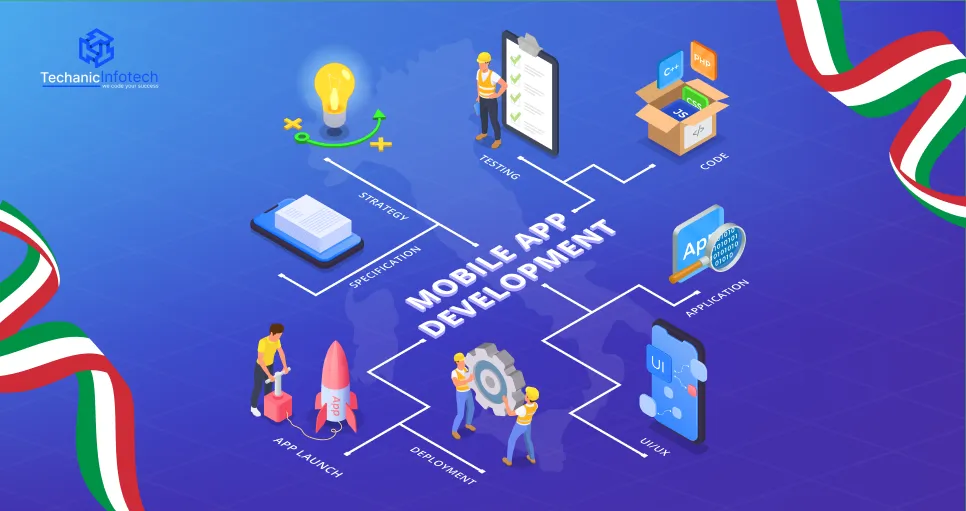
From MVP development to full-scale enterprise apps, we guide clients through every stage, strategy, UI/UX design, development, testing, and launch.
By using modern technologies and agile methods, Techanic Infotech ensures faster delivery and reliable performance.
Whether you want to build a new app or upgrade an existing one, we help you achieve the right balance between budget, quality, and long-term growth.
Understanding the mobile app development cost in Italy in 2026 helps businesses plan their investment with more clarity and confidence.
From app type and features to development stages and hidden expenses, several factors influence the final budget and timeline.
While costs can range widely based on complexity, careful planning, prioritizing essential features, and choosing the right development partner can help control expenses without compromising quality.
Italy continues to be a strong market for digital innovation, making it a valuable location for app development.
By evaluating costs strategically and focusing on long-term scalability, businesses can launch mobile apps that deliver real value and support sustainable growth.
The mobile app development cost in Italy typically ranges between €7,000 and €25,000+, depending on the app’s complexity, features, design requirements, and development approach.
The mobile app development cost in Italy typically ranges between €7,000 and €25,000+, depending on the app’s complexity, features, design requirements, and development approach.
The development timeline usually takes 2 to 6 months. A simple MVP app may be completed in a few weeks, while complex or enterprise-level apps require more time for development and testing.
The development timeline usually takes 2 to 6 months. A simple MVP app may be completed in a few weeks, while complex or enterprise-level apps require more time for development and testing.
Key factors include app type, number of features, UI/UX design complexity, platform choice (iOS or Android), third-party integrations, security requirements, and the development team’s location.
Key factors include app type, number of features, UI/UX design complexity, platform choice (iOS or Android), third-party integrations, security requirements, and the development team’s location.
Yes, offshore developers generally have lower hourly rates. However, businesses must consider communication, project management, and quality control when choosing between local and offshore teams.
Yes, offshore developers generally have lower hourly rates. However, businesses must consider communication, project management, and quality control when choosing between local and offshore teams.
Yes. Post-launch expenses include maintenance, updates, hosting, third-party subscriptions, and security monitoring. These costs typically range between 15–25% of the initial development cost annually.
Yes. Post-launch expenses include maintenance, updates, hosting, third-party subscriptions, and security monitoring. These costs typically range between 15–25% of the initial development cost annually.
Yes. Starting with an MVP, prioritizing essential features, using cross-platform development, and selecting the right development partner can help reduce costs while maintaining quality.
Yes. Starting with an MVP, prioritizing essential features, using cross-platform development, and selecting the right development partner can help reduce costs while maintaining quality.


Bharat Sharma is the CTO of Techanic Infotech, bringing deep technical expertise in software architecture, mobile app development, and scalable system design. He leads the engineering team with a strong focus on innovation, performance, and security.