Developing a podcast app in 2026 comes with new opportunities and new cost factors you’ll want to plan for.
As user demand rises and more creators turn to digital audio, businesses are racing to launch feature-rich apps that stand out.
But before diving into the process, it’s important to understand the real podcast app development cost and what drives it.
From essential features like audio streaming and user profiles to advanced tools such as AI recommendations, offline listening, and multi-device syncing, every choice impacts your final budget.
This guide breaks down the major factors influencing pricing in 2026, helping you estimate costs accurately and build a podcast platform that meets user expectations without overspending.
The podcast industry continues to surge, creating massive opportunities for businesses exploring the cost to develop a podcast app in 2026.
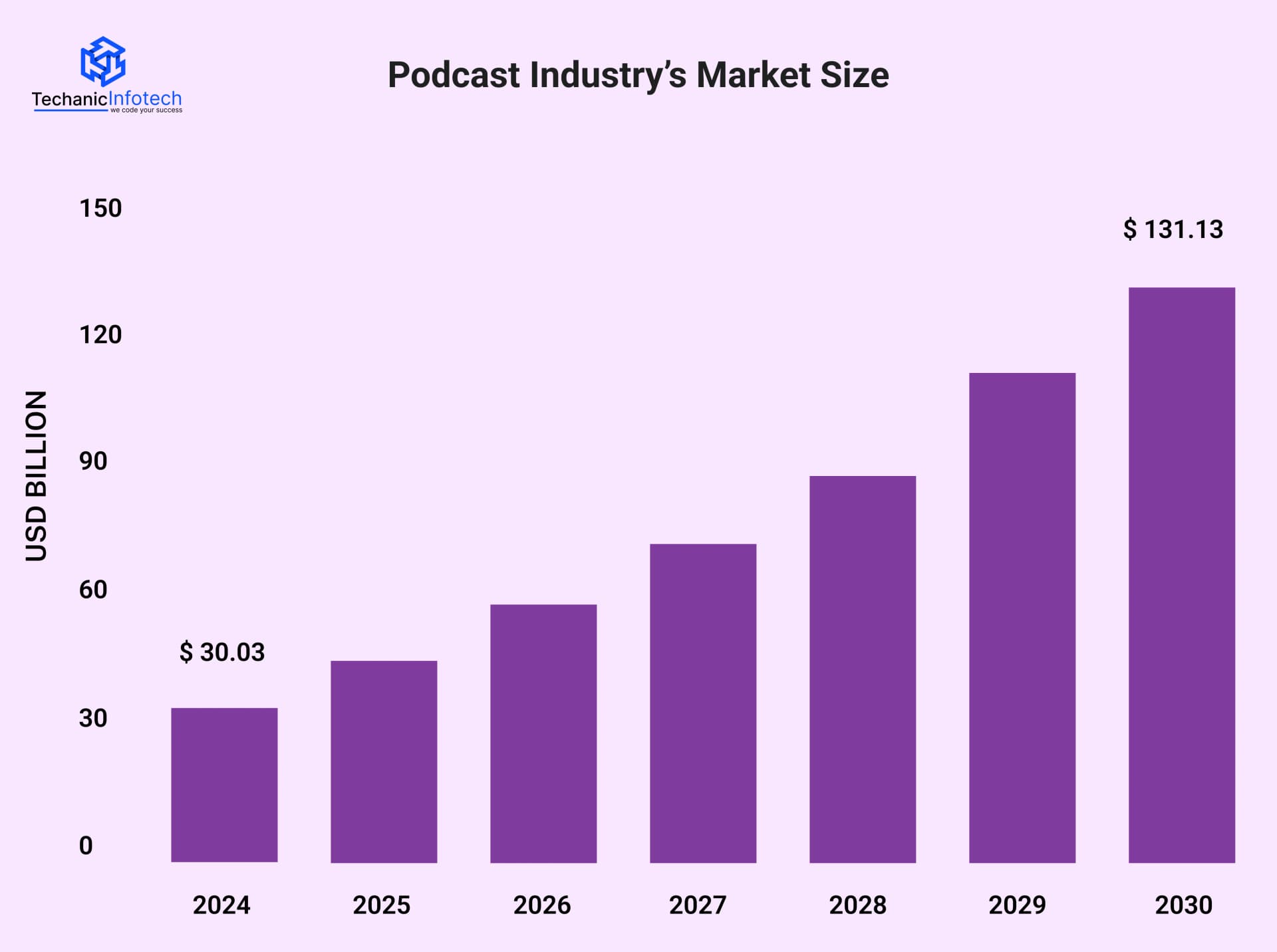
With listener demand rising every year, the market is becoming one of the fastest-growing segments in digital media.
U.S. podcast advertising revenue is projected to surpass $4 billion by 2024 and could climb to nearly $12 billion by 2030.
There are over 4.5 million podcasts available worldwide.
The global podcast market value is projected to exceed $38 billion by 2025.
129.9 million people in the U.S. listen to podcasts monthly.
Podcast ad revenue is forecast to grow, with billions in spending worldwide.
Before estimating the podcast app development cost in 2026, it's important to understand the different types of podcast apps you can create.
Each one serves a distinct purpose and comes with its own feature needs, which directly influence the overall budget.
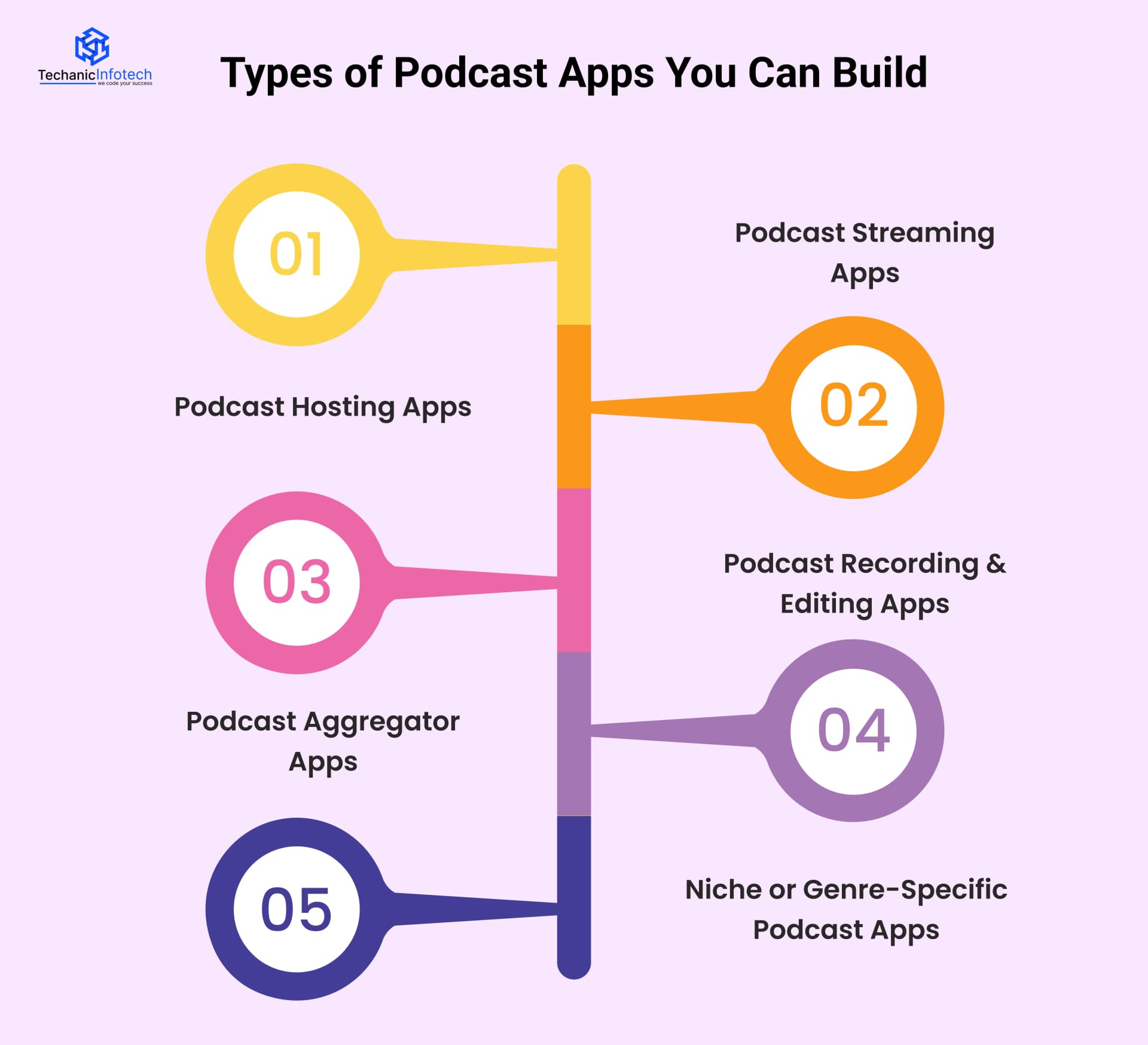
These apps let users explore, stream, and follow countless shows. They focus on smooth playback, smart search tools, episode recommendations, and easy browsing.
This option works well for businesses targeting large audiences and engagement-driven platforms.
Hosting platforms are built for creators who want to upload, manage, and distribute episodes.
They typically include analytics, RSS feed generation, monetization options, and cloud storage. This type requires strong backend support and scalable server infrastructure.
Designed for creators who want to record and edit audio on the go, these apps offer noise reduction, trimming tools, multi-track editing, filters, and exporting.
They act like mobile studios, removing the need for desktop editing software.
Aggregator apps gather podcast content from various sources and display it in one place. They rely on RSS feed imports, category-based browsing, trending lists, and personalized playlists.
This type prioritizes content organization and a seamless listening experience.
These apps focus on dedicated categories like news, comedy, motivation, fitness, or education.
They use curated feeds, tailored recommendations, and community features to attract highly targeted listeners. Niche platforms offer lower competition and strong user retention.
Every successful podcast platform relies on core features that improve listening, discovery, and user experience.
These essentials form the foundation of your app and directly influence development time and overall quality.
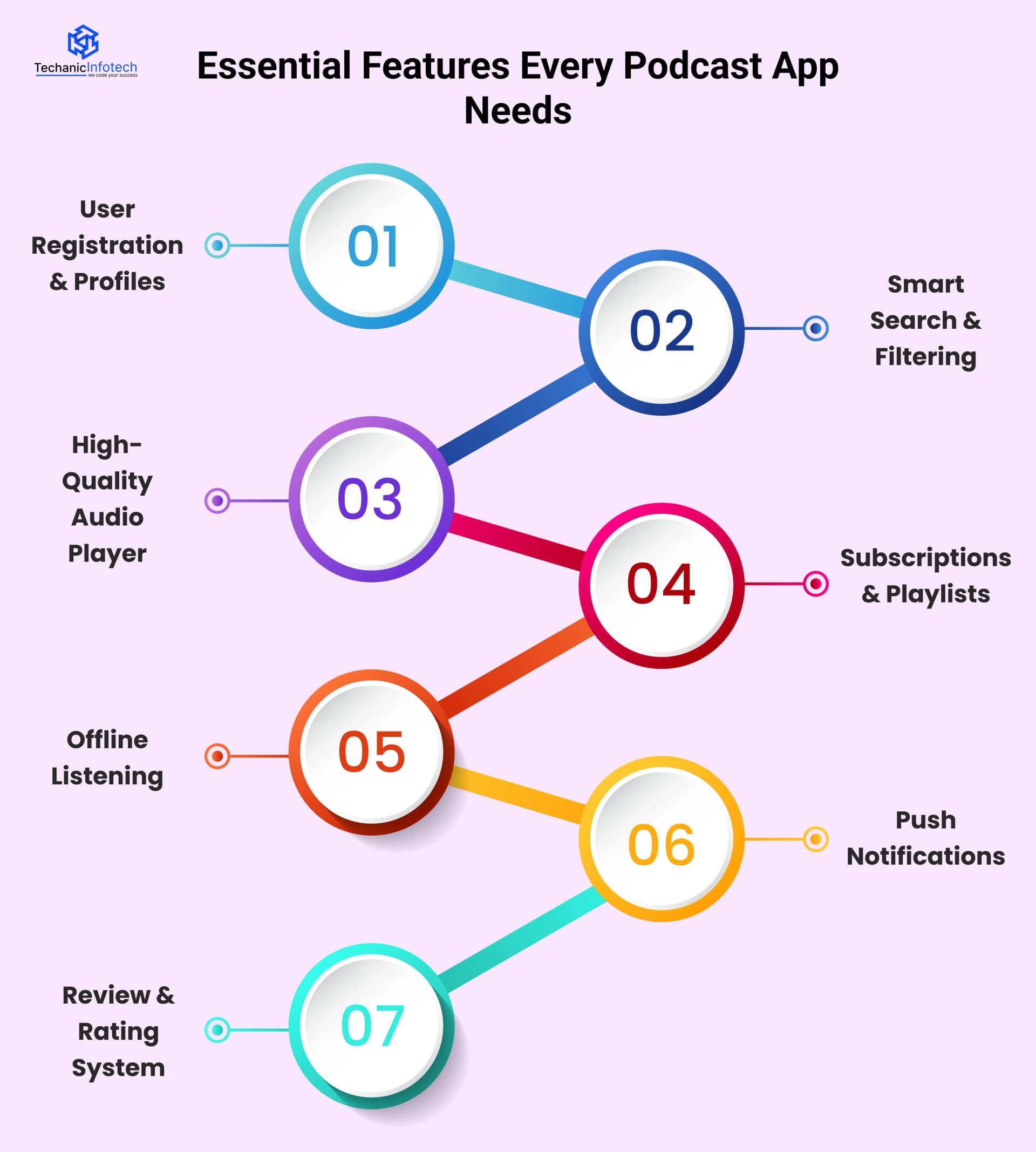
Profiles help determine podcast app cost by features, as they allow users to save favorites, manage subscriptions, track listening history, and personalize their experience. They also enable cross-device syncing and tailored recommendations.
A powerful search system helps users find episodes quickly using keywords, categories, genres, or trending lists. Strong filtering improves navigation and boosts overall content discovery.
A reliable audio player with controls like speed adjustment, skip options, and sleep timers ensures a smooth listening experience. It’s essential for engagement and long-term user satisfaction.
As part of key mobile app features, users expect simple ways to subscribe to podcasts and build custom playlists. This helps improve retention by letting listeners organize content their way.
Offline mode lets users download episodes and listen without internet access. It’s a must-have for commuters, travelers, and anyone wanting uninterrupted audio.
Notifications alert users when new episodes drop or favorites update. They boost daily engagement and keep listeners consistently active.
A rating system helps users evaluate shows, improves content credibility, and enhances recommendations. Creators also gain insights into audience preferences.
The overall podcast app pricing breakdown for 2026 typically ranges between $8,000 and $60,000, depending on complexity, integrations, and platform choices.
Below are the major cost factors, each explained with simple tables to help you plan your budget effectively.
Basic app features influence your custom podcast app development cost, especially when you start with essential elements like login, episode browsing, and a simple audio player.
This setup is ideal for early-stage validation with a clean, functional user experience.
|
Feature Set |
Cost |
Notes |
|
Basic UI |
$4,000–$7,000 |
Simple screens |
|
Audio Player |
$3,000–$5,000 |
Essential playback |
|
User Login |
$2,000–$4,000 |
Email/social login |
Adding personalized feeds, playlists, and multi-device syncing increases complexity and aligns well with MVP software development strategies.
These features boost user engagement but require more backend logic, which raises overall development effort.
|
Feature Set |
Cost |
Notes |
|
Personalized Feed |
$4,000–$7,000 |
AI logic optional |
|
Playlist Tools |
$3,000–$6,000 |
Custom lists |
|
History Sync |
$2,000–$4,000 |
Multi-device |
Building a smart search engine with categories, genres, and metadata directly impacts your podcast app development budget.
Strong discovery features make the app easier to navigate and keep listeners engaged longer.
|
Feature Set |
Cost |
Notes |
|
Search Engine |
$3,000–$6,000 |
Fast indexing |
|
Filters |
$2,000–$4,000 |
Categories, genres |
|
Metadata Setup |
$1,000–$2,000 |
Episode tagging |
Advanced playback controls improve the user experience and align with current mobile app industry trends.
Features like speed adjustments, bookmarking, and sleep timers require custom audio development and add significant value to the app.
|
Feature Set |
Cost |
Notes |
|
Audio Controls |
$3,000–$5,000 |
Speed, skip, timer |
|
Streaming Engine |
$3,000–$6,000 |
Stable playback |
|
Bookmarking |
$1,000–$3,000 |
Save spots |
Offline mode improves convenience for commuters and travelers.
Secure download handling, encryption, and storage management increase the development workload but significantly enhance overall user satisfaction.
|
Feature Set |
Cost |
Notes |
|
Download Manager |
$3,000–$7,000 |
Multi-episode support |
|
Storage Handling |
$2,000–$4,000 |
Local files |
|
Encryption |
$1,000–$3,000 |
Secure access |
A creator dashboard with uploading, analytics, and distribution tools increases backend requirements and raises the overall podcast streaming app development cost.
It's ideal for platforms targeting both listeners and content creators.
|
Feature Set |
Cost |
Notes |
|
Upload Tools |
$2,000–$6,000 |
Episode management |
|
Analytics |
$2,000–$5,000 |
Plays, reach |
|
RSS Distribution |
$2,000–$4,000 |
Auto-sync |
AI-driven suggestions require tracking user behavior, processing data, and building models. This significantly impacts time to build a mobile app, as machine learning features add specialized development stages.
|
Feature Set |
Cost |
Notes |
|
ML Model |
$4,000–$8,000 |
Recommendations |
|
User Behavior Tracking |
$2,000–$5,000 |
Listening patterns |
|
Data Processing |
$2,000–$4,000 |
Backend logic |
Community features like comments, forums, and social sharing increase user engagement. They add complexity due to moderation needs, user roles, and interactive UI components.
|
Feature Set |
Cost |
Notes |
|
Sharing Tools |
$1,000–$3,000 |
Social platforms |
|
Comment System |
$2,000–$4,000 |
Moderation needed |
|
Community Tabs |
$3,000–$5,000 |
Forums/groups |
Premium tiers, ads, and in-app purchases require secure payment gateways and subscription logic. These features drive revenue while making the app more versatile across different user groups.
|
Feature Set |
Cost |
Notes |
|
Subscription Setup |
$3,000–$6,000 |
Monthly tiers |
|
Ad Integration |
$2,000–$4,000 |
Audio/banner ads |
|
Payment Gateway |
$2,000–$5,000 |
Stripe/PayPal |
Building for multiple platforms impacts the mobile app creation process, especially when choosing between native or cross-platform tools.
Wider device coverage increases reach but requires additional design and testing effort.
|
Feature Set |
Cost |
Notes |
|
Native Build |
$8,000–$25,000 extra |
iOS + Android |
|
Cross-Platform |
$40,000–$14,000 |
Flutter/React Native |
|
Testing & QA |
$3,000–$7,000 |
Device coverage |
Understanding the major factors behind podcast app development cost helps you plan a realistic budget and prioritize essential features.
In 2026, pricing varies based on functionality, technology choices, and long-term scalability needs.
Here are the key cost drivers explained clearly and simply.
Adding advanced features like AI recommendations, offline listening, creator tools, and analytics increases development time.
The more functionality your app requires, the higher the overall cost and engineering effort.
Choosing iOS, Android, or both directly affects pricing. Cross-platform builds reduce costs, while native builds raise your audio streaming app development cost due to additional coding, optimization, and testing.
High-quality design with smooth navigation, clean layouts, and interactive elements boosts user experience. However, custom design work takes more time, which increases the project’s total cost.
A strong backend is essential for streaming, downloads, analytics, and creator uploads. Choosing the best tech stack for mobile apps ensures performance and scalability, but may increase development expenses.
Adding tools like payment gateways, ad networks, analytics, and hosting platforms requires setup and testing. Each integration contributes to the final development cost and long-term maintenance needs.
Testing across devices, networks, and operating systems ensures a smooth user experience. QA adds time to the development cycle but prevents performance issues and costly post-launch fixes.
Choosing the right monetization model is essential for long-term revenue growth. In 2026, podcast platforms have multiple ways to generate income while keeping users engaged.
Below are the most effective strategies that also influence overall revenue potential.
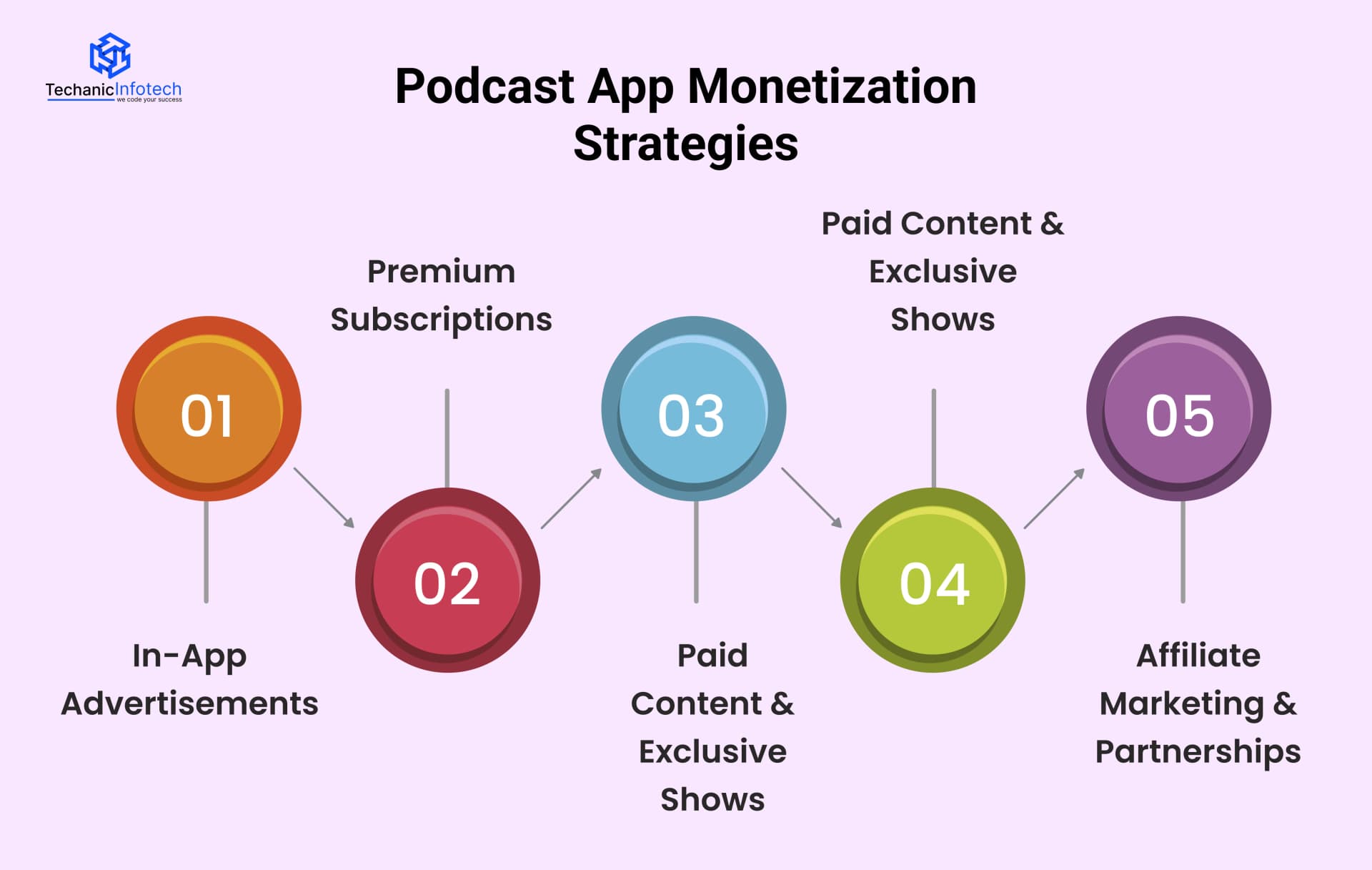
Ads remain a strong revenue driver for podcast apps. Brands pay for audio ads, display banners, or sponsored content placements. This lets apps stay free for users while still generating steady earnings.
Subscription plans unlock ad-free listening, exclusive shows, and early access to episodes. These recurring payments help offset podcast app development expenses and create a consistent revenue stream from loyal listeners.
Offering premium episodes, limited series, or creator-exclusive content allows users to pay for unique experiences. These niche offerings boost engagement and encourage long-term loyalty from dedicated listeners.
Built-in features like tipping, donations, or membership tiers enable creators to earn directly from fans. This also supports overall platform growth and helps balance the build a podcast app cost with ongoing revenue.
Promoting partner products through curated links or sponsored recommendations earns affiliate commissions. This provides passive revenue while offering listeners products and services aligned with their interests.
Building a scalable podcast app requires the right blend of strategy, technology, and execution, something Techanic Infotech consistently delivers with expertise.
As a leading mobile app development company, they specialize in creating high-performance, feature-rich podcast platforms designed to grow with user demand.
From intuitive UI and seamless streaming to powerful backend architecture, their team ensures your app runs smoothly even as your audience expands.
With a focus on innovation and long-term scalability, Techanic Infotech helps businesses launch podcast apps that are not only robust but also future-ready.
If you’re looking to enter the booming audio market, partnering with a skilled development team can turn your podcast vision into a profitable digital product.
Building a successful and scalable podcast app requires the right technology, strategic planning, and a development partner who understands long-term growth.
Whether you're launching a simple audio platform or a feature-rich streaming solution, it’s essential to balance innovation with performance.
By collaborating with an experienced team, you can ensure your app delivers immersive experiences, strong monetization potential, and reliable scalability as your audience increases.
As businesses continue to enter the audio market, understanding the factors influencing podcast app development cost becomes vital for efficient planning and budgeting.
With a clear roadmap and the right development expertise, you can confidently bring your podcast app vision to life and position your platform for sustainable success in the competitive digital landscape.
The cost to develop a podcast app depends on features, design complexity, platform choice, and integrations. Prices vary widely, but proper planning and a clear development strategy help estimate expenses accurately and avoid unexpected costs.
Development time depends on app complexity, backend requirements, custom features, and testing cycles. A basic MVP may take a few weeks, while a full-featured podcast streaming app can require several months of structured development.
A strong podcast app typically includes user profiles, playlists, downloads, recommendations, search tools, analytics, and monetization options. Additional features like AI-driven suggestions and cross-device syncing can enhance user experience and increase engagement.
Yes. Podcast apps can be monetized through ads, subscriptions, premium content, sponsorships, affiliate integrations, and in-app purchases. Choosing the right monetization mix ensures consistent revenue growth while maintaining a positive user experience.
A professional team ensures quality development, scalability, strong architecture, and seamless performance. They provide expertise in design, backend systems, security, and maintenance helping your podcast app launch smoothly and succeed in a competitive digital market.


Bharat Sharma is the CTO of Techanic Infotech, bringing deep technical expertise in software architecture, mobile app development, and scalable system design. He leads the engineering team with a strong focus on innovation, performance, and security.