Salon App Development
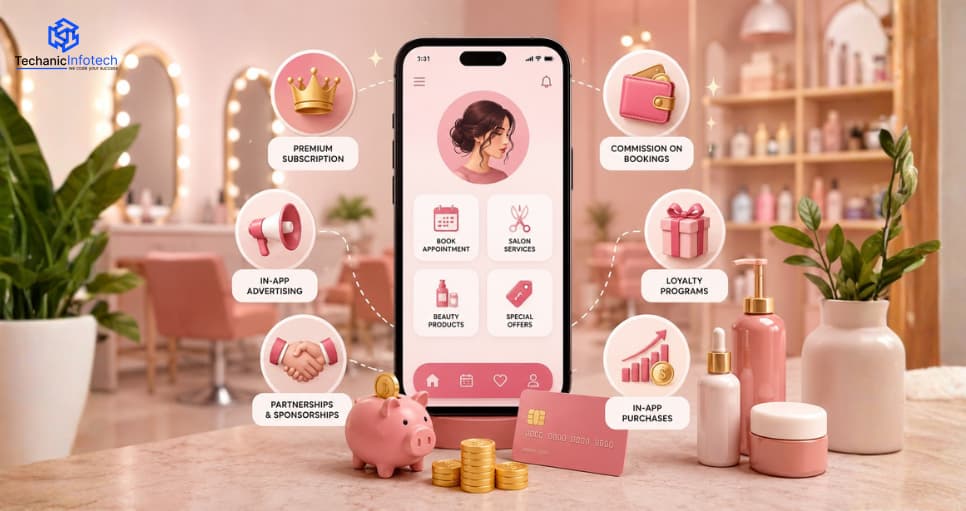
Salon App Monetization Strategies: How Successful Salon Apps Generate Revenue
June 9, 2026
June 9, 2026
Are you an investor planning to create a salon app? Then you must be wondering how salon apps make money.
Well, that's a valid question.
Building a salon app requires significant investment in design, development, maintenance, and marketing.
However, creating the app is only one side of the equation. The real challenge lies in selecting the right monetization strategy that can generate consistent revenue while delivering value to salon owners and customers.
Fortunately, there are several proven monetization models that successful salon apps use today. From subscriptions and commissions to premium features and brand partnerships, these strategies can help transform your application into a sustainable business.
Many businesses partner with a professional salon app development company to build scalable salon platforms while implementing profitable revenue models from day one.
Let's explore the most effective salon app monetization strategies and discover how you can maximize your salon app revenue.
Before investing in salon app development, it is important to understand the industry's growth potential.
The beauty and salon software market has witnessed remarkable growth over the last few years due to increasing digital adoption and customer demand for online appointment booking solutions.
|
Statistics |
Data |
|
Global Salon Software Market Size (2022) |
USD 726.82 Million |
|
Expected Market Size (2032) |
USD 2.76 Billion |
|
CAGR (2023-2032) |
14.31% |
|
Largest Market |
North America |
|
Fastest Growing Segment |
Hair Care Services |
The increasing demand for online bookings, loyalty programs, digital payments, and personalized customer experiences is driving salon businesses toward mobile-first solutions.
Businesses researching salon app opportunities also explore salon app development cost, appointment booking app development, and best salon app features before entering the market.
Salon apps are not just booking platforms. They can become highly profitable digital businesses when paired with the right revenue model.
Let's explore the most successful monetization strategies.
One of the most common salon app monetization models is the subscription model.
Under this model, salon owners or customers pay a recurring monthly or annual fee to access premium app features and services. Subscription plans provide predictable recurring revenue, making them one of the most stable monetization methods.
For example, a basic package may offer appointment scheduling and customer management, while premium plans can unlock marketing automation, analytics dashboards, and advanced reporting features.
Businesses evaluating revenue opportunities often compare subscription models alongside salon app trends and customer retention strategies before launching their platform.
Benefits
Predictable recurring income
Easy scalability
Higher customer retention
Multiple pricing tiers
The commission model generates revenue whenever a customer books a salon service through the app.
A small percentage is deducted from each successful booking transaction. This model aligns platform success with salon success because businesses only pay when they receive customers.
As the user base grows, revenue naturally increases without requiring additional monetization efforts.
A similar strategy is commonly used in online marketplaces and service-booking applications.
Benefits
Revenue scales with bookings
Attractive to salon owners
Low entry barriers
No fixed monthly commitment
The freemium model combines free access with premium upgrades.
Users can access basic features at no cost while advanced functionalities require a paid subscription.
For example:
Free Features:
Appointment booking
Service browsing
Basic customer support
Premium Features:
Advanced analytics
Marketing tools
Customer loyalty programs
Staff management
This strategy helps attract a larger user base while gradually converting free users into paying customers.
Benefits
Fast user acquisition
High conversion potential
Better user engagement
Scalable monetization
Advertising remains one of the most popular revenue streams for mobile applications.
Salon apps can display:
Banner ads
Sponsored listings
Native advertisements
Promotional campaigns
Beauty brands, cosmetic companies, and local businesses often pay to advertise directly to salon customers.
However, ads should never interfere with the user experience. Non-intrusive advertising formats generally perform better and improve long-term retention.
Benefits
Passive income stream
No direct user charges
Easy implementation
Suitable for large user bases
In-app purchases allow users to buy additional products or services directly inside the application.
Examples include:
Beauty products
VIP memberships
Priority bookings
Special offers
Gift cards
This model enhances customer convenience while increasing average revenue per user.
Businesses implementing advanced monetization systems often reviewsalon app development challenges before integrating payment and inventory management systems.
Benefits
Additional revenue source
Increased customer engagement
Higher customer lifetime value
Better user experience
Some salon apps generate revenue by leveraging anonymized customer insights and market trends.
This data can help brands understand:
Customer preferences
Product demand
Buying behavior
Service trends
However, businesses must prioritize transparency, user consent, and compliance with privacy regulations.
Data monetization should always follow ethical and legal standards.
Benefits
Additional passive income
Valuable market insights
Strategic brand partnerships
Business intelligence opportunities
Affiliate marketing and sponsorships represent another profitable monetization strategy.
Salon apps can partner with:
Beauty brands
Cosmetic companies
Hair care manufacturers
Wellness providers
When users purchase products through affiliate links or sponsored promotions, the app earns a commission.
This strategy creates value for users while generating additional revenue streams.
Benefits
No user charges
Additional revenue opportunities
Strong brand collaborations
Better customer offers
|
Monetization Model |
Revenue Potential |
Scalability |
User Impact |
|
Subscription |
High |
High |
Low |
|
Commission |
High |
High |
Low |
|
Freemium |
Medium-High |
High |
Low |
|
Advertising |
Medium |
High |
Medium |
|
In-App Purchases |
High |
Medium |
Low |
|
Data Monetization |
Medium |
Medium |
Low |
|
Brand Partnerships |
Medium-High |
High |
Low |
Selecting the right monetization model depends on your audience, business goals, and platform functionality.
The first step is understanding customer expectations.
Budget-conscious users may prefer freemium models, while professional salon businesses may be willing to pay recurring subscription fees for advanced features.
Understanding customer behavior helps identify the most suitable revenue strategy.
Before selecting a monetization model, define your financial objectives.
If you want predictable recurring income, subscriptions work well. If growth-focused revenue is the goal, commission-based models may be more suitable.
Clear goals make monetization decisions easier and more effective.
Revenue generation should never compromise user satisfaction.
Too many ads, aggressive upselling, or hidden charges can negatively affect customer retention.
Successful salon apps monetize without disrupting the user experience.
Many successful apps combine multiple monetization methods.
Testing different strategies allows businesses to identify which approach generates the best results while maintaining customer satisfaction.
Continuous optimization improves profitability over time.
Choose a monetization model that can grow alongside your business.
Subscription and commission-based models generally offer better scalability compared to one-time revenue sources.
Long-term planning ensures sustainable business growth.
Different revenue models require different resources.
For example:
Always consider operational costs before selecting a monetization strategy.
The salon app industry offers tremendous opportunities for businesses looking to build profitable digital platforms.
Whether you choose subscriptions, commissions, in-app purchases, advertisements, or brand partnerships, selecting the right monetization strategy is critical for long-term success.
The best revenue model depends on your target audience, business goals, and growth plans. Many successful salon apps combine multiple monetization methods to maximize profitability while maintaining an excellent user experience.
By partnering with an experienced salon app development company, businesses can build scalable salon applications that not only attract users but also generate sustainable revenue and long-term growth.
Salon apps earn through subscriptions, commissions, ads, partnerships, and in-app purchases.
Subscription and commission-based models usually generate the highest recurring revenue.
Yes, combining multiple revenue models helps maximize profitability and growth.
Yes, it attracts users and converts them into paying customers gradually.
Through affiliate partnerships, sponsored promotions, advertisements, and product recommendations.
Analyze users, revenue goals, scalability needs, and business objectives carefully.


Neha Sharma is a tech expert at heart who loves exploring new technologies and turning complex ideas into easy-to-understand content. With a passion for learning and writing, she enjoys sharing insights on emerging tech, digital products, and innovation that help businesses stay ahead.