Salon App Development
AI in Salon App Development: Features, Cost & Monetization Strategy
January 28, 2026
January 28, 2026
The beauty and wellness industry is undergoing a digital transformation, and artificial intelligence (AI) is at the core of this evolution.
Today’s customers expect more than just online appointment booking—they demand personalization, convenience, speed, and intelligent experiences.
By integrating AI into salon apps, businesses can automate operations, enhance customer engagement, and gain valuable insights that drive growth.
As competition in the beauty industry intensifies, adopting smart salon app features is no longer optional; it’s a strategic necessity.
This comprehensive guide explores key AI features, a step-by-step salon app development process, detailed cost breakdowns, monetization strategies, challenges, and expert insights to help salon owners and entrepreneurs build scalable, future-ready salon applications.
AI-powered salon apps leverage advanced technologies to streamline operations, enhance customer experiences, and boost revenue.
From intelligent scheduling to personalized recommendations, these top salon app features help salons work smarter, reduce manual effort, and deliver highly tailored services.
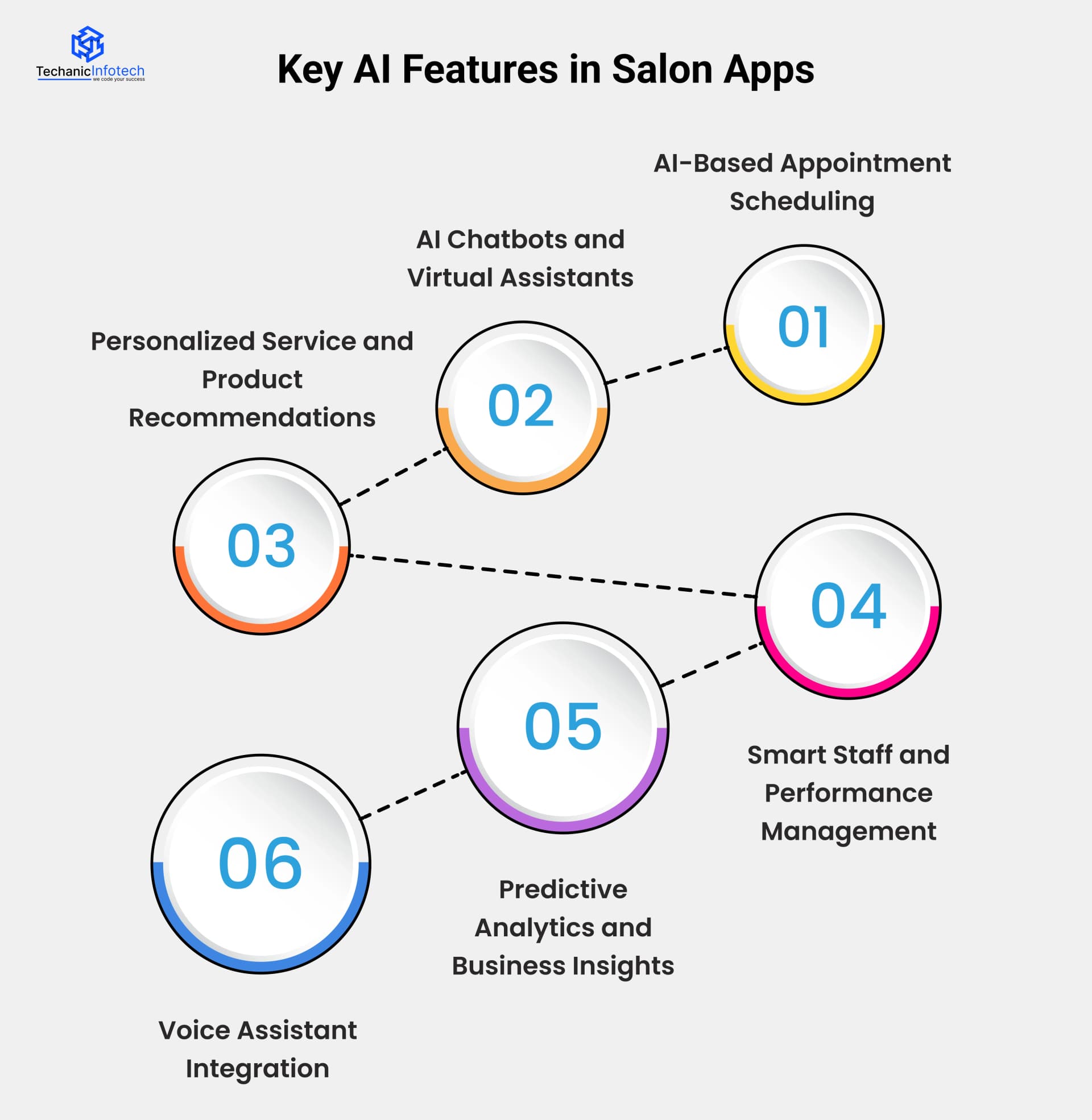
AI-based appointment scheduling is one of the most impactful features in modern salon apps.
Unlike basic booking systems, AI analyzes historical booking data, customer behavior, staff availability, service duration, peak hours, and cancellation patterns.
Based on this analysis, it intelligently suggests optimal time slots for both customers and salon owners.
This reduces overbooking, idle staff time, and last-minute cancellations.
AI can also trigger smart reminders and rescheduling suggestions, significantly lowering no-show rates.
Over time, the system continuously learns from user behavior, improving accuracy and efficiency, resulting in smoother daily operations and higher customer satisfaction.
AI-powered chatbots and virtual assistants act as a digital front desk available 24/7.
They can handle appointment bookings, cancellations, rescheduling, service inquiries, pricing questions, and frequently asked questions without human intervention.
This ensures instant responses, even outside business hours.
For salon owners, chatbots reduce dependency on front-desk staff, lower operational costs, and improve response consistency.
For customers, they deliver fast, convenient support across multiple platforms such as mobile apps, websites, WhatsApp, and social media. This enhances trust, engagement, and overall user experience.
Personalization is a major differentiator in the beauty industry.
AI-powered salon apps analyze customer profiles, booking history, preferences, service frequency, and purchase behavior to recommend tailored services and products.
For example, a customer who frequently books hair coloring services may receive personalized suggestions for hair treatments or care products.
These AI-driven recommendations improve customer satisfaction and loyalty while increasing average order value.
Personalized experiences make customers feel understood and valued, encouraging repeat visits and long-term relationships with the salon brand.
Managing salon staff efficiently is often challenging, especially for growing or multi-location businesses.
AI simplifies staff management by analyzing employee availability, workload, skill sets, performance metrics, and customer feedback.
It ensures the right professional is assigned to the right customer at the right time. AI also helps identify peak workloads, training needs, and performance gaps.
By balancing schedules fairly and reducing burnout, salons can improve service quality, employee satisfaction, and overall productivity.
This leads to better customer experiences and stronger team morale.
AI-powered predictive analytics transform raw data into actionable insights.
Salon owners can forecast demand, identify high-performing services, track customer retention, and analyze revenue trends.
These insights enable data-driven decision-making rather than relying on assumptions.
For example, predictive analytics can help determine which services are most profitable, when to run promotions, or how many staff members are needed during peak seasons.
This level of intelligence helps salon businesses optimize pricing, marketing strategies, and resource allocation for sustainable growth.
Voice assistants add an extra layer of convenience and accessibility to salon apps.
Customers can use voice commands to book appointments, check availability, or inquire about services without navigating the app manually.
This feature in the mobile app aligns with the growing adoption of smart devices and voice-based interactions.
Voice-enabled functionality improves user experience, especially for busy customers or those with accessibility needs.
It also positions the salon app as modern and technologically advanced, enhancing brand perception.
Building a salon app with AI helps automate bookings, personalize services, and boost customer engagement.
This guide walks you through each step, from idea to launch.
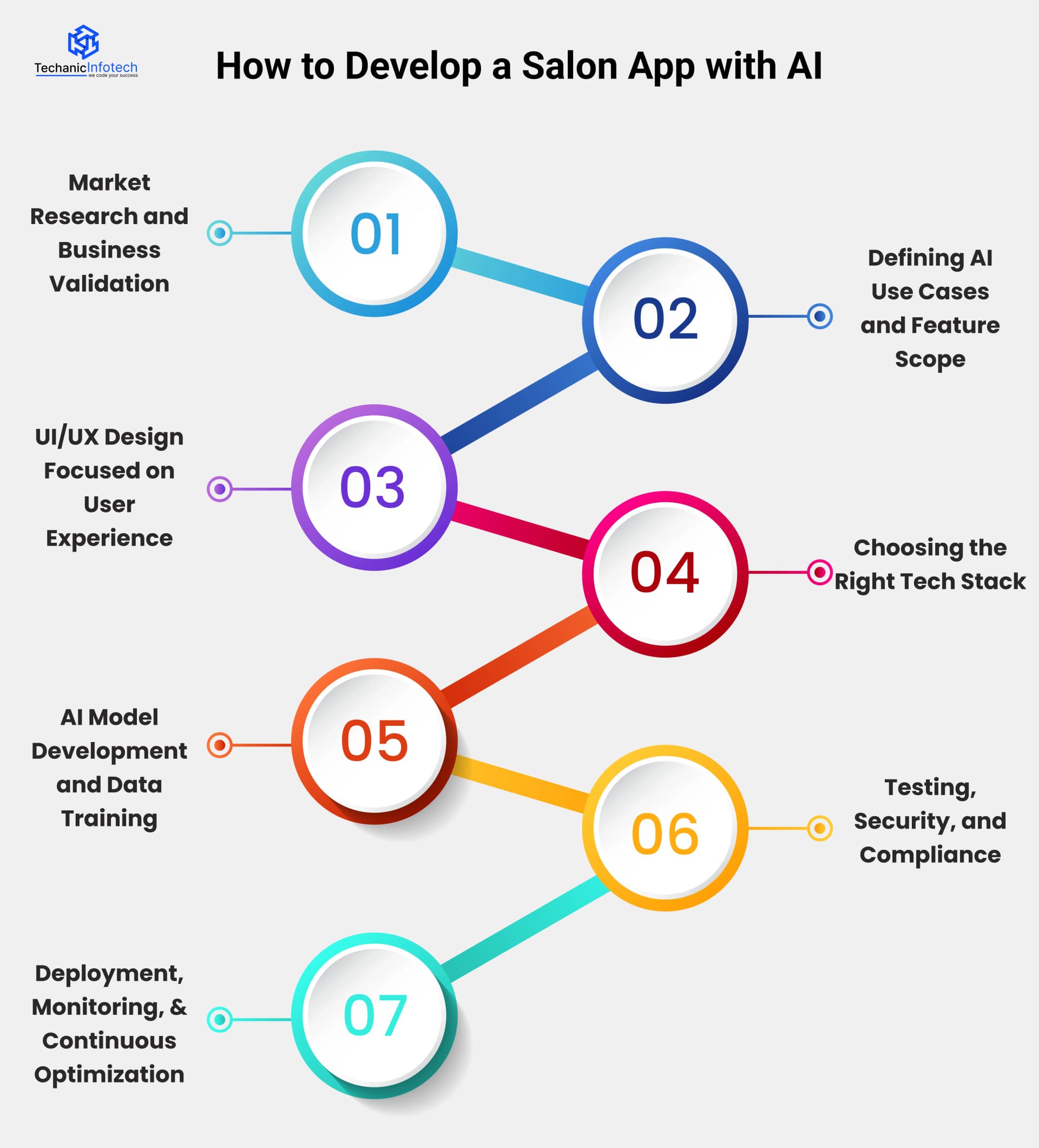
The first step in AI salon app development is thorough market research.
This includes identifying your target audience, understanding customer pain points, analyzing competitors, and studying industry salon app development trends.
Clear business objectives, such as increasing bookings, improving retention, or expanding to multiple locations, should guide all development decisions.
This foundation prevents wasted investment and ensures the app aligns with long-term business goals.
AI should be implemented strategically, not excessively.
Defining clear AI use cases, such as scheduling automation, personalization, or analytics, helps control cost and complexity.
Each AI feature should have a measurable business benefit.
This step involves prioritizing features based on budget, timeline, and target audience needs. A well-defined scope prevents feature creep and ensures faster, more efficient development.
An AI-powered salon app must be intuitive and easy to use.
UI/UX design should prioritize seamless navigation, fast booking flows, and minimal user effort. AI features should feel helpful and natural rather than overwhelming.
A well-designed interface improves engagement, reduces bounce rates, and increases conversions.
Accessibility, responsiveness, and consistent branding are essential for delivering a positive user experience across devices.
Selecting the right tech stack is critical for scalability, performance, and security.
This includes choosing technologies for frontend development, backend systems, databases, cloud infrastructure, and AI frameworks.
A scalable salon app tech stack ensures the app can handle growing user bases, data volumes, and feature expansions.
Security and performance optimization should be considered from the start to avoid costly rework later.
AI models require high-quality data for accurate predictions and recommendations.
This step involves collecting, cleaning, and training data related to bookings, customer behavior, and staff performance.
Machine learning models should be continuously trained and optimized to adapt to changing patterns.
Ethical data usage, transparency, and bias mitigation are essential to maintain trust and reliability.
Rigorous testing ensures the app performs reliably across different scenarios.
This includes functional testing, AI accuracy testing, performance testing, and security assessments.
Data protection and compliance with privacy regulations are critical, as salon apps handle sensitive customer information.
Secure authentication, encryption, and access control mechanisms build user trust and protect business reputation.
Once launched, the app should be continuously monitored for performance, user behavior, and AI accuracy.
Regular updates, feature enhancements, and AI model optimization ensure the app remains competitive and aligned with evolving customer expectations.
Long-term success depends on ongoing refinement rather than a one-time launch.
The salon app development cost typically ranges from $10,000 to $90,000+, depending on complexity, features, and scalability requirements.
Understanding cost distribution helps businesses plan budgets effectively.
A basic AI-powered salon app focuses on essential digital features such as appointment scheduling, customer profiles, service listings, and an admin dashboard.
It may include a simple AI-driven service or stylist recommendations. This level is ideal for small salons or startups beginning their digital journey.
These features usually affect development cost from $10,000 to $25,000 that may fluctuate as per the complexity level.
The following table shows the basic AI salon development cost divided according to the features included.
|
Feature |
Description |
Estimated Cost |
|
Appointment Booking System |
Core booking, rescheduling, cancellations |
$5,000 |
|
Customer Profile Management |
Customer data & visit history storage |
$3,500 |
|
Service & Pricing Catalog |
Service listings with pricing |
$3,500 |
|
Admin Dashboard |
Manage bookings, customers, and services |
$4,000 |
|
AI Stylist Recommendation |
Basic AI-driven service suggestions |
$5,000 |
A mid-level AI salon app offers advanced automation and operational tools, including AI-based scheduling optimization, intelligent chatbots for customer support, staff and inventory management, secure online payments, and performance analytics dashboards.
This solution suits growing salons seeking improved efficiency, better customer engagement, and data-driven decision-making.
These features result in influencing the development cost of the salon app range from $25,000-$55,000 may differ as per integrations.
The following table shows the mid-level app development cost divided according to the features included.
|
Feature |
Description |
Estimated Cost |
|
AI-Based Schedule Optimization |
Smart staff & time-slot allocation |
$3,400 |
|
Intelligent Chatbot Support |
AI chatbot for customer interaction |
$7,500 |
|
Staff Management Module |
Shift planning & performance tracking |
$ 8,000 |
|
Inventory Management System |
Product stock & usage monitoring |
$6,500 |
|
Secure Online Payments |
Payment gateway & transaction security |
$8,000 |
An advanced AI salon app delivers enterprise-grade functionality such as predictive analytics for demand forecasting, AI personalization engines, voice-enabled assistants, CRM, third-party integrations, multi-location management, and high-level security compliance.
Designed for large salon chains, it enables scalable operations, deep customer insights, and highly personalized experiences.
These advanced-level features affect the development time and make proces more comple by which development prices range from $55,000-$90,000+ easily.
The following table shows the advanced-level app development cost divided according to the features included.
|
Feature |
Description |
Estimated Cost |
|
Predictive Demand Forecasting |
AI-driven demand & revenue prediction |
$3000 |
|
AI Personalization Engine |
Personalized offers & recommendations |
$2,800 |
|
Voice-Enabled Assistant |
Voice-based booking & navigation |
$4,500 |
|
Multi-Location Management |
Centralized branch operations |
$3,500 |
|
Enterprise Security & Compliance |
Advanced security & compliance layers |
$3,300 |
Salon app monetization strategies focus on generating revenue through subscriptions, commissions, advertisements, and many more.
The following are the salon app monetization strategies that one should consider during the development process.
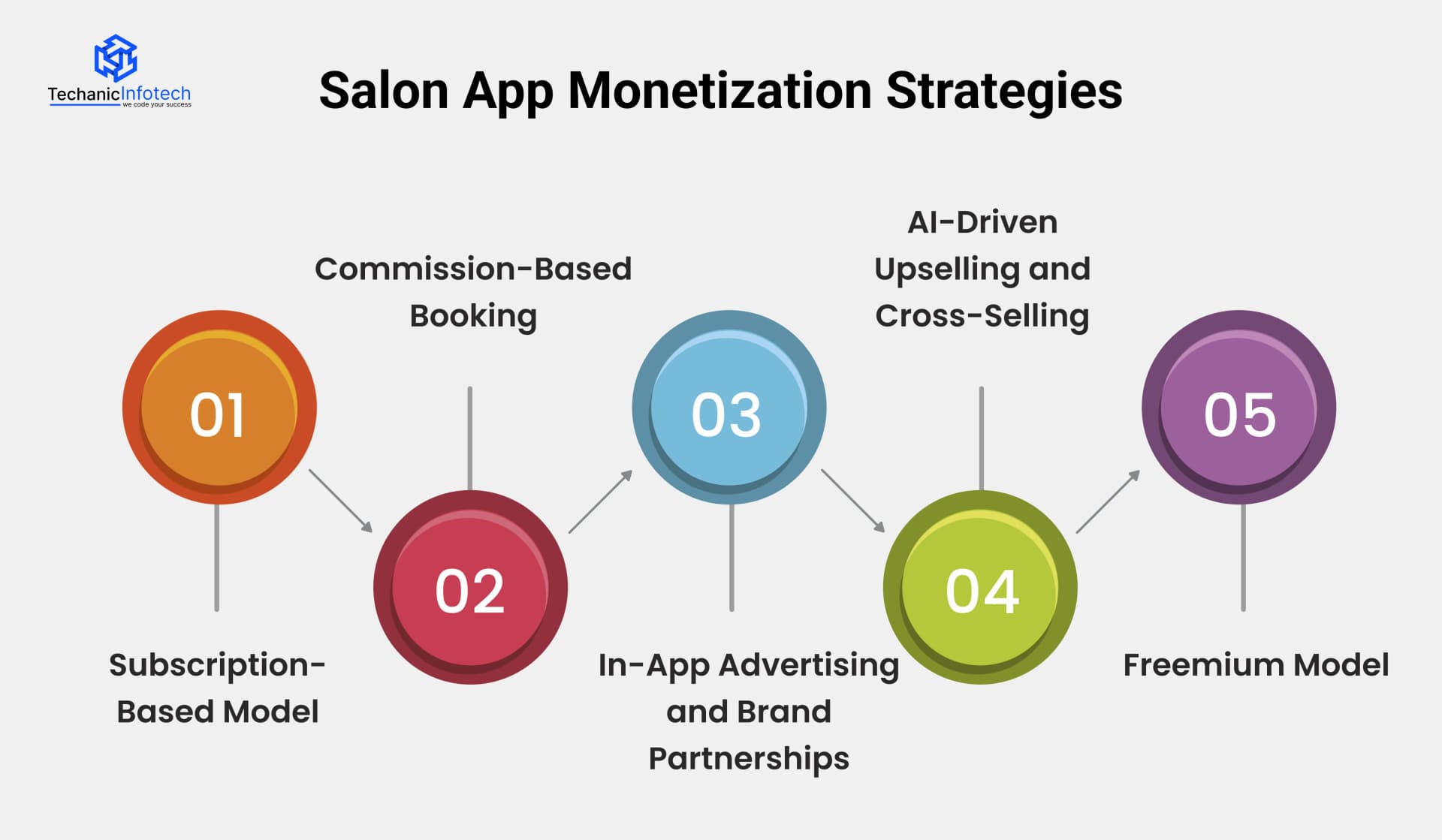
Subscription plans provide predictable and recurring revenue by offering monthly or annual access to premium features.
These may include priority appointment booking, exclusive member-only discounts, loyalty rewards, and AI-powered business or beauty insights.
This model strengthens long-term customer relationships and ensures consistent cash flow.
A commission-based model generates revenue by charging a fixed percentage on every successful booking made through the app.
As salon traffic and appointment volume grow, revenue scales naturally.
This approach is particularly effective for marketplace-style salon platforms connecting multiple salons and independent professionals.
Salon apps can partner with beauty, skincare, and haircare brands to display targeted advertisements within the platform.
AI-driven targeting ensures ads remain relevant to users’ preferences, enhancing engagement while creating a steady secondary revenue stream without disrupting the user experience.
AI algorithms analyze customer behavior, booking history, and preferences to recommend add-on services, premium treatments, or retail products.
This personalized approach increases average transaction value organically, avoids aggressive sales tactics, and improves customer satisfaction through tailored service suggestions.
The freemium model allows users to access core features at no cost while reserving advanced AI capabilities, analytics, or automation tools for paid plans.
This lowers the entry barrier, encourages rapid adoption, and enables gradual monetization as users recognize the value of premium features.
Techanic Infotech is a trusted salon app development company with strong expertise in AI-powered mobile solutions.
Their team combines technical excellence, industry knowledge, and a business-first approach to deliver scalable and secure salon applications.
From intelligent scheduling and personalization to advanced analytics, every solution is tailored to measurable business outcomes.
With agile development methodologies, transparent communication, and end-to-end services, Techanic Infotech ensures smooth project execution.
Their focus on data security, performance optimization, and post-launch support makes them a reliable long-term technology partner for salon businesses worldwide.
AI-powered salon apps are redefining how beauty businesses operate, compete, and grow.
By automating routine tasks, personalizing customer journeys, and providing actionable insights, AI enables salons to deliver superior experiences while improving efficiency and profitability.
Although AI integration increases initial investment, the long-term benefits in scalability, customer loyalty, and revenue growth far outweigh the costs.
Success depends on clear goals, strategic feature planning, and choosing the right development partner.
As AI continues to evolve, salons that adopt intelligent technology today will gain a sustainable competitive advantage in the digital beauty ecosystem
The cost of developing an AI-powered salon app generally ranges between $20,000 and $120,000, depending on the app’s complexity, number of features, and scalability requirements.
Features that deliver the most value include AI-driven appointment scheduling, intelligent chatbots for customer support, personalized service recommendations, and predictive analytics for demand forecasting and sales trends. These tools improve operational efficiency, increase bookings, and enhance customer satisfaction.
Development typically takes 3 to 6 months, depending on the project scope, level of customisation, and integration of AI functionalities. More advanced features, such as predictive analytics or multi-location management, may extend the timeline slightly.
Absolutely. Small salons can start with basic AI features, such as appointment scheduling and personalised recommendations, and gradually scale as their business grows. This allows for digital transformation without high upfront costs while still benefiting from AI efficiencies.
An experienced development partner ensures your app is secure, scalable, and AI-accurate, reducing risks and saving time. They guide the project from planning to deployment, ensuring long-term success, smooth integration, and a seamless user experience for both salon staff and customers.


Neha Sharma is a tech expert at heart who loves exploring new technologies and turning complex ideas into easy-to-understand content. With a passion for learning and writing, she enjoys sharing insights on emerging tech, digital products, and innovation that help businesses stay ahead.